Vigenère
VIGENÈRE — *polyalphabetic keyword cipher; the Caesar-on-a-rotating-keyword pattern.* The cryptography primitive of *cycling through multiple Caesar shifts based on a keyword.*
A story read by Vigenère
Press play to listen along. The line being read lights up as you go.
Show full transcript
Loading transcript…

Vigenère was a small magpie-tween. She moved with quick, tidy steps. A small, folded *keyword-tablet* was always in her hand. She had bright eyes and loved patterns that spun around.
She was small, yes. Her feathers were black and white, with a flash of blue when she turned her head. Her eyes sparkled like tiny beads. But the most important thing about her was that *keyword-tablet*. It was a special card. It showed a keyword at the top. Below it were many rotating Caesar shifts. Each letter of the keyword told her how much to shift a letter in the message.
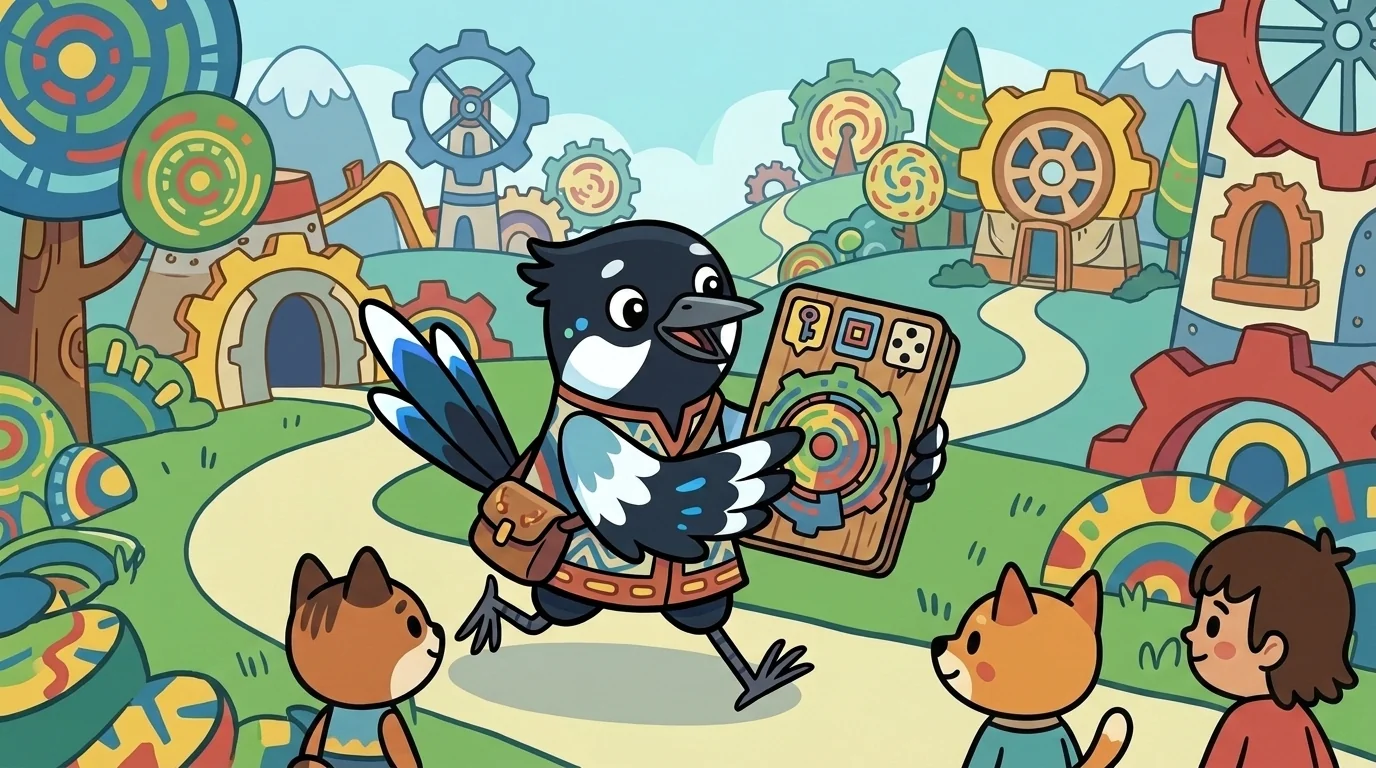
This was super important. Vigenère showed everyone the *Vigenère cipher. Think of it this way: Caesar used one secret shift for a whole message. But Vigenère used many* shifts. These shifts cycled through a keyword.
She held up her tablet. "Let's say our keyword is 'KEY'," she chirped. "K means shift by 10. E means shift by 4. Y means shift by 24." She tapped the card. "If we want to hide the word 'CAT', we do this: Shift the 'C' by 10. Shift the 'A' by 4. Shift the 'T' by 24." She paused. "Then, if our message keeps going, we start the keyword again. The next letter shifts by 10, and so on."
"It's like having a whole team of Caesars," she explained. "Each one takes a turn."

But here was the really big secret. Vigenère never said her cipher was unbreakable. Not ever. She was very clear about this. "For hundreds of years," she would say, "people called my cipher 'le chiffre indéchiffrable'." She made a face. "That means 'the unbreakable cipher'." She shook her head. "They were wrong."
She tapped her tablet. "A smart man named Kasiski found the crack. That was in 1863. Another smart man, Babbage, found it around the same time. He just didn't tell anyone right away."
"They learned this," Vigenère continued. "If you can figure out how long the keyword is, you can break my cipher. You just split it into many tiny Caesar ciphers. Then you break each one using frequency analysis." She looked around. "It's all about the keyword's length. And how it's put together."
Vigenère taught many things about her cipher. These were her main lessons: Keyword length makes it harder or easier. A longer keyword is much tougher to break. If the keyword is super long and totally random, as long as the message itself, it's almost impossible to break. That's a hint for later, by the way. The *encrypting cycle is how it works. You use one letter of the keyword for one letter of the message. When you run out of keyword letters, you just start over. *Decrypting is the same. You use the exact same keyword. It just reverses the shifts. *Kasiski examination is a cool trick. You look for letters that repeat in the hidden message. If you find them, the distance between them is often a clue. It's usually a multiple of the keyword's length. *Frequency analysis* comes next. Once you know the keyword length, you can split the message. Each slice is like a simple Caesar cipher. Then you can break each one.
Vigenère grew up in a small village. Her family had a special job there. They were the village's pattern-makers. They were magpies, just like her. Every season, they designed new patterns for the village festivals. Different decorations would spin and cycle through the days. This work taught her all about cycling rotations. She learned to see patterns everywhere.
When she was twenty-two, she walked all the way to CipherForge. Cypher, the leader, met her at the gate.
"What is the *Vigenère cipher*?" Cypher asked. His voice was deep.
Vigenère stood up straight. She held her tablet tight. "It's many Caesar shifts," she said. "They cycle through a keyword. It's stronger than Caesar's cipher. But it's not unbreakable." She took a breath. "Kasiski found the way. You use frequency analysis on slices. The keyword's length is its biggest weakness."
Cypher nodded slowly. A small smile touched his lips. "You are appointed," he said.
Vigenère often repeated her most important lesson. She made sure everyone heard it. "My cipher was called unbreakable for centuries," she'd say. Her voice would get a little louder. "Then Kasiski found the crack. He showed everyone it could be done."
She looked each person in the eye. "No cipher is unbreakable forever. Not one. Cryptography is like a moving river. What's safe today might be broken tomorrow. That's the real lesson."
"It's not hard to understand," she would finish. "It's just *cycling Caesar shifts*. It's strong against simple frequency analysis. But it's weak against Kasiski's trick and sliced frequency analysis." Then she'd tuck her tablet away and smile, feeling calm and glad — happy that no puzzle stays a mystery forever, and that there's always something new waiting to be figured out.
The CipherForge ensemble
Vigenère is part of CipherForge's distributed-narrative cast. Each character embodies a different curricular primitive; together they teach the full subject.
-

Caesar
Caesar shift / monoalphabetic shift cipher
-

Mask
Atbash + general monoalphabetic substitution (every letter has a fixed substitute)
-

Echo Pair
Playfair digraph cipher (letters encoded in pairs through a 5×5 grid)
-

Rail
Rail-fence + columnar transposition ciphers (rearrange letter order without changing the letters themselves)
-

Tally
Number-based codes (A1Z26, ASCII, binary, book ciphers — any mapping that converts letters to numbers)
-

Sift
Frequency analysis + cryptanalysis-by-statistics (the cipher-breaking method, not a cipher itself)
-

Lattice
Modern cryptography fundamentals — XOR, public-key concept, hashing (the irreversible / asymmetric family)
-

Hollow
Hides a secret message inside something ordinary, so nobody even knows there is a message to look for.
-

Tome
Keeps a shared code-book where whole words stand for secret words, so only someone with the same book can read the note.