
Sift and Tally
frequency analysis — counting letter patterns to break ciphers
A story read by Sift and Tally
Press play to listen along. The line being read lights up as you go.
Show full transcript
Loading transcript…
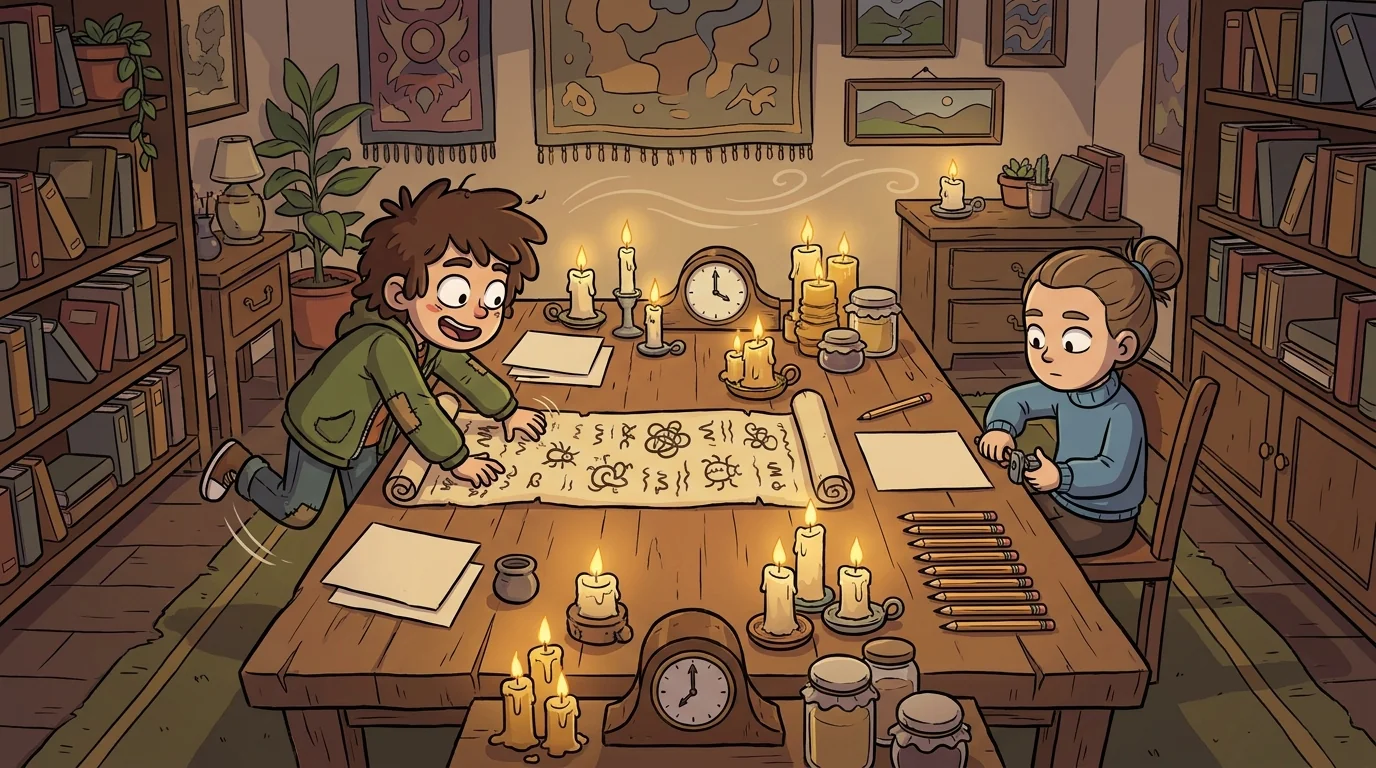
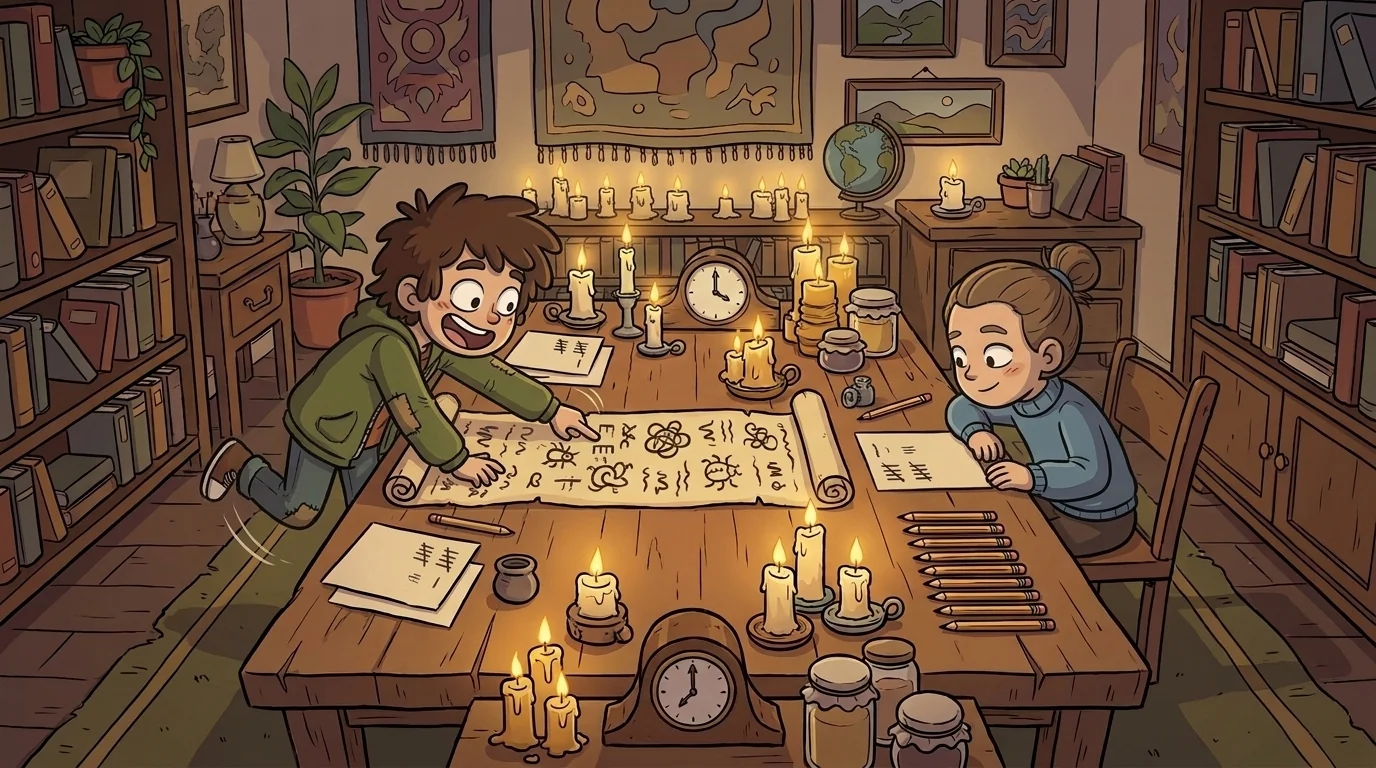
The air in the study hung thick with the scent of aged parchment, the subtle sweetness of beeswax candles, and the sharper tang of intense focus. Dust motes danced in the candlelight, illuminating the quiet industry of the room. In the very center, a heavy oak table formed an island, its polished surface reflecting the wavering flames. Upon this sturdy island lay a long scroll of ancient parchment, its surface densely covered with an intricate script. The symbols looked like tangled knots and scribbled bugs, an alien language waiting to be untangled. At one end of the table, Sift bounced on the balls of their feet, a whirlwind of nervous energy barely contained. At the other, Tally sat perfectly still, a picture of absolute calm.
Sift’s fingers drummed a frantic, irregular rhythm on the dark wood. "Look at it, Tally! It’s a mess. A beautiful, wonderful, impossible mess. Where do we even begin? There are so many of these strange marks!" Sift gestured wildly at the scroll, their excitement bubbling over.
Tally didn’t look up from sharpening a row of pencils, each one honed to an exquisite, needle-sharp point. Their movements were deliberate, each turn of the blade precise and unhurried. "We begin where we always begin," Tally said, their voice as smooth and even as a polished river stone. "Not with the meaning, but with the shape." Tally meticulously lined up the ten sharpened pencils in a neat, parallel row, a small, orderly army. "Not with the story, but with the count." This was the fundamental principle guiding their work, a quiet agreement between them.
Sift bounced again, leaning so far over the scroll that a lock of hair fell across their face. Their eyes weren't attempting to read the symbols; instead, they scanned, searching, hunting for anything that stood out. "Yes, yes, the count! I already see a bunch of the little squiggles with a tail. And the double-dot one! It’s next to the boxy one again, just like last time! Oh, this is going to be good." Sift’s mind raced ahead, already piecing together possibilities.
Tally finally looked up, their gaze steady and reassuring, offering Sift a small, almost imperceptible smile. "Then let us begin." The simple words were an anchor, pulling Sift’s scattered energy into focus.
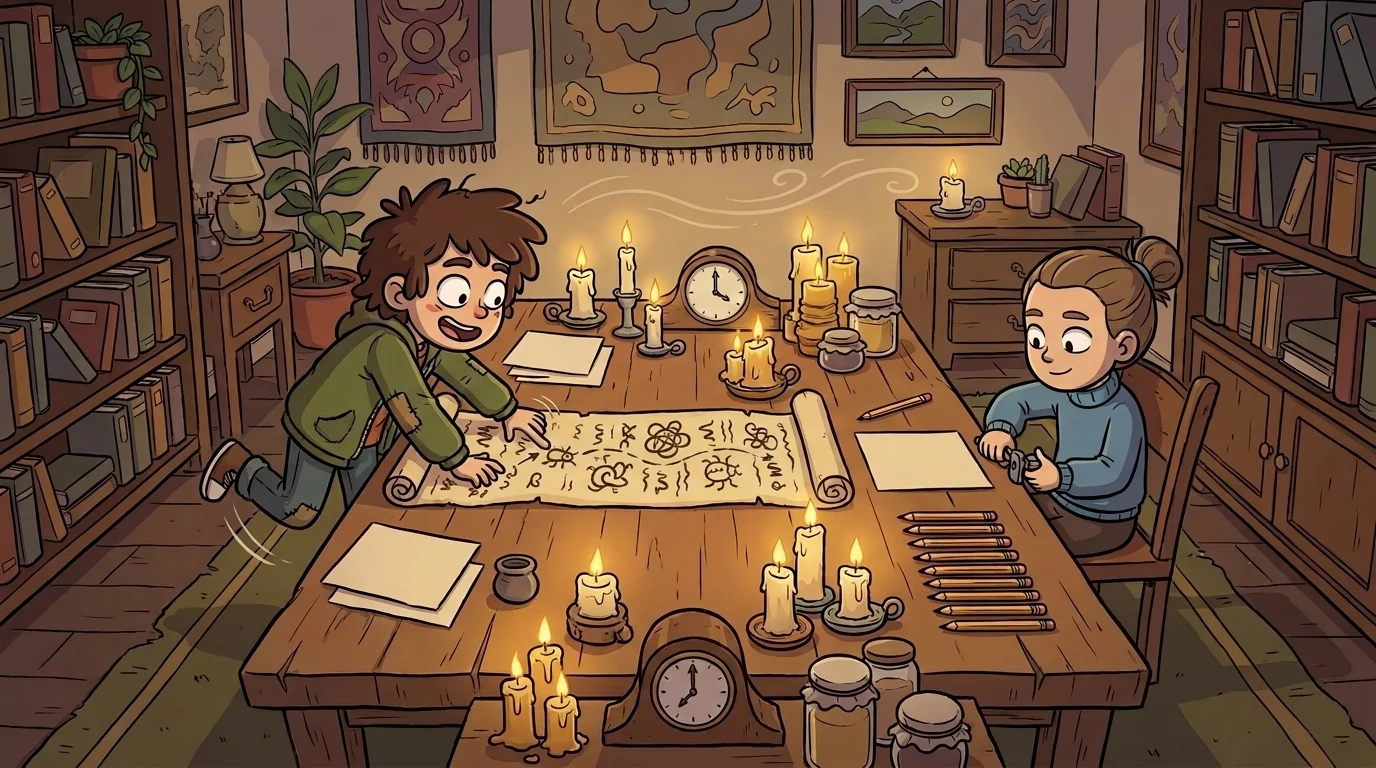
Sift swooped over the coded message like a hawk circling its prey. Their immediate task wasn't to count, not yet. Their job was to see the forest before counting the trees. They needed to find the rhythm in the jumble, to discern the unconscious habits of the person who had written it. They deliberately ignored the few symbols that appeared only once or twice, scattered like lost pebbles. Those were the lonely letters, the rare Js and Qs of this secret world; they held little importance at this initial stage. Sift was hunting for the popular ones, the symbols that gregariously appeared everywhere.
"There!" Sift chirped, pointing a slim finger at a symbol that looked like a tiny, slightly lopsided crown. "That one. It’s a regular chatterbox." Sift’s finger darted from one lopsided crown to the next, a firefly connecting invisible dots across the page. "It’s absolutely everywhere. It simply must be important." The sheer ubiquity of the symbol suggested a fundamental role in the code's construction.
Sift then noticed something else, a more subtle pattern emerging from the chaos. "And look," they whispered, leaning closer, their breath barely stirring the parchment. "See this pair? The arrow and the circle? They're almost always together. Like best friends, or perhaps a secret handshake." Sift circled a few of the arrow-and-circle pairs with a dry finger, careful not to leave a mark on the precious scroll. The map of the code was forming in their head, a mental landscape of recurring shapes and clustered companions. They gathered these patterns—the clumps, the lonely symbols, the friendly pairs—and prepared to report back on the code’s topography.
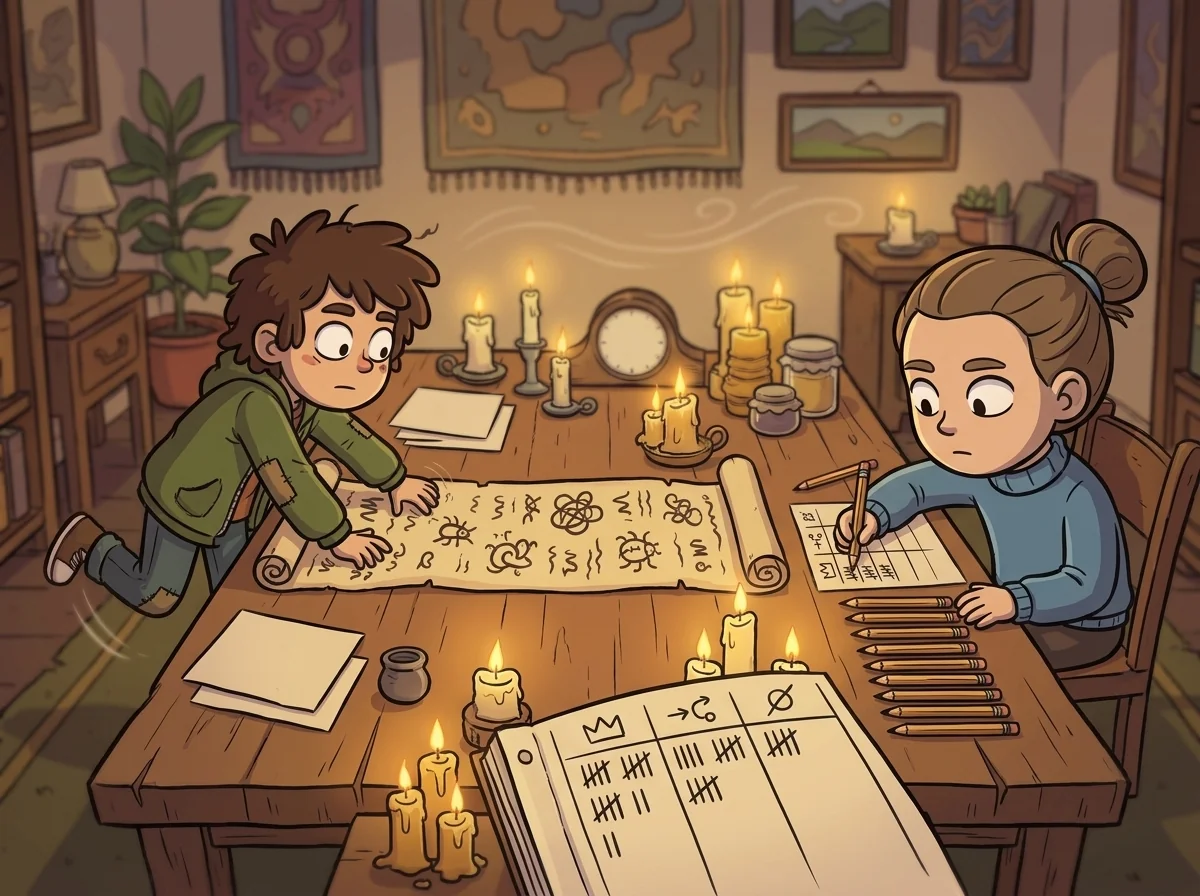
While Sift hunted for visual patterns, Tally prepared the ledger. Their movements were a study in quiet efficiency, a stark contrast to Sift’s restless energy. Tally drew a clean, precise grid on a fresh sheet of parchment, using a straightedge and a finely sharpened pencil. Each line was perfectly straight, each square uniform. At the top of each column, Tally carefully copied one of the unique symbols Sift had identified. The lopsided crown, being the "chatterbox," earned the first column. The arrow-and-circle pair, recognized as a frequent duo, received its own special spot. Tally’s process left no room for guesswork; this was a place for verifiable facts, meticulously recorded.
"Ready," Tally said quietly, their voice a low, steady hum.
Sift took a deep breath, then began to call out the symbols, their voice gaining a steady cadence as they moved systematically across the top line of the scroll. "Lopsided crown! Box! Circle! Arrow-and-circle! Lopsided crown again!" Each symbol was announced with clear, crisp articulation.
With each word from Sift, Tally’s pencil made a tiny, neat vertical mark in the correct column. When a column accumulated four marks, the fifth was a swift, diagonal slash through the first four, creating a neat little bundle of five. It was a simple, elegant system, a language Tally understood perfectly, requiring no translation. The stacks of tick marks grew steadily, column by column, a silent city of numbers rising from the blank page. Tally no longer needed to see the code itself; they were listening to its heartbeat, one deliberate tick at a time, transforming visual data into quantifiable information.
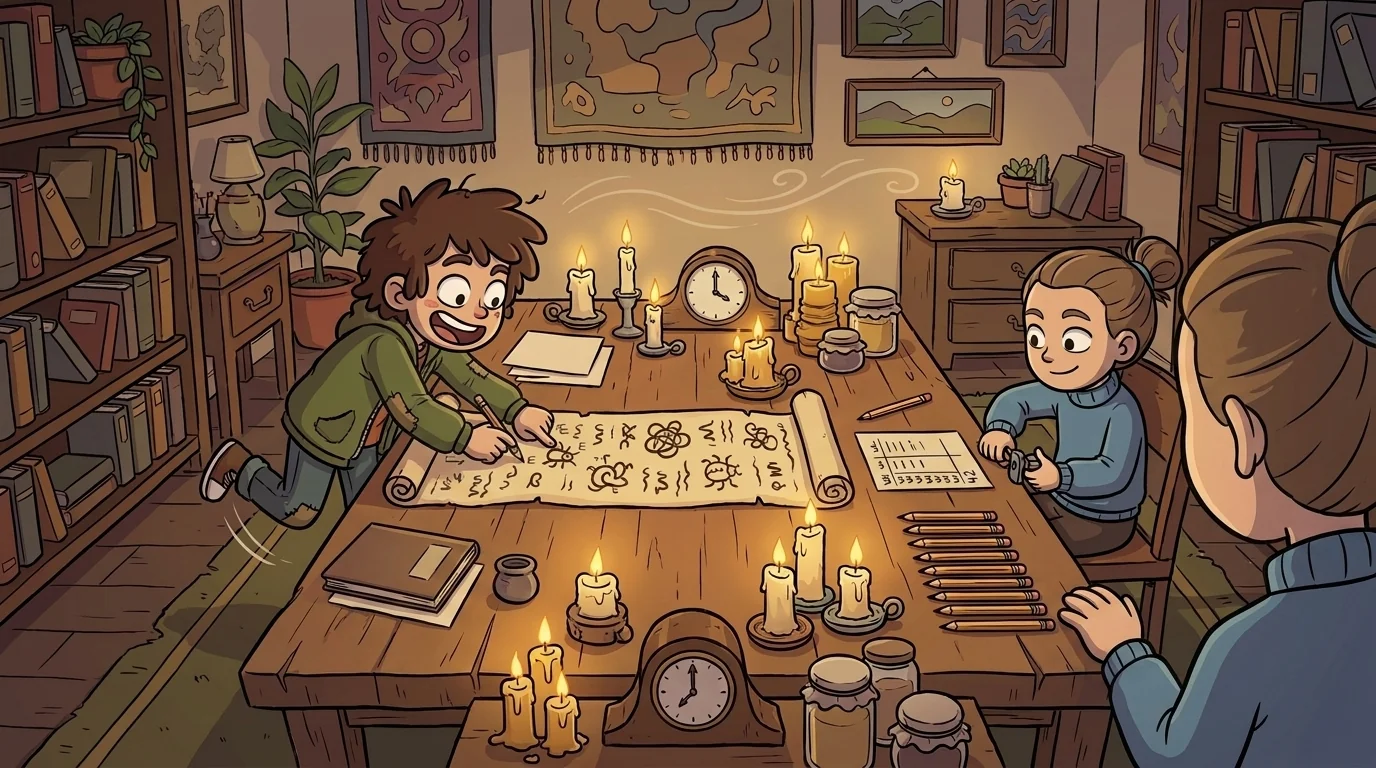
After a full hour, Sift’s voice was hoarse from constant calling, and Tally’s ledger was densely filled. Tally’s pencil moved one last time, writing a final, clear number at the bottom of each column. They then slid the ledger across the table with a gentle push. "The count is complete," Tally announced, their voice devoid of triumph, merely stating a fact.
Sift peered at the numbers, their eyes scanning for the most prominent figures. The column beneath the lopsided crown symbol was by far the tallest, its final tally reading "42." The next closest was the boxy symbol, with a significantly lower count of "28." The disparity was striking.
"Forty-two!" Sift breathed, a wide grin spreading across their face. "It’s the most common by a long shot. Just like I thought!" Sift tapped a finger on the ledger, their mind already leaping ahead. "In our language, what’s the letter we use more than any other?"
Tally didn't need to check a chart or consult a reference. "The letter E," Tally said simply, the answer an ingrained piece of knowledge.
A wide grin now spread across Sift’s entire face, a flash of pure delight. "So... what if we pretend?" Sift picked up a soft charcoal pencil, its tip blunt and gentle. "What if, just for a moment, every lopsided crown is an E?" Sift found the first crown on the coded scroll and lightly, carefully, wrote a tiny 'E' above it. Then the next. And the next. Each penciled 'E' was a small act of faith, a hypothesis taking tentative form.
As Sift diligently filled in the 'E's, the messy code began to offer up its secrets, like a shy creature peeking from behind a curtain. A word with three letters near the beginning, previously an indecipherable jumble, now looked like this: a symbol, an 'E', another symbol. But Sift recognized the first symbol from their earlier scan. It was the one that always seemed to appear with the last symbol, a familiar pair.
"Tally, look!" Sift said, pointing excitedly. "The `_ E _` word! And the first symbol and the last one are the same!" Their voice was a hushed exclamation of discovery.
Tally leaned in, their calm eyes studying the word with focused intensity. "A common pattern," Tally stated, acknowledging the structural similarity. "Like in the word 'level' or 'rotor'." Tally always provided the logical framework for Sift's intuitive leaps.
"Or 'eye'!" Sift exclaimed, already picturing the possibilities. They quickly penciled in an 'E' for the first and last symbols, just to see if it fit. The word became 'EEE'. That didn't seem quite right; it lacked the familiar cadence of a real word. Sift erased the marks with a soft rub. "Okay, not 'eye'. But what about a really, really common three-letter word? The most common one of all?"
Tally and Sift looked at each other, the same thought sparking silently between them, a shared moment of insight. Together, their voices merging in a soft unison, they said, "THE!" The answer felt inevitable, a lock clicking into place.
Sift’s hand flew across the page, no longer tentative. The symbol before the 'E' must be a 'T'. The symbol after it must be an 'H'. They filled in all the 'T's and all the 'H's across the scroll with a renewed sense of purpose. Suddenly, whole words started to take shape, emerging from the coded obscurity. The code wasn't a tangled mess anymore; it was a puzzle, and they had just found the crucial corner pieces, revealing the intricate picture beneath.
The CipherForge ensemble
Sift and Tally is part of CipherForge's distributed-narrative cast. Each character embodies a different curricular primitive; together they teach the full subject.
-
Caesar
Caesar shift / monoalphabetic shift cipher
-
Mask
Atbash + general monoalphabetic substitution (every letter has a fixed substitute)
-

Vigenère
Vigenère / polyalphabetic keyword cipher (the Caesar-on-a-rotating-keyword pattern)
-

Echo Pair
Playfair digraph cipher (letters encoded in pairs through a 5×5 grid)
-
Rail
Rail-fence + columnar transposition ciphers (rearrange letter order without changing the letters themselves)
-

Tally
Number-based codes (A1Z26, ASCII, binary, book ciphers — any mapping that converts letters to numbers)
-

Sift
Frequency analysis + cryptanalysis-by-statistics (the cipher-breaking method, not a cipher itself)
-

Lattice
Modern cryptography fundamentals — XOR, public-key concept, hashing (the irreversible / asymmetric family)
-

Hollow
Hides a secret message inside something ordinary, so nobody even knows there is a message to look for.
-
Tome
Keeps a shared code-book where whole words stand for secret words, so only someone with the same book can read the note.