Splitter Sasha
decomposition — breaking hard numbers into friendlier pieces
Loading audio…
Press play to listen along. The line being read lights up as you go.
Show full transcript
Loading transcript…
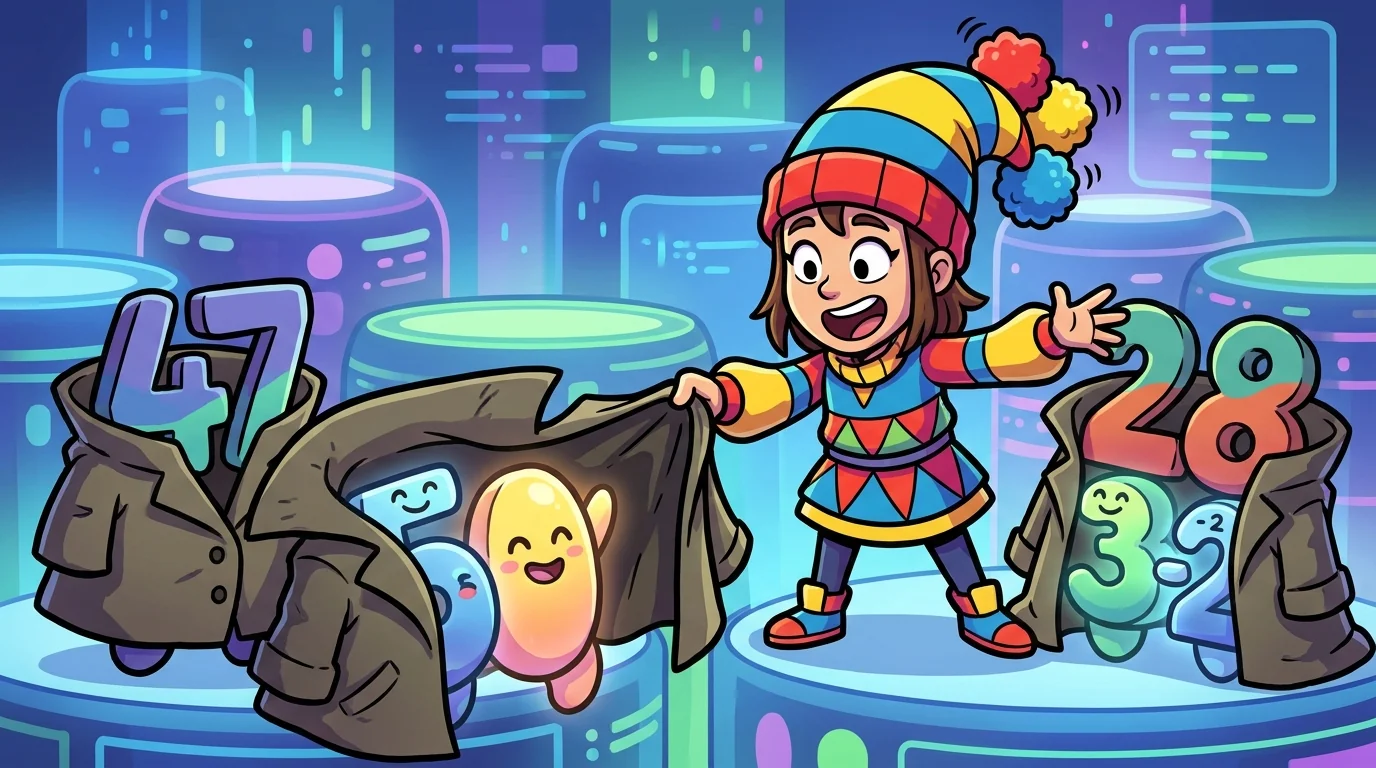
Splitter Sasha wore a tall, silly knit cap. Three bright pompoms bounced on top when she talked. And she talked a lot. Her older sister had given her the hat when she was nine. Sasha was now twenty-seven, but she still wore it every single day. Some things are too good to outgrow.
Sasha was the person who showed up when a number was being a bully.
Most numbers, Sasha insisted, were friendlier than they looked. A tough number like 47 or 348 was just a few nice numbers wearing a trench coat. Her whole job was to pop onto the NumberSense screen and pull off the disguise. She revealed the friendly numbers hiding inside.
Maya first met Sasha while staring at 47 + 28. It shouldn't have been a hard problem. She knew she could solve it on paper. But doing it in her head was another story. The timer for the estimate had ticked down from ten seconds. Maya’s brain went blank. She panicked and typed 60. Totally wrong. Now she was stuck, trying to figure out the real answer without a pencil.
Suddenly, Sasha appeared on the screen. The pompoms wobbled.
"Hi! You don't need to add 47 and 28 the hard way," she said, her voice fizzing with energy. "You can use the friendly way. Want me to show you?"
Maya nodded, relieved. "Okay."
"Watch this. 47 is really just 50 minus 3. And 28 is just 30 minus 2." Sasha's fingers danced in the air. "So you're really adding 50 minus 3, plus 30 minus 2. That's the same as 50 plus 30, minus 3, minus 2. Which is 80 minus 5. And that's 75!"

Maya's jaw dropped a little. "You did all that in your head?"
"Yep."
"Without writing anything down?"
"Yep. But I've been practicing for eighteen years. You don't need to be that fast." Sasha leaned closer to the screen. "You just need to know that 47 has a 50 hiding inside it. And 28 has a 30. Once you find the friendly numbers, the math gets way easier."
Maya squinted, thinking it over.
"Why are 50 and 30 friendlier?" she asked.
"Because they're round! They end in zero," Sasha explained. "Numbers that end in zero are a piece of cake to add. So if you can turn hard numbers into round ones, you're golden. Even if you have to add or subtract a little bit."
She paused, a grin spreading across her face.
"It's officially called decomposition," she said. "But that's a mouthful. I just call it finding the friendlier numbers. They're always in there. You just have to look."
Over the next few weeks, Maya started looking for them herself.

When she saw 347 in a problem, her brain automatically thought 350 minus 3. When 198 popped up, she saw 200 minus 2. The number 64 could be 60 plus 4. Or it could be 70 minus 6. It all depended on what she needed to do next.
This new trick made arithmetic feel completely different. The numbers weren't little walls she had to climb anymore. They felt more like LEGO bricks she could take apart and rearrange.
Sasha was thrilled whenever Maya rearranged a number.
"Yes! You found the friendlier number!" she would cheer. Her pompoms would wobble like crazy. "Which ones did you use this time?"
Maya would explain her thinking. Sometimes she found the same friendly numbers Sasha would have. Sometimes she found completely different ones. Sasha always listened carefully. "Oh, that's a clever one! I hadn't thought of that. Tell me why you picked it."
Maya soon learned a surprising secret. There wasn't just one right way. Most hard numbers had several friendlier numbers hiding inside. 47 could be 50 minus 3. But it could also be 40 plus 7. Or 45 plus 2. Or even 100 minus 53. Picking the best one depended on the problem you were trying to solve.
"That's the magic of it," Sasha said one afternoon. "There isn't ONE friendlier version of a number. There are LOTS. Your job is to pick the best one for the job. Sometimes it's a round number above. Sometimes it's the one below. And sometimes—my personal favorite—it's the same number, just cut in half."
"Cut in half?"
"Totally. If I need to multiply 48 by 5, I could do it the long way. Or I can see that 48 is just 24 doubled. And 5 doubled is 10. So 48 times 5 is the same as 24 times 10. Which is 240. A nice, friendly answer."
"Wait—does that always work?" Maya asked, grabbing a notebook.
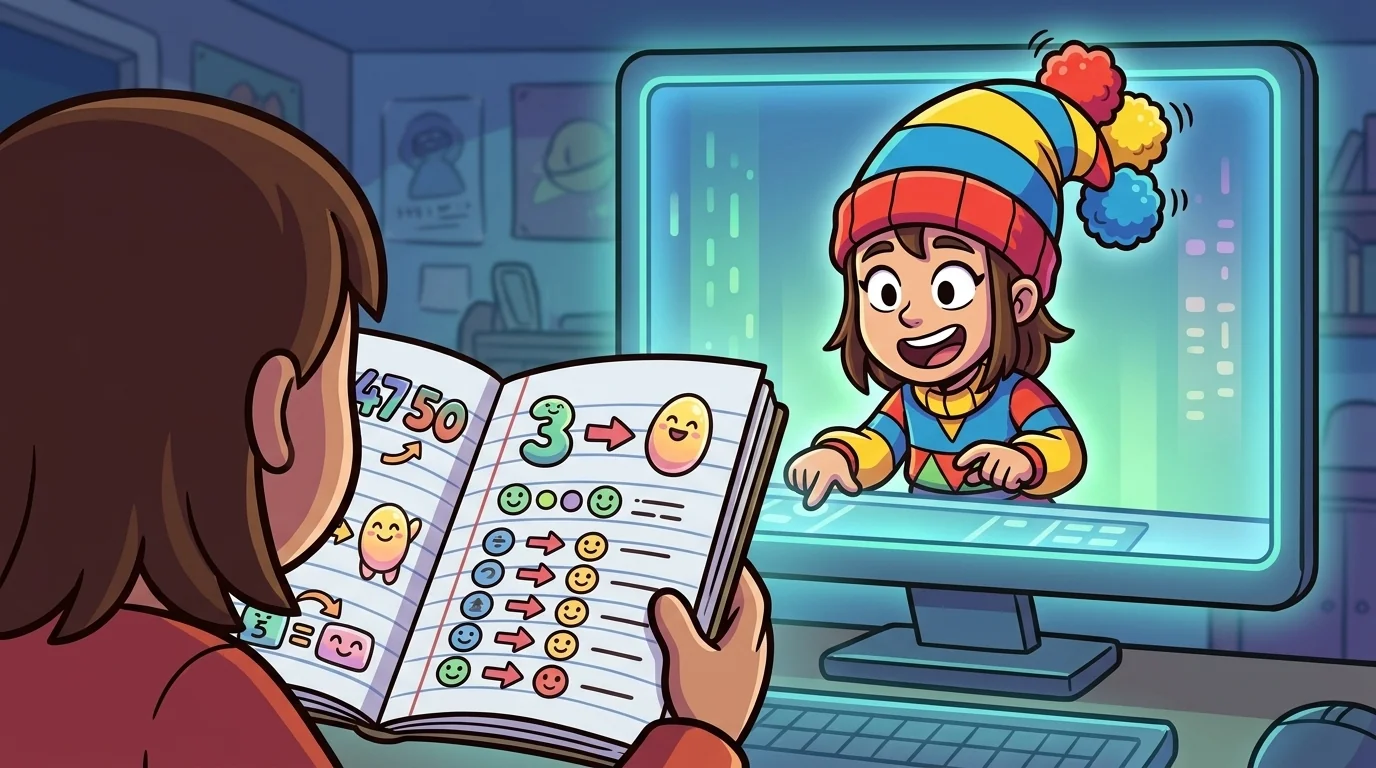
"It works when one number is even and the other is easy to double. Like 5, or 25, or even 2.5. It's a special trick. I'll show you more of them later."
Maya scrawled that one down.
By the end of her second month, Maya had a small notebook full of Sasha's tricks.
- 47 = 50 - 3 - 198 = 200 - 2 - To multiply by 5, halve the other number, then add a zero. - To multiply by 25, divide the other number by 4, then add two zeros. - Adding a long list? Look for pairs that make 10 first! - Round before you multiply, then fix it at the end.
She held the notebook up to the screen one day.
Sasha beamed. "You're making your own rulebook," she said, her pompoms bobbing. "That's the whole point! The tricks I show you aren't the real lesson. The real lesson is that numbers are friendlier than they look. You can rearrange them. Once you truly believe that, you'll start finding your own tricks. And there are infinite tricks out there."
"How do you know all of them?" Maya asked.
"I don't! I only know the ones I've found so far. New ones appear all the time. Just last week, a kid on the app showed me a new way to multiply by 11. I had never seen it before. She was younger than you."
"What was the trick?"
"To multiply a two-digit number by 11, you just add the two digits together. Then you stick the sum right in the middle. So 23 times 11 is 2, then 5—because 2 plus 3 is 5—then 3. The answer is 253. Try 34 times 11. It's 3, then 7, then 4. 374. Check it on a calculator if you want!"
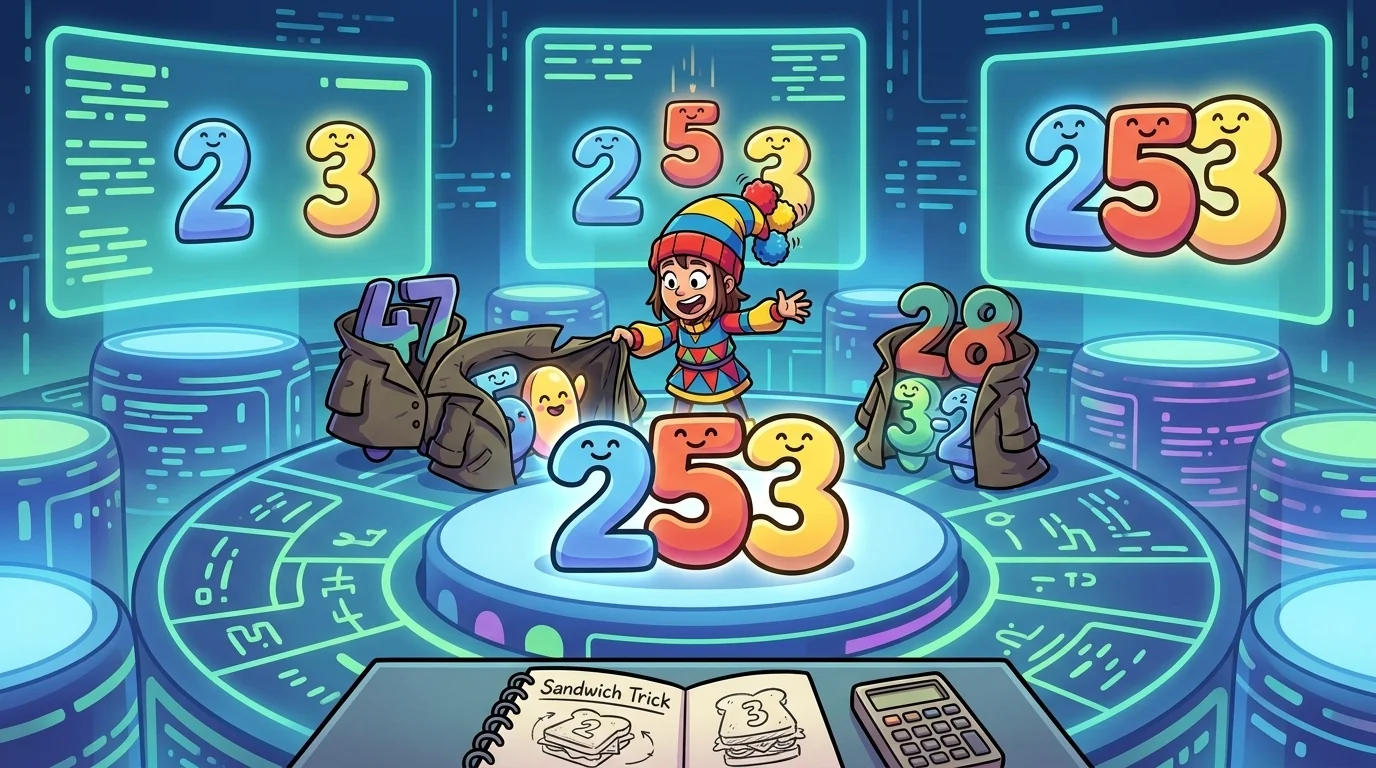
"Whoa," Maya breathed.
"Right? She was eight years old. She called it the Sandwich Trick."
Maya carefully wrote: Sandwich Trick: to multiply by 11, put the sum between the digits.
She turned to a fresh page.
"What's tomorrow's trick?"
"Tomorrow's is for division," Sasha said with a wink. "But you have to find it yourself. I'm not telling. Give it a try."
And she faded from the screen.
Maya stayed up late that night, scribbling in her notebook.
By morning, she had found one.
The next day, Sasha’s pompoms wobbled with so much enthusiasm, Maya thought they might fly right off her hat. And Maya — who a few weeks ago had felt scared and stuck in front of a simple sum — felt something brand new. She felt proud. Not because someone had handed her the answer, but because she had gone looking in the dark and found it herself. That warm, glowing feeling stayed with her all day.
The NumberSense ensemble
Splitter Sasha is part of NumberSense's distributed-narrative cast. Each character embodies a different curricular primitive; together they teach the full subject.
-

Estimator Ernie
Confidently approximate; the first-guess advocate
-

Pivot Pia
Deceptively casual question-flipper; reframes the prompt
-

Ratio Rio
Per-something specialist; rate thinker
-

Nudge Nora
Compensation — nudge a number to a friendly round one, do the easy math, then give back exactly what you borrowed.
-

Doubler Della
Doubling and halving — to multiply, double one number and halve the other; the product stays the same while one side gets friendlier.
-

Landmark Lena
Benchmark numbers — judge any number by how it sits next to friendly landmarks like 0, a half, 10, 50, and 100.
-

Factor Fiona
Factors and multiples — every number is built from smaller numbers multiplied together, and seeing the building blocks makes hard arithmetic come apart.
-

Gap Gus
Constant difference — subtraction is the gap between two numbers; slide both the same amount and the gap stays the same, so you can land on friendly numbers.
-

Bridge Bao
Derived facts — reach a fact you don't know by taking one short step out from a fact you do.