
Doubler Della
doubling and halving — to multiply, double one number and halve the other; the product never changes, and one side keeps getting friendlier
Press play to listen along. The line being read lights up as you go.
Show full transcript
Loading transcript…
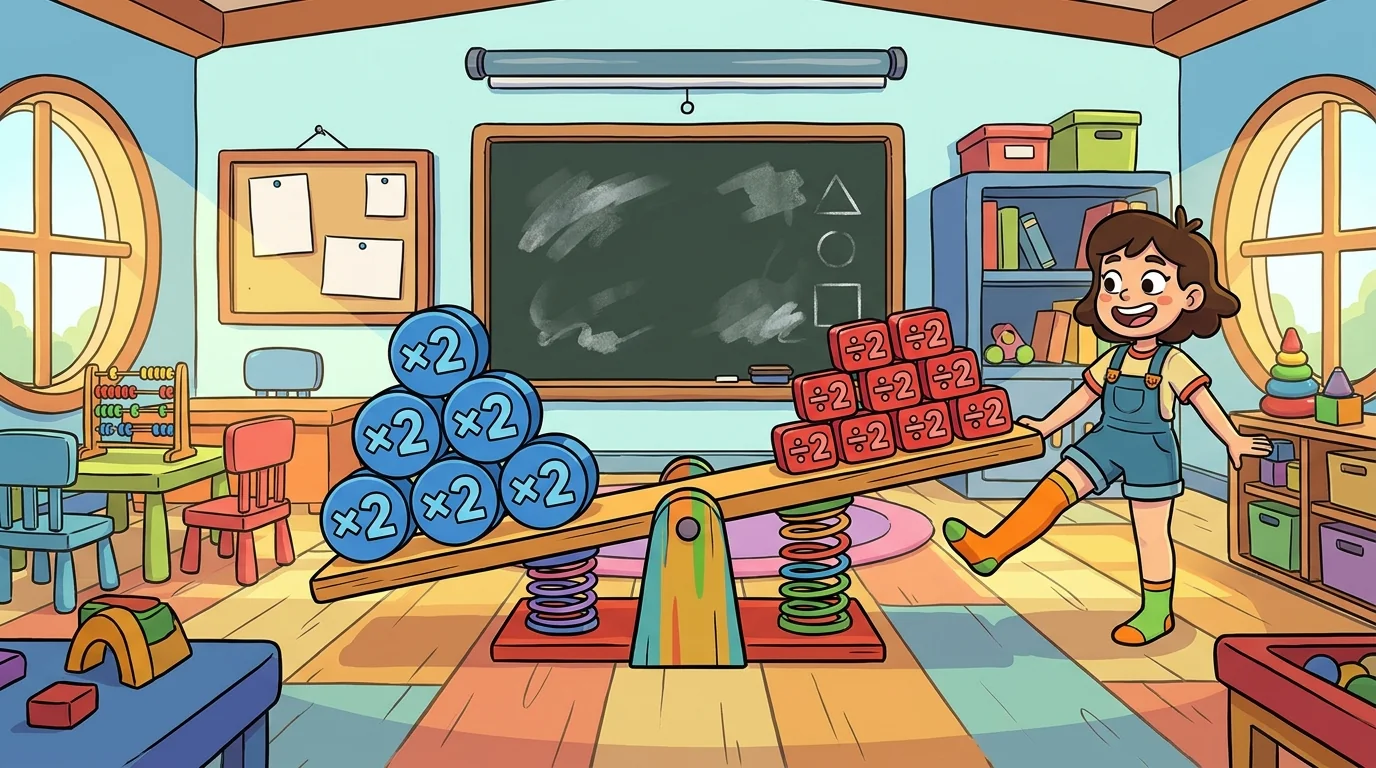
Doubler Della moved like a see-saw — up on one side, down on the other, always in balance. She wore one tall sock and one short sock, on purpose, and if you asked her why she'd just grin and say, "Because they add up to two normal socks."
She popped onto the NumberSense screen whenever a kid was wrestling a multiplication that looked worse than it was.
Theo was stuck on *16 × 25*. "Sixteen times twenty-five," he muttered. "I don't even know where to start."
"Ooh, this one's perfect for me," Della said, bouncing. "Watch the see-saw. I'm going to halve one number and double the other, at the very same time. Sixteen, cut in half, is eight. Twenty-five, doubled, is fifty. So sixteen times twenty-five is the same as eight times fifty."
Theo blinked. "Wait, you're allowed to just... do that?"
"As long as I do both at once!" Della said. "One side goes down, the other goes up by exactly as much. The see-saw stays balanced, so the answer doesn't change. And look — eight times fifty is way friendlier. That's four hundred." She tipped from one foot to the other. "Sixteen times twenty-five is four hundred. Same answer, easier ride."
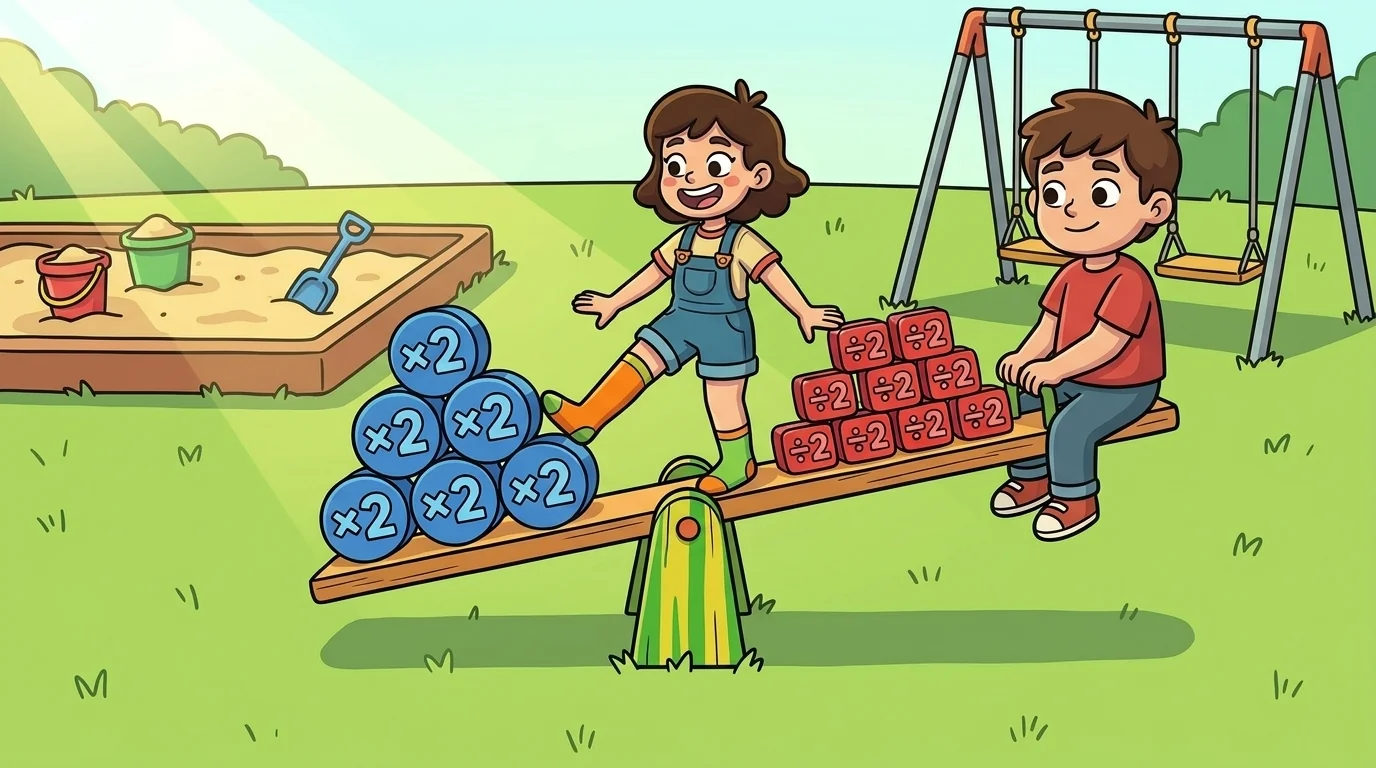
Della discovered her trick on an actual see-saw, when she was small.
She and her cousin used to play on the one in the park, and her cousin was much heavier. To balance, Della learned she had to scoot way out to the end, and her heavy cousin had to scoot in close to the middle. Light-but-far balanced heavy-but-close. The see-saw didn't care how — it only cared that the two sides matched.
Years later, staring at a multiplication problem, she felt the same thing click. A times B was a kind of see-saw. If she made A smaller, she could make B bigger by the same factor, and the product — the thing the see-saw was really weighing — stayed exactly the same.
She'd halve the heavy, awkward side and double the light, friendly side, again and again, scooting the numbers along the plank, until one side landed on something lovely and round. Then the answer was easy to read.
"It's not cheating," she'd tell anyone who looked suspicious. "It's balancing."
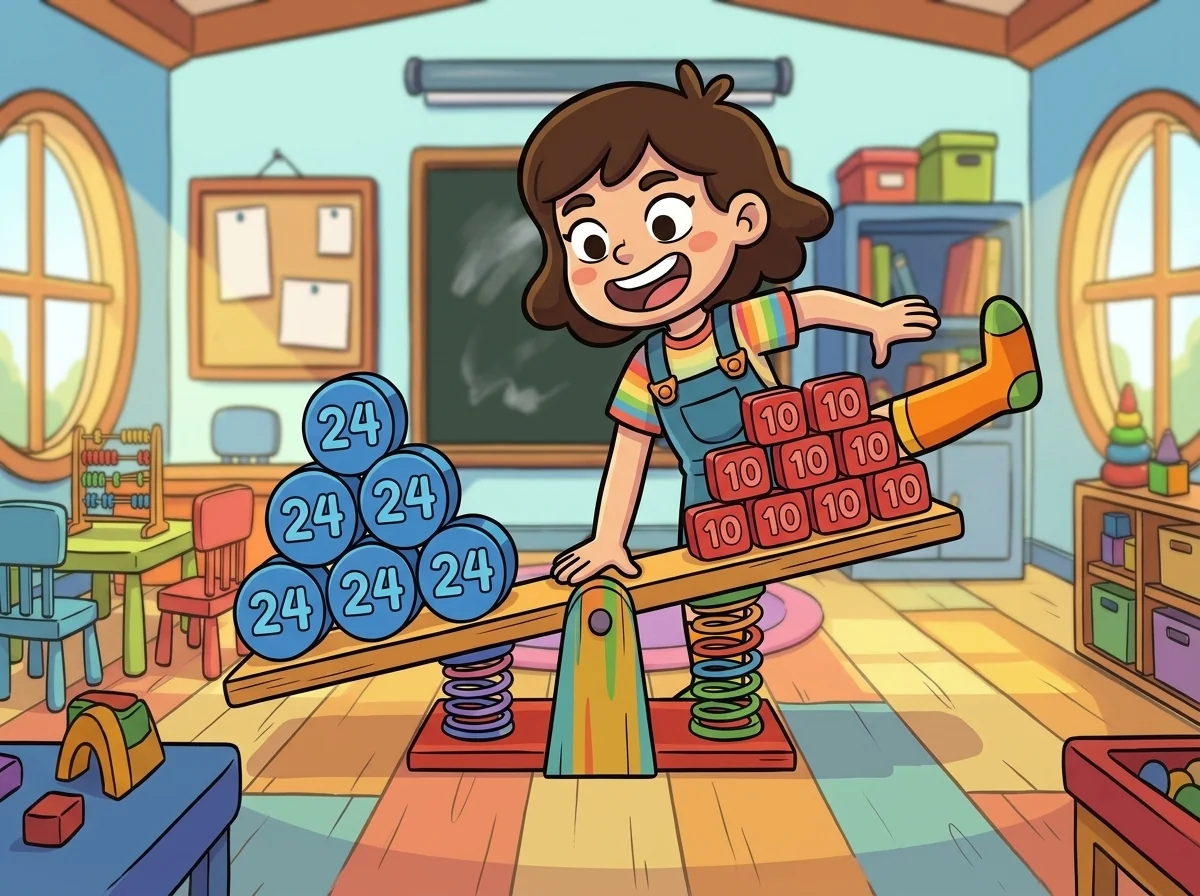
The trick had a favorite home, Della explained: any time one number was even, and the other was something you'd love to double.
A girl named Mira had *48 × 5.*
"Five is begging to be doubled," Della said. "Doubled, it's ten — and times-ten is the easiest thing in the world. So halve the forty-eight to keep the see-saw level. Forty-eight halved is twenty-four." She clapped. "Now it's twenty-four times ten. Which is two hundred forty."
Mira's eyes widened. "Forty-eight times five is two hundred forty? That was so fast."
"Because five hates being five," Della laughed. "It always wants to be ten. So let it! Just halve the other side to keep things fair."
Mira tried it again with a different one, scooting the numbers along her own imaginary plank, halving and doubling, until a friendly round number popped out. "It balanced," she said, a little amazed.
"It always balances," said Della. "That's the whole point of a see-saw."
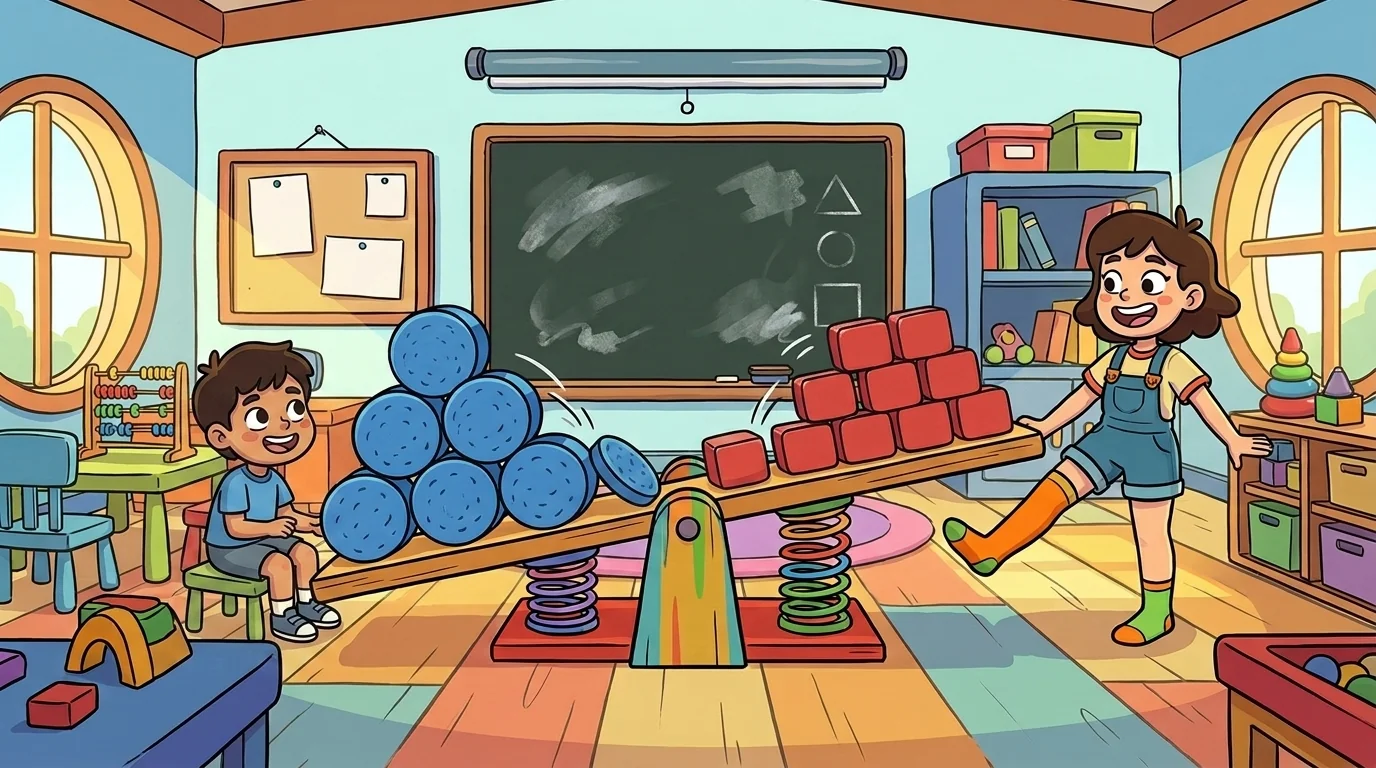
What Della really wanted kids to feel was that they could keep trading for as long as they needed.
"You don't have to fix it in one move," she told a boy named Ravi, who thought the trick only worked once. "If halving and doubling once doesn't land you somewhere friendly, do it again. Scoot the numbers along the plank as many times as you like. The see-saw doesn't get tired. Every single time, one side goes down, the other goes up to match, and the answer stays exactly the same. You just keep trading until the hard number turns into an easy one."
Ravi took a big number, halved and doubled, halved and doubled, watching one side melt toward something round while the other grew. "It's like the answer was always hiding in there," he said. "I just had to keep rocking the see-saw until it showed up."
"Now you're seeing it," Della said, rocking happily up onto her tall-sock foot. "The answer never moved. We just kept changing the ride until the ride got easy."

That night, after the app went still, Della sat with one tall sock and one short sock and thought about the park see-saw, and her heavy cousin scooting in close so light little Della could lift him from way out at the end.
Ravi's last note glowed on the screen: I kept trading until it got easy. It worked every time.
She read it and smiled, rocking gently from foot to foot.
That was the thing she most wanted a kid to carry, more than any single answer: that you're allowed to keep changing how you do a thing — trading a little here for a little there — without ever changing what you're really after. The goal stays put. Only the path gets friendlier. And there's a quiet, balanced kind of joy, she thought, switching off her screen, in knowing that an awkward, heavy problem can always be rocked, little by little, into something light enough to lift.
The NumberSense ensemble
Doubler Della is part of NumberSense's distributed-narrative cast. Each character embodies a different curricular primitive; together they teach the full subject.
-

Estimator Ernie
Confidently approximate; the first-guess advocate
-

Pivot Pia
Deceptively casual question-flipper; reframes the prompt
-

Ratio Rio
Per-something specialist; rate thinker
-

Splitter Sasha
Make-10 and place-value specialist; benchmark builder
-

Nudge Nora
Compensation — nudge a number to a friendly round one, do the easy math, then give back exactly what you borrowed.
-

Landmark Lena
Benchmark numbers — judge any number by how it sits next to friendly landmarks like 0, a half, 10, 50, and 100.
-

Factor Fiona
Factors and multiples — every number is built from smaller numbers multiplied together, and seeing the building blocks makes hard arithmetic come apart.
-

Gap Gus
Constant difference — subtraction is the gap between two numbers; slide both the same amount and the gap stays the same, so you can land on friendly numbers.
-

Bridge Bao
Derived facts — reach a fact you don't know by taking one short step out from a fact you do.