
Nudge Nora
compensation — nudge a number to a friendly round one, do the easy math, then give back exactly what you borrowed
Press play to listen along. The line being read lights up as you go.
Show full transcript
Loading transcript…
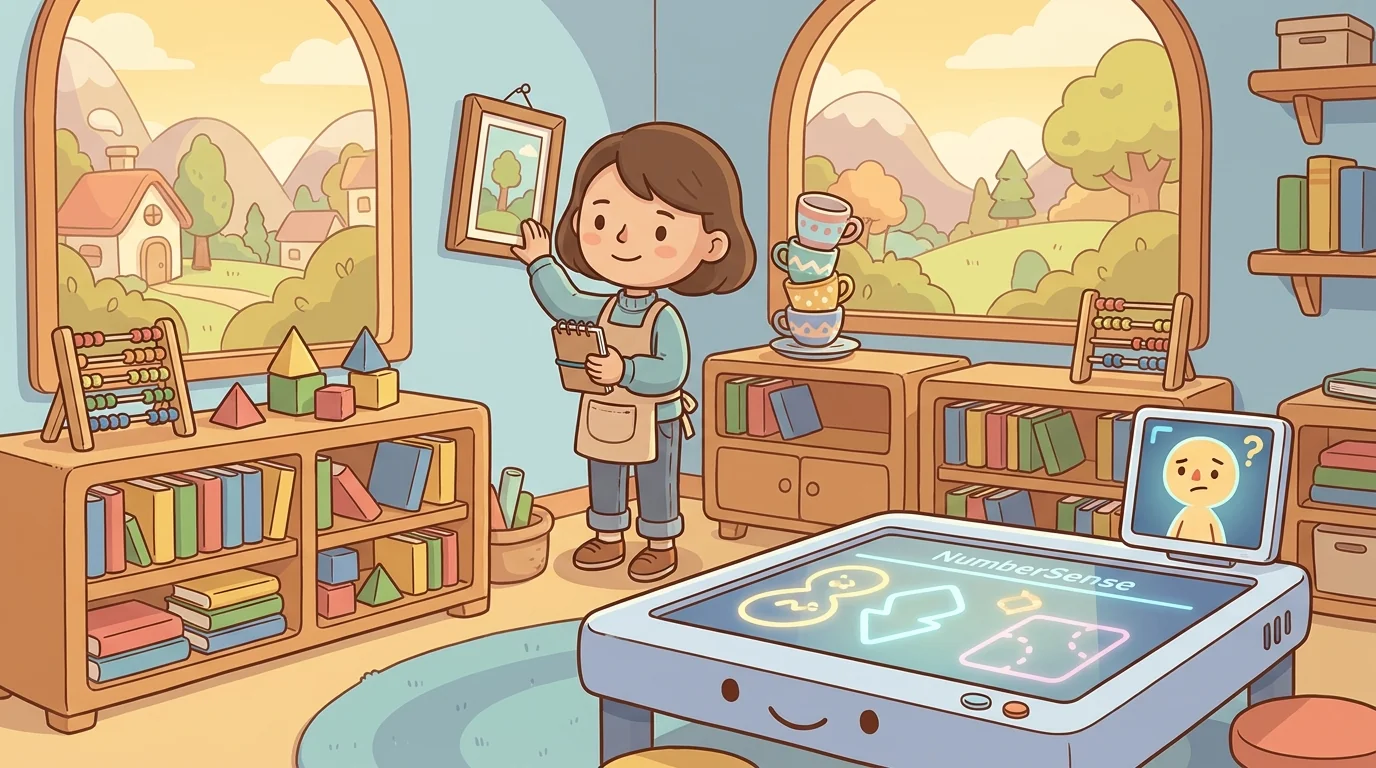
Nudge Nora always carried a little notebook with a rubber band around it, and she was forever straightening things — a crooked picture frame, a wobbly stack of cups, a number that didn't sit on a round ten.
She helped kids on the NumberSense screen the way some people tidy a room: gently, and one small move at a time.
Leo was glaring at *53 − 18 when she popped up. He could feel the answer was somewhere in the thirties, but in his head the eighteen kept tangling him up. Subtracting eighteen was just awkward.*
"It's an awkward number," Nora agreed, as if she'd read his mind. Her voice was calm and tidy. "Eighteen doesn't sit nicely. But twenty does. So let's borrow."
"Borrow?" Leo said.
"Watch. I'm going to nudge eighteen up to twenty — that's two extra. Now the problem is easy: fifty-three minus twenty is thirty-three." She tapped the air. "But I borrowed two to get there. So I have to give it back. Thirty-three plus two is thirty-five." She smiled, small and pleased. "Two steps. Nudge to make it easy. Then give back exactly what you borrowed. The answer is thirty-five, and it's exactly right — because nothing got lost."
Leo checked it on paper. Thirty-five. Exactly.
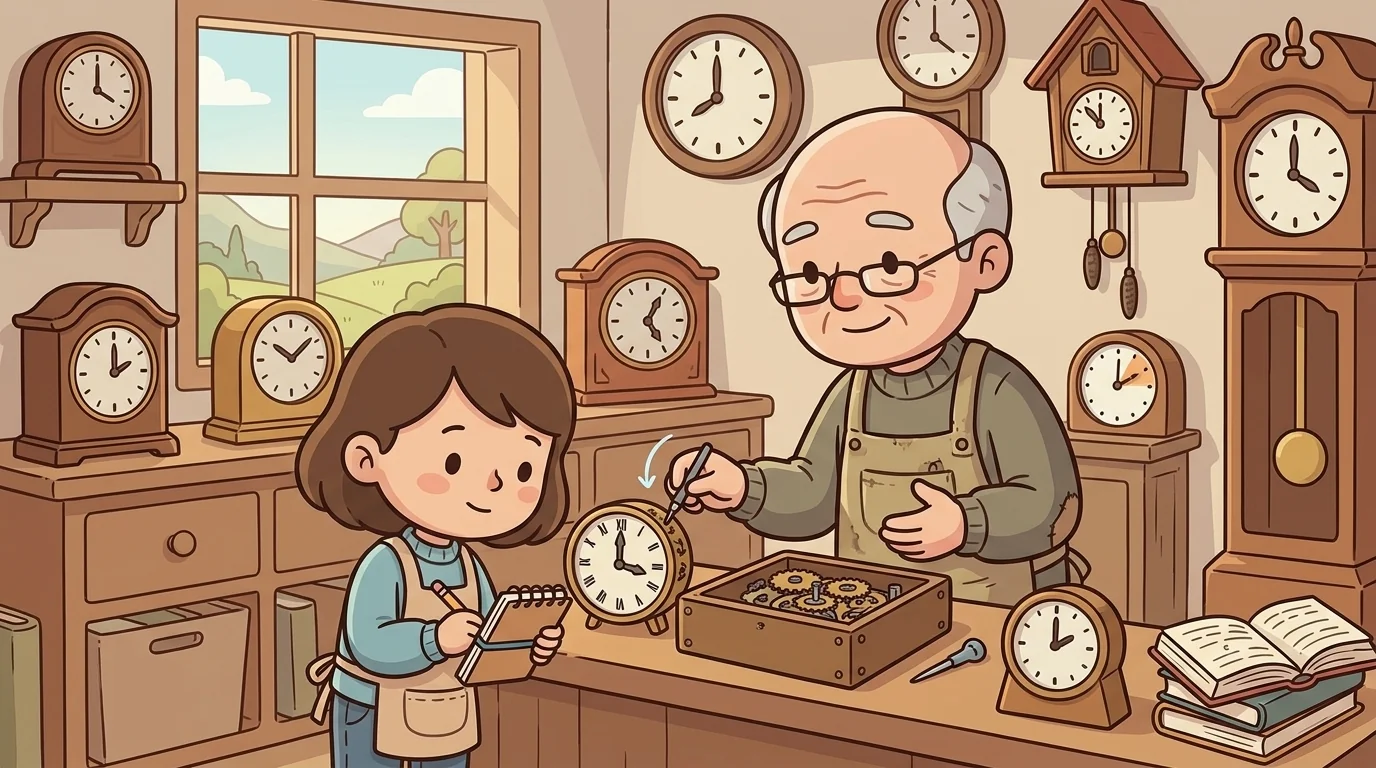
Nora learned her trick from her grandfather, who fixed clocks.
When she was little, she'd watch him work. A clock would be running a few minutes fast, and instead of taking the whole thing apart, he'd make one tiny adjustment — a gentle turn of a small screw — and then, carefully, note down exactly how much he'd turned it, in case he needed to turn it back.
"Never change a thing without remembering what you changed," he'd tell her. "A small nudge can fix almost anything. But you have to keep track of it. A nudge you forget is just a mistake waiting to happen."
Young Nora started doing it with numbers. A hard number like nineteen? She'd nudge it to twenty and remember the one. A clumsy ninety-eight? Nudge it to a hundred, remember the two. The math got easy — and as long as she gave back exactly what she'd borrowed, the answer always came out perfect.
She filled a whole notebook with nudges, each one written next to the little number she'd have to give back. She never lost track of a single one. That, she decided, was the real trick — not the nudging, but the remembering.
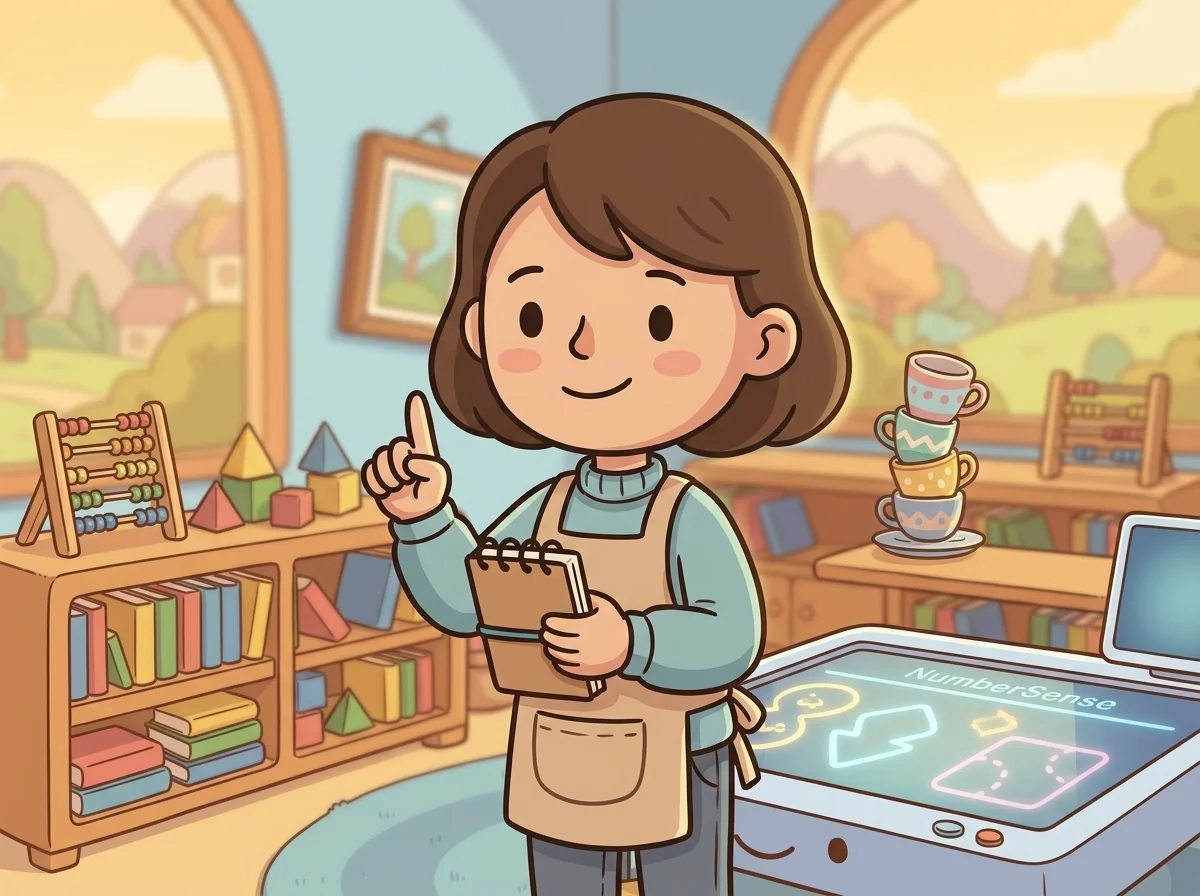
The thing about Nora's trick was that it worked for adding, too — you just gave back in the opposite direction.
A girl named Priya was stuck on *47 + 18*.
"Same idea," Nora said warmly. "Forty-seven is so close to fifty. Let's nudge it up — that's three extra borrowed. Now it's easy: fifty plus eighteen is sixty-eight." She held up a finger. "But this time I added three to get there. So to give it back, I take three away. Sixty-eight minus three is sixty-five."
Priya frowned, working it through. "So... when I nudge a number up to make it round, I give the extra back at the end?"
"Exactly. If you borrowed by adding, you give back by subtracting. If you borrowed by subtracting, you give back by adding. The nudge makes it easy. The give-back makes it right."
Priya tried one on her own: *199 + 36.* "Nudge one ninety-nine up to two hundred — that's one borrowed. Two hundred plus thirty-six is two thirty-six. Give the one back... two thirty-five!"
"Look at you," Nora said, quietly delighted.

What Nora loved most was watching a kid stop being afraid of the give-back step.
Because that was where everyone got nervous. Borrowing felt fun and clever — but kids worried they'd forget to return what they'd taken, and the answer would come out wrong.
"That's the part people skip," Nora told a boy named Sam one afternoon, "and then they think the trick is broken. But the trick isn't broken. They just forgot to give back." She tapped her rubber-banded notebook. "That's why I write the little number down. The nudge and the give-back are a pair. You never do one without the other. As long as they always travel together, you can borrow as much as you like, and nothing is ever truly lost. It always comes back to exactly the right answer."
Sam wrote, at the top of his own notebook: Nudge AND give back. Always both.
"Now you've got it," Nora said. "That's the whole secret. Not the borrowing. The returning."

That evening, after the app went quiet, Nora straightened a crooked little number on her own screen and snapped the rubber band back around her notebook.
She thought about her grandfather and his clocks — how he'd never once changed a thing without writing down how to change it back, and how safe that had always made her feel. Nothing he touched ever stayed broken. Nothing ever got lost.
Sam's last message was still glowing on the screen. I wasn't scared of the second step today.
Nora read it twice.
She'd spent her whole life learning that you can borrow from anything — a number, a clock, a hard afternoon — and make it easier to carry, as long as you remember, gently, to give back exactly what you took. And the best feeling in the world, she thought, switching off her screen, wasn't getting the answer fast.
It was knowing that nothing you touched would ever be left worse than you found it.
The NumberSense ensemble
Nudge Nora is part of NumberSense's distributed-narrative cast. Each character embodies a different curricular primitive; together they teach the full subject.
-

Estimator Ernie
Confidently approximate; the first-guess advocate
-

Pivot Pia
Deceptively casual question-flipper; reframes the prompt
-

Ratio Rio
Per-something specialist; rate thinker
-

Splitter Sasha
Make-10 and place-value specialist; benchmark builder
-

Doubler Della
Doubling and halving — to multiply, double one number and halve the other; the product stays the same while one side gets friendlier.
-

Landmark Lena
Benchmark numbers — judge any number by how it sits next to friendly landmarks like 0, a half, 10, 50, and 100.
-

Factor Fiona
Factors and multiples — every number is built from smaller numbers multiplied together, and seeing the building blocks makes hard arithmetic come apart.
-

Gap Gus
Constant difference — subtraction is the gap between two numbers; slide both the same amount and the gap stays the same, so you can land on friendly numbers.
-

Bridge Bao
Derived facts — reach a fact you don't know by taking one short step out from a fact you do.