Estimator Ernie
gut-feel estimation — guessing first then computing
Loading audio…
Press play to listen along. The line being read lights up as you go.
Show full transcript
Loading transcript…
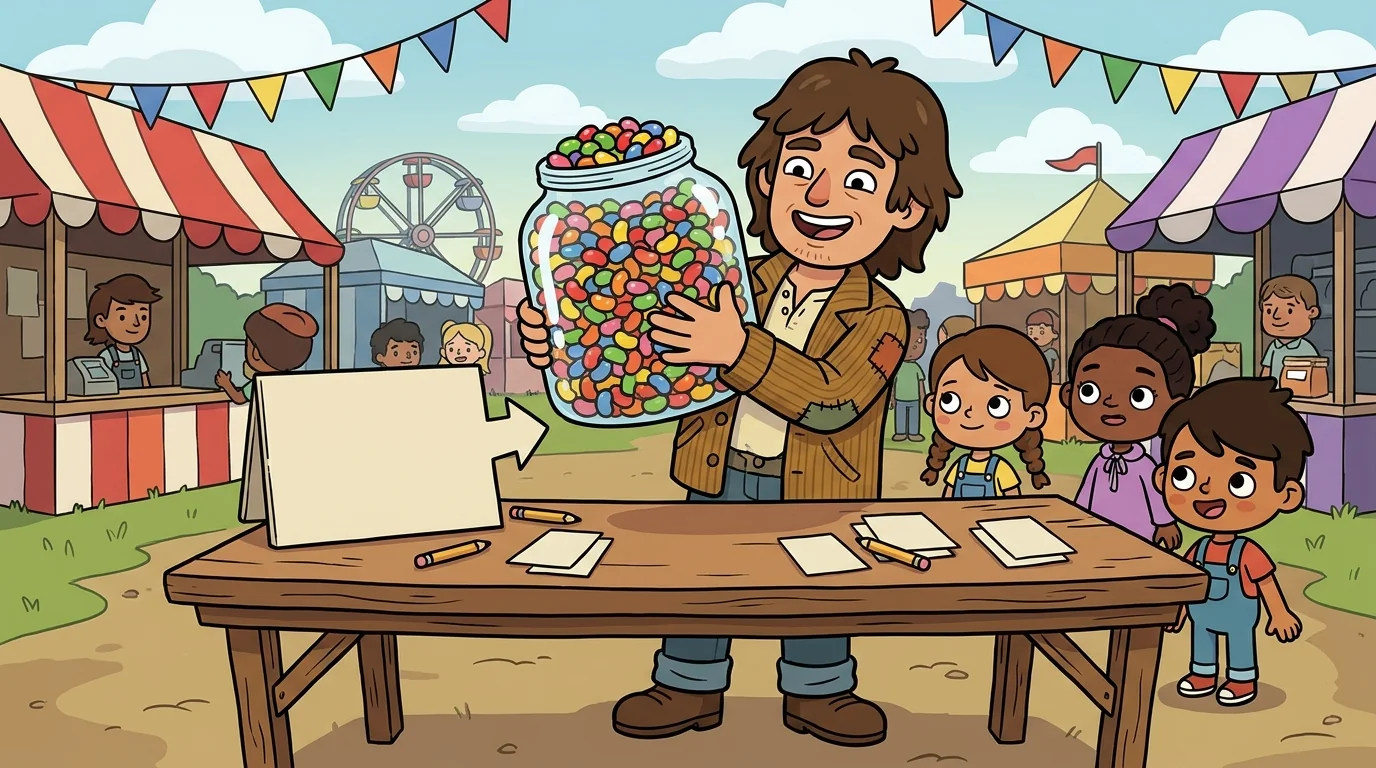
The first thing Maya learned about Estimator Ernie was his jellybean story. He had won a giant jar of them when he was eight.
He told this story at the start of almost every conversation. He wasn't embarrassed at all. He told it with a cheerful confidence, like it was the most amazing thing that had ever happened. And maybe it was. There was a county fair. A wobbly card table. A huge glass jar packed with jellybeans. A sign said Guess how many. Closest guess wins the jar. Three hundred kids guessed. But only one kid—eight-year-old Ernie—guessed 847. He was off by only nine.
He took the jar home. For a whole week, he didn't eat a single jellybean. He was too busy just looking at them.
"That was the day I knew," he would always say, his voice full of wonder. "That was the day I knew estimation was the best thing in the whole world."
Maya was ten. She'd been using the NumberSense app for three weeks. And she was skeptical. To her, estimation was just a fancy word for guessing. And guessing was basically cheating. It was what you did when you didn't know the real answer. How could that be the best thing in the world?
Estimator Ernie had a very clear answer.
"Estimation isn't guessing," he said, on Maya's third day with the app. "It's making your guess smart. You use what you already know to get as close as you can. It's the opposite of cheating. Cheating is when you skip the thinking. Estimation is doing the thinking in ten seconds instead of ten minutes. The thinking is harder, not easier. It's just way faster."
"Why is it harder?" Maya asked.
"Because when you calculate, you just follow the rules. You add this, you multiply that. But when you estimate, there are no rules on paper. You have to look at a problem and just… feel where the answer lives. You have to know a little bit about how the world works."
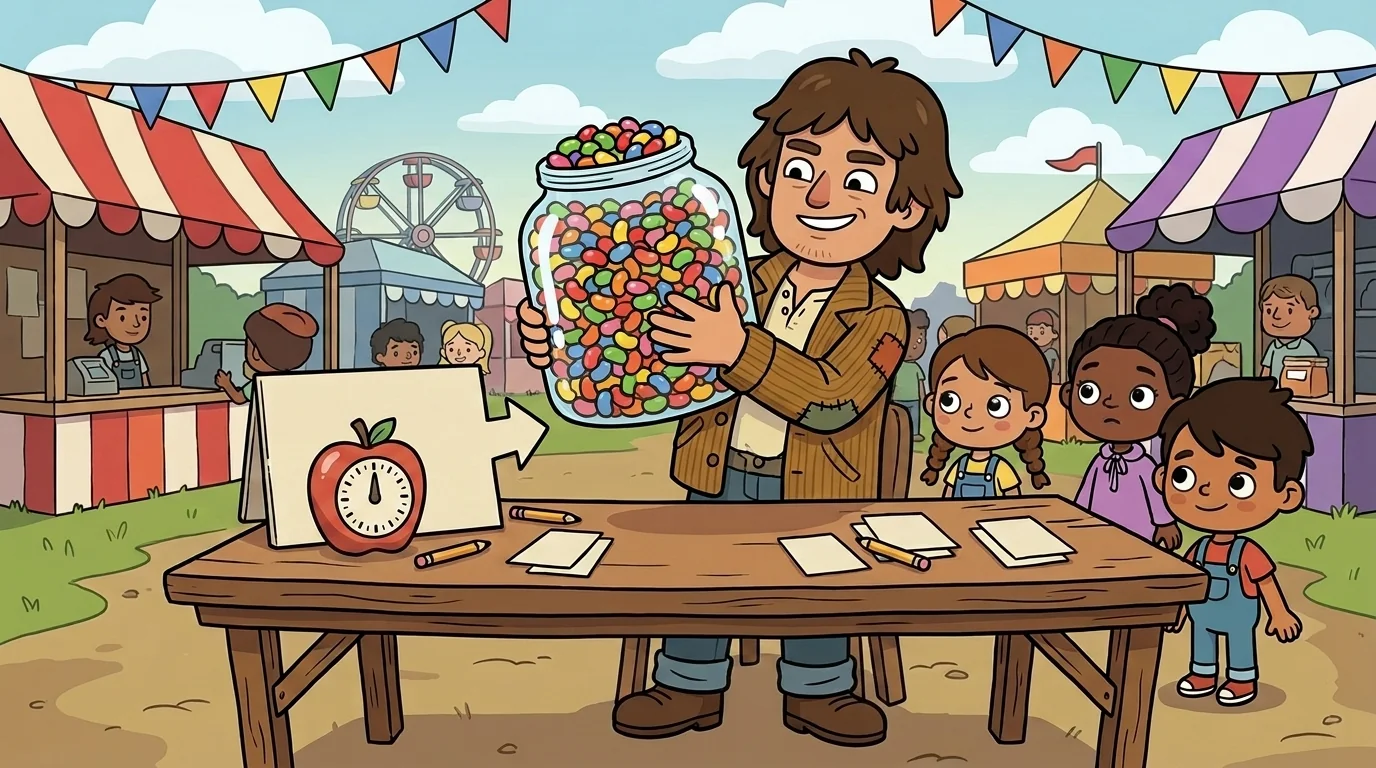
Maya wasn't so sure, but she was curious.
The NumberSense app always started the same way. A problem would pop up. Then a ten-second timer would start ticking. You had to type in a guess before it ran out. No pencils. No paper. No calculators. Only after you guessed did the app show the real answer.
Maya hated the estimate phase at first.
The ten-second timer was a tiny, ticking bomb. Her brain would freeze. She just wanted to write the problem down, the way her teacher taught her. But the timer took all her tools away. Tick. Tick. Boom.
"Those tools are for calculating later," Ernie said when she complained. "The estimating part has its own tool."
"What tool?" Maya asked.
"Your gut," Ernie said. "What feels true?"
"That's not a tool," Maya grumbled.
"It's the most important one you've got," he said. "You use it all the time. When your mom asks how long till you're ready and you say 'like, five minutes,' you're estimating. You're just practicing it on purpose here."
Maya thought about that.
The next problem flashed on the screen: How many words does the average book have?

Ten seconds.
Her mind went completely blank. A million? A thousand? She’d read hundreds of books. She had never once thought to count the words. With three seconds left, she jabbed at the screen. She typed 10,000. It was a nice, round number. That was her only reason.
The timer buzzed. The real answer appeared: about 70,000 for a typical novel.
She was off by sixty thousand words. She felt her face get hot. It was a terrible guess.
Estimator Ernie popped up on the screen. He was munching on a jellybean.
"That was a good first guess," he said.
"It was sixty thousand words off!"
"Yep," Ernie said, not bothered at all. "But now you know something new. You know books are way bigger than you thought. Your next guess will be better. That's the whole point. Estimation isn't about being perfectly right. It's about getting closer and closer."
"I want to be perfectly right," Maya muttered.
"That's a different job," Ernie said. "That's for calculating. Estimating's job is to make you a pro at being roughly right."
Maya thought about it for a long time.

The next day, a new prompt appeared. How many seconds are in a week?
Ten seconds.
Okay, don't panic, she told herself. Break it down. Sixty seconds in a minute. Sixty minutes in an hour. That’s 3,600 seconds per hour. A day has 24 hours. That’s roughly… 86,000 seconds. A week has seven days. Seven times 86,000 is… she rounded again… about 600,000.
She typed 600,000 just as the timer hit zero.
The compute phase revealed the answer: 604,800.
She was so close!
Ernie appeared again, holding another jellybean. "Now THAT was a good guess," he said, with a huge grin.
Maya stared at the screen.
"That felt… different," she said.
"How so?"
"It felt like I actually knew what I was doing."
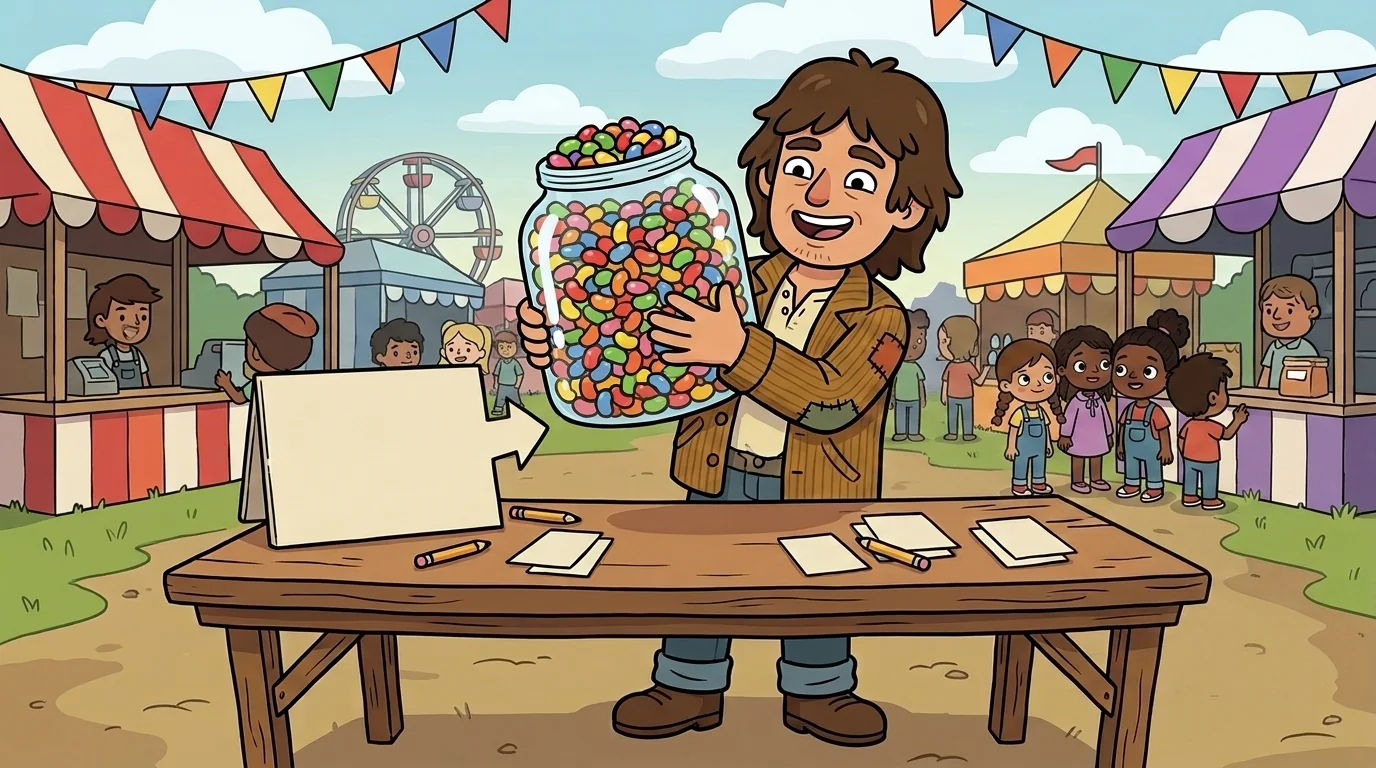
"You did," Ernie said. "You just used a real estimation technique. You broke the problem into pieces. You rounded at each step. You did it without even thinking about it."
Maya thought about that first story. The one about the jellybean jar.
"Is that what you did?" she asked. "When you were eight?"
"Exactly," Ernie said. "I looked at the jar. I figured it was about as tall as my arm from my elbow to my fingers. About 18 inches. A jellybean is about an inch long. So, 18 jellybeans stacked up. Then I looked at the bottom. It was as wide as my hand. Four jellybeans across. A layer on the bottom would be four-by-four. That's sixteen jellybeans. So, sixteen in a layer, times eighteen layers..." He paused. "That gets you to about 288. But that was for a square jar. This one was round. So I doubled it. The jellybeans were also pretty small. So I doubled it again. Then I added a little more, just for luck. And I landed on 847."
Maya’s jaw dropped. "You did all that in your head?"
"Took me about twelve seconds," Ernie said. "I was a little slow back then. I'm faster now."
Maya stared at his smiling face on the screen.
"Teach me," she said.
Estimator Ernie’s smile got even wider.
"That's what I'm here for."
And for the first time since she'd downloaded the app, Maya didn't feel scared of the ten-second timer. She felt something warmer and steadier in her chest — a little spark of I can do this. The numbers hadn't changed. She had. And that felt good.
The NumberSense ensemble
Estimator Ernie is part of NumberSense's distributed-narrative cast. Each character embodies a different curricular primitive; together they teach the full subject.
-

Pivot Pia
Deceptively casual question-flipper; reframes the prompt
-

Ratio Rio
Per-something specialist; rate thinker
-

Splitter Sasha
Make-10 and place-value specialist; benchmark builder
-

Nudge Nora
Compensation — nudge a number to a friendly round one, do the easy math, then give back exactly what you borrowed.
-

Doubler Della
Doubling and halving — to multiply, double one number and halve the other; the product stays the same while one side gets friendlier.
-

Landmark Lena
Benchmark numbers — judge any number by how it sits next to friendly landmarks like 0, a half, 10, 50, and 100.
-

Factor Fiona
Factors and multiples — every number is built from smaller numbers multiplied together, and seeing the building blocks makes hard arithmetic come apart.
-

Gap Gus
Constant difference — subtraction is the gap between two numbers; slide both the same amount and the gap stays the same, so you can land on friendly numbers.
-

Bridge Bao
Derived facts — reach a fact you don't know by taking one short step out from a fact you do.