
Nudge Nora and Gap Gus
TWO ROADS TO ONE ANSWER — a subtraction can be made friendly two different ways: nudge one number to a round one and give back the difference (compensation), OR slide both numbers the same amount so the gap is unchanged (constant difference). Both reach the exact same answer.
A story read by Nudge Nora and Gap Gus
Press play to listen along. The line being read lights up as you go.
Show full transcript
Loading transcript…
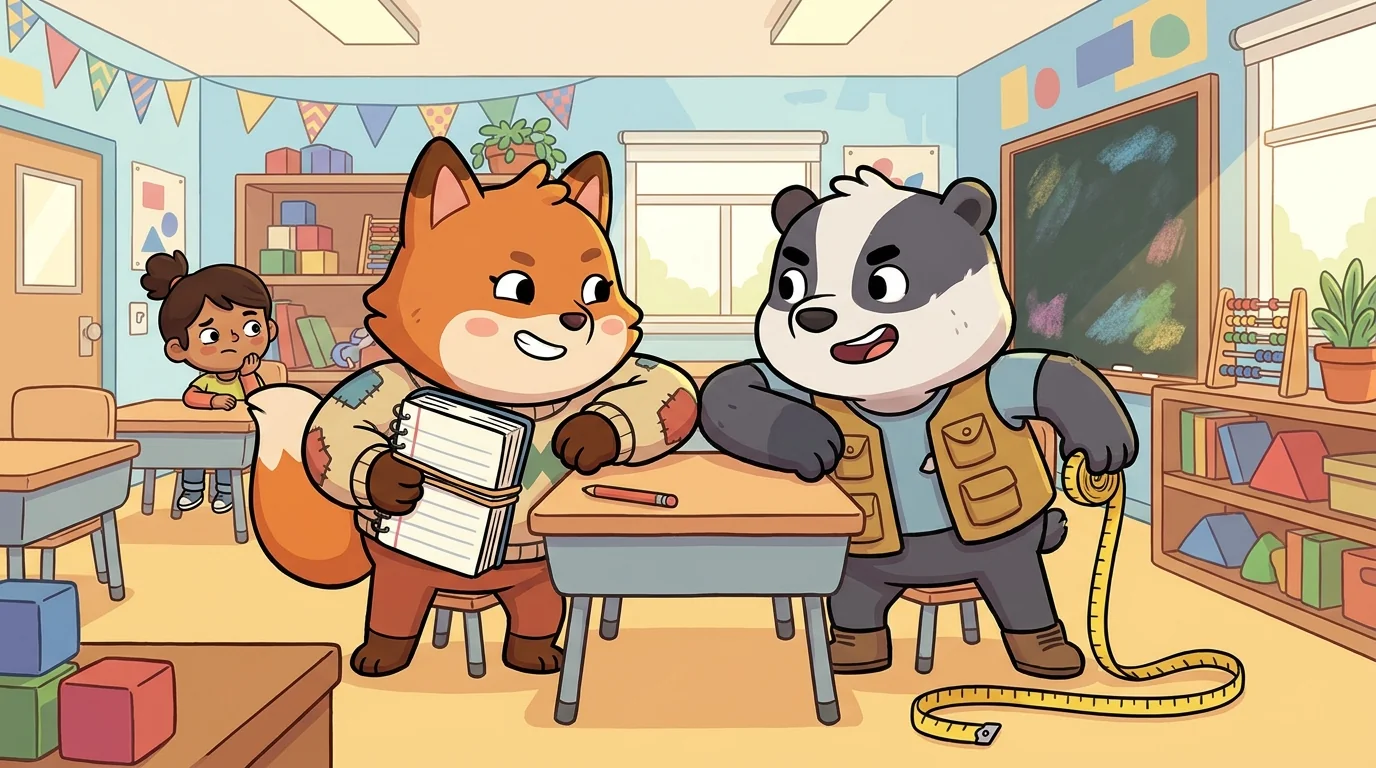
Wren had a subtraction on her screen — *72 − 38* — and before she could even sigh, two characters popped up at once, each elbowing for room.
"I've got this," said Nudge Nora, straightening her rubber-banded notebook.
"No no, this one's mine," said Gap Gus, unspooling a bit of tape measure. "It's practically begging for my trick."
They looked at each other. Wren looked at both of them.
"Are you two... fighting over my homework?" she asked.
"Friendly fighting," Nora said.
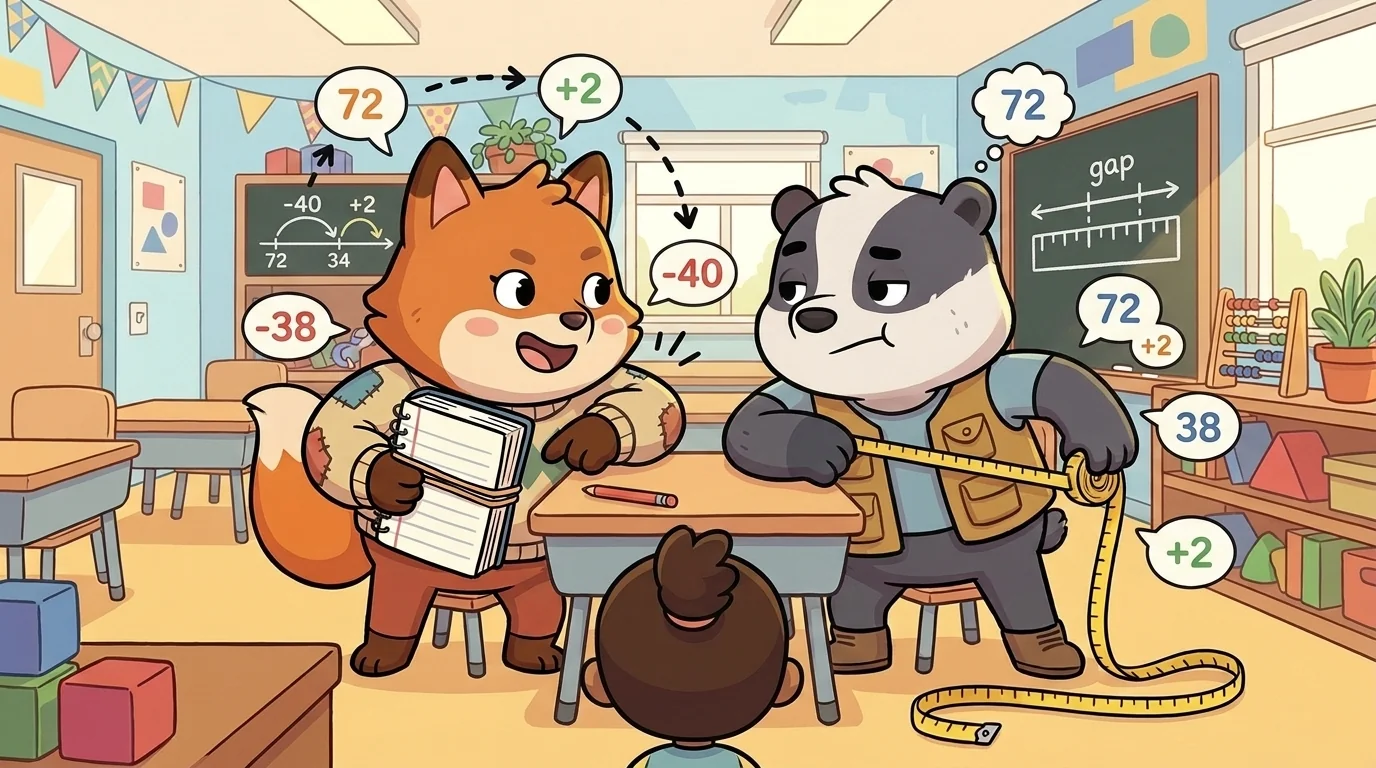
Nora went first, because she was already tapping at the air.
"My way is called nudging," she said. "Thirty-eight is so close to forty. So I borrow — I nudge it up to forty. That's two extra I've borrowed. Now the problem is easy: seventy-two minus forty is thirty-two." She held up a finger. "But I borrowed two to get there, so I have to give it back. Thirty-two plus two is thirty-four."
She closed her notebook with a soft snap. "Seventy-two minus thirty-eight is thirty-four. Two steps — nudge one number, then give back exactly what you borrowed. Tidy, honest, done."
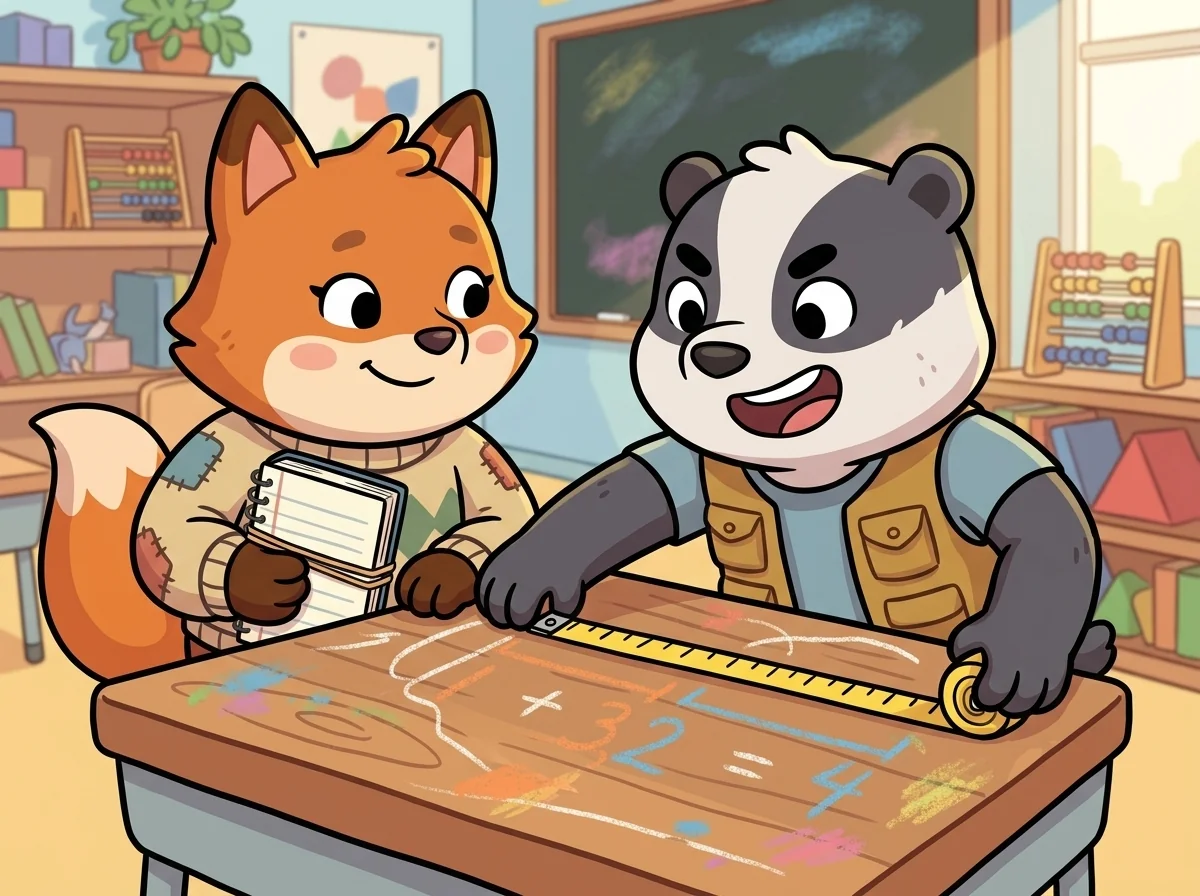
Gus laid his tape measure flat.
"My way is called keeping the gap," he said. "I don't think of this as 'take away.' I think of it as the distance from thirty-eight up to seventy-two. And here's the magic: if I slide both numbers up by the same amount, the distance between them doesn't change one bit." He nudged both ends of his tape. "Thirty-eight wants to be forty — so I slide it up by two. But I slide seventy-two up by two as well, to keep the gap the same. Now it's seventy-four minus forty."
He sat back, pleased. "Seventy-four minus forty is thirty-four. No borrowing. No give-back. I just slid the whole problem onto friendlier ground."
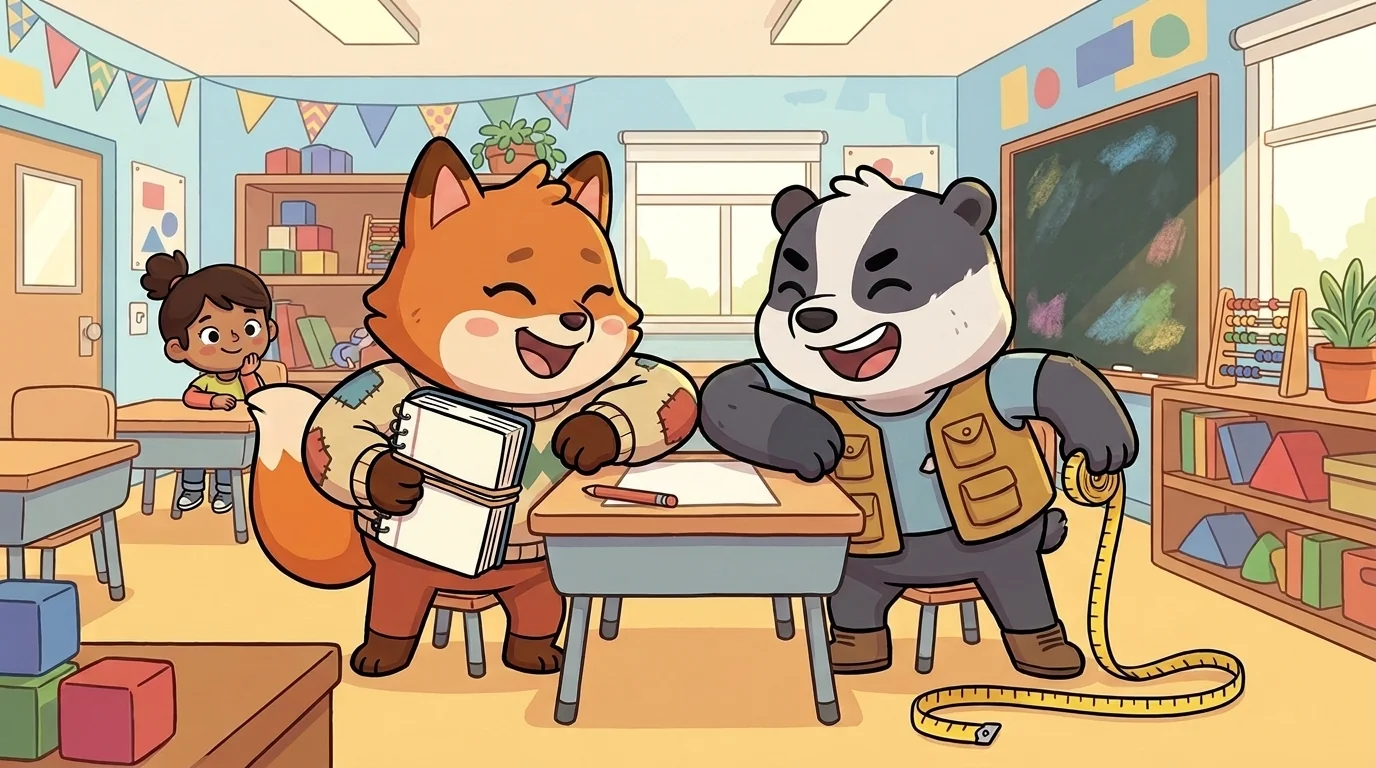
There was a short, surprised silence. Then both characters started laughing.
"Of course we did," said Nora. "It's the same subtraction. There's only one right answer. We just took different roads to it."
"That's the part people miss," said Gus, reeling in his tape. "We act like rivals, but we're really doing the same thing — making an awkward problem friendly without changing the answer. I keep the gap the same by sliding both. Nora keeps the answer the same by giving back. Different trick. Same promise: make it easier, change nothing that matters."
Wren looked back and forth between them. "So I don't have to pick the 'right' one. I just pick whichever feels easier for this problem."
"Now you've really got it," Nora said warmly. "Some days my give-back feels tidiest. Some days Gus's slide feels smoother. They're both true. They both work. The only mistake would be thinking there's just one road."
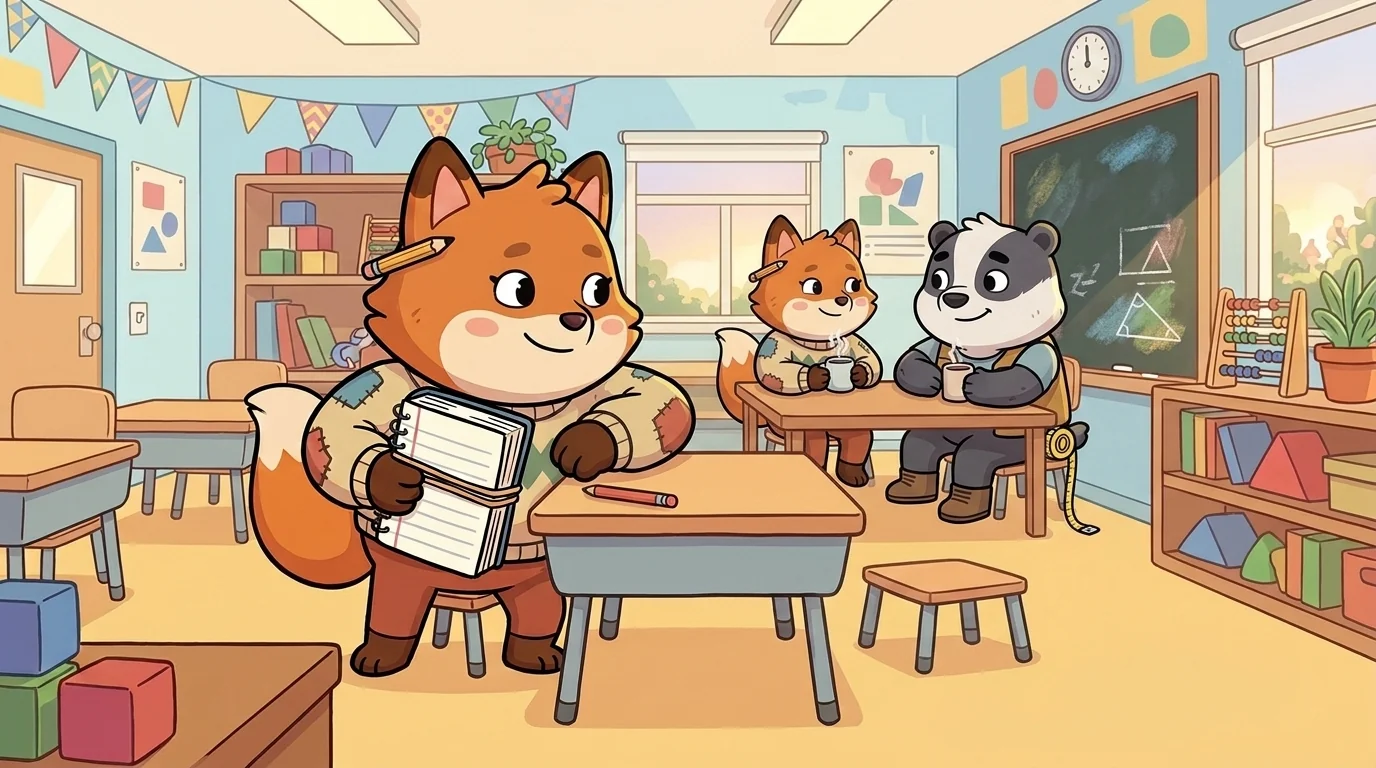
Later, after Wren had gone and the screen dimmed, Nora snapped the band around her notebook and Gus clipped his tape to his belt, and the two old friends sat in comfortable quiet.
"You know," Gus said, "for two people who argue this much, we agree on an awful lot."
"We agree on everything that matters," said Nora. "We just like the arguing."
The NumberSense ensemble
Nudge Nora and Gap Gus is part of NumberSense's distributed-narrative cast. Each character embodies a different curricular primitive; together they teach the full subject.
-

Estimator Ernie
Confidently approximate; the first-guess advocate
-

Pivot Pia
Deceptively casual question-flipper; reframes the prompt
-

Ratio Rio
Per-something specialist; rate thinker
-

Splitter Sasha
Make-10 and place-value specialist; benchmark builder
-

Nudge Nora
Compensation — nudge a number to a friendly round one, do the easy math, then give back exactly what you borrowed.
-

Doubler Della
Doubling and halving — to multiply, double one number and halve the other; the product stays the same while one side gets friendlier.
-

Landmark Lena
Benchmark numbers — judge any number by how it sits next to friendly landmarks like 0, a half, 10, 50, and 100.
-

Factor Fiona
Factors and multiples — every number is built from smaller numbers multiplied together, and seeing the building blocks makes hard arithmetic come apart.
-

Gap Gus
Constant difference — subtraction is the gap between two numbers; slide both the same amount and the gap stays the same, so you can land on friendly numbers.
-

Bridge Bao
Derived facts — reach a fact you don't know by taking one short step out from a fact you do.