Ratio Rio
proportional reasoning — thinking in ratios, rates, and per-one units
Loading audio…
Press play to listen along. The line being read lights up as you go.
Show full transcript
Loading transcript…
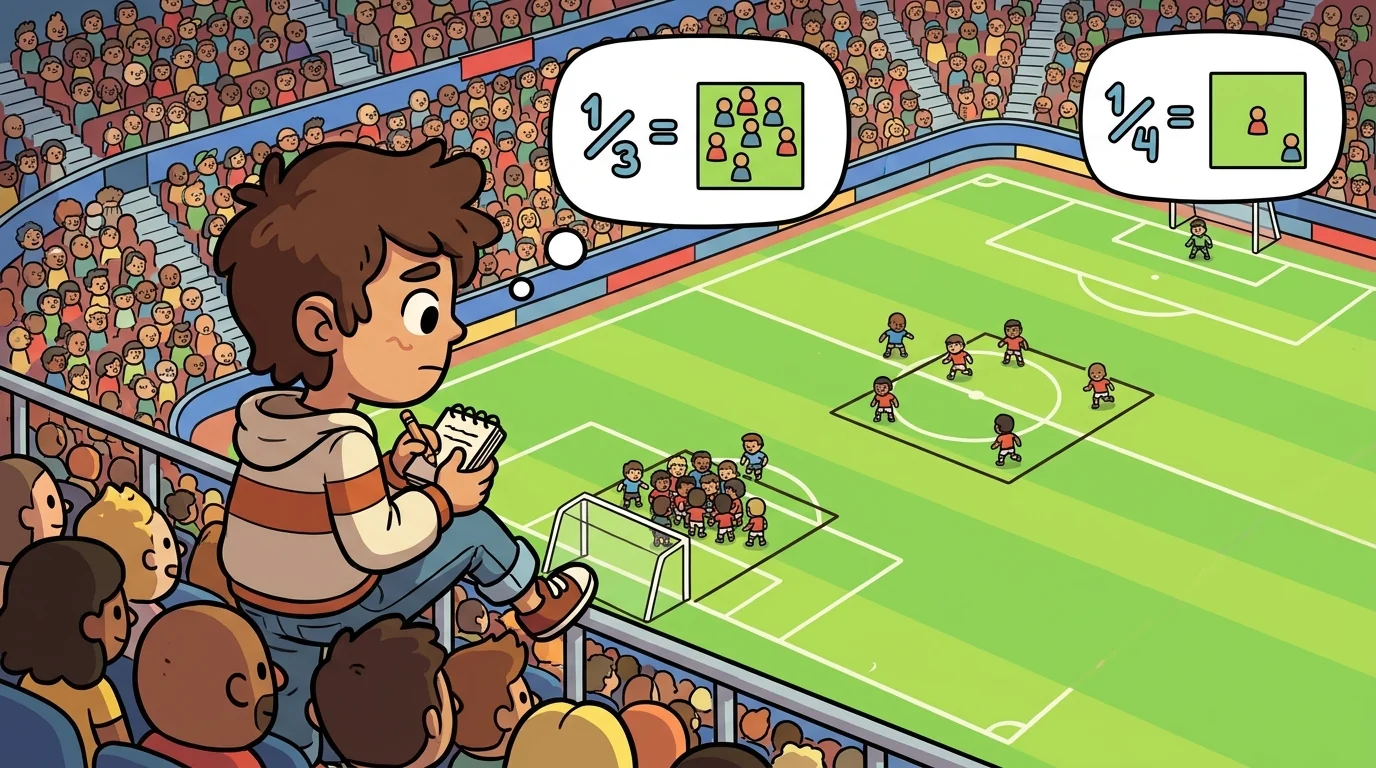
Ratio Rio loved soccer.
This was not unusual. Plenty of people love soccer. But Rio watched the game differently than anyone else. He didn't watch for the thrilling goals. He ignored the acrobatic saves by the goalie. He didn't care about team rivalries or which superstar player had the coolest haircut.
Ratio Rio watched soccer for the ratios. He had been doing it since he was eleven.
"It all started when I was eleven," he told Maya one afternoon. She had just groaned about a tricky ratio problem. "My big brother took me to my first real pro game. The noise of the crowd was huge. I sat way up in the stands, just watching. And after about ten minutes, I noticed something weird. The players weren't just running around. They were moving in clumps."
He leaned forward. "There were tight clumps near the ball. Then there were looser groups far away from it. The clumps had different densities. Near the goal, you'd see way more attackers packed into one little square of grass."
"Per square of grass?" Maya repeated.
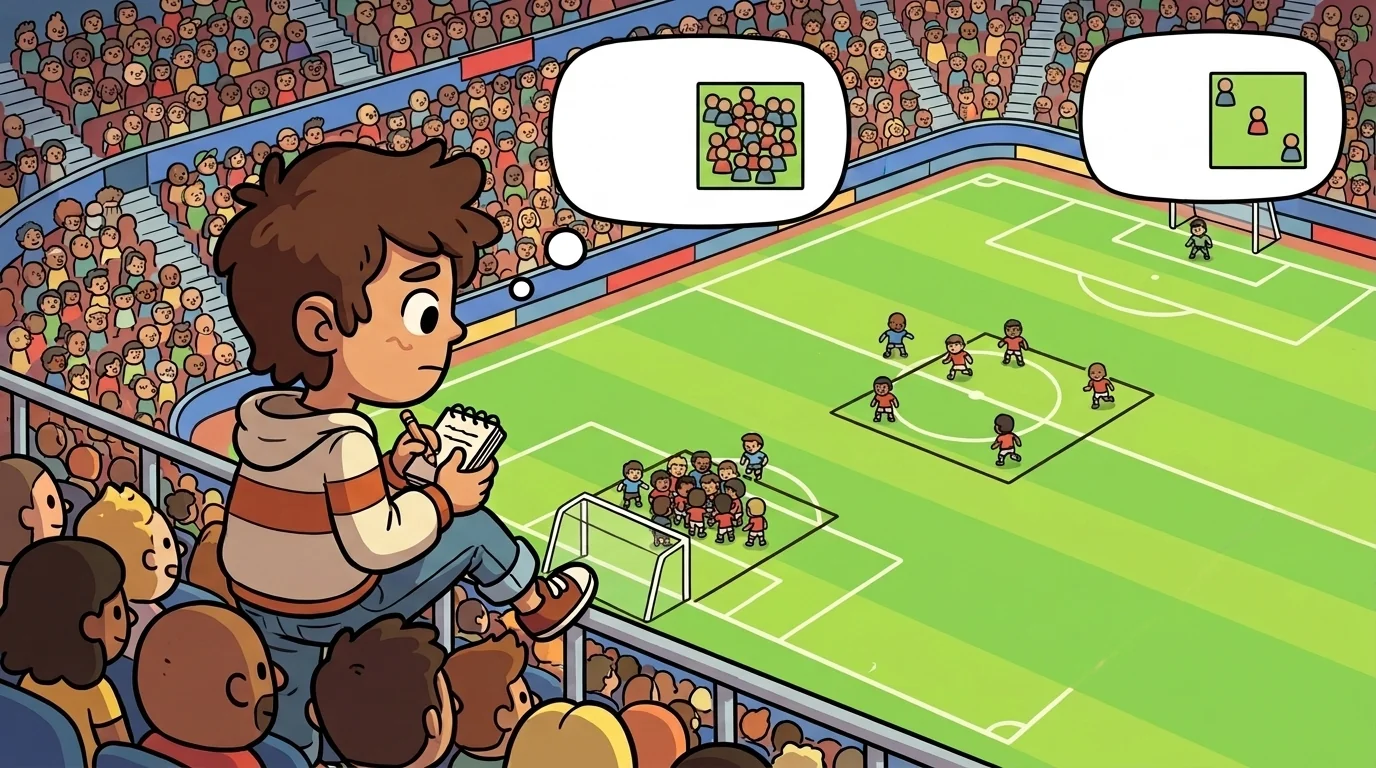
"Exactly. I started counting in my head. In the middle of the field, maybe three players per ten-by-ten-foot square. But near the goal, there were six players in the same size area. Sometimes more. The DENSITY of players was a ratio. It was players per area. The whole game became a slow, shifting pattern of densities. I never watched soccer the same way again."
Maya, who was ten and thought soccer was just okay, frowned.
"That sounds kind of boring."
"It's the most exciting thing in the world!" Rio said. "The whole game is a flow of ratios. When the density of attackers near the goal goes up, the goalkeeper's job is to raise the density of DEFENDERS to match. When the attackers spread out, the defenders spread out. Every single moment is two ratios trying to balance each other. If you watch enough, you can feel when a team is about to score. The attacker-density rises, but the defender-density isn't rising fast enough. You can see the goal coming."
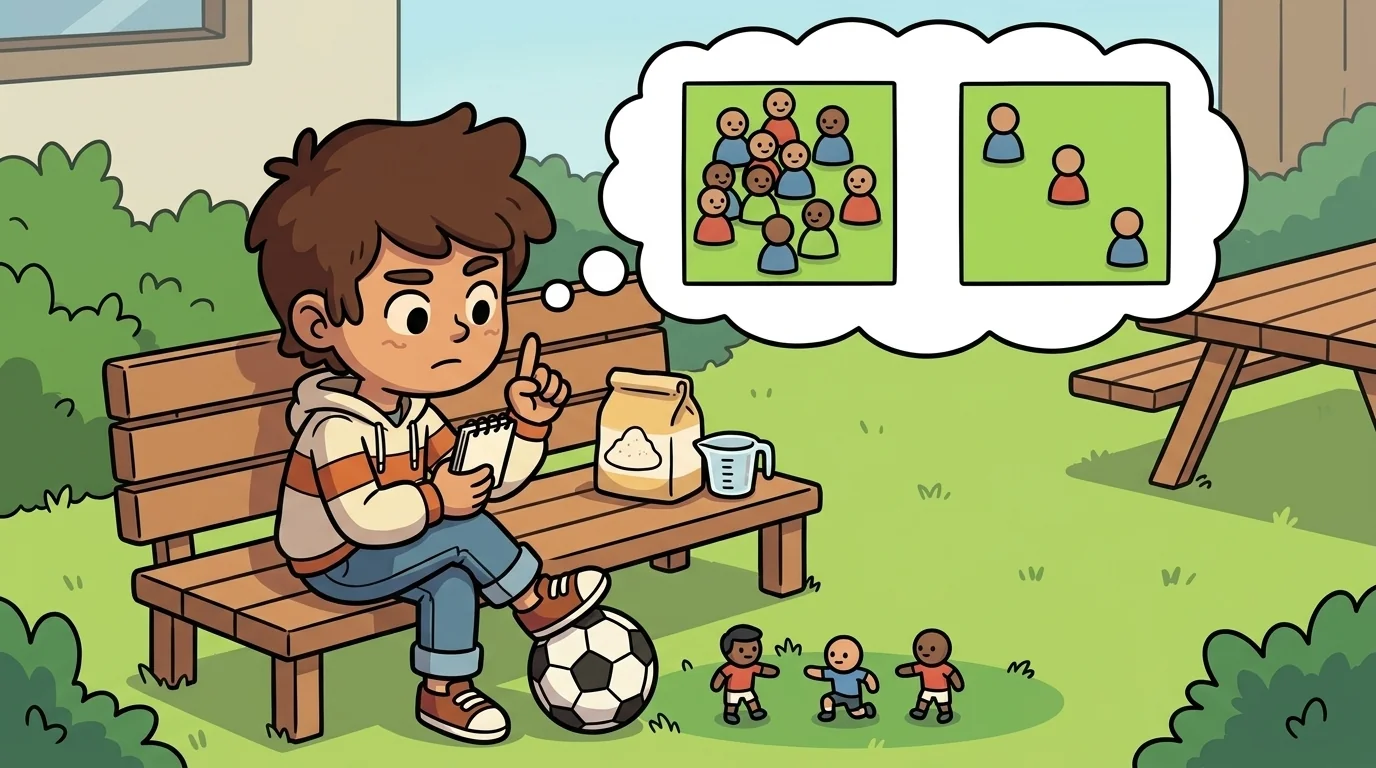
Maya thought about this.
"You really watch the whole game like that?"
"Always. Every game. I don't know how to watch it any other way now."
"What about the actual players?"
"They're just flowing dots," Rio said with a shrug. "They flow in ratios. The ratios are the real game."
Maya was stuck on a NumberSense problem. It was one of the ten-second estimates. A recipe makes 12 cookies and uses 2 cups of flour. How many cups of flour for 30 cookies?
She had tried to set up a proportion in her head. She tried to cross-multiply. But she ran out of time. Every single time.
"Stop trying to set up big, formal proportions," Rio told her gently. She had just thrown her hands up in defeat. "You don't have time for that. The estimate phase wants you to feel the ratio. Just ask yourself one simple question." He held up a finger. "How many of THIS for one of THAT? Then you just multiply or divide. That's the whole trick."
"That doesn't feel like real math."
"It IS real math. It's the secret, faster version of cross-multiplication. Watch. 12 cookies for 2 cups of flour. So, how many cookies for ONE cup of flour?"
"Six," Maya said.

"Right. Six cookies per one cup. That's your rate. Now you want 30 cookies. How many cups do you need?"
Maya thought. "Thirty cookies... divided by six cookies per cup... is five cups."
"You did it!" Rio grinned. "In your head. In about three seconds. No messy proportions. Just per-one thinking."
Maya tried it on the next problem.
8 markers cost 12 dollars. How much for 5 markers?
She thought: Okay. 8 markers for $12. How much for ONE marker? Twelve dollars divided by eight markers was $1.50 per marker. So, 5 markers would be 5 times $1.50. That's $7.50.
She typed in 7.50.
The screen flashed green. Correct.
She had solved it in four seconds.
"That was fast," she said, surprised.
"Per-one thinking is the fastest way," Rio said. "Always. You find the 'per-one' amount first. Then you can find any other amount easily. Most grown-ups can't even do this. They still pull out paper and pencil to cross-multiply. You're already way ahead of them."
Maya started practicing per-one thinking in the real world.
When her family went out for pizza, the bill came. Before her dad could open his calculator app, she would estimate how much each person owed. Her dad was usually pretty impressed.
On family hikes, her mom might say, "We've walked half a mile in fifteen minutes." Maya would quickly figure out their per-mile time. Then she'd estimate how much longer the whole hike would take. She got good at it.
She used it grocery shopping. Two pounds of grapes for six dollars meant three dollars per pound. Four cans of soup for twelve dollars was three dollars per can. She compared the per-unit prices on the shelf tags to find the best deal. Her mom started asking for her help.
Rio was delighted whenever she shared one of these stories.
"That's the whole point," he said. "The goal isn't just to solve ratio problems on a screen. It's to see ratios hiding all over the world. Once you see them, they're everywhere. And once they're everywhere, they get easier."
He paused, a twinkle in his eye.
"Also," he added, "now you can watch soccer the right way."
"I still don't really care about soccer," Maya said.
"That's okay. You can watch any sport this way. Basketball, hockey, you name it. The density patterns are in any game where players move on a field. They're in board games. They're definitely in traffic jams. They're in flocks of birds and schools of fish. Per-one thinking lets you see the secret structure underneath it all."
Maya thought about that for a long time.
She did not start watching soccer.

But on the drive home from school, she did start noticing the traffic patterns. She saw how the cars bunched up at red lights and spread out on the open road.
Which was, Rio thought when she told him, a perfectly fine place to start.
About Ratio Rio
Rio is warm, practical, and a little obsessed with soccer. But he doesn't watch it for the goals. He watches for the patterns, the secret math hiding on the field. He believes the fastest way to solve any ratio problem is with per-one thinking. It's a trick most adults never learn. He gets super excited when he hears about kids spotting ratios out in the real world.
He often says things like: - "It's just cross-multiplication, but all in your head, with no messy symbols." - "Per-one thinking is the fastest way. Always." - "Just ask: how many of THIS for one of THAT?" - "Once you learn to see ratios, they're everywhere. And that makes them easier." - "The density of attackers was rising. I could see the goal coming a mile away."
Maya's Big Year with Ratios
- At the start: Maya tries to solve ratio problems the slow, school way. She keeps running out of time. Ugh. - A week later: She tries Rio's per-one thinking for the first time. It actually works! - One month in: At a restaurant, Maya figures out how to split the bill in her head. She beats her dad's calculator app. - Three months in: Maya helps her mom find the best deals at the grocery store by comparing prices. - Six months in: Stuck in traffic, Maya suddenly notices the patterns, just like Rio's soccer players. - By the end of the year: Maya is so good at per-one thinking that she teaches the trick to a friend.
Rio's Friends
- Estimator Ernie: Ernie and Rio are a great team. Ernie likes to solve problems one step at a time. Rio's ratio-thinking is often one of those key steps. They see the same problem from different angles. - Splitter Sasha: Sasha is an expert at breaking down big numbers into smaller, friendlier pieces. Rio does the same thing with ratios. They're always borrowing each other's best tricks. - Pivot Pia: Pia and Rio have a friendly rivalry. Pia is amazing at looking at a problem and flipping it around to find a new way in. Rio does the same thing, turning confusing ratios into simple "per-one" units.
A Note from the Team
We gave Ratio Rio his special way of watching soccer for a reason. It's easier to understand a math idea when you can see it in the real world. Watching players get crowded on a field is a great way to start seeing what a ratio really is. From there, it's a short hop to seeing them with numbers.
Most grown-ups were taught to solve ratio problems with a complicated method called cross-multiplication. It works, but it's slow and you need paper. Rio teaches per-one thinking instead. It's a faster, simpler way that you can do in your head. Our goal is for you to get really good at this powerful trick. It will help you with more than just math class.
The NumberSense ensemble
Ratio Rio is part of NumberSense's distributed-narrative cast. Each character embodies a different curricular primitive; together they teach the full subject.
-

Estimator Ernie
Confidently approximate; the first-guess advocate
-

Pivot Pia
Deceptively casual question-flipper; reframes the prompt
-

Splitter Sasha
Make-10 and place-value specialist; benchmark builder
-

Nudge Nora
Compensation — nudge a number to a friendly round one, do the easy math, then give back exactly what you borrowed.
-

Doubler Della
Doubling and halving — to multiply, double one number and halve the other; the product stays the same while one side gets friendlier.
-

Landmark Lena
Benchmark numbers — judge any number by how it sits next to friendly landmarks like 0, a half, 10, 50, and 100.
-

Factor Fiona
Factors and multiples — every number is built from smaller numbers multiplied together, and seeing the building blocks makes hard arithmetic come apart.
-

Gap Gus
Constant difference — subtraction is the gap between two numbers; slide both the same amount and the gap stays the same, so you can land on friendly numbers.
-

Bridge Bao
Derived facts — reach a fact you don't know by taking one short step out from a fact you do.