
Ratio Rio
proportional reasoning — thinking in ratios, rates, and per-one units
Loading audio…
Press play to listen along. The line being read lights up as you go.
Show full transcript
Loading transcript…
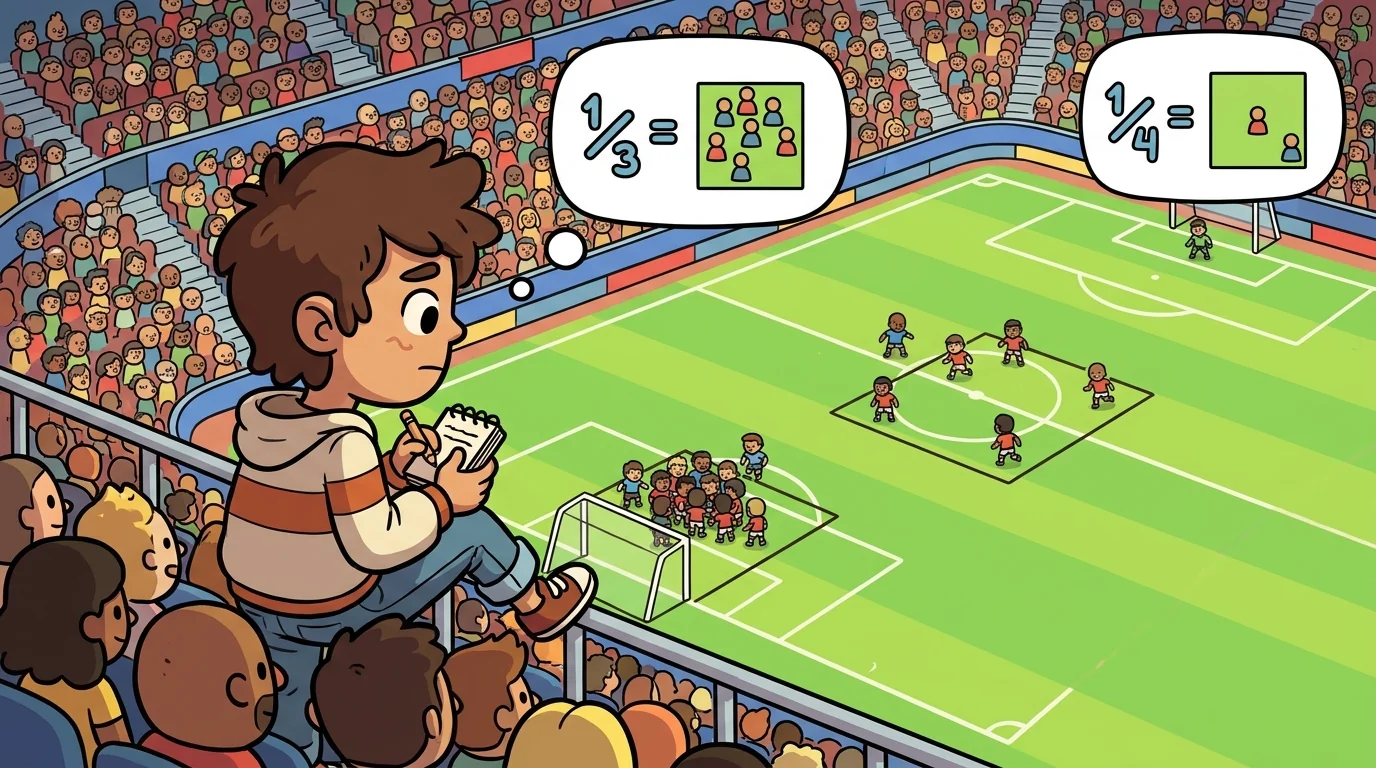
Ratio Rio had been eleven when soccer broke open for him.
His older brother Dele had taken him to his first professional game. They had driven into the city. They had taken the train to the stadium. They had eaten hot dogs in their seats. Rio had not understood much about soccer at that point — he had played a little in his backyard, he had watched a few games on TV, he had a vague sense of the rules — but he had been thrilled to be there with Dele.
The game had started.
For the first ten minutes, Rio had watched the way every kid watches a soccer game. He had followed the ball. He had cheered when his team's player had it. He had groaned when the other team got it. He had been bored when the play moved to the far end of the field.
And then, somewhere around the eleventh minute, something had changed.
He had not been able to explain it later. He had just suddenly seen the game differently. He had noticed, with a sudden clarity that was almost physical, that the players were not chasing the ball at random. They were arranging themselves into shapes. There were attackers in clumps. Defenders in lines. The clumps and lines had spacing — more dense in some places, less dense in others — and the spacing was changing all the time.
He had stopped following the ball.
He had started watching the spacing.
The spacing had been beautiful.
When the ball went near the goal, the attackers compressed. The defenders compressed too, but slower. There was a moment of mismatched density — attackers tight, defenders still loose — and in that moment a goal almost happened. The goal didn't happen because the defenders caught up. But Rio had seen it coming, and he had not understood how, until he realized: he had seen the density mismatch. The density mismatch was the goal-about-to-happen. The defenders catching up was the goal-not-happening.
He had spent the rest of the game watching the dance of densities.
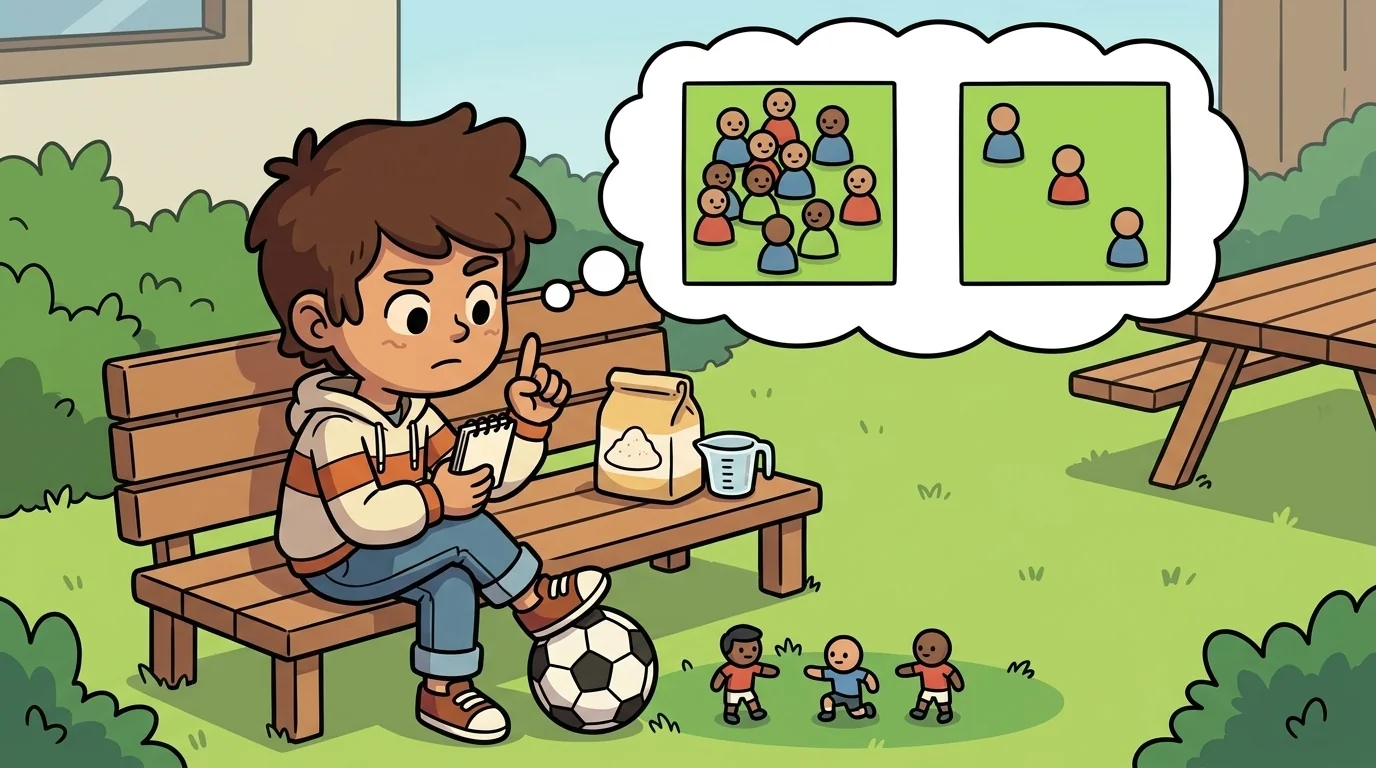
He had been quiet on the train home. Dele had asked him if he had enjoyed the game.
He had said, "I think I figured something out."
Dele had said, "About soccer?"
He had said, "About numbers, maybe."
Dele had not understood. Dele had said, "You're a weird kid, Rio."
Rio had agreed.
Twenty years later, when Maya asked him what had happened, Rio had told her this story.
Maya was fourteen. She had been using the NumberSense app for two years. She had become fluent in per-one thinking. She had started, over the past several months, to notice ratios in everyday life — gas mileage, recipe scaling, currency conversion, batting averages, hourly wages — with an automaticness that had begun to feel like seeing.
"It feels like I see the world differently now," she had told Rio.
"You do," Rio had said.
"Is that because of you?"
"Partly. Partly because of you. The habit takes installing, and I help install it. But you had to do the installing yourself. I just provided the tools."

"Is that what happened to you with soccer?"
Rio had been quiet for a moment.
"The same thing, kind of. Different sport. Different age. Same kind of click. The world stopped being random and started being structured. The structure was ratios. Everywhere I looked, ratios."
Maya had said: "Tell me what you started seeing after the soccer game."
Rio had laughed.
"Everything," he had said. "I started seeing density patterns at the grocery store. I started seeing rates in the kitchen — how long pasta took per pound, how much oil per egg in a recipe. I started seeing per-unit prices everywhere. I started noticing that my dad's job paid him per hour, and that this was a rate, and that the rate could be compared to other rates. I noticed that my mom's car had a mileage rate. I noticed that water came out of the kitchen tap at a rate. I noticed that my own pulse was a rate. I noticed that days had a rate of going by — different in summer than in school. I noticed that traffic on the highway had a rate, and the rate changed, and the change in the rate was itself a rate."
"That sounds overwhelming."
"It was, at first. It was a lot to see all at once. I had to learn to turn the noticing off. Now I turn it on when I need it and off when I don't. But the structure is always there. The structure is always ratios. Even when I'm not looking at them, I know they're there."
What Rio did not tell Maya, not for several more conversations, was that his brother Dele had died when Rio was sixteen.
Dele had been a careful driver. Dele had been on his way home from work. Another car had crossed the median. The crash had been quick. Dele had not lived through the night.
Rio had been at school when it happened. He had come home to a house that was not yet quiet but was about to be.
He had spent the months after that doing two things, mostly. He had been very sad. And he had been watching the world for ratios. He had not understood, at sixteen, why these two activities were happening at the same time. He had only understood, much later, that the ratio-noticing had been a kind of way of staying connected to Dele. The ratios had been the thing Rio had figured out the day of his first soccer game. The figuring-out had been the thing he had been quiet about on the train home. Dele had teased him for being a weird kid. The teasing had been kind. The kindness had been the part Rio could not let go of.
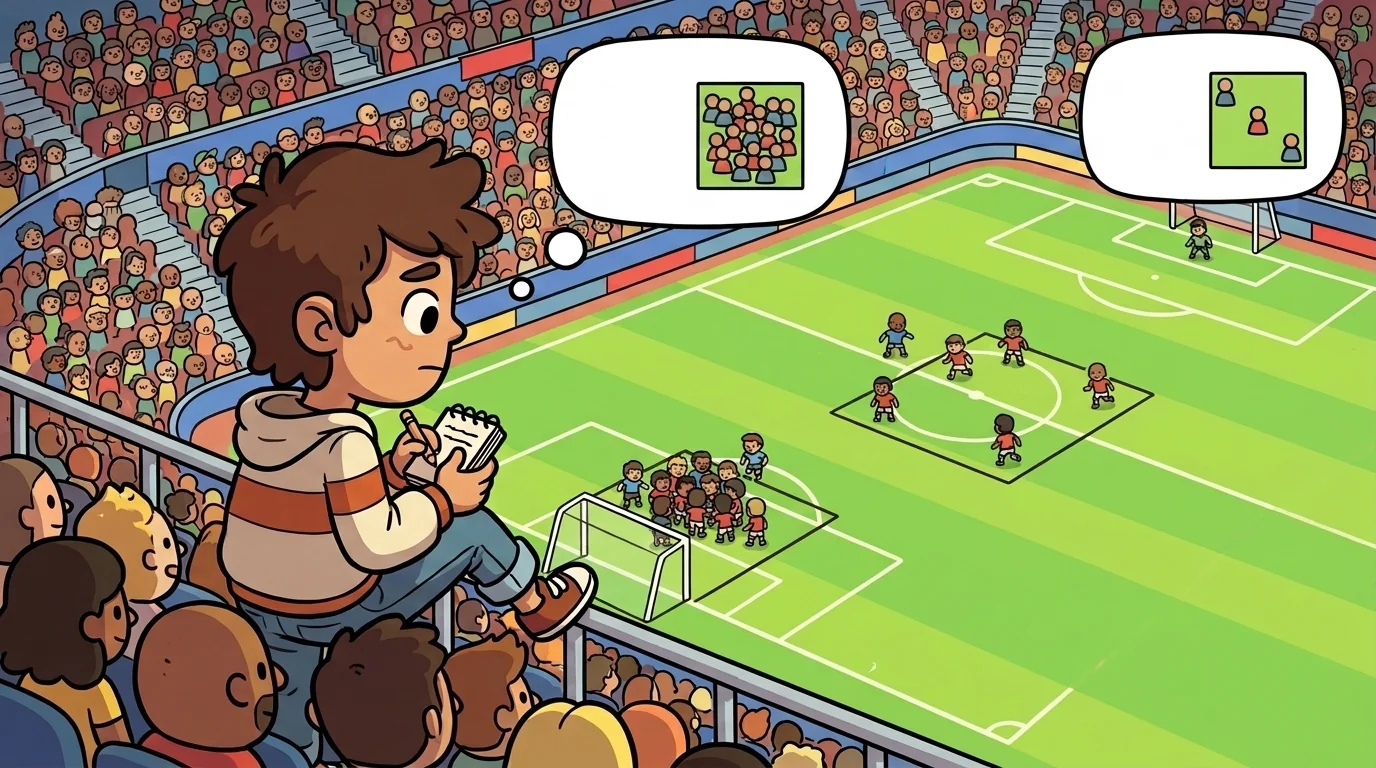
So Rio had kept watching for ratios.
He had become, in his twenties, a person who taught number sense to kids for a living.
He had become, in his thirties, the voice in the NumberSense app who told kids that ratios were everywhere and per-one thinking was the fastest way through them.
He had taught thousands of kids the habit by now.
Every time a kid told him they had started seeing ratios in the world — every time a kid said something like "I noticed traffic has a rate now" or "I figured out the per-unit price at the grocery store" or "I estimated dinner correctly without using my phone" — Rio thought of Dele. He did not always say so. He almost never said so. But he thought of Dele every time.
The teaching, he had decided, was a kind of long thank-you. The thank-you was to a brother who had taken him to a soccer game one Saturday and made him into the person who saw the world this way.
Maya, in her last year of using the app every day — she was fifteen, she was about to start high school, the daily prompts were beginning to feel a little too easy — asked Rio one afternoon: "Why do you teach this?"
Rio had thought about it. He had thought about it for a long time. The silence had stretched longer than usual. Maya had known by then that Rio's silences usually meant a real answer was coming, so she had waited.
Finally, Rio had said: "I teach this because someone took me to a soccer game when I was eleven. And the world cracked open for me. And the person who took me died five years later, and the cracking-open is what I still have of him. Every kid who learns to see ratios is another room of him that's not gone. I don't know how to explain it better than that."
Maya had been quiet for a long time.
She had not known what to say.
She had finally said: "What was his name?"

"Dele."
"I'm sorry."
"Thank you."
"I'll think of him sometimes. When I notice a ratio."
Rio had nodded. Slowly.
"That's the whole job," he had said. "That's what it ever was."
He had faded.
Maya had sat at the kitchen table for a long time, not saying anything.
She had noticed, on the way home, that the leaves on the trees outside were falling at a rate. The rate was different on different trees. She had thought about Dele. She had not known him. She had thought about him anyway. That was, she realized, how lineages worked when they were good ones. You thought of people you had never met because someone you cared about had cared about them first.
She had walked home.
The leaves had kept falling.
She had counted, briefly, in her head. And as she counted, she felt a soft, aching kind of gladness — a little sad, a little warm, both at once. She was holding a person she had never met, gently, in the middle of an ordinary afternoon. It felt, she thought, like the best thing a number had ever done for her.
The NumberSense ensemble
Ratio Rio is part of NumberSense's distributed-narrative cast. Each character embodies a different curricular primitive; together they teach the full subject.
-

Estimator Ernie
Confidently approximate; the first-guess advocate
-

Pivot Pia
Deceptively casual question-flipper; reframes the prompt
-

Splitter Sasha
Make-10 and place-value specialist; benchmark builder
-

Nudge Nora
Compensation — nudge a number to a friendly round one, do the easy math, then give back exactly what you borrowed.
-

Doubler Della
Doubling and halving — to multiply, double one number and halve the other; the product stays the same while one side gets friendlier.
-

Landmark Lena
Benchmark numbers — judge any number by how it sits next to friendly landmarks like 0, a half, 10, 50, and 100.
-

Factor Fiona
Factors and multiples — every number is built from smaller numbers multiplied together, and seeing the building blocks makes hard arithmetic come apart.
-

Gap Gus
Constant difference — subtraction is the gap between two numbers; slide both the same amount and the gap stays the same, so you can land on friendly numbers.
-

Bridge Bao
Derived facts — reach a fact you don't know by taking one short step out from a fact you do.