
Estimator Ernie
gut-feel estimation — guessing first then computing
Loading audio…
Press play to listen along. The line being read lights up as you go.
Show full transcript
Loading transcript…

Estimator Ernie had not always been confident.
When he was eleven, he had been one of the worst kids in his class at math. He had not been bad at math because he was unintelligent — he had not been unintelligent, his teachers had agreed about that — he had been bad at math because he was slow at arithmetic. He had counted on his fingers longer than most kids did. He had been slow at multiplication tables. He had been slow at long division. The other kids in his class had finished worksheets before he had finished half. He had been called slow so often that he had started believing it.
He had been twelve when his uncle had taken him to a baseball game.
The stadium had been enormous. Ernie had never been in a place that big before. He had sat in his seat and looked around at the stands and at the field and at the crowd, and he had said, mostly to himself, "There must be a million people here."
His uncle had laughed. His uncle had been a kind man who had not laughed in a mean way.
"A million is a lot of people," his uncle had said. "Let me show you something."
His uncle had taken out a pencil.
He had said: "Look around. The stands are made of rows. How many rows do you see in your section?"
Ernie had counted. Maybe forty.
"And each row has seats. How many seats per row in your section?"
Ernie had counted one row. About thirty.
"So how many seats in your section?"
Ernie had thought. Forty times thirty was — he wasn't sure. He thought it was around twelve hundred.
"That's right. About 1,200. Now look around. How many sections like ours are there in this stadium?"
Ernie had looked. He had counted the lower bowl. About thirty sections. Then the upper deck — another thirty maybe.
"About sixty sections, then. So how many seats total?"
Sixty times 1,200. Ernie had thought hard. That was 72,000.
"That's about right. The actual capacity of this stadium is 56,000. You overestimated, because the sections in the upper deck are smaller than the sections in the lower bowl. But you got within a factor of two."
"That's not very close."
"That is extremely close. You estimated the population of a stadium, in about ninety seconds, in your head, without using a single multiplication table. You are not bad at math. You are slow at arithmetic. Those are different things."
Ernie had not said anything for a long time.
His uncle had then said: "Most of the math you'll ever need in your life is estimation, not arithmetic. Arithmetic is what computers are for. Estimation is what humans are for. You're already good at the human part. The computers can do the rest."
Ernie had thought about this for the rest of the baseball game.
He had thought about it for the next twenty years.
Maya, who was thirteen and had been using the NumberSense app daily for almost a year, asked Estimator Ernie about the stadium story.
She had asked it on a Tuesday afternoon, after a particularly hard daily prompt about the number of cars in a city. She had gotten the prompt wrong — way wrong — and she had been frustrated. Estimator Ernie had appeared and asked her if she wanted him to talk her through how he would have done it. She had said yes. He had walked her through, step by step, the way his uncle had walked him through the stadium.

When he had finished, she had said: "Why aren't you bad at math anymore?"
He had laughed.
"I'm still bad at arithmetic," he had said. "I haven't gotten much faster at multiplication tables since I was twelve. What I got good at was the OTHER thing. The thing my uncle showed me. The thing that turns out to be more useful in actual life than arithmetic."
"Is that true? Is estimation more useful than arithmetic in actual life?"
"For most adults, yes. Most adults don't compute exact answers. They estimate. They estimate how much groceries will cost. They estimate how long a drive will take. They estimate how much paint to buy. They estimate whether a tip is reasonable. They estimate whether a news headline makes sense — that's a big one. They estimate whether someone is lying to them about a number. They use exact arithmetic maybe one percent of the time, and even then only for things they really care about getting right."
"What if I want to be a scientist?"
"Then you'll need both. But you'll start with estimation. Every real scientific calculation begins with a back-of-the-envelope estimate. Without the estimate, you don't know whether your exact answer is reasonable. The estimate is the sanity check on the arithmetic. The estimate is the actual thinking."
Maya thought about this.
"My math teacher doesn't talk about it that way."
"Your math teacher is teaching you arithmetic. That's a real and useful thing. But estimation has gotten left out of most school math for the last hundred years, and that's bad. I'm here because nobody else is teaching it."
He had paused.
"Do you want to try the cars-in-a-city problem again? With my method this time?"
She had said yes.
He had walked her through. They had estimated the city's population (a million people, ballpark). They had estimated how many people had cars (about half, maybe, given the city). They had multiplied. They had gotten 500,000. The actual answer was 480,000. Maya had been within 5%.

She had stared at the screen.
"That was the same problem I just got wrong by a factor of ten."
"Yes."
"Why?"
"Because the first time, you tried to remember a number you didn't actually know. The second time, you built the number from things you DID know. That's the difference between guessing and estimating. The first one is the lottery. The second one is engineering."
Maya practiced for the next year.
She practiced on real-life problems she encountered. She estimated how many words were in her math textbook. She estimated how much money her family spent on groceries each month. She estimated how many leaves were on a single tree outside her bedroom window. She estimated how long it would take her to walk to her friend's house. Sometimes her estimates were off by a lot. More and more often, they were within ten percent.
She started catching things grown-ups got wrong.
She caught her uncle saying once that a politician's claim about a budget number was off by a factor of a hundred. She caught her older brother saying a hiking trip would take six hours when, on her own estimate, it would take at least nine. She caught a news article reporting a statistic that, when she checked, was off from the underlying source by about thirty percent.
This last one — the news-article one — had been the thing Estimator Ernie had told her would happen eventually.
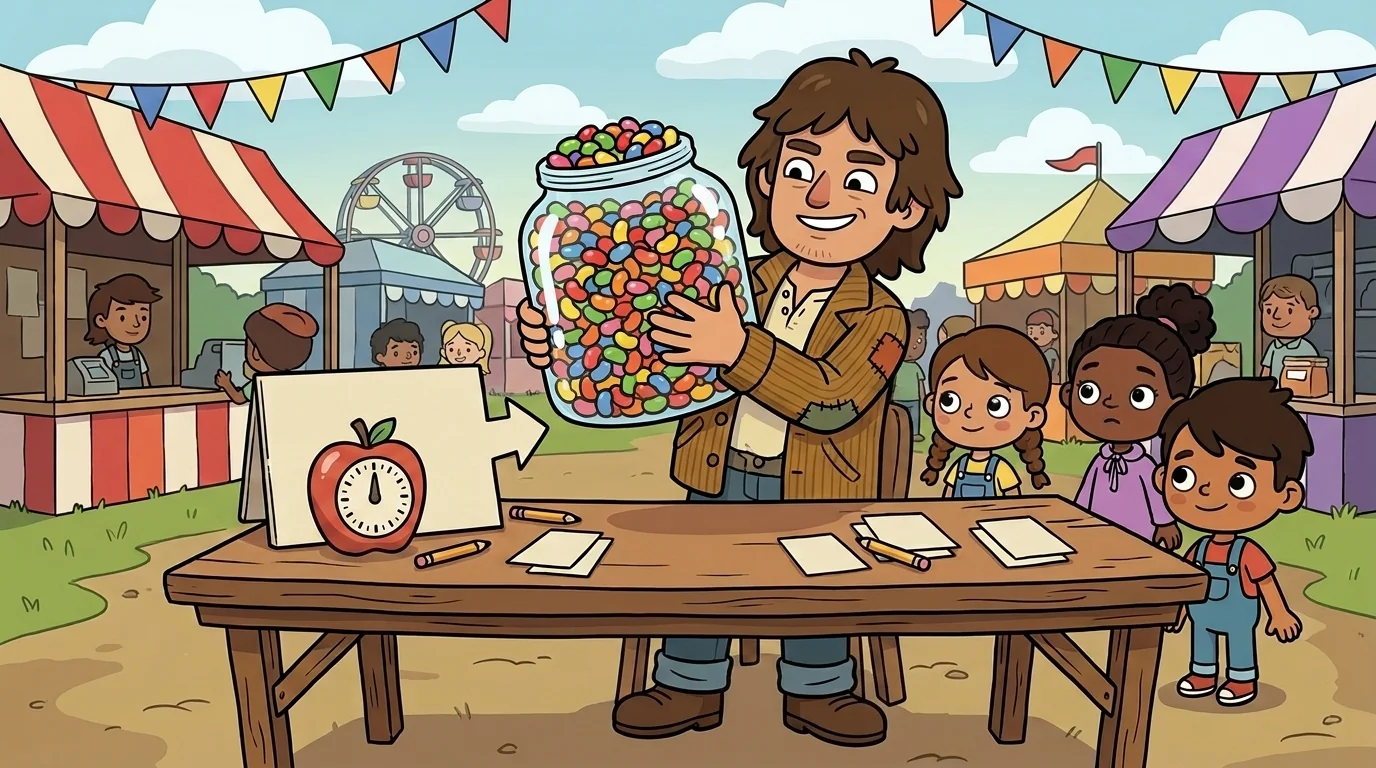
"That's the actual prize," he had said. "The prize isn't the jellybean jar. The prize isn't even getting good guesses right. The prize is being hard to lie to with numbers. The prize is being a person who notices when a number doesn't add up. Most adults aren't that person. You can be."
Maya had thought about this.
She had thought about her uncle, the kind one, who had told Ernie at twelve that he wasn't bad at math, just slow at arithmetic. She had thought about the stadium. She had thought about the jellybeans.
"Ernie," she had said.

"Yes?"
"I'm going to teach this to my younger cousin."
"Good."
"He's eight."
"Eight is a good age to start. He'll be very good at it by twelve."
"What's the first thing I should show him?"
Estimator Ernie had smiled.
"Take him to a baseball game," he had said. "Or anywhere big. A stadium, a mall, a stretch of beach. Show him how to break a big number into smaller numbers he already knows. Then multiply. Then notice that he just estimated a population in his head. Tell him he's not bad at math. Tell him he's good at the human part."
Maya had nodded.
She had taken her cousin to a baseball game that summer.
She had walked him through.
He had estimated the stadium population within a factor of two.
She had told him he was good at the human part.
He had glowed. And watching his face light up — the same relief and pride she had once felt herself, the same one Ernie had felt in a stadium thirty years before — Maya felt a quiet warmth spread through her chest. This was the feeling, she understood now. Not the right answer. This. The moment a kid stops being scared of numbers and starts feeling brave with them. She was proud to be the one passing it on.
The NumberSense ensemble
Estimator Ernie is part of NumberSense's distributed-narrative cast. Each character embodies a different curricular primitive; together they teach the full subject.
-

Pivot Pia
Deceptively casual question-flipper; reframes the prompt
-

Ratio Rio
Per-something specialist; rate thinker
-

Splitter Sasha
Make-10 and place-value specialist; benchmark builder
-

Nudge Nora
Compensation — nudge a number to a friendly round one, do the easy math, then give back exactly what you borrowed.
-

Doubler Della
Doubling and halving — to multiply, double one number and halve the other; the product stays the same while one side gets friendlier.
-

Landmark Lena
Benchmark numbers — judge any number by how it sits next to friendly landmarks like 0, a half, 10, 50, and 100.
-

Factor Fiona
Factors and multiples — every number is built from smaller numbers multiplied together, and seeing the building blocks makes hard arithmetic come apart.
-

Gap Gus
Constant difference — subtraction is the gap between two numbers; slide both the same amount and the gap stays the same, so you can land on friendly numbers.
-

Bridge Bao
Derived facts — reach a fact you don't know by taking one short step out from a fact you do.