
Lantern and Breeze
seasonal-marker pair — Lantern carries the season's image (light, festival); Breeze carries the season's movement (wind, change). Together they show that haiku has both a still picture and a moving feeling.
A story read by Lantern and Breeze
Press play to listen along. The line being read lights up as you go.
Show full transcript
Loading transcript…
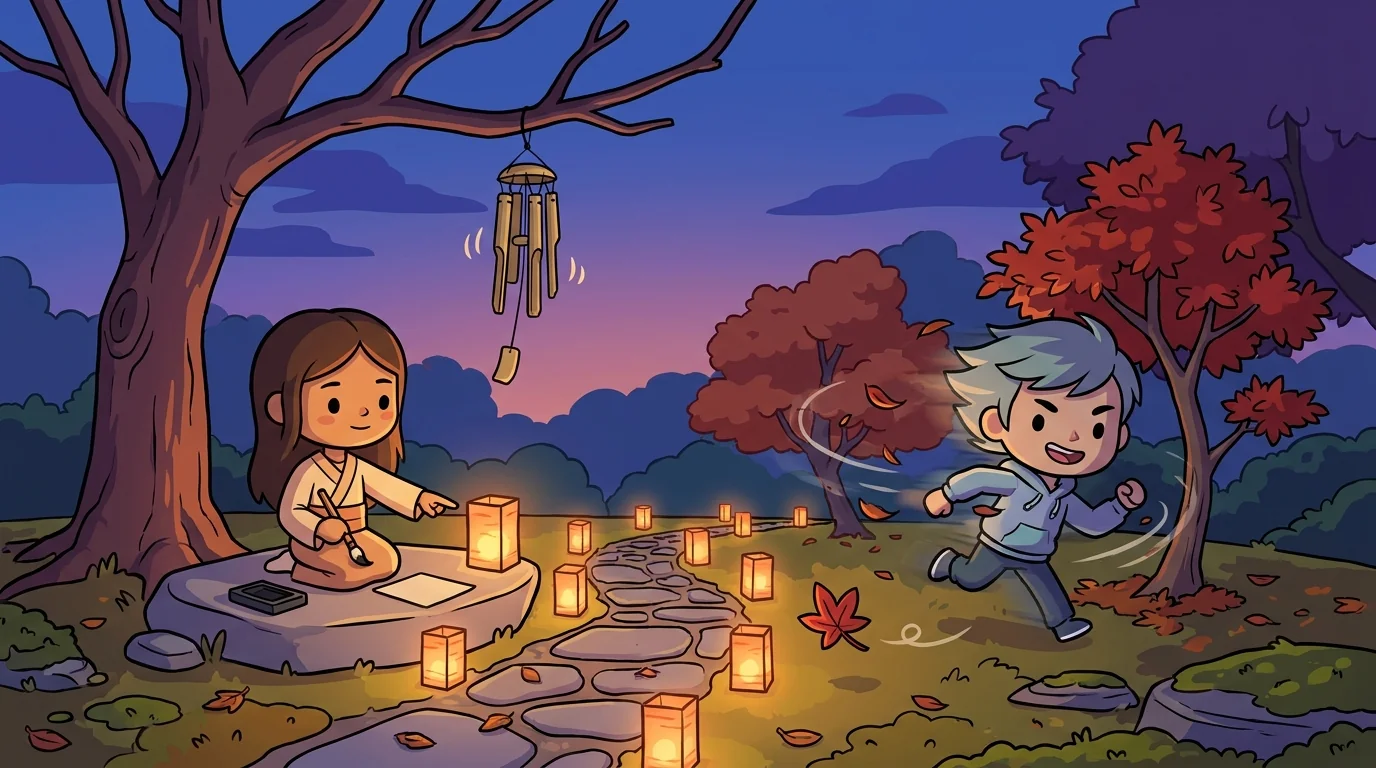
The garden was sinking into the deep blue of dusk. Along the stone path, a dozen small paper lanterns gave off a warm, steady glow. They were Lantern’s pride and joy. From the branch of a cherry tree, a set of bamboo wind chimes waited for a push. They were Breeze’s favorite toy. Lantern sat perfectly still on a smooth, flat rock, a writing brush held carefully in her fingers. Breeze, on the other hand, couldn’t stay still. He zipped from the path to the cherry tree and back again, making the chimes clink softly.
“We need a poem for tonight,” Lantern said, her voice as soft as the light she tended. “An autumn haiku.”
“I know, I know!” Breeze whispered, rustling the leaves of a small maple tree. “It should be about… whoosh! The feeling of the world getting ready to sleep! The shiver of the air!”
Lantern shook her head gently. “No, a haiku is a picture. It should be about the light. See how it pools on the moss? How it makes the shadows long and peaceful?” She pointed with her chin at one of her lanterns. “It’s a perfect, still moment.”
Breeze sighed, a puff of air that made a single red leaf spin to the ground. “Still is boring. A poem needs to move.” They had been at this for an hour, and their inkstone was still clean.
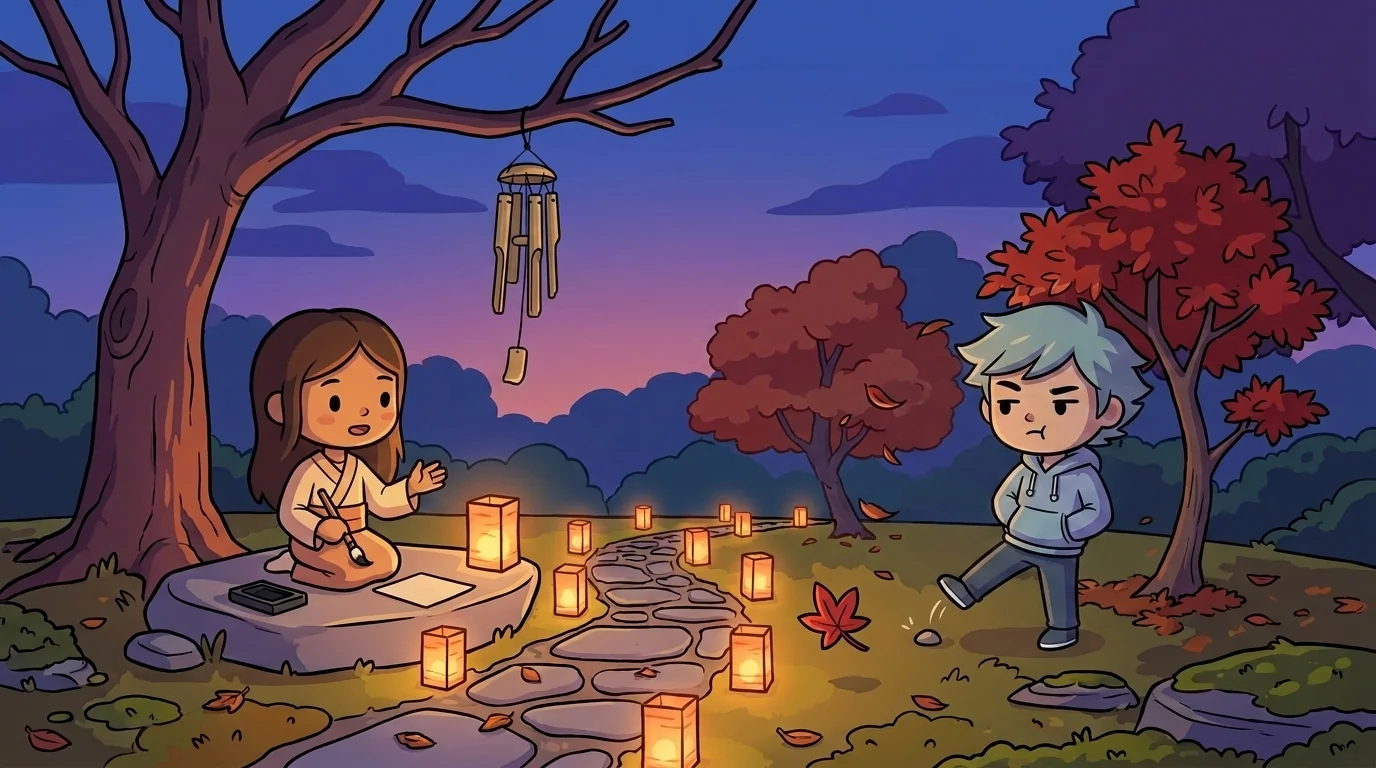
Lantern decided to show him. She closed her eyes for a moment, picturing the scene exactly as it was. The purpose of a poem, she believed, was to capture a single, perfect image, like a photograph made of words. You had to hold it completely still in your mind before you could share it.
“Okay, listen,” Lantern said calmly. “Let’s just focus on the picture. The feeling will follow.” She looked down the path, at the row of glowing paper shapes. They didn't move. They simply were. That was their magic. “How about this for a first line: Warm paper lanterns...”
She paused, letting the words hang in the quiet air. It was a good start. It painted the main subject. It had five syllables. Anyone hearing that line could picture it instantly. It was clear and calm, a small island of light in the growing darkness.
“...glow along the path,” she finished, imagining the rest of the poem. It would be about the stillness, about the way the light held back the night. It would be a poem about peace. She looked over at Breeze, expecting him to see the beauty in it. But he was just kicking at a pebble, looking impatient.
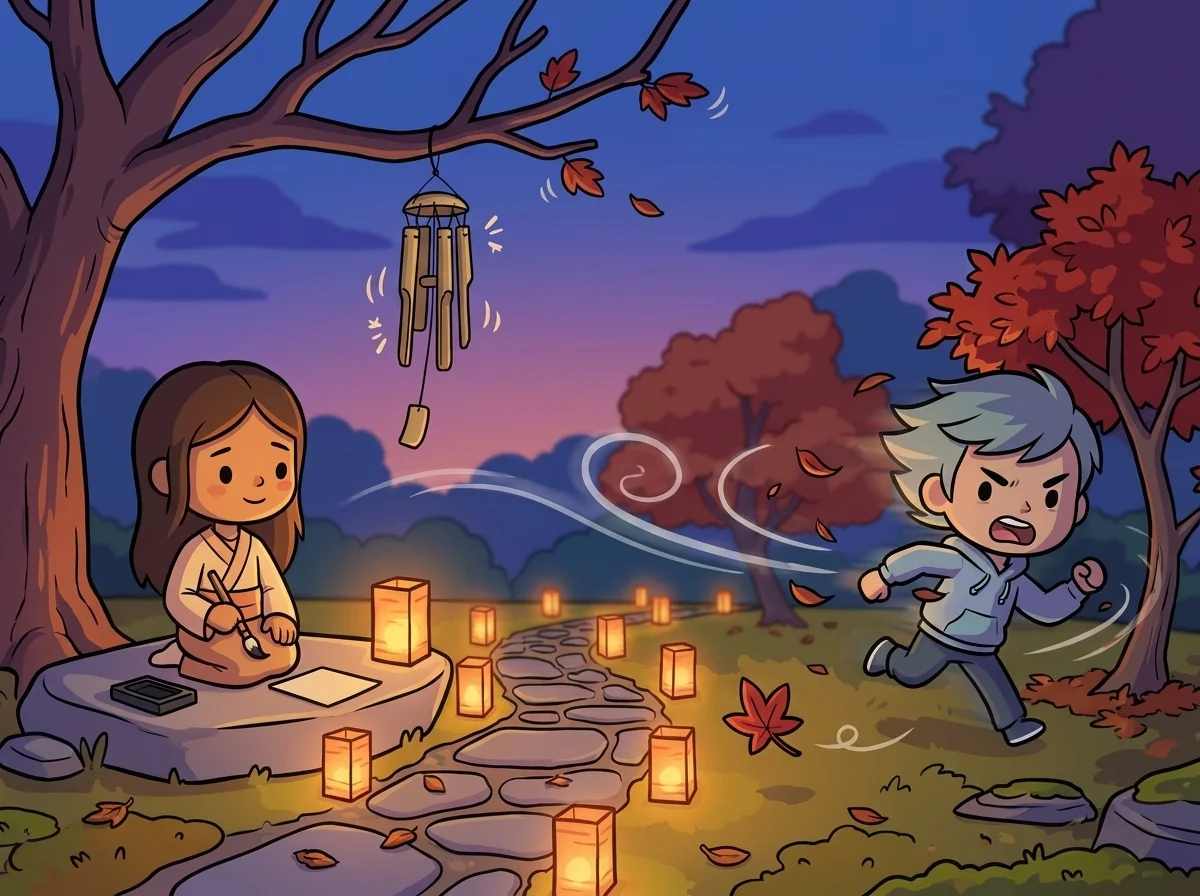
“But nothing is happening!” Breeze burst out. He zipped over to the cherry tree and gave the branch a little shake. The bamboo chimes knocked against each other, making a hollow, lonely sound. Clonk, clonk-clink. “A poem isn’t a painting that just sits there. It’s a feeling that runs through you! Like me!”
He took a deep breath and then puffed it out, a cool current of air that swirled through the garden. The lantern flames flickered inside their paper shells. The leaves on the cherry tree whispered. The wind chimes sang their hollow song again. “That’s the poem!” he declared. “The feeling of autumn arriving.”
“A poem is about what you can feel,” Breeze insisted. He tried his own first line, his voice full of energy. “Cool wind starts to blow... See? It has action! It has sound! You can feel it on your skin.” He spun in a little circle, making a few more leaves dance. For him, the garden wasn't a still picture. It was a collection of movements and sounds, and a poem had to capture that energy, or it wasn't alive at all.
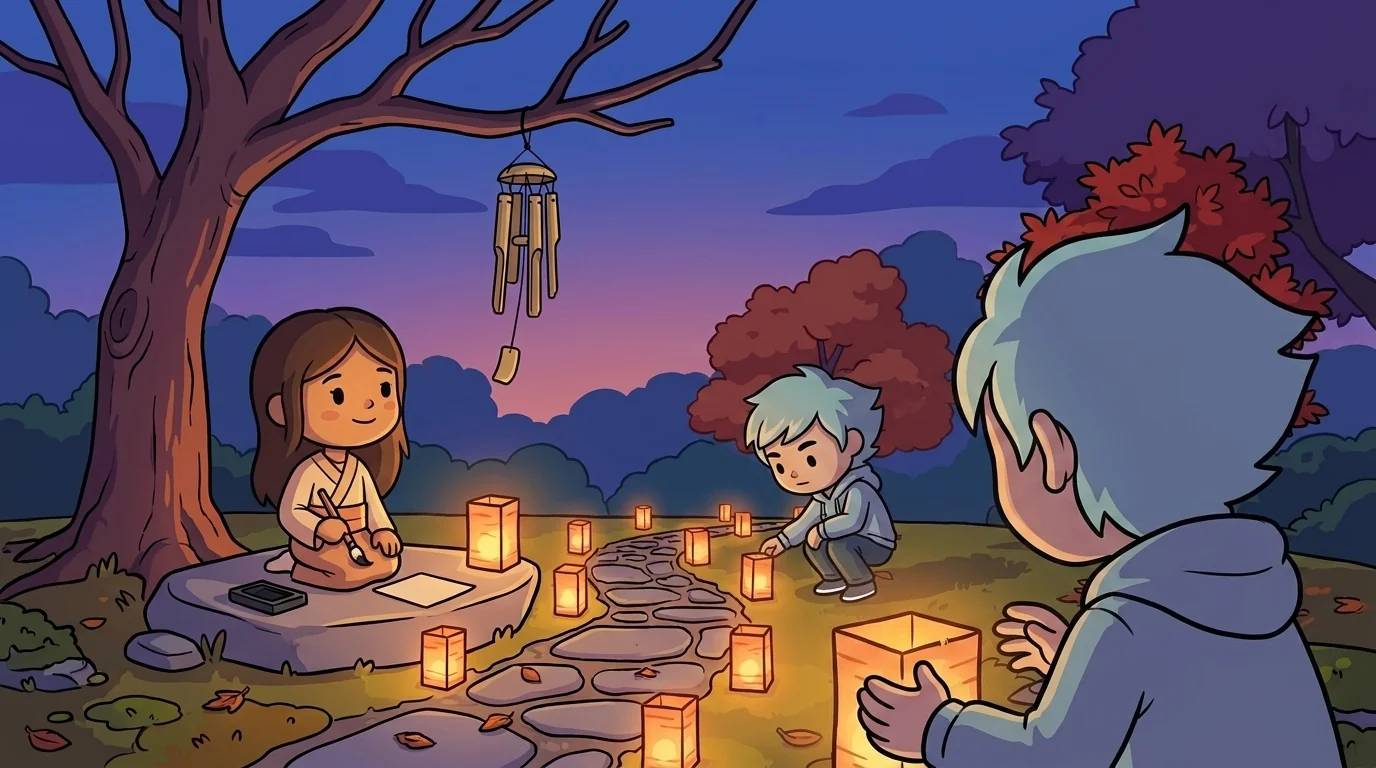
“It needs a picture, or nobody knows what you’re talking about,” Lantern said, her quiet voice firm. “Your line could be happening anywhere. In a field, on a mountain. My line puts you right here.”
“And my line makes you feel like you’re here!” Breeze retorted, zipping past her ear with a soft whoosh. “Your lanterns just sit there until I come along and make their little lights dance!” He was right. As he passed, the flames inside the paper wavered, and the shadows on the ground wiggled and stretched.
Lantern watched the dancing shadows. A small smile touched her lips. “You’re right,” she admitted. “They are more interesting when you’re around.” She looked up at the cherry tree. In the fading light, the leaves were just dark shapes. But when Breeze rustled them, she could suddenly see each one distinctly as they shivered. “And I suppose you can’t see your leaves rustling unless my light is shining on them.”
Breeze stopped his zipping. He hovered near a lantern, watching its light and shadow play on the mossy ground. He hadn't thought of it that way. His movement needed her light to be seen. Her light needed his movement to feel alive. They weren't writing two different poems. They were trying to describe two parts of the very same moment.
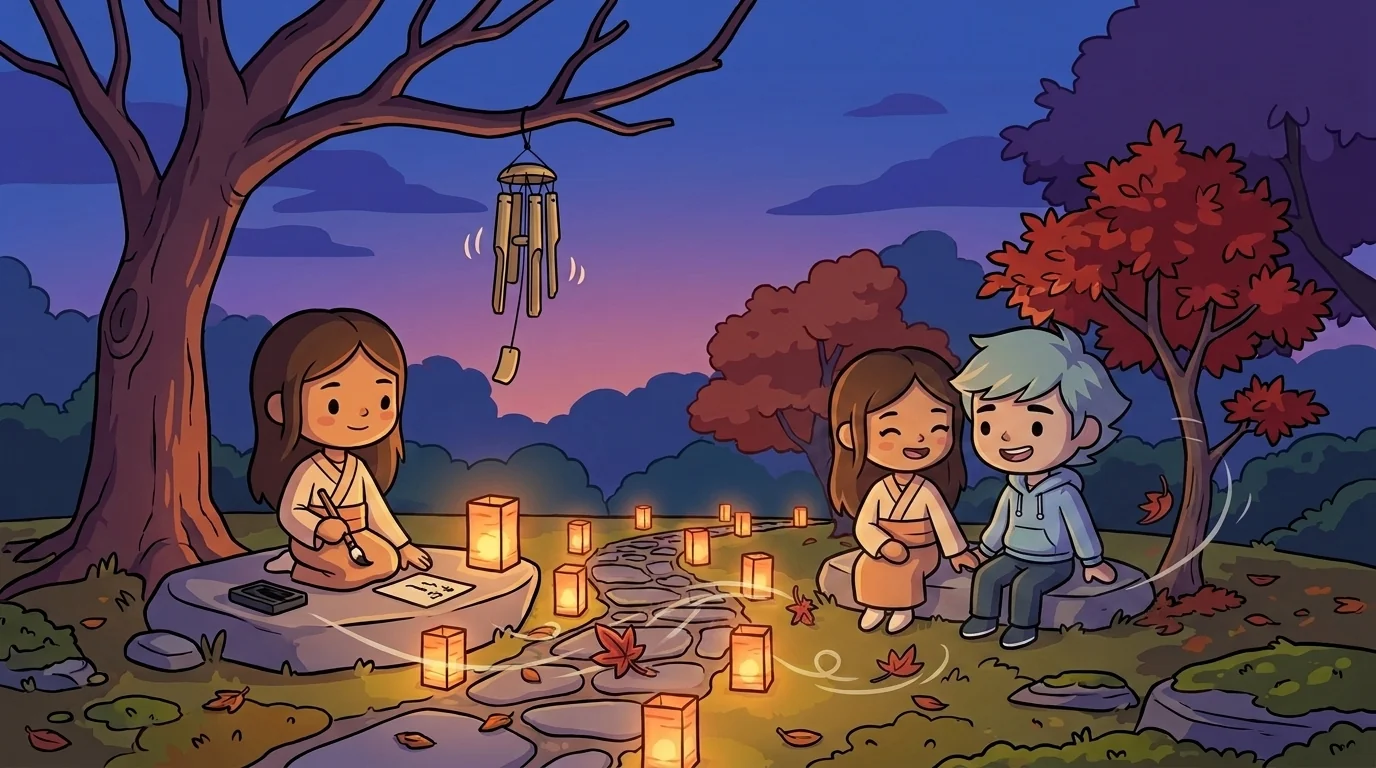
They sat together on the smooth, flat rock, the inkstone finally between them. This time, they would build it together.
“You start,” Breeze offered. “With the picture.”
Lantern dipped her brush in the ink and nodded. She wrote the first line carefully on the paper. “Paper lanterns glow.” It was a perfect, still image.
Breeze leaned in, his voice a low whisper that seemed to carry the sound of the leaves with it. “Now for the feeling, the movement,” he said. He thought for a moment, listening to his chimes. “A cool wind whispers through leaves.”
It was perfect. The picture was there, and now something was happening inside the picture. It felt complete. They looked at each other, and then down at the two lines. They only needed one more. Together, they looked at the ground, where the light from Lantern’s paper globes met the motion from Breeze’s airy current. They saw the answer right there on the moss.
They said the last line at the same time: “Shadows start to dance.”
Lantern wrote it down. They read their haiku aloud in the quiet garden. The lanterns glowed. The wind whispered. The poem was finished.
The HaikuQuest ensemble
Lantern and Breeze is part of HaikuQuest's distributed-narrative cast. Each character embodies a different curricular primitive; together they teach the full subject.
-

Count
Syllable count / count-discipline — magpie-tween whose beak-tap enacts the rhythmic underpinning of every counted form
-

Pause
Kireji / cut / productive break — snowy-egret-tween whose perpetually-mid-step body IS the kireji in physical form
-

Lantern
Season-word / anchoring image — chipmunk-tween whose wooden lantern visibly shifts color with the season
-

Trim
Brevity / saying-less — red-squirrel-tween with brass scissors who snips redundant words to find the smaller-stronger version
-

Flint
Juxtaposition — flinty badger-creature who strikes two smooth stones to make a spark; two images set side by side make a third meaning leap up in the gap
-

Gallop
Meter / the stressed beat — long-legged pony-creature whose hooves fall da-da-DUM; not how MANY beats (that's Count) but which ones to stomp (esp. the limerick)
-

Bell
Rhyme — silver creature with tuned tail-bells that chime the same note when end-sounds match; a forced rhyme jammed in just to chime is worse than none
-

Hinge
The line break — folding-door creature who holds a small pause at the end of each line; the end of a line is a little stage, so end on a word that earns it
-

Mold
Shape on the page — clay-colored creature who builds a poem's silhouette (a cinquain's 2-4-6-8-2 diamond); shape is meaning you can see from across the room
-
Braid
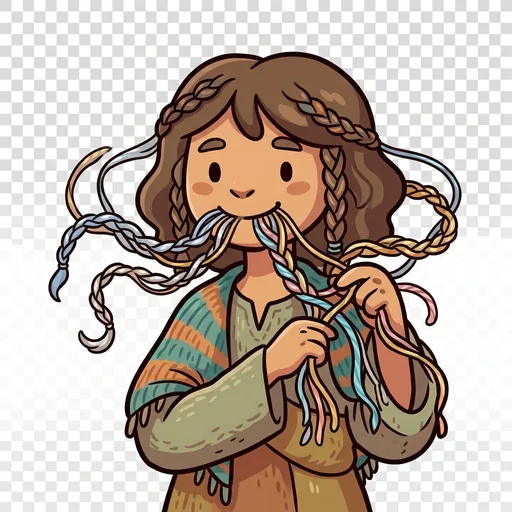
Sound texture — nimble creature who weaves repeated sounds through a line (alliteration + assonance); enough echo makes music, too much makes a tongue-twister knot