
Agreement Ada
SUBJECT-VERB AGREEMENT — singular subject takes singular verb; plural subject takes plural verb. *The dog barks.* *The dogs bark.* Tricky cases: collective nouns, *either/or*, indefinite pronouns, intervening phrases.
Press play to listen along. The line being read lights up as you go.
Show full transcript
Loading transcript…
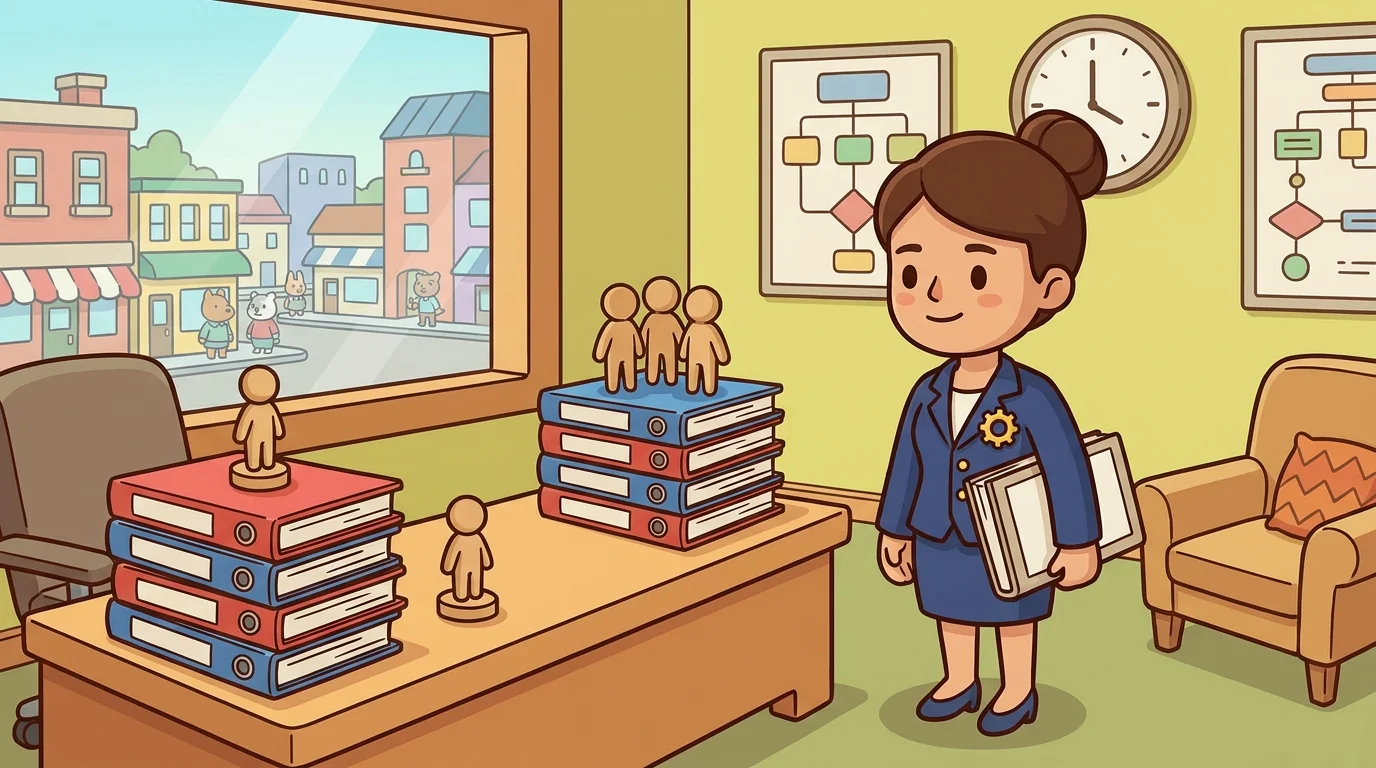
*Agreement Ada* was Sentence-Town's protocol officer. It was a role that sounded simple, almost invisible, but without her, everything would fall apart. Ada made sure Mayor Subject and Verb Verity always matched. Singular subjects needed singular verbs. Plural subjects demanded plural verbs. The rule itself felt straightforward, yet in practice, it held countless tricky cases. Ada handled them all, with a quiet patience that was her trademark.
Her full name was Adelaide, but everyone called her Ada. She believed subject-verb agreement wasn't just a grammar rule; it was the deepest expression of the relationship between a subject and its verb. Mayor Subject and Verb Verity were partners, colleagues, the closest professional pair in Sentence-Town. They had to match. If the Mayor was the dog (singular), the verb barks (singular). If the Mayor was the dogs (plural), the verb bark (plural). This matching was protocol, and Ada, the protocol officer, enforced it.
Ada had grown up in a diplomatic family. Both her parents served as protocol officers in the kingdom's foreign ministry. They were civil servants who specialized in the correct forms of address for every diplomatic interaction. The kingdom had an ancient, elaborate tradition of protocol, and Ada’s parents made sure every letter, every formal meeting, every ceremonial occasion used the exact titles, forms, and sequences. Even a misplaced comma could cause an international incident, or so it seemed.
From a young age, Ada learned that form-matching mattered. A letter addressed To His Royal Highness Prince X carried a different weight than one addressed To Prince X. The form had to fit the relationship. If the form was wrong, the diplomatic relationship suffered, sometimes beyond repair. Ada watched her parents navigate these delicate situations with calm precision, understanding that small details held enormous power.

By the time she was fourteen, Ada recognized the same principle at work in English subject-verb agreement. The form of the verb had to match the form of the subject. A mismatch didn’t just sound off; it damaged the sentence. It signaled either carelessness or a lack of understanding to a careful reader. A protocol officer’s job, whether in diplomacy or grammar, was to enforce that essential matching.
Ada attended the GrammarForge academy at nineteen. She had been Agreement Ada for thirteen years now, a steady presence in the town’s linguistic structure.
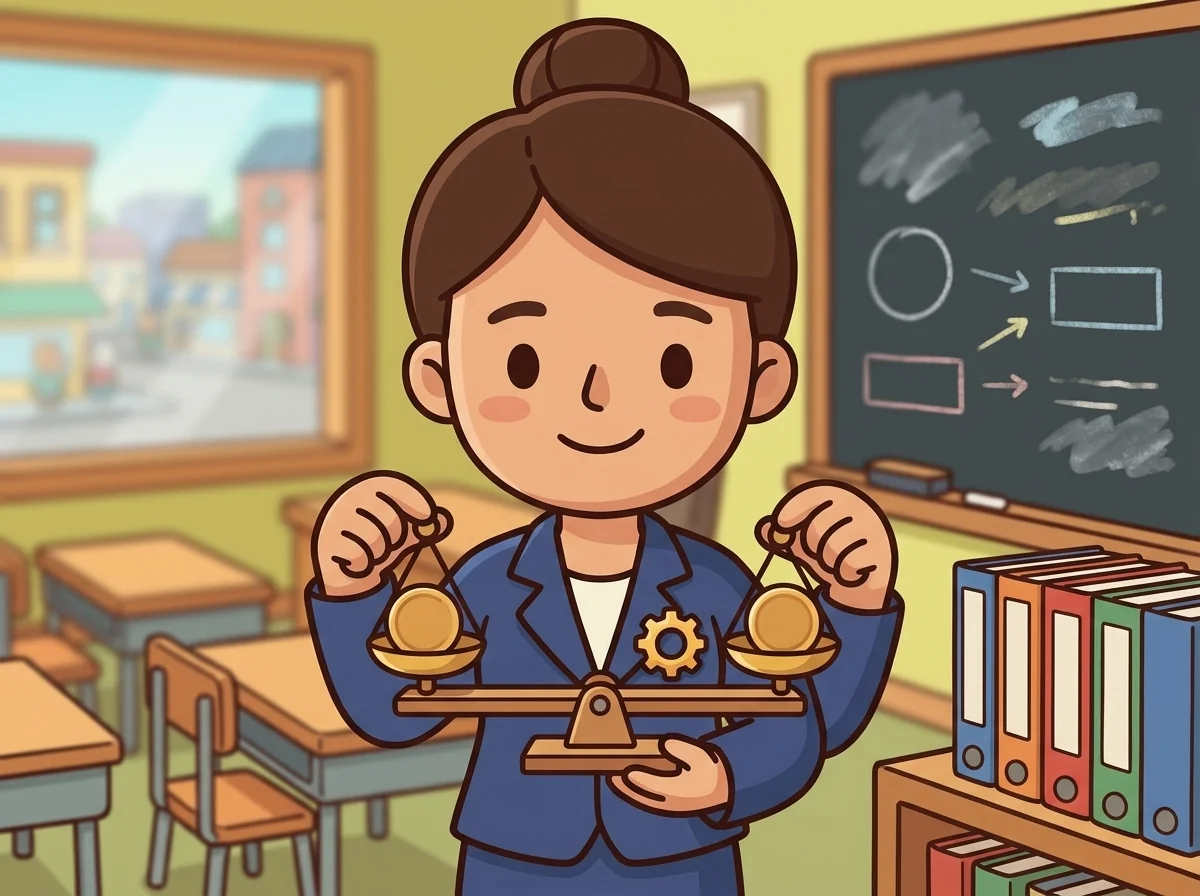
In her classroom, she began every first-day lesson the same way. She would hold up a small balance scale, a teaching prop with two tiny pans on either side of a fulcrum. On the left pan, she’d place a token labeled Subject. On the right, a token labeled Verb. She’d turn to the class, her gaze calm and steady.
"My job," she would say, her voice clear, "is to make sure these two are balanced. Subject form on one side. Verb form on the other. They must match. If they do not match, the sentence does not balance."
She demonstrated, writing on the board. The dog barks. She tapped the dog. "Singular subject," she explained. Then she tapped barks. "Singular verb. Barks is the third-person singular present form. Matched. Balanced."
Next, she wrote: The dogs bark. "Plural subject," she said, pointing. "Plural verb. Bark is the plural form. Matched. Balanced."
Then came the tricky cases. This was where the students’ eyes would widen.
"What about this?" she’d ask, writing: The dog and the cat bark.
A student, Leo, raised his hand. "But 'dog' is singular, and 'cat' is singular."
"True," Ada nodded. "But when two singulars are joined by and, they become a compound subject. Together, they count as plural. So, we need a plural verb: bark. Matched."
She wrote another: Either the dog or the cat barks.
Another student, Maya, looked puzzled. "Why 'barks' there? Still two animals."
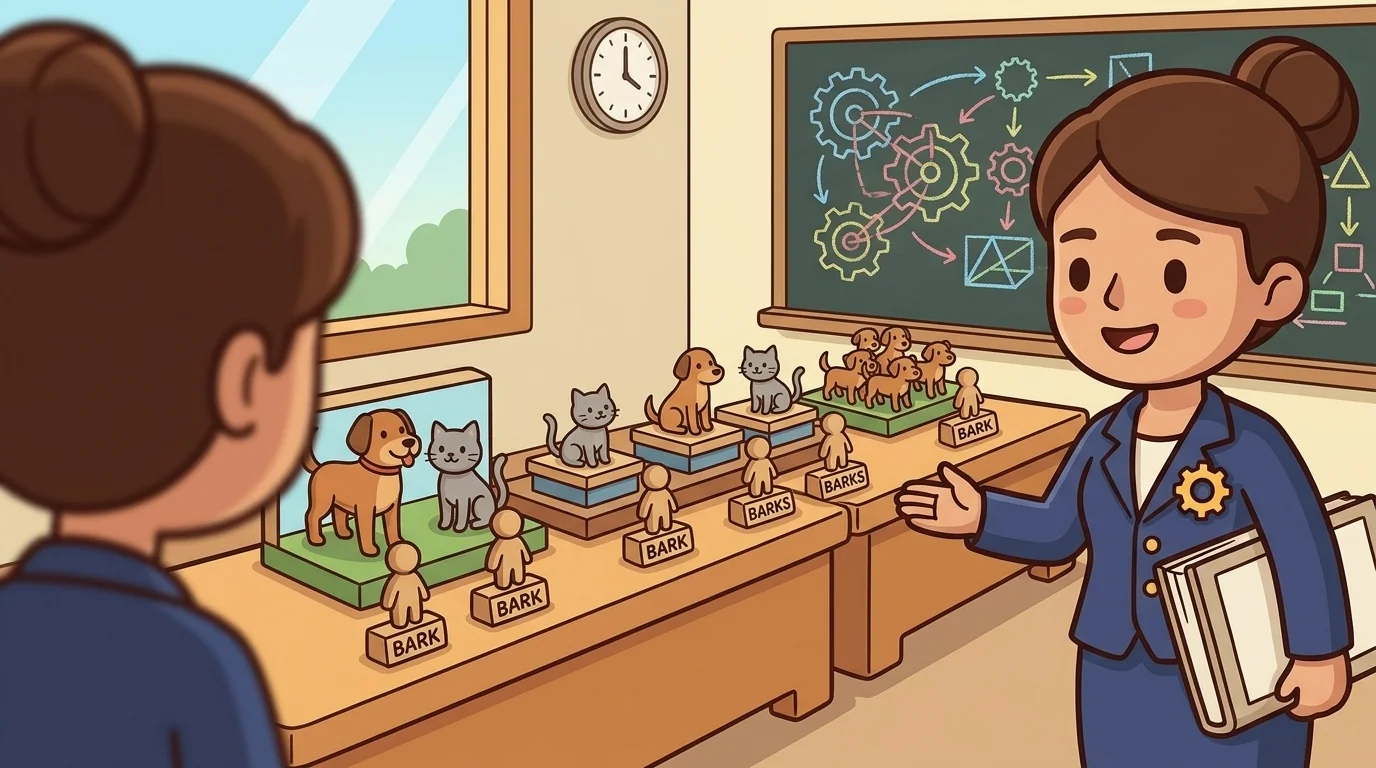
"Good question, Maya," Ada replied. "With or, the verb agrees with the subject nearer to it. In this case, 'cat' is singular, so the verb is 'barks.' Matched."
Then, a variation: Either the dog or the cats bark.
"Here, 'cats' is nearer," Ada explained. "And 'cats' is plural. So, the verb is 'bark.' Matched."
She moved to another common point of confusion: The pack of dogs barks.
"The head noun here is 'pack'," Ada clarified. "Even though there are many dogs, 'pack' is a singular collective noun. The verb agrees with 'pack,' not with 'dogs.' So, 'barks' is correct. Matched."
Finally, a truly modern challenge: Everyone in the village brings their lunch.
"Wait," piped up a boy named Sam. "Shouldn't it be 'his or her lunch' if 'everyone' is singular?"
Ada smiled. "Traditionally, yes, Sam. But modern English accepts 'their' as a gender-neutral pronoun for 'everyone.' However, the verb itself stays singular. 'Everyone' is still grammatically singular, so it's 'brings.' Matched."
The children, without fail, found these tricky cases eye-opening. They hadn't realized subject-verb agreement had so many sub-rules. Ada always normalized the complexity. "There are tricky cases," she’d say. "Each tricky case has a rule. Once you know the rules, the cases become manageable."
When children asked if subject-verb agreement was hard, Ada always gave the same answer.
"It is not hard," she'd say. "It is matching. The form of the subject must match the form of the verb. Singular with singular. Plural with plural. Tricky cases have their own rules, and those rules are learnable. Patience handles the rest."
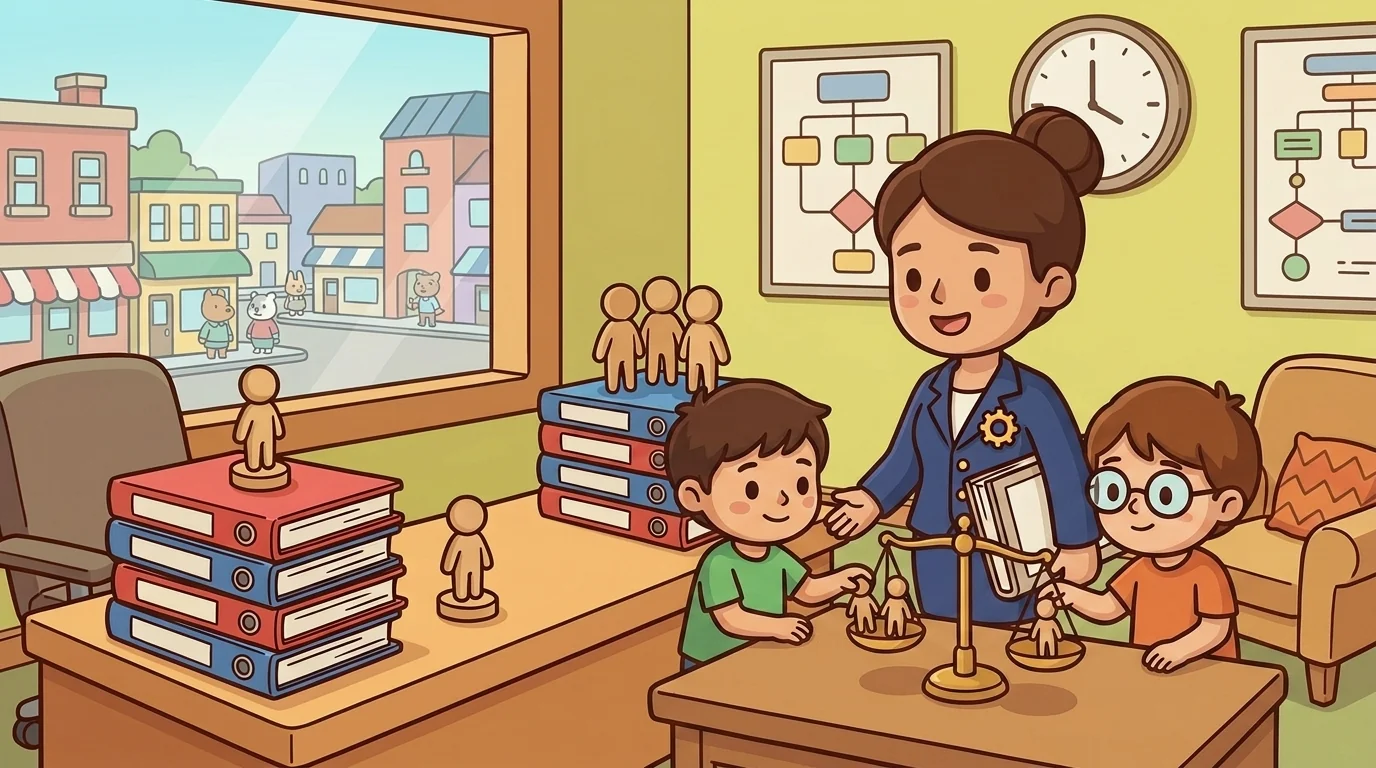
She still kept the small balance scale on her desk. Sometimes, a child would ask to test their own sentences on it. Ada always allowed it. The scale, from years of use, now tilted slightly to the left. Ada had been meaning to have it recalibrated for several years but hadn’t gotten around to it. She would simply say, "The scale tilts. But the principle holds."
The GrammarForge ensemble
Agreement Ada is part of GrammarForge's distributed-narrative cast. Each character embodies a different curricular primitive; together they teach the full subject.
-

Mayor Subject
Subject (noun/pronoun performing the action)
-

Verb Verity
Verb (action / state of being)
-

Object Otto
Direct / indirect object (receiver of the verb's action)
-

Modifier Mike
Adverb (modifies verb / adjective / other adverb)
-

Modifier Madge
Adjective (modifies noun / pronoun)
-

Connector Chen
Conjunction (coordinating / subordinating — *and*, *but*, *because*, *although*)
-

Pronoun Perry
Pronoun (substitute for noun — *he*, *she*, *they*, *it*, *who*)
-

Article Anne
Article (*a*, *an*, *the* — definite vs. indefinite)
-

Preposition Pat
Preposition (spatial / temporal relations — *on*, *under*, *between*, *before*)
-

Clause-Chief Carla
Clause-types (independent / dependent / subordinate / relative)
-

Punctuator Polly
Punctuation guardian (commas, semicolons, apostrophes, colons, dashes)