
Contract
CONTRACTUALISM — the view that *moral worth is derived from what rules everyone affected could reasonably agree to* under conditions of fairness. The right action is one that *no one could reasonably reject* as a principle for action.
Listen along — Contract
Loading audio…
Press play to listen along. The line being read lights up as you go.
Show full transcript
Loading transcript…
Chapter 5 — Contract and the Fair-Rules Table
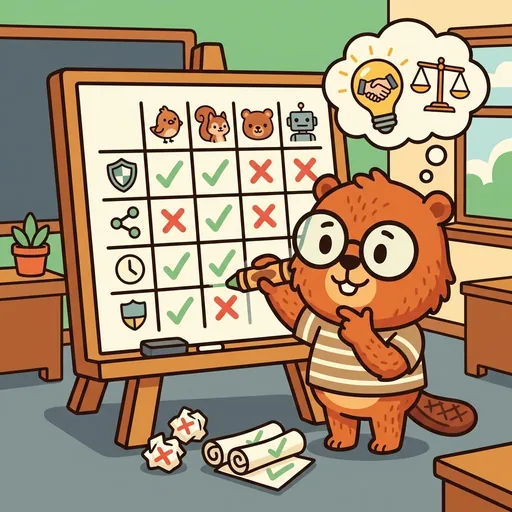
Contract was a beaver drawing a table of fair rules. He stood at the front of the classroom, a tall, calm figure with a worn tweed vest and a perpetually sharpened pencil tucked behind his ear. His fur was a deep, rich brown, and his eyes held a thoughtful, patient gleam. The students knew him for his quiet manner and his meticulous drawings.
His table was always there, a large, laminated poster board propped on an easel. It had neat rows for different ideas or principles the class might be considering. Across the top, it had columns for each person who would be affected by that idea. Contract would pick up a marker, his movements slow and deliberate. He would fill in the cells one by one. For each person, for each principle, he would ask: Would this person agree to this principle?
If every single cell ended up with a happy yes, then the principle was fair. It could become a rule everyone followed. But if any cell showed a no—even just one—then the principle was not fair. The framework then asked a crucial question: Can the principle be modified so that this person could agree? This wasn’t just a drawing. It was the philosophical work itself, laid out for everyone to see.
Contract believed that truly good rules, truly fair rules, weren’t just handed down. They were built, piece by careful piece, by everyone involved. He called this idea Contract. It was all about finding rules that everyone affected could reasonably agree to. Not just the loudest voices, or the most powerful ones. Everyone.
His central question wasn’t about what produced the best results, or what universal truths existed, or even what kind of person you should be. For Contract, the most important thing was: what rules could everyone affected reasonably agree to? If you could find rules that no one could reasonably reject, those rules were fair. They should guide how we all live together.
This was the framework’s great strength. It took seriously the perspectives of everyone affected. No one’s interests were automatically more important than anyone else’s. Contract asked you to seriously consider how a proposed rule would affect the person least well-served by it. Then, you had to ask if that person could reasonably accept the rule, even if it wasn’t their first choice. It also felt very democratic. It said that moral authority came from what reasonable people would agree to, not from what one person or group decided.
But Contract was also honest about its challenges. He freely admitted that figuring out who counted as “everyone affected” could be tricky. Did it include people far away? People not yet born? Animals? Whole ecosystems? These were not easy questions. He also knew the framework could struggle with really hard situations. Sometimes, no principle seemed acceptable to everyone. Ethical life sometimes required imperfect compromise, and his table didn’t always make that easy. And of course, reasonable people could disagree about what counted as a reasonable rejection. That made the framework’s main test surprisingly hard to apply.
In his classroom appearances, Contract would always begin by drawing his fair-rules table. He’d finish the basic grid, then turn to the class, his calm gaze sweeping over their faces.
“I am Contract,” he would say, his voice soft but clear. “The framework I advocate weighs what we could all agree to. What could we all agree to? That’s fair. The framework’s strength: it takes everyone’s perspective seriously. The framework’s weakness: who counts as ‘everyone’ can be unclear, and reasonable people can disagree about what is reasonably rejectable.”
Then, he would present a dilemma. Today, it was about the school’s new rule for using the computer lab during lunch. The old rule was first-come, first-served. But some students always hogged the best computers, leaving others with slow, glitchy machines or no computer at all. The principal proposed a new rule: Everyone gets ten minutes, then they have to switch.
Contract drew the principle at the top of a new row: “Ten minutes per person in the computer lab.” Then he listed the people affected: “Students who like to play games,” “Students who need to finish homework,” “Students who only have a short lunch break,” “Students who don’t care about computers.” He even added “The librarian, who has to enforce the rule.”
He started filling in the cells. “Students who like to play games,” he wrote, then paused. “Would they agree to only ten minutes?” A few kids in the front row shook their heads. “Probably not happily,” one girl mumbled. Contract nodded. “Maybe not. But could they reasonably reject it? Is it truly unfair, or just inconvenient?” This was the tricky part, the space where opinions could differ.
He moved to “Students who need to finish homework.” “They might like it,” a boy offered. “Better than no computer at all.” Contract carefully wrote “Yes” in that cell. He worked through each column, honestly acknowledging where the framework left things unclear. Especially for those students who were quiet, or who rarely used the lab, or who felt their needs weren’t often considered. He did not claim that contractualism was the only right way. He simply showed how it worked.
When students asked Contract whether his framework was the right one, he would always pause, consider the question, and then offer his consistent reply:
“That is for you to decide. The framework offers one way to weigh moral questions. It takes everyone’s perspective seriously. It struggles with hard cases and with deciding who counts as ‘everyone.’ Other frameworks weigh differently. Listen to all five. Consider the strengths and weaknesses. You are the judge.”
He drew the table. The cells filled in. The rules emerged, not as absolute truths, but as agreements. He advocated for his approach with the same calm dedication as the other four framework-advocates. The kid, sitting in the classroom, was always the judge.
The EthosForge ensemble
Contract is part of EthosForge's distributed-narrative cast. Each character embodies a different curricular primitive; together they teach the full subject.
-

Consequence
Consequentialism / Utilitarianism — calm, methodical; weighs trade-offs; capybara at a balance-scale
-
Duty
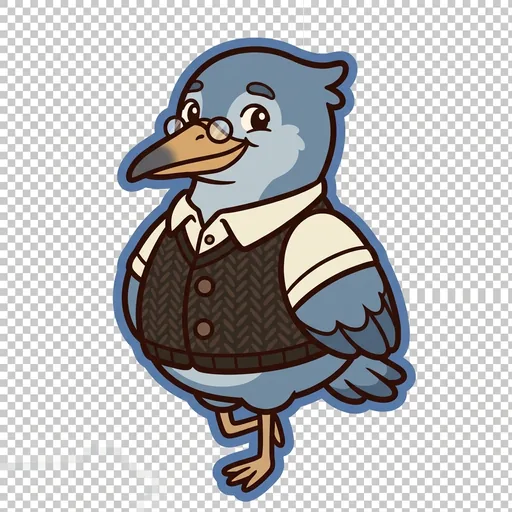
Deontology / Kantian — upright, principled; sticks to rules even when costly; heron in vest on one leg
-

Virtue
Virtue Ethics / Aristotelian — steady, earnest; 'what kind of person do I want to be?'; badger tending a plant
-

Care
Care Ethics / Noddings + Gilligan — attentive, present; 'ethics begins in relationship'; otter listening beside empty spot
-

Bound
Rights ethics — each person has protections you may not cross, even for a good outcome; pangolin who curls to shield ('some lines you never cross')
-

Kin
Ecological ethics — the circle of concern reaches to animals, living systems, and the not-yet-born; elephant asking 'who else has to live with this?'
-

Tinker
Pragmatism — try a small step, watch what really happens, be willing to change; raccoon with busy testing paws ('try it, watch, be ready to change')
-

Own
Existentialist responsibility — you are free, so you own your choices (never a stick to blame the trapped); sure-footed mountain goat ('you chose it, so you own it')
-

Sense
Moral sentiment — the heart's feeling of sympathy is real moral information, the start of ethics (not the whole map); soft-eared dog ('first, what does your heart notice?')