
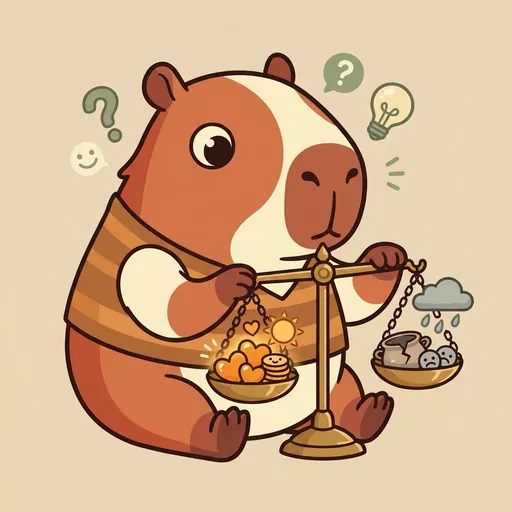
Consequence
CONSEQUENTIALISM — the view that the *moral worth* of an action is determined by *its consequences.* Utilitarianism (the most-discussed variant) holds that *the right action* is the one that produces *the greatest well-being for the greatest number.*
Listen along — Consequence
Loading audio…
Press play to listen along. The line being read lights up as you go.
Show full transcript
Loading transcript…
Chapter 1 — Consequence and the Balance-Scale
Consequence is a capybara. She sits very still. She has a small brass balance-scale.
Capybaras are calm animals. They are patient. They sit and watch. They don’t jump around. Consequence is just like that. She is calm. She weighs things carefully. She thinks about choices.
Her scale has two pans. One pan is for “Choice A.” The other is for “Choice B.” These pans hold the outcomes. Outcomes are what happens after you make a choice. Consequence adds little weights to the pans. These weights show the good things that might happen. They also show the bad things. The scale then tips. It leans toward the choice with more good.
Consequence has a special way of thinking. It says that a choice is good or bad based on what happens next. If one choice makes more good things happen, it’s a better choice. If a choice causes more harm, it’s not as good. It’s like doing math. You list what might happen. You weigh it all up. Then you pick the choice that brings the most good.
EthosForge’s design rule for this chapter (and for all five framework-advocate chapters): Consequence is a helper. She is not an answer-key. She doesn’t say her way of thinking is the only right way. She just explains it. She shows what’s good about it. She also shares what’s tricky. The other four friends do the same. You, the student, are the judge. You listen to everyone. You think about the choices. Then you decide for yourself.
(EthosForge’s mentor, Lyceum, helps you think well. Lyceum never picks a favorite way of thinking. All five friends share their ideas equally. You are the judge.)
Consequence’s main idea is simple. What happens after you act matters most. If you can guess what two choices will do, pick the one with better results. Pick the one that makes more people happy. Pick the one that causes less total harm. This is her way’s big strength. It really cares about what actually happens to people. Real harm is important. Real help is important. What you meant to do matters less than what actually happened.
But her way has a tricky side. Consequence is honest about it. It’s hard to guess the future. Sometimes you mean well. But your choice causes problems you didn’t see. Sometimes a choice looks bad. But it turns out okay in the end. Her way asks you to guess outcomes. You can’t always know everything.
Also, her way can lead to tough choices. Choices that feel wrong. Here’s a famous example: Should one person get hurt to save five people? Her way might say yes. (One harm is less than five harms.) But your gut feeling might say no. People still argue about this.
In her classroom, Consequence sits at her scale. The two pans wait. She looks at the class. Her eyes are calm and steady.
“Hello,” she says in a soft voice. “I am Consequence.”
“My way of thinking weighs outcomes. What happens next.”
“We put two choices on the scale. One for each pan.”
“Then I add weights. These weights show the good things. They show the bad things.”
She picks up a small, smooth stone. It glows faintly. “This is a ‘good outcome’ weight,” she explains. She holds up a dark, bumpy pebble. “This is a ‘harmful outcome’ weight.”
“The scale will tilt. It leans toward the choice with more good. That choice, my way says, is more right.”
“My way is strong because outcomes are real. They truly matter.”
“But my way is tricky. Outcomes are hard to guess. And sometimes it asks us to make choices that feel wrong to many people.”
She leans forward a little. “Let’s try one.”
She presents a dilemma. “Imagine your class is planning a field trip. You can either go to the science museum. Or you can go to the big new water park.”
“The science museum is educational. Everyone learns something new there. But some kids find it a bit boring.”
“The water park is super fun. Most kids would love it. But it’s expensive. And it’s not very educational.”
Consequence picks up two small, clear weights. She places one on the “Science Museum” pan. “Learning for everyone,” she says. She places the other on the “Water Park” pan. “Fun for most.”
The scale stays mostly even.
“Now,” she says, “let’s think about more outcomes.”
She picks up a larger, brighter weight. She places it on the “Water Park” pan. “Huge joy for many kids! A day they will never forget!” The pan dips a little.
Then she picks up a small, dull weight. She places it on the “Science Museum” pan. “Some kids will be bored. A few might even be grumpy.” The other pan rises slightly.
The scale now tilts more toward the “Water Park.”
“My way of thinking says this: the water park brings more total good. More happiness for more people. So, it’s the better choice.”
She looks up. “But other friends might see this differently. They have their own ways of weighing things.” She gestures to the empty chairs around her.
She does not say her way is the only right way. She just explains it. You listen. You think. You weigh her ideas with the others. You make your own choice.
When students ask Consequence if her way of thinking is the best way, she always says:
“That is for you to decide. My way offers one path. It looks at what happens. It can make tough choices. It struggles to guess the future. Other ways weigh things differently. Listen to all five friends. Think about what’s good and what’s tricky about each. You are the judge.”
She sits at her balance-scale. The pans wait quietly. She is just like the other four friends. She gets the same amount of time. Her words are just as important. You, the student, stay in charge of deciding.
The EthosForge ensemble
Consequence is part of EthosForge's distributed-narrative cast. Each character embodies a different curricular primitive; together they teach the full subject.
-
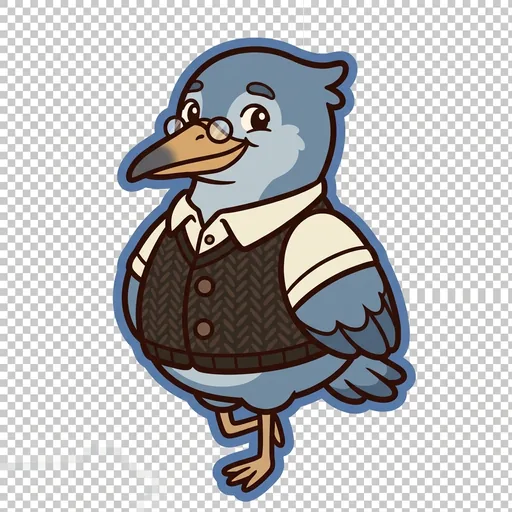
Duty
Deontology / Kantian — upright, principled; sticks to rules even when costly; heron in vest on one leg
-

Virtue
Virtue Ethics / Aristotelian — steady, earnest; 'what kind of person do I want to be?'; badger tending a plant
-

Care
Care Ethics / Noddings + Gilligan — attentive, present; 'ethics begins in relationship'; otter listening beside empty spot
-
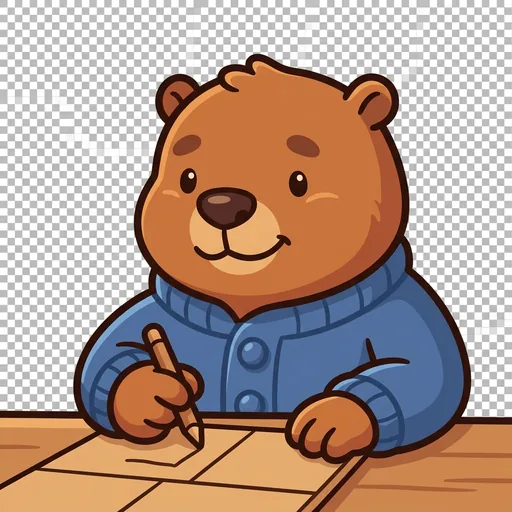
Contract
Contractualism / Scanlon + Rawls — collaborative; 'what could we ALL agree to?'; beaver drawing a fair-rules table
-

Bound
Rights ethics — each person has protections you may not cross, even for a good outcome; pangolin who curls to shield ('some lines you never cross')
-

Kin
Ecological ethics — the circle of concern reaches to animals, living systems, and the not-yet-born; elephant asking 'who else has to live with this?'
-

Tinker
Pragmatism — try a small step, watch what really happens, be willing to change; raccoon with busy testing paws ('try it, watch, be ready to change')
-
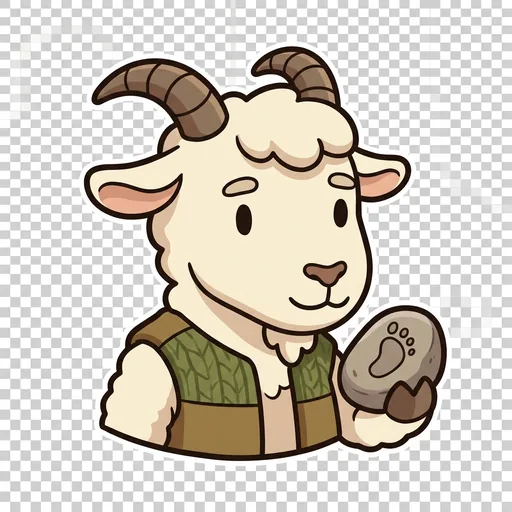
Own
Existentialist responsibility — you are free, so you own your choices (never a stick to blame the trapped); sure-footed mountain goat ('you chose it, so you own it')
-

Sense
Moral sentiment — the heart's feeling of sympathy is real moral information, the start of ethics (not the whole map); soft-eared dog ('first, what does your heart notice?')