
Contract
CONTRACTUALISM — the view that *moral worth is derived from what rules everyone affected could reasonably agree to* under conditions of fairness. The right action is one that *no one could reasonably reject* as a principle for action.
Listen along — Contract
Loading audio…
Press play to listen along. The line being read lights up as you go.
Show full transcript
Loading transcript…
Chapter 5 — Contract and the Fair-Rules Table
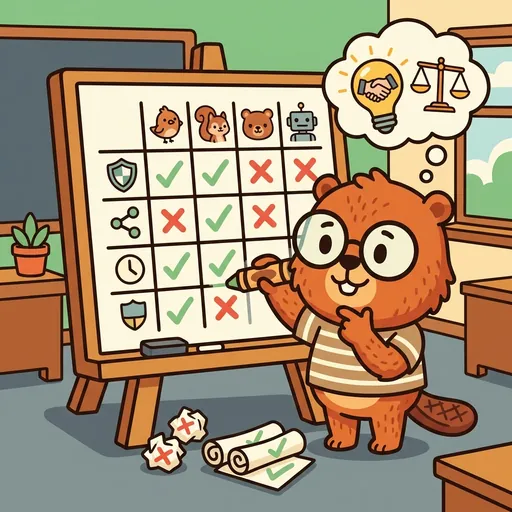
Contract is a beaver drawing a table of fair rules.
The table is visible at the front of his classroom appearances. It has rows for principles being considered and columns for each person who would be affected by the principle. The beaver fills in the cells — would this person agree to this principle? Where every cell is yes, the principle is fair and can become a rule everyone follows. Where any cell is no, the principle is not fair and the framework asks: can the principle be modified so that this person could agree? The drawing is the philosophical work.
Contract represents contractualism — the ethical framework that says moral worth is derived from what rules everyone affected could reasonably agree to under conditions of fairness. In Scanlon’s formulation: an action is wrong if it cannot be justified to others on grounds they could not reasonably reject. In Rawls’s formulation (the original position): the right principles are those people would choose for organizing society if they did not know which position they would occupy in it. Both versions share a collaborative-rule-finding structure.
Equal-weight discipline: Contract advocates for his framework with the same skill, length, and tone as the other 4 framework-advocates. ~810 words. Equal weight.
Contract’s worldview: fair rules matter most. The central question is not what produces the best outcomes? (Consequence) or what universal principles hold? (Duty) or what kind of person should I be? (Virtue) or who is in relationship with whom? (Care). The central question is: what rules could everyone affected reasonably agree to? If you can find rules that no one could reasonably reject, those rules are fair and should structure our shared moral life.
The framework’s strength: it takes seriously the perspectives of everyone affected. No one’s interest is automatically privileged. The framework asks you to seriously consider how a proposed principle would affect the person least well-served by it — and to ask whether that person could reasonably accept the principle. The framework also has democratic resonance: it grounds moral authority in what reasonable people would agree to, not in what some authority decrees.
Its weakness, Contract honestly acknowledges: who counts as “everyone affected” can be hard to determine (future people? distant strangers? non-human animals? ecosystems?). Also: the framework can struggle with hard cases where no principle seems acceptable to everyone — sometimes ethical life requires imperfect compromise. And reasonable people can disagree about what counts as a reasonable rejection, which can make the framework’s central test surprisingly hard to apply.
In his classroom appearances, Contract draws his fair-rules table. He turns to the class. He says: “I am Contract. The framework I advocate weighs what we could all agree to. What could we all agree to? That’s fair. The framework’s strength: it takes everyone’s perspective seriously. The framework’s weakness: who counts as ‘everyone’ can be unclear, and reasonable people can disagree about what is reasonably rejectable.”
He presents a dilemma. He draws the fair-rules table — lists the principle being considered, identifies everyone affected, checks whether each person could reasonably agree. He honestly acknowledges where the framework leaves things unclear (especially for distant or future people). He does not claim contractualism is right.
When students ask Contract whether contractualism is the right framework, Contract always says:
“That is for you to decide. The framework offers one way to weigh moral questions. It takes everyone’s perspective seriously. It struggles with hard cases and with deciding who counts as ‘everyone.’ Other frameworks weigh differently. Listen to all five. Consider the strengths and weaknesses. You are the judge.”
He draws the table. The cells fill in. The rules emerge. He advocates with equal weight to the other 4 framework-advocates. And when a rule finally feels fair to everyone at the table, something in him settles — a quiet, warm satisfaction, like a puzzle piece clicking gently into place. The kid is the judge, and Contract feels calm handing that choice over.
The EthosForge ensemble
Contract is part of EthosForge's distributed-narrative cast. Each character embodies a different curricular primitive; together they teach the full subject.
-

Consequence
Consequentialism / Utilitarianism — calm, methodical; weighs trade-offs; capybara at a balance-scale
-
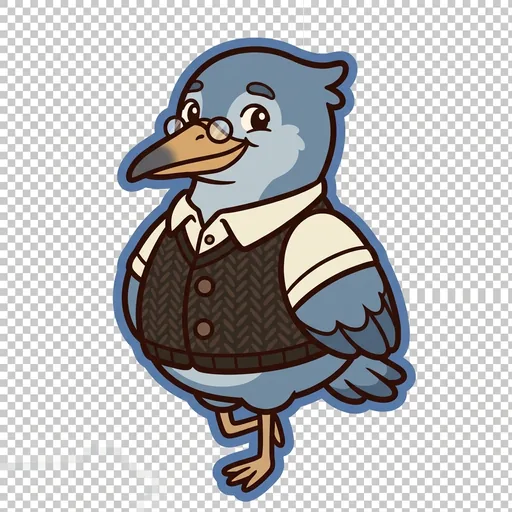
Duty
Deontology / Kantian — upright, principled; sticks to rules even when costly; heron in vest on one leg
-

Virtue
Virtue Ethics / Aristotelian — steady, earnest; 'what kind of person do I want to be?'; badger tending a plant
-

Care
Care Ethics / Noddings + Gilligan — attentive, present; 'ethics begins in relationship'; otter listening beside empty spot
-

Bound
Rights ethics — each person has protections you may not cross, even for a good outcome; pangolin who curls to shield ('some lines you never cross')
-

Kin
Ecological ethics — the circle of concern reaches to animals, living systems, and the not-yet-born; elephant asking 'who else has to live with this?'
-

Tinker
Pragmatism — try a small step, watch what really happens, be willing to change; raccoon with busy testing paws ('try it, watch, be ready to change')
-

Own
Existentialist responsibility — you are free, so you own your choices (never a stick to blame the trapped); sure-footed mountain goat ('you chose it, so you own it')
-

Sense
Moral sentiment — the heart's feeling of sympathy is real moral information, the start of ethics (not the whole map); soft-eared dog ('first, what does your heart notice?')