
Twoby the Pair-Matcher
PARITY AND INVARIANTS — pair things up two by two; if one is left over, the count is odd, and if none is, it's even. Some pairings can never come out even no matter how you try, and that single unchanging fact can prove a thing is impossible without checking every case.
A story read by Twoby the Pair-Matcher
Press play to listen along. The line being read lights up as you go.
Show full transcript
Loading transcript…
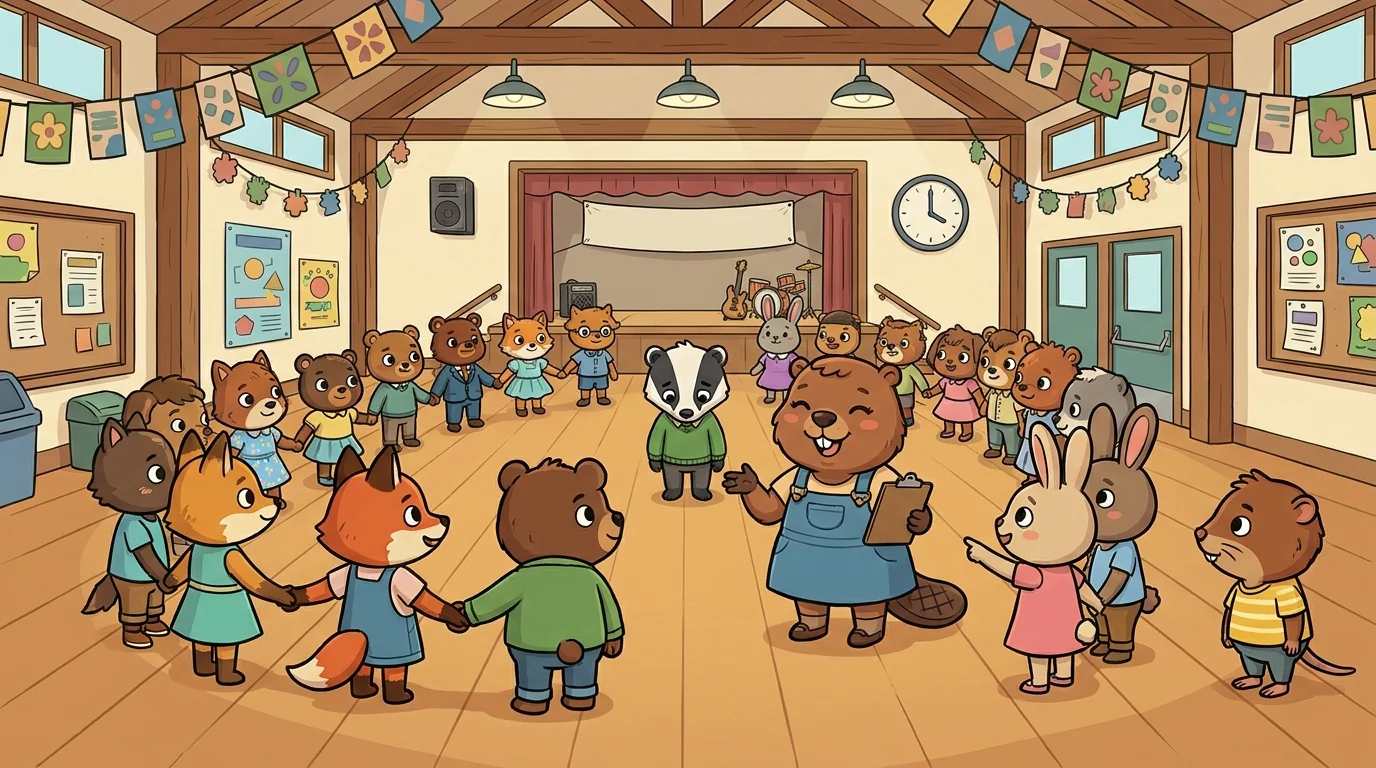
Twoby was a round, gentle beaver, and she saw the whole world two by two.
At the DiscreteQuest academy she ran the partner-matching for every dance, every relay, every two-by-two thing the school did. She had a quiet little ritual: she'd pair everyone off, two and two and two, and then she'd notice — always notice — whether anyone was left standing alone at the end.
A young vole named Bit watched her match the spring dance.
"Why do you always count the leftover?" Bit asked. "You pair everybody up, and then you stare at whoever's left."
"Because the leftover tells me everything," Twoby said softly. "Pair them two by two. If everyone finds a partner and none is left, the number is even. If one is left over, all alone, the number is odd. That one leftover — or no leftover — is a tiny true fact about the whole crowd. And tiny true facts," she added, "can prove the biggest things."
Bit frowned. "It's just... one person left over. How's that proving anything?"
"Oh," Twoby said, her eyes warm. "Let me show you what a leftover can do."
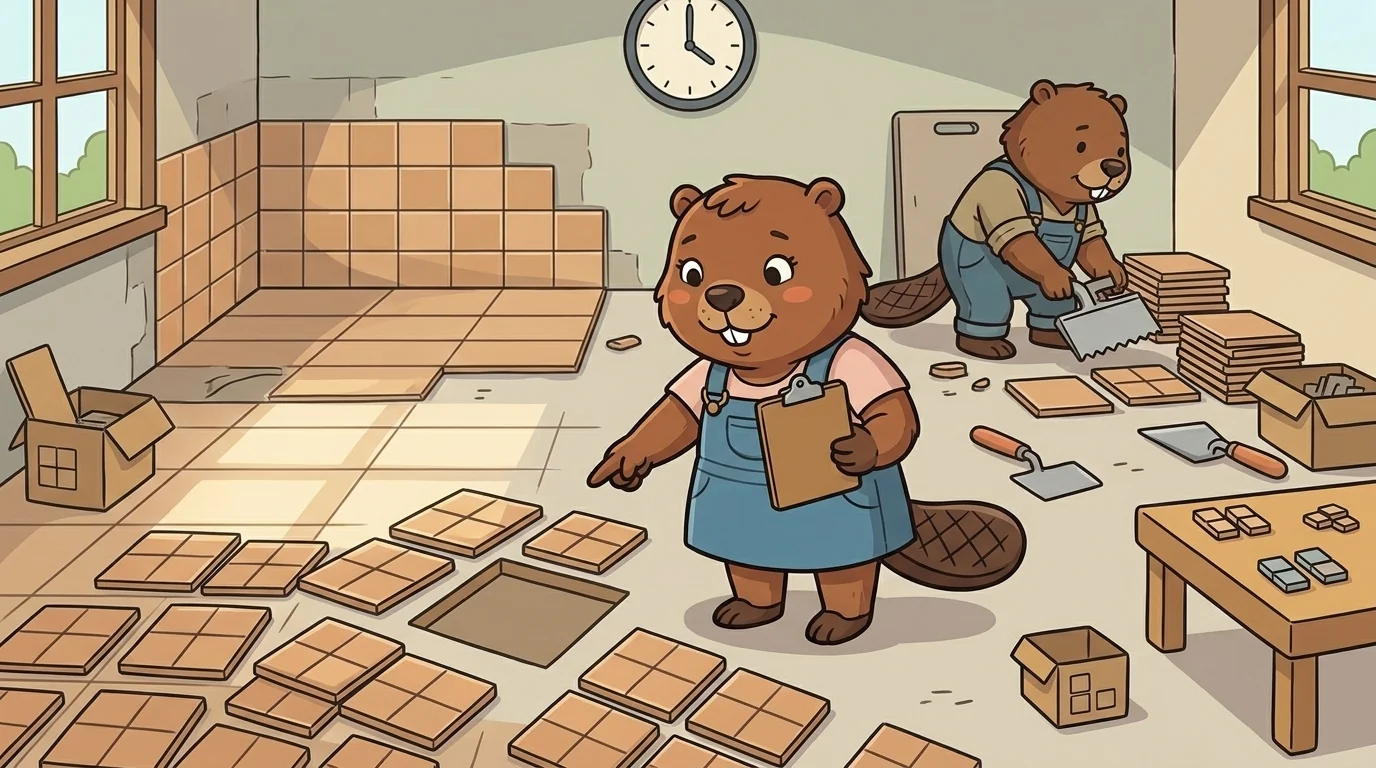
Twoby had been a pairer-of-things since she was small.
Her family laid tile floors — little square tiles, set down two at a time from a double-wide trowel that always placed exactly two. As a kit she loved watching the floor fill up, two tiles, two tiles, two tiles. But one day a customer asked for a floor with an odd number of spaces, and no matter how her father laid the tiles — two at a time, two at a time — there was always, always one bare square left at the end.
"Why can't we just cover it?" little Twoby had asked.
"Because we lay them two at a time," her father said. "Two at a time can only ever fill an even number of squares. An odd floor will fight us every single time. Not because we're clumsy. Because it simply can't come out even."
That landed in Twoby like a stone in a still pond. It wasn't about trying harder. Some things couldn't be done, and you could know they couldn't, just from the way the counting worked. You didn't have to try every arrangement and fail. You could see the impossibility from the start, in the leftover.
When she was grown, Twoby waddled the long road to DiscreteQuest, because she'd heard it was a school that respected a good "that's impossible."
The head of the academy, an old owl with patient eyes, asked her, "What is a parity argument?"
Twoby answered slowly and surely. "Parity is just even-or-odd. You pair things two by two and see what's left. And an argument from parity is this: if there's something about a puzzle that's always even, or always odd, no matter what move you make — then anything that would break that pattern simply can't happen." She folded her paws. "You don't check every case. You find the one thing that never changes, and let it do the proving."
"Give me an example," the owl said.
"Each handshake involves exactly two hands," Twoby said. "So all the hands that ever shake, counted up, must be an even number. Always. That one unchanging fact rules out whole piles of impossible claims, without my checking a single party guest."
The owl's eyes gleamed. "You are appointed."
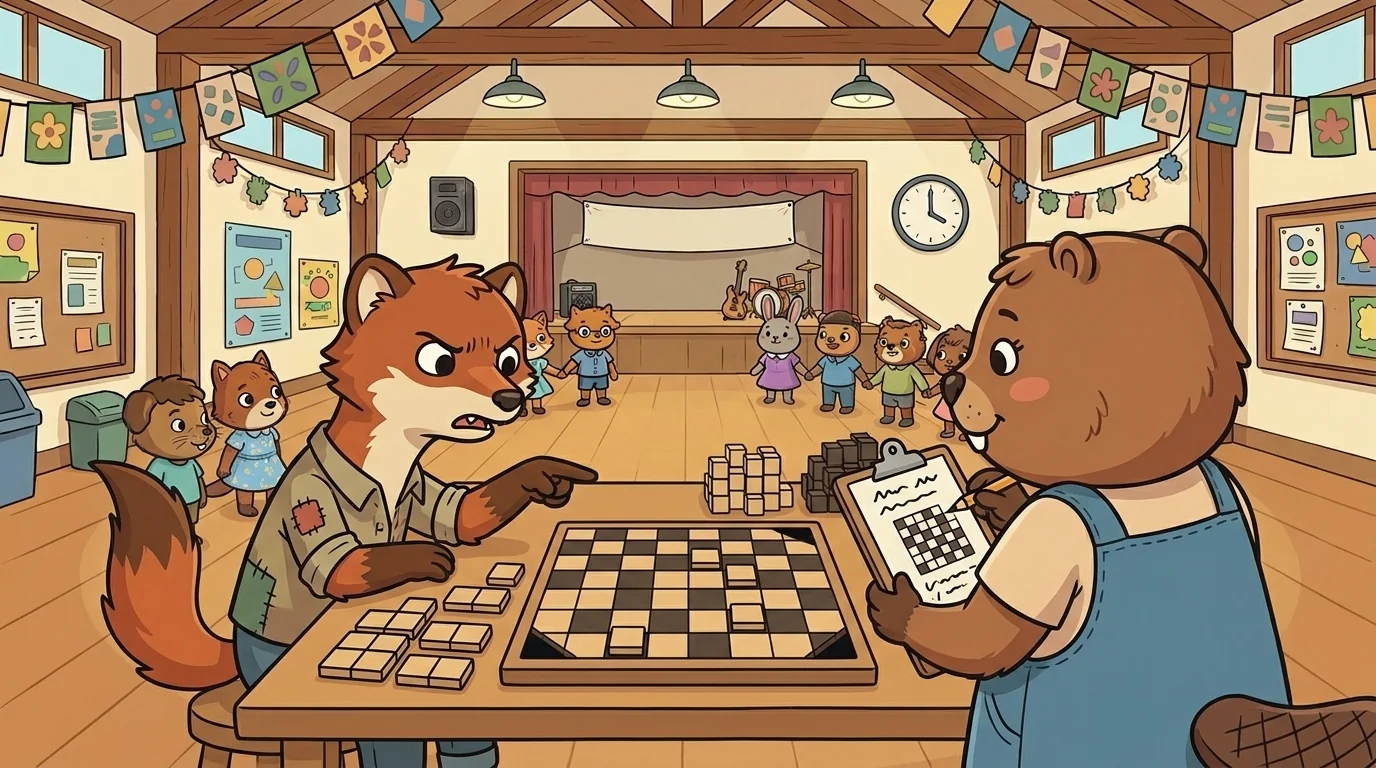
Twoby's favourite thing was using a leftover to settle an argument for good.
A stubborn marten named Cobb came to her with a checkerboard — eight squares by eight, dark and light, sixty-four squares in all — and a pile of little tiles, each one long enough to cover exactly two squares side by side.
"I want to cover the whole board with these two-square tiles," Cobb said, "but I snipped off two corners — see, the two dark corners, opposite each other. Now I can't make it work and I've been trying for hours. There must be some clever way."
Twoby looked at it and shook her head, kindly. "There's no way, Cobb. And I can prove it without you trying for one more second."
She pointed at a single tile. "Every tile covers two squares that touch — and on a checkerboard, two touching squares are always one dark and one light. Always. One of each. That never changes." She tapped the board. "So however you lay them, the tiles always cover the same number of dark squares as light ones. But you snipped off two dark corners. Now there are thirty light squares and only —" she counted — "thirty-two light, thirty dark. Wait —" she recounted gently — "the board's missing two darks, so it has more light than dark. The tiles need them equal. They never can be. So it can't be covered. Not because you're not clever. Because the leftover won't allow it."
Cobb stared at the board for a long moment, then set down the tile he'd been gripping. "Hours," he breathed. "And one leftover would've told me."
"One leftover almost always knows," Twoby said.
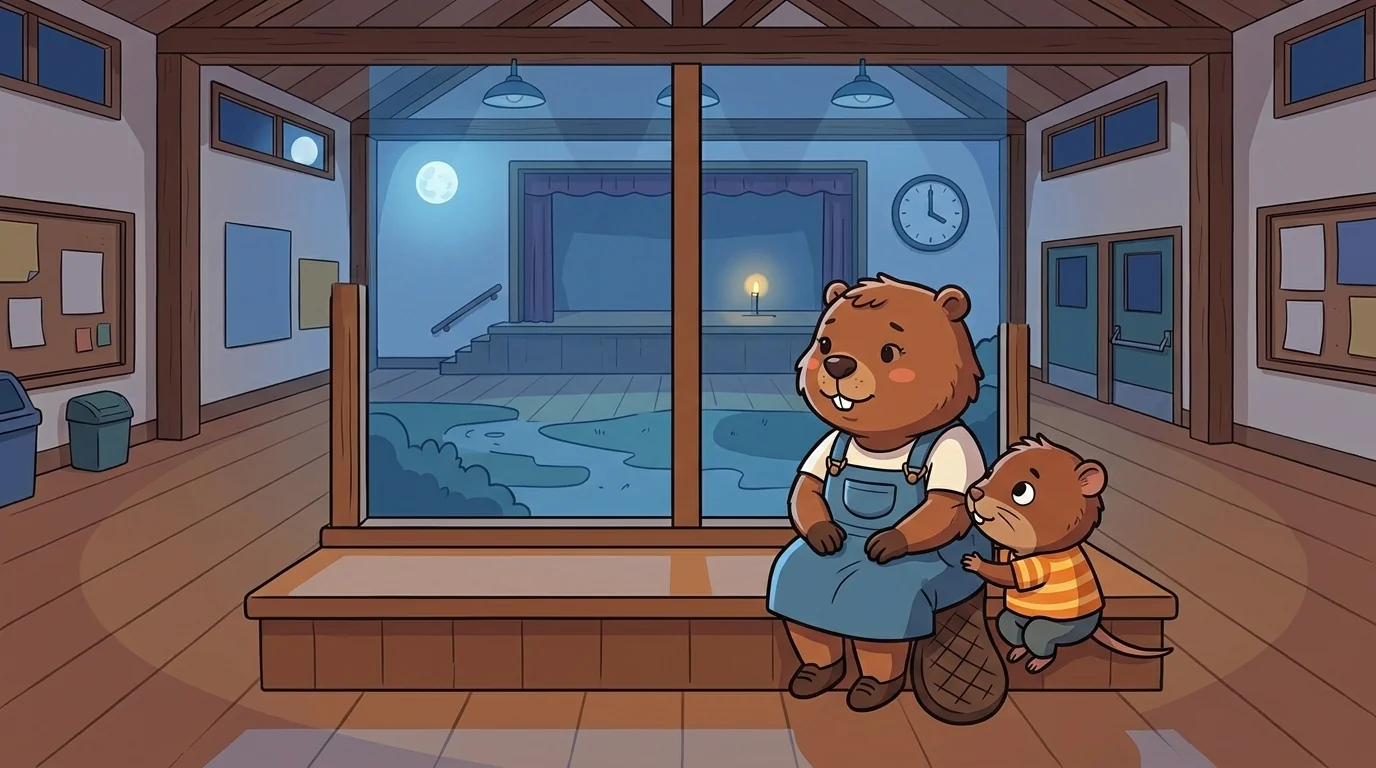
Later, when the dance hall was swept and the tiles were stacked away, Twoby sat by the window watching the moon and counting nothing in particular.
Bit climbed up beside her. "Can I ask you something? You always notice the one who's left over without a partner. Doesn't that make you sad? Being the one nobody paired with?"
Twoby was quiet for a while.
"When I was little, I thought being the leftover meant being forgotten," she said. "The odd one out. Nobody's two. But the tiles taught me something different." She smiled. "The leftover isn't the unimportant one. The leftover is the one that tells the truth. It's the leftover that proves what a whole crowd is really like — even or odd, possible or not. The one standing alone is the one everyone else's answer depends on."
She looked out at the quiet grounds, where somewhere a single light still burned.
And as Bit settled against her warm side, Twoby felt the gentle thing she always felt when she found a leftover — not loneliness, but a kind of tenderness. Being the one who doesn't quite pair up isn't being unwanted. Sometimes it's being the most important one in the room: the small, unmatched, easily-overlooked thing that quietly holds the whole truth.
The DiscreteQuest ensemble
Twoby the Pair-Matcher is part of DiscreteQuest's distributed-narrative cast. Each character embodies a different curricular primitive; together they teach the full subject.
-

Sortie the Set-Curator
Sets, subsets, set operations (union, intersection, difference)
-

Tally the Pattern-Counter
Counting principles and combinatorics (multiplication rule, permutations, combinations)
-

Verity the Truth-Tester
Propositional logic, truth tables, AND/OR/NOT operators
-

Wander the Bridge-Walker
Graph theory — Eulerian paths, Hamiltonian paths, connectivity
-

Coil the Self-Reference
Recursion and sequences (Fibonacci, factorials, recursive patterns)
-

Prime the Indivisible
Number theory — primes, factorization, modular arithmetic
-

Cubby the Cubby-Keeper
The pigeonhole principle — when there are more things than places, at least one place must hold two
-
Swatch the Border-Painter
Graph coloring — coloring connected things so no two neighbors match, with the fewest colors
-
Marshal the Line-Arranger
Permutations — counting arrangements where order matters (factorials, ordered choices)
-

Surge the Growth-Racer
Order of growth — how the work scales as a problem gets bigger