Wander the Bridge-Walker
GRAPH THEORY — *Eulerian paths, Hamiltonian paths, connectivity.* The discrete-math primitive of *vertices + edges as the structure of network problems.*
A story read by Wander the Bridge-Walker
Press play to listen along. The line being read lights up as you go.
Show full transcript
Loading transcript…
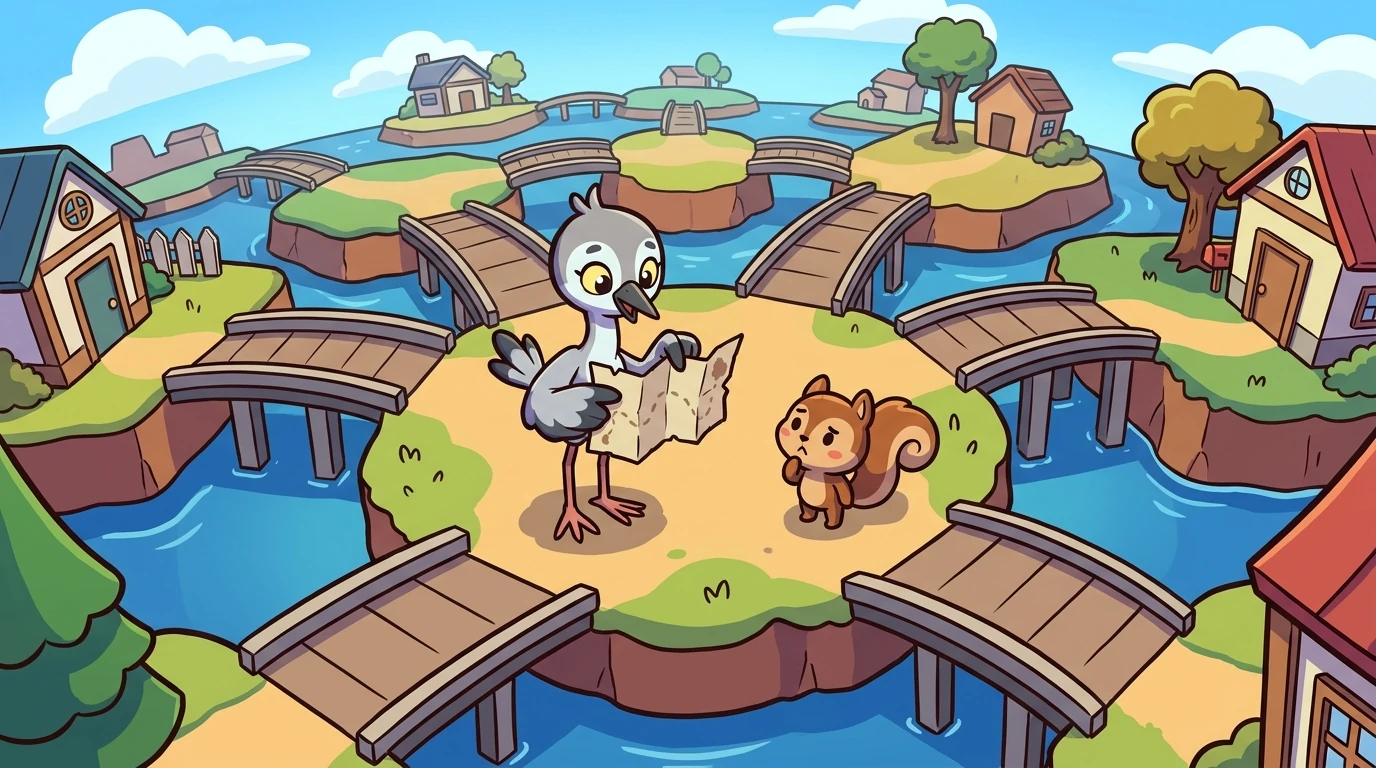
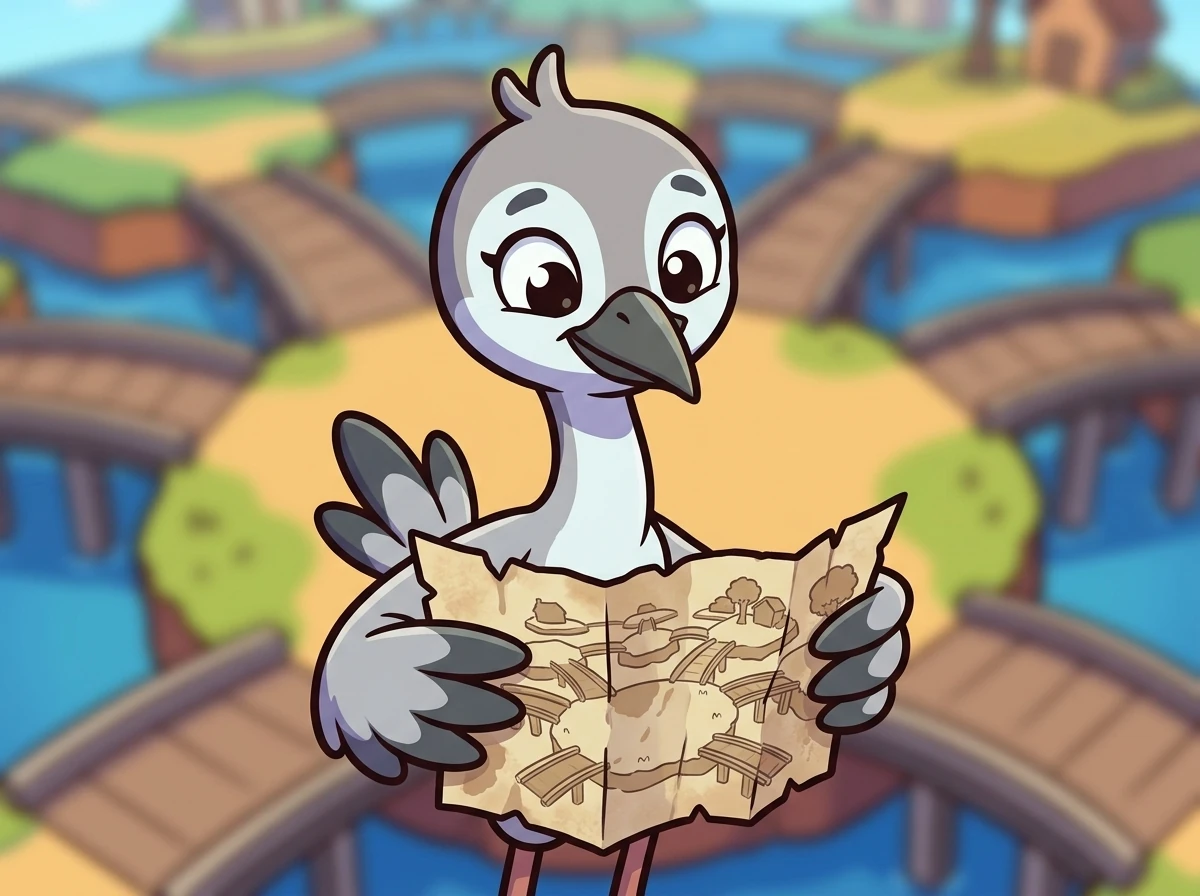
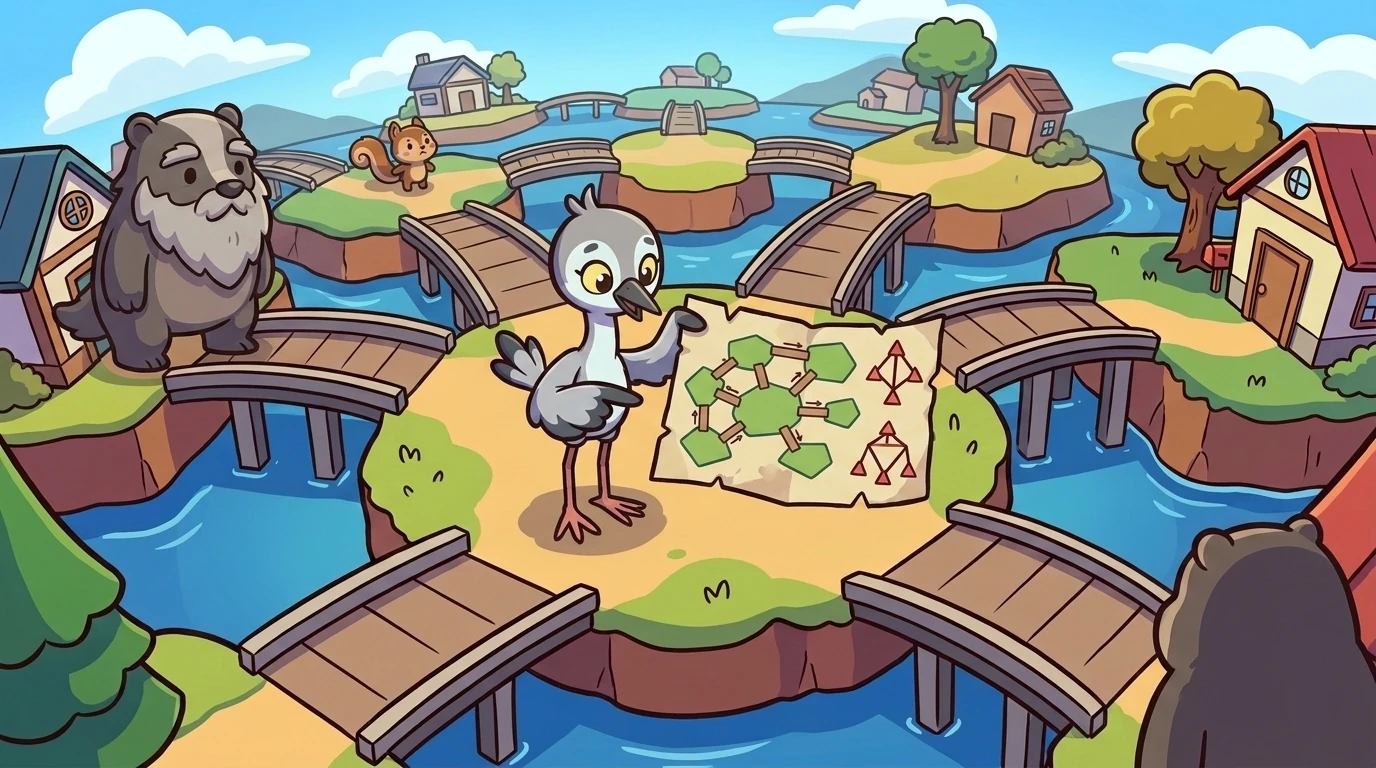
Wander was a crane-tween. She was small for her age. But her legs were long. She moved with careful, steady steps. Her grey-and-white feathers were always neat. In her hand, she always carried a small, folded map. It was old and crinkled. It was her most important thing.
The map showed an old town. It had many landmasses. These were like little islands. Bridges connected them. Wander called the landmasses vertices. She called the bridges edges. When Wander thought about a problem, she used her map. She would trace paths with her finger. Her finger would walk along the edges. It would stop at the vertices. This was her way of doing things.
One sunny afternoon, a new student named Pip watched Wander. Pip was a squirrel-kit. He looked confused. Wander was tracing a path on her map.
"What are you doing?" Pip asked. He tilted his head.
Wander looked up. Her eyes were bright. "I am walking the graph," she said. She held out her map. "See? These are vertices. They are the land bits. And these are edges. They are the bridges."
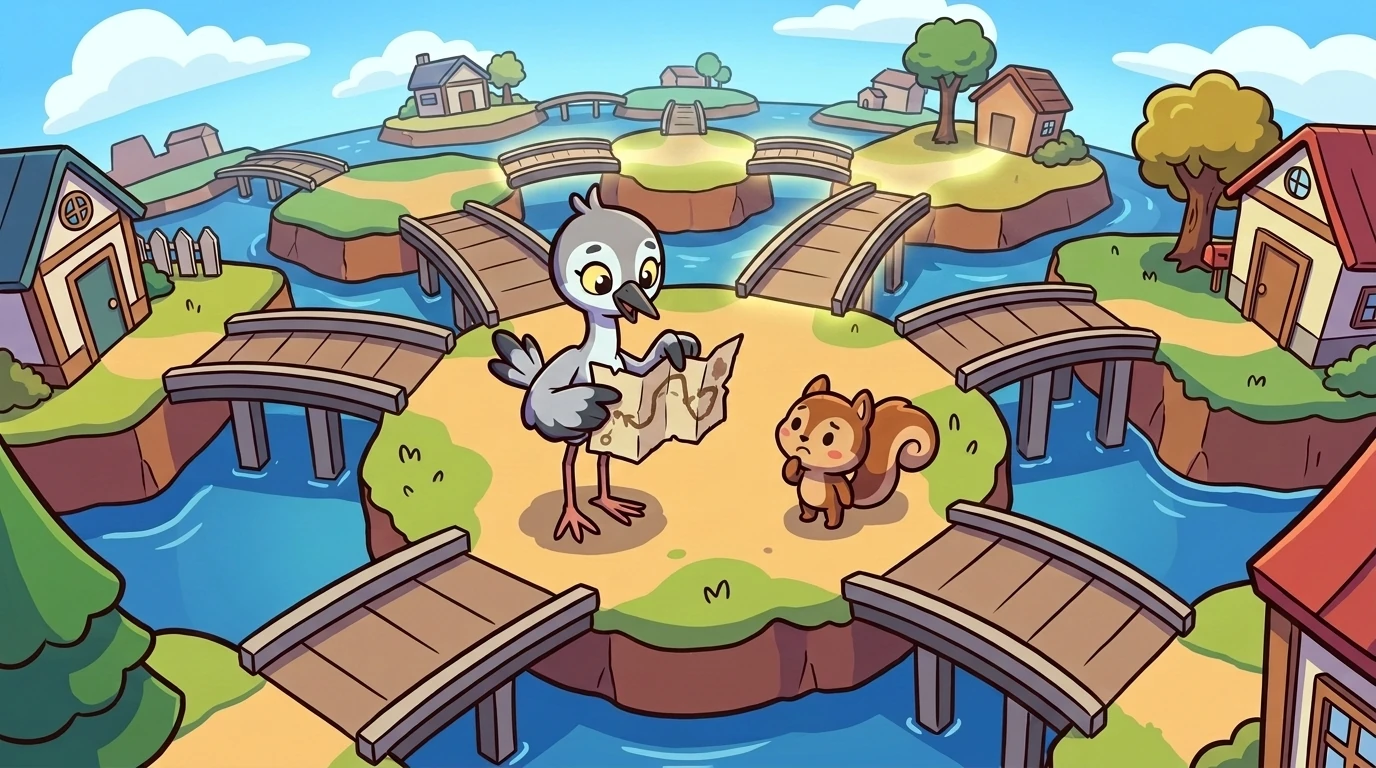
Pip peered at the map. "So, like, a subway map?" he asked.
"Exactly!" Wander nodded. "Or friends on a playground. Or even computers talking. They are all graphs."
"What's a graph?" Pip asked.
"It's simple," Wander said. She tapped the map. "It's just vertices connected by edges. That's all."
"Oh," Pip said. He still looked a little lost.
"Sometimes," Wander continued, "you want to visit every bridge. You want to walk every single edge. But only once." She traced a winding path. Her finger moved slowly. "If you can do that, it's called an *Eulerian path*."
Pip frowned. "Why would I want to do that?"
"Maybe you're a bridge inspector," Wander said. "You need to check every bridge. But you don't want to walk the same bridge twice. That would waste time." She smiled. "My family did that."
"What if you want to visit every land bit?" Pip asked. "Every vertex?"
"Ah, that's different!" Wander said. Her finger moved again. This time, it jumped from landmass to landmass. It touched each vertex. "If you visit every vertex exactly once, that's a *Hamiltonian path*. Very different rules."
"So, *Eulerian is about bridges," Pip said. "And Hamiltonian* is about land?"
"You got it," Wander said. "Walk every edge: *Eulerian. Walk every vertex: Hamiltonian. Different rules for different problems."
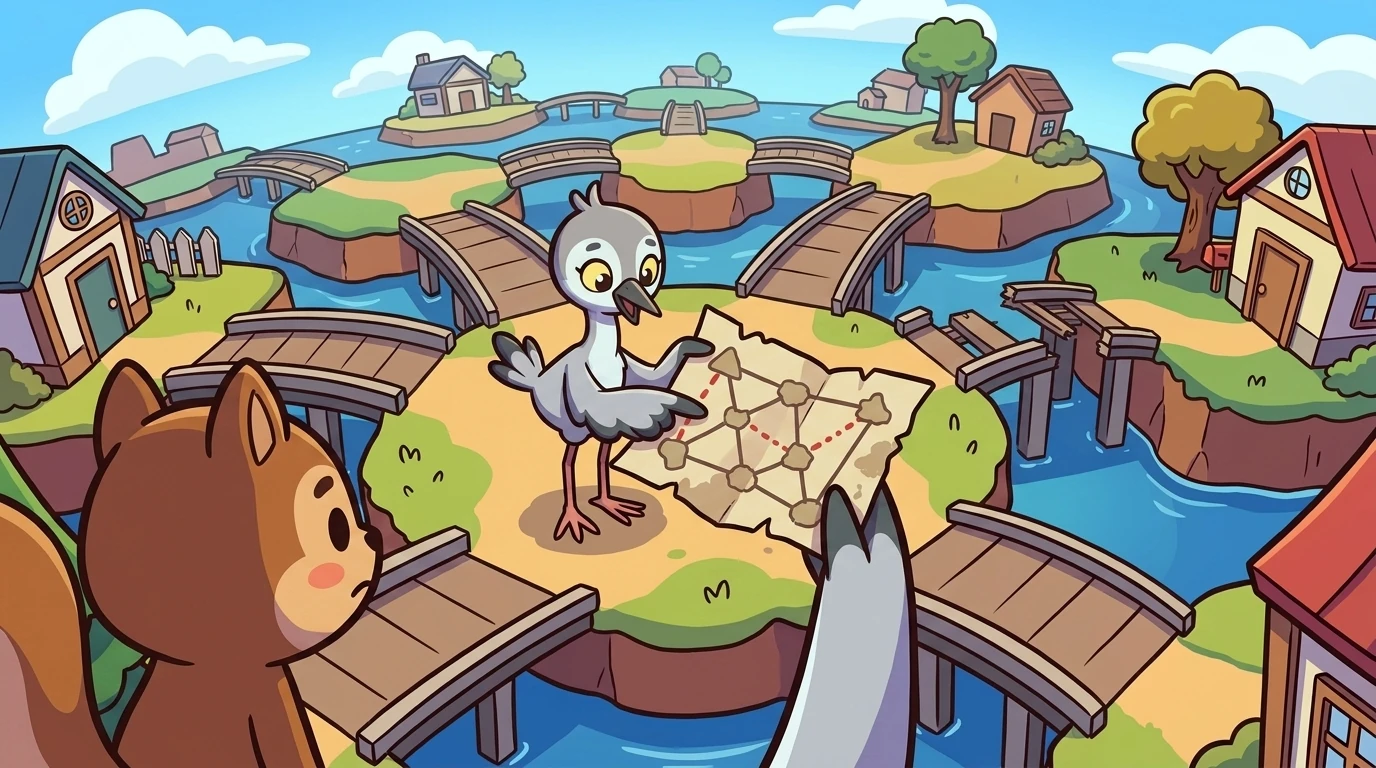
Wander grew up in a place called Bridge-Village. It was a funny name. But it made perfect sense. Bridges stretched everywhere. They crisscrossed over rivers. They connected tiny islands. Her family were the village's bridge-walkers. They were cranes, just like Wander.
Every morning, they had an important job. They walked the village's many bridges. They checked each one. Was this bridge safe? Could that one hold a cart? They recorded everything. Young Wander learned this job early. She learned to trace paths. She learned to see connections.
She loved her map. It was a hand-drawn copy. It showed every bridge. It showed every landmass. She knew the village's network by heart. She knew which paths were open. She knew which paths were closed.
Sometimes, a bridge would break. Then a part of the village became cut off. "Can you get from this island to that one?" her father would ask. Wander would look at her map. She would trace with her finger. "No," she might say. "Not anymore. That bridge is out."
This was about connectivity. Can you get from any vertex to any other vertex? If you can't, the graph is disconnected. Some places are unreachable. Wander understood this deeply. She saw it every day.
When Wander was older, she heard about DiscreteQuest. It was a special school. She walked a long way to get there. The head mentor was a wise old owl. He looked at her carefully.
"What is graph theory?" the mentor asked. His voice was deep.
Wander held out her map. "It's vertices and edges," she said. Her voice was clear. "You walk every edge, or you walk every vertex. They are different rules. It's how you solve network problems."
The mentor smiled. "You are appointed," he said.
Wander never thought these things were hard. She just saw them. She saw the paths. She saw the connections. "It's not hard," she always said. "It's just vertices and edges. And you walk the paths."
Sometimes, the edges had arrows. "That means you can only go one way," she would explain. "Like a one-way street. Those are directed edges." If there were no arrows, you could go both ways. Those were undirected edges.
She showed how a path was just a sequence of vertices. You moved from one to the next. You followed the edges. She showed how some graphs had no cycles. They were like trees. You could not go in a circle.
Wander helped anyone who asked. She made everything simple. She made it real. She used her map. She used her finger. She showed them the way.
The DiscreteQuest ensemble
Wander the Bridge-Walker is part of DiscreteQuest's distributed-narrative cast. Each character embodies a different curricular primitive; together they teach the full subject.
-

Sortie the Set-Curator
Sets, subsets, set operations (union, intersection, difference)
-

Tally the Pattern-Counter
Counting principles and combinatorics (multiplication rule, permutations, combinations)
-

Verity the Truth-Tester
Propositional logic, truth tables, AND/OR/NOT operators
-

Coil the Self-Reference
Recursion and sequences (Fibonacci, factorials, recursive patterns)
-

Prime the Indivisible
Number theory — primes, factorization, modular arithmetic
-

Cubby the Cubby-Keeper
The pigeonhole principle — when there are more things than places, at least one place must hold two
-

Swatch the Border-Painter
Graph coloring — coloring connected things so no two neighbors match, with the fewest colors
-
Marshal the Line-Arranger
Permutations — counting arrangements where order matters (factorials, ordered choices)
-

Twoby the Pair-Matcher
Parity and invariant arguments — even/odd pairing that proves what's possible
-

Surge the Growth-Racer
Order of growth — how the work scales as a problem gets bigger