Sortie the Set-Curator
SETS + SET OPERATIONS — union, intersection, difference; sets are collections, and operations on sets produce new collections.
A story read by Sortie the Set-Curator
Press play to listen along. The line being read lights up as you go.
Show full transcript
Loading transcript…
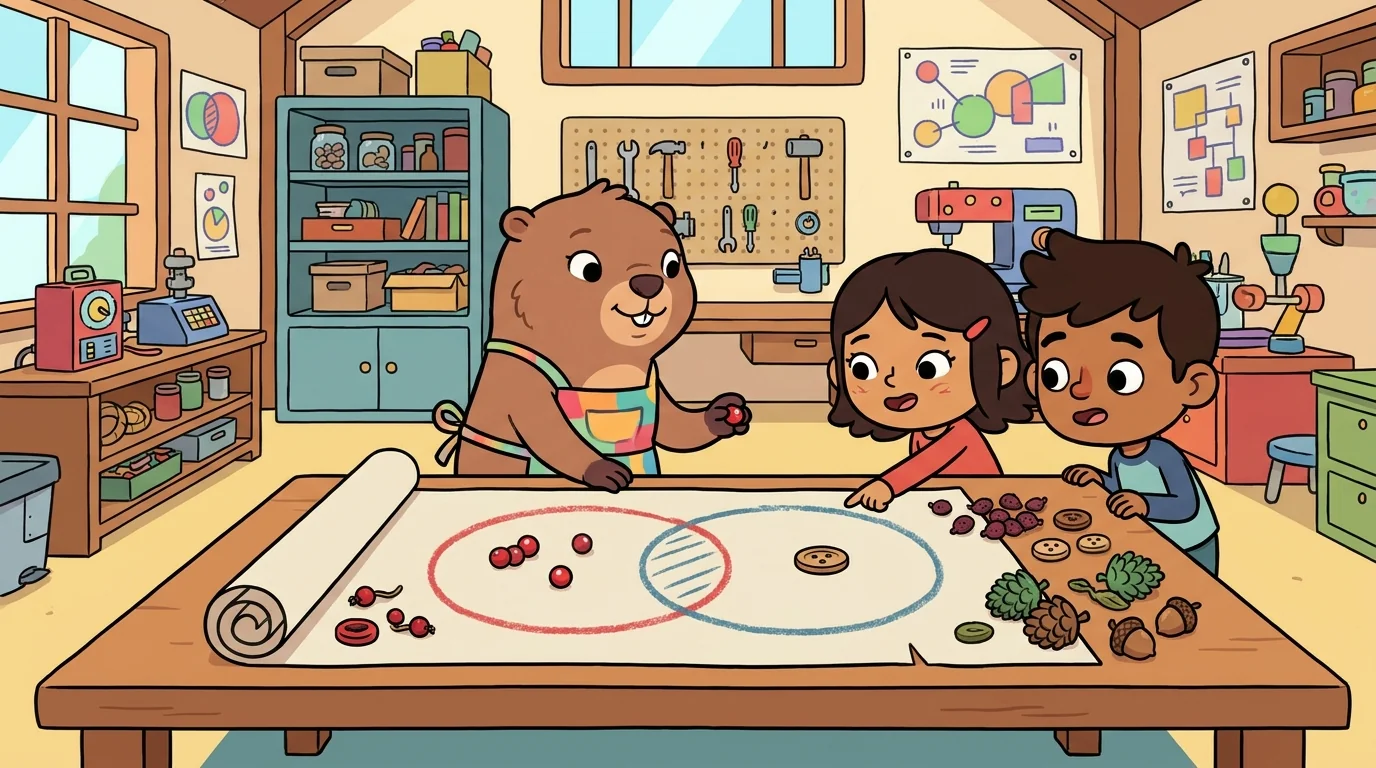
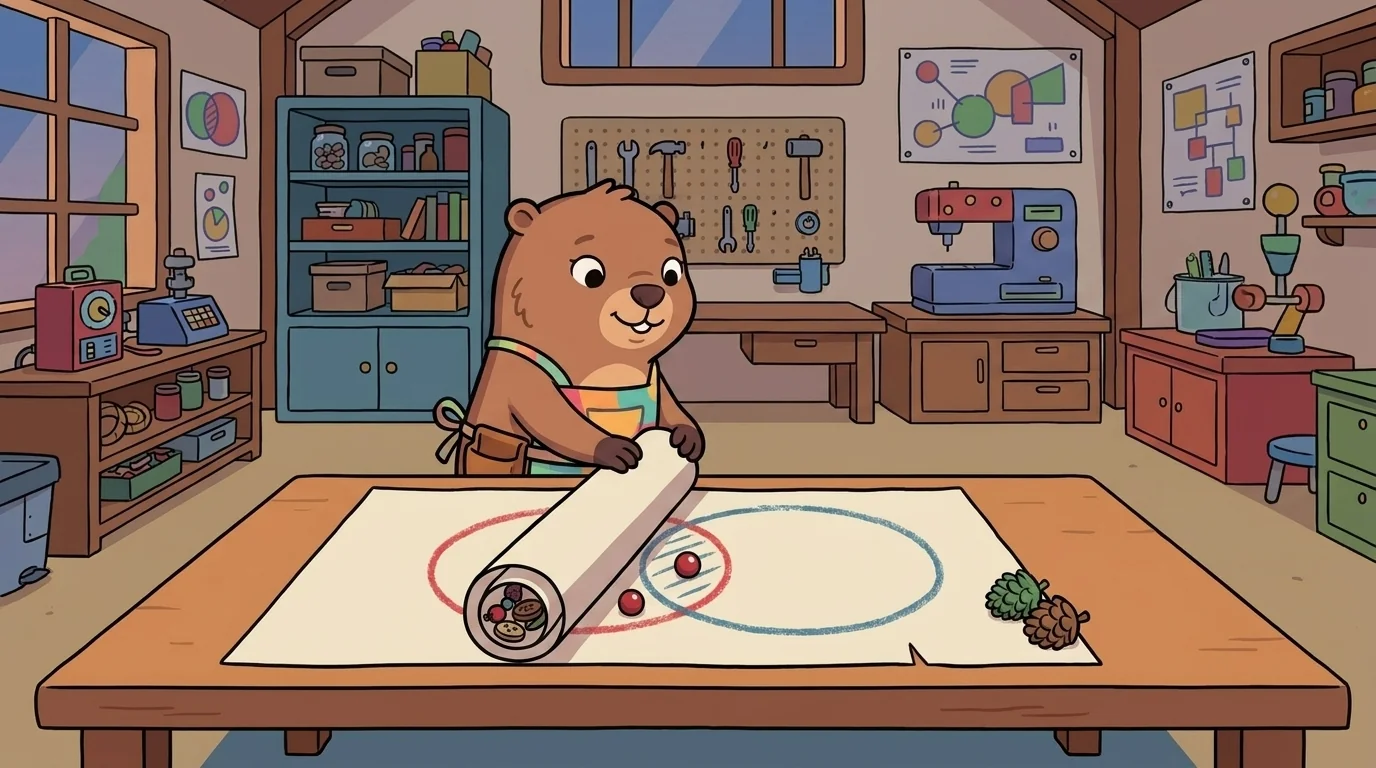
On the longest table in the DiscreteQuest workshop, a marmot-tween named Sortie unrolled a mat with two big chalk circles on it and started dropping acorns into them, one at a time, without saying a word.
Two kids leaned over the table to watch. She had labeled one circle RED and the other ROUND, and she was sorting a pile of buttons, beads, and dried berries into it. A red bead went into the RED circle. A round wooden button went into the ROUND circle. Then she picked up a small red marble — and set it right in the middle, where the two circles overlapped.
"You put it in both," a girl said.
"I put it where it belongs," Sortie said. "It's red and round. So it goes in the part where red and round agree." She tapped the overlap. "This little lens-shaped bit in the middle? That's the stuff that's in both groups at once. Nothing else fits there."
She kept going. A green pinecone — not red, not round — she placed on the bare mat outside both circles.
"That one's out in the cold," the boy said.
"It's just not in either group," Sortie said, not unkindly. "That's allowed. Being in no circle is still an answer." She sat back and looked at the whole mat, all its little regions filled. "See? I didn't do anything clever. I made two groups, and then I asked each thing one honest question: which circles are you in? Both, one, or none. That's the whole trick. Everything after this is just that, done carefully."
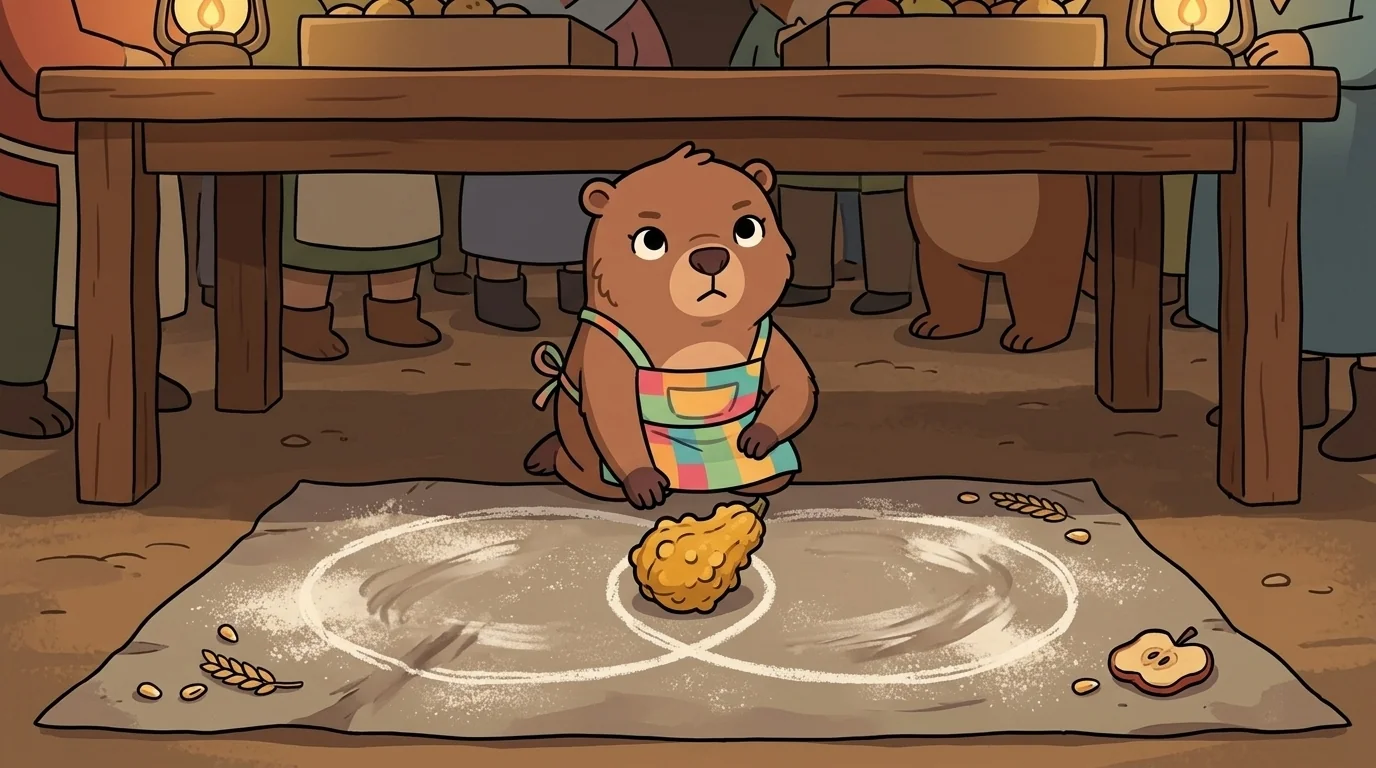
Sortie learned to sort before she learned it had a name.
Her family, back in her home village, were the ones who put away the harvest each autumn. Root vegetables in one cellar, grains in another, dried fruit in a third. Simple enough — until the year the whole village brought in a strange knobbly squash that was somehow both a keeper-vegetable and a thing that dried well. The elders argued for an hour. Cellar one or cellar three? Put it in the wrong place and half of it might rot.
Little Sortie had sat under the sorting-table, tummy twisted up, listening to the grown-ups get louder. It felt like the squash was a problem with no right answer, and everyone was upset, and she couldn't fix it.
Then her aunt knelt down, spread out a cloth, and drew two loops in the flour dust. "Keepers here. Driers here." She set the knobbly squash right where the loops crossed. "It's in both. So we take a little from it for each. We don't have to choose. We just have to see that it belongs to two groups."
The knot in Sortie's stomach loosened all at once. The squash wasn't a fight. It was just an overlap. Once you drew the loops, the scary argument turned into a quiet, obvious picture — and pictures, she found, she could sit with.
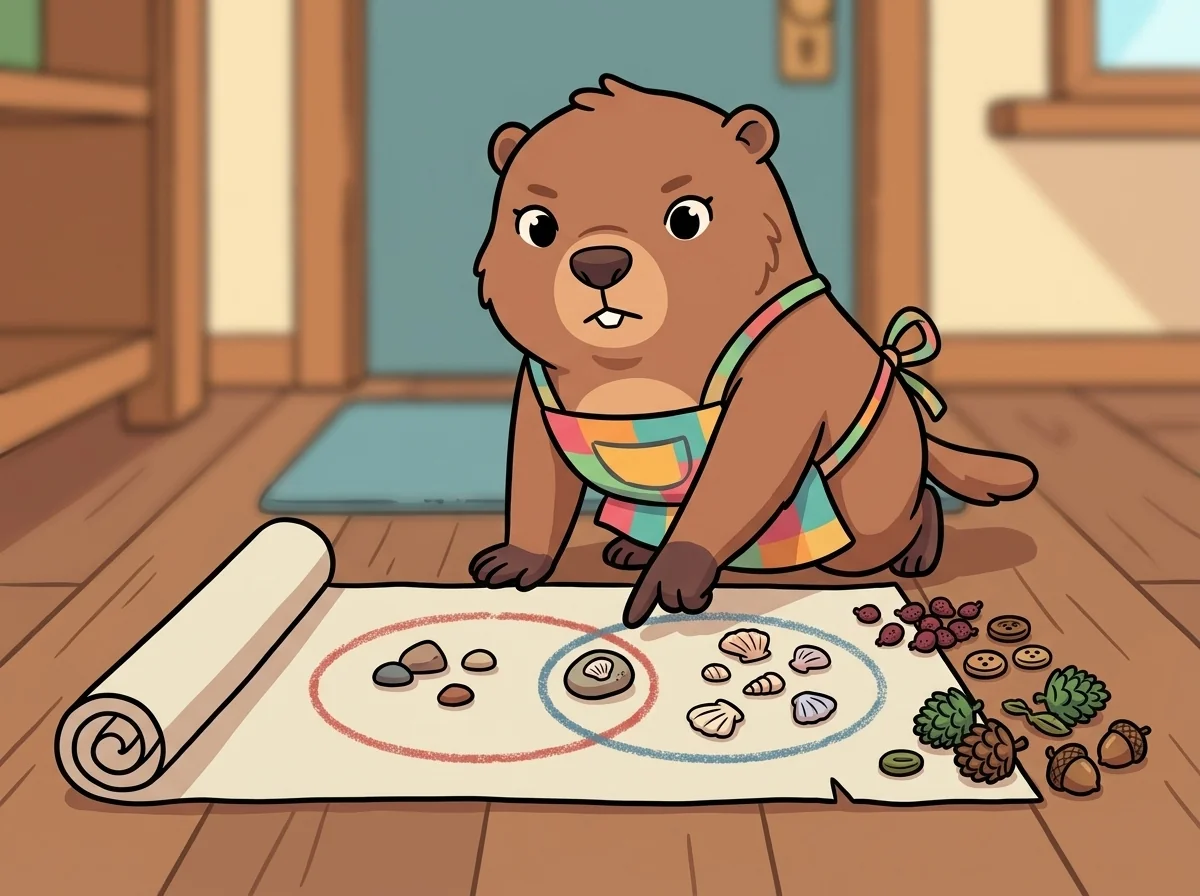
She walked to DiscreteQuest when she was old enough to carry her own folding mat, because a place that studied patterns ought to have room for someone who thought in circles and loops.
The mentor met her at the door and asked only one thing. "What is a set?"
Sortie didn't answer with a speech. She unrolled her mat on the entryway floor, dropped a handful of pebbles into one circle and a handful of shells into another, and nudged a single pebble-that-was-also-a-shell into the overlap between them.
"A set is just a group of things you've decided to gather," she said. "These are two of them. And this—" she pointed to the middle "—is the part they share. I can combine the groups, or find where they overlap, or find what one has that the other doesn't. I don't need to be smart. I need to be able to see."
The mentor looked at the little mat for a long moment. "You belong here," he said.
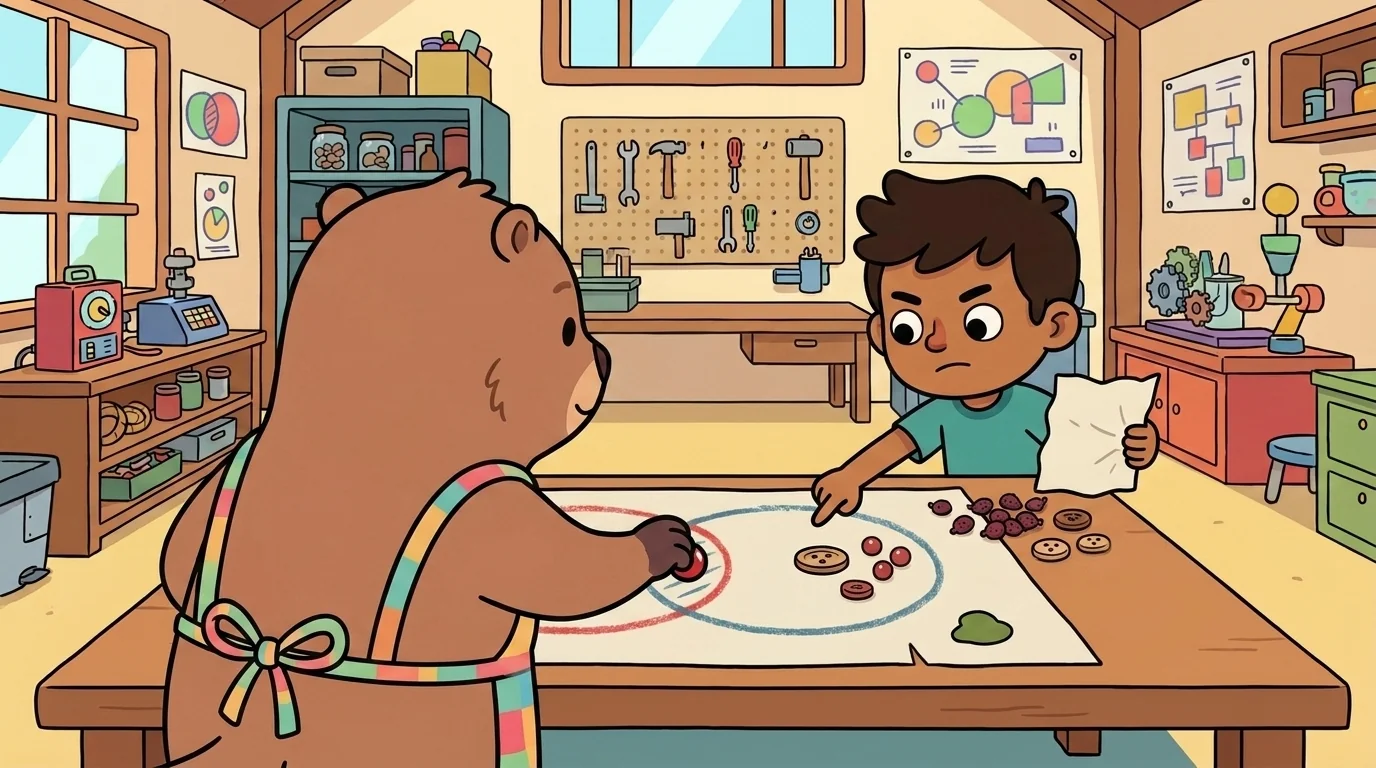
Sortie's workshop filled up fast with kids who had jumbles they couldn't untangle.
One afternoon a boy came in gripping two crumpled lists. "It's the class trip," he said, miserable. "This is who wants the museum. This is who wants the aquarium. Some kids signed both, some signed neither, and I'm supposed to figure out how many people total and who to email and I—" He waved the papers. "It's just a mess."
Sortie knew that waving. She'd felt it under the sorting-table. "Put them down," she said, and unrolled her mat. "Two circles. Museum, aquarium. Read me a name."
"Priya. She's on both lists."
"Overlap. Middle." He set a token in the lens. "Next."
"Marcus — museum only."
"Museum circle, but only the part that doesn't overlap. Next." One by one the names became tokens, and the mess spread out into clear little regions. When the lists were empty, the mat just... showed it. Plain as anything.
"Now count," Sortie said. "Everybody in either circle — that's your total for the trip. That's the union. The kids in the middle — they'll go either day, so email them last. The kids outside both circles—" she pointed to two lonely tokens on the bare mat "—those two never signed up at all. You'd have missed them."
The boy stared at the two tokens. "I would have. I'd have totally forgotten them." He looked up. "How did you make it that easy?"
"I didn't make it easy," Sortie said. "It was always this simple. It just didn't look simple, all crumpled up in your hands. Circles don't add anything. They only let you see what was already true."
Later, when the workshop had gone quiet, the boy lingered by the door with the two lists smoothed flat and one more question.
"When it was all folded up in my pocket," he said slowly, "it felt impossible. Like too much. But it was the same information the whole time, wasn't it? Nothing changed except... I could see it."
Sortie thought about the flour dust, and the loosening knot, and her aunt's two loops.
"Nothing changed but the seeing," she agreed. "That's most of the messes there are, you know. They're not too big. They're just not laid out yet." She rolled her mat back up, slow and careful, and tucked it into her belt-pouch. "Any time your head gets that tight, crowded, too-much feeling — that's not the problem being impossible. That's just the picture not drawn yet. Find the circles. Ask each thing which ones it's in. And watch the whole knot come loose."
The boy nodded, and Sortie saw the tightness go out of his shoulders — the same quiet way, years ago, hers had gone loose under a sorting-table, watching a squash find its place in the overlap of two flour-dust loops.
The DiscreteQuest ensemble
Sortie the Set-Curator is part of DiscreteQuest's distributed-narrative cast. Each character embodies a different curricular primitive; together they teach the full subject.
-

Tally the Pattern-Counter
Counting principles and combinatorics (multiplication rule, permutations, combinations)
-

Verity the Truth-Tester
Propositional logic, truth tables, AND/OR/NOT operators
-

Wander the Bridge-Walker
Graph theory — Eulerian paths, Hamiltonian paths, connectivity
-

Coil the Self-Reference
Recursion and sequences (Fibonacci, factorials, recursive patterns)
-

Prime the Indivisible
Number theory — primes, factorization, modular arithmetic
-

Cubby the Cubby-Keeper
The pigeonhole principle — when there are more things than places, at least one place must hold two
-
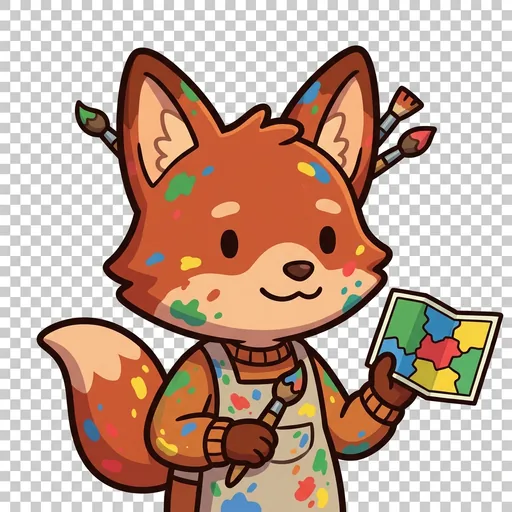
Swatch the Border-Painter
Graph coloring — coloring connected things so no two neighbors match, with the fewest colors
-
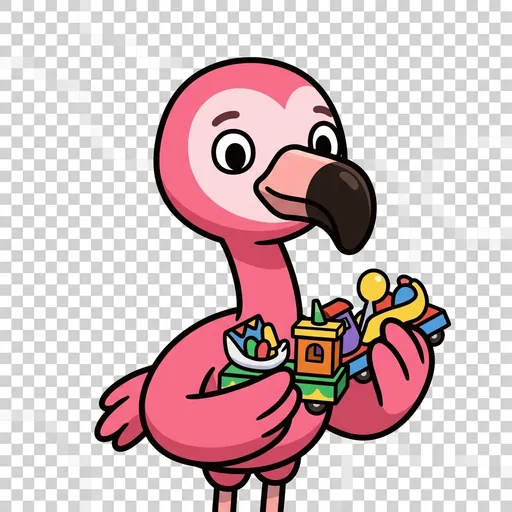
Marshal the Line-Arranger
Permutations — counting arrangements where order matters (factorials, ordered choices)
-

Twoby the Pair-Matcher
Parity and invariant arguments — even/odd pairing that proves what's possible
-

Surge the Growth-Racer
Order of growth — how the work scales as a problem gets bigger