
Cubby the Cubby-Keeper
THE PIGEONHOLE PRINCIPLE — if you have more things than places to put them, then at least one place must hold more than one thing. You can be certain of it without ever looking inside.
A story read by Cubby the Cubby-Keeper
Press play to listen along. The line being read lights up as you go.
Show full transcript
Loading transcript…
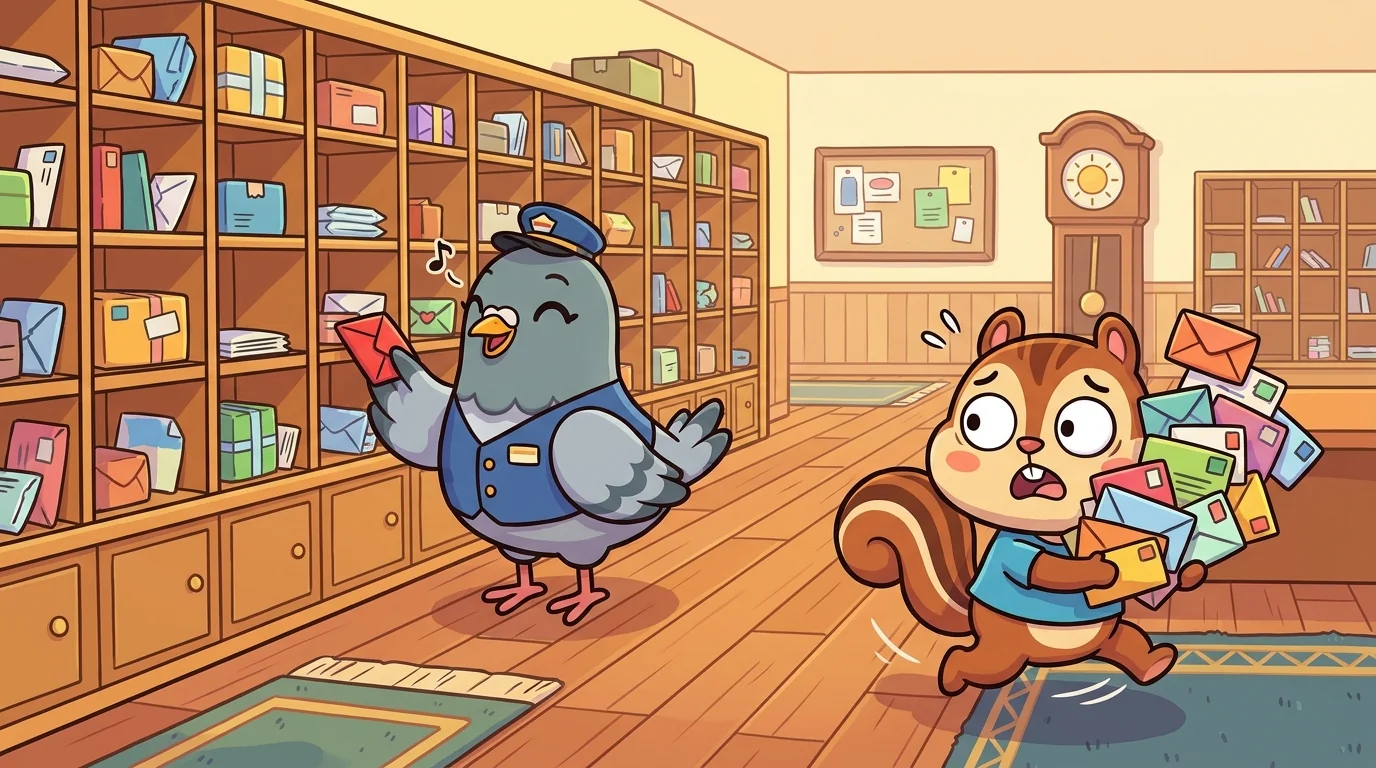
Cubby was a soft grey pigeon, and the most important thing in her life was a wall.
It was the message wall at the DiscreteQuest academy — rows and rows of little open boxes, one for each student, where notes and parcels waited to be picked up. The students called the little boxes cubbies, which is exactly how Cubby got her name. She knew every box by heart. She tucked letters into them with quick, neat pushes of her beak, humming as she worked.
One morning a flustered chipmunk named Tuck came skidding up with his arms full of envelopes.
"Cubby! The morning post is a disaster. I've got thirteen letters and I don't know whose is whose yet — but they all have to go up on the wall, and the wall only has twelve cubbies free."
Cubby didn't even look at the letters. She just smiled.
"Then one cubby is going to end up with two," she said.
Tuck blinked. "You didn't count them. You didn't even look at the wall."
"Didn't need to," Cubby said. "Thirteen letters. Twelve cubbies. There's no way to spread thirteen things across twelve places without doubling up somewhere. I don't know which cubby gets two. But I know one of them must. I'd bet my breakfast on it."
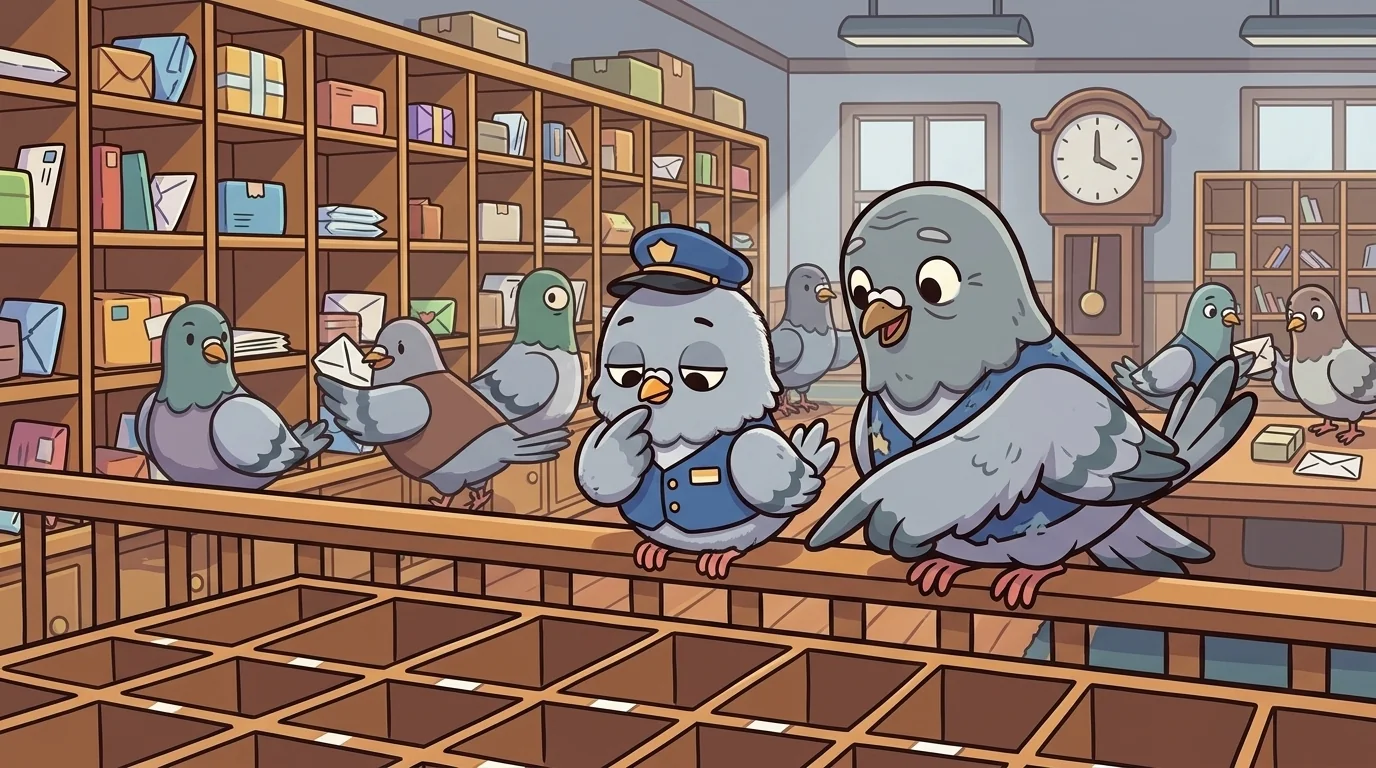
Cubby had felt that strange, sure feeling for as long as she could remember.
She had grown up in a great noisy roost above a mail-house, where her family sorted letters from dawn till dusk. As a chick she used to worry herself sick trying to see every letter land before she could relax. Then one grey afternoon her grandmother set her on the railing and said, "Stop watching the letters, little one. Watch the numbers."
Her grandmother pointed a wing at the sorting shelves. "Count the slots. Count the letters. If there are even one more letter than slot, then no matter how cleverly anyone sorts — no matter who tries — at least one slot has to hold a double. You don't have to chase it down to know it's there."
Cubby remembered the feeling that washed over her: not excitement, exactly. Something quieter. A kind of steadiness. The world had a rule in it that would always hold, and she could lean on it. She didn't have to see everything to be sure of something. She just had to count.
From then on she stopped chasing letters. She counted slots, and she rested.
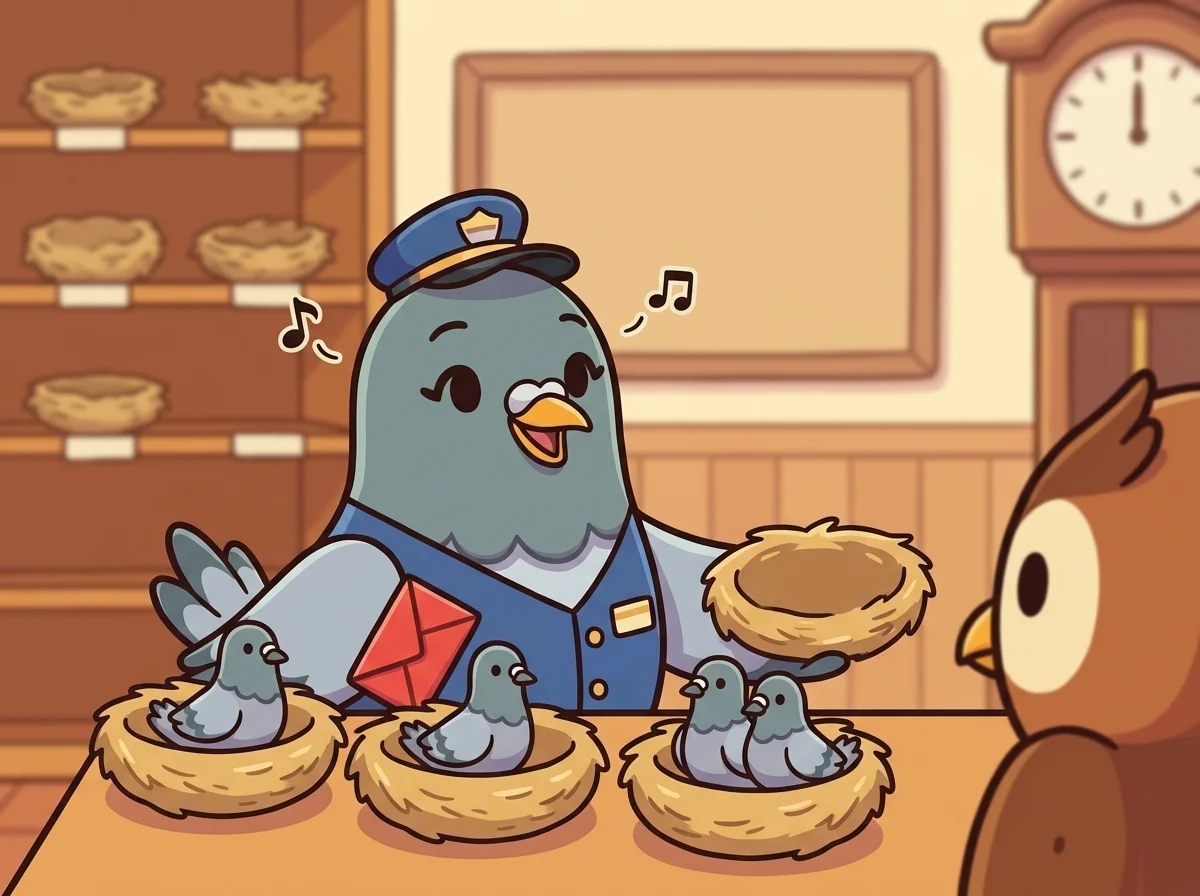
When Cubby was older she walked the long road to DiscreteQuest, because she had heard it was a place that loved sure things.
The head of the academy was an old owl with slow, kind eyes. He peered down at the small grey pigeon and asked, in his deep voice, "What is the pigeonhole principle?"
Cubby didn't fidget. "It's the surest little rule I know," she said. "If you have more things than places to put them, then at least one place has to hold more than one thing. Put five birds in four nests, and some nest has two birds. Put thirteen letters in twelve cubbies, and some cubby has two letters. You never have to look to find out that it happens. It just has to."
The owl tilted his head. "And if the things and the places are equal?"
"Then maybe everyone gets their own," Cubby said. "The rule only bites when there's one too many. One extra is all it takes." She ruffled her feathers. "Pigeons named the principle, you know. We've been overcrowding cubbies since the beginning of time."
The owl's eyes crinkled. "You are appointed," he said.
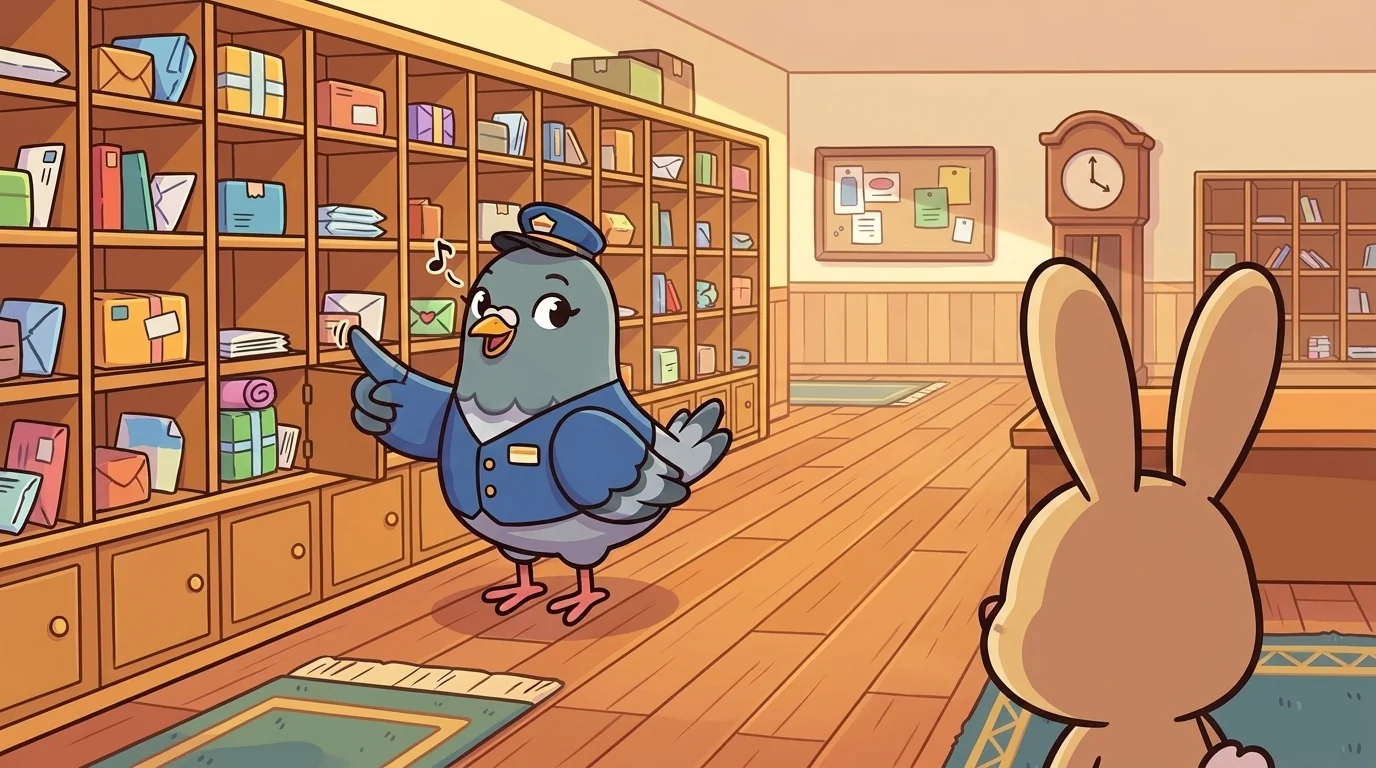
Cubby's favourite thing was showing a doubtful student how certain the rule could make them feel.
A young hare named Lop once came to her, gloomy. "We've got seven friends coming to the sleepover," he said, "and only six sleeping-mats. I keep counting and recounting, hoping I miscounted."
"You didn't miscount," Cubby said gently. "Seven friends, six mats. Somebody is sharing tonight — that's certain. But here's the thing, Lop." She hopped along her wall, tapping cubbies. "Certain isn't the same as bad. You don't know yet who will share. You get to decide that part. The rule only promised you a double; it didn't say it had to be a problem."
Lop thought about it. "So... two of my friends are definitely going to be squished together on one mat."
"Definitely," Cubby agreed. "And the two squished friends are probably going to whisper and giggle half the night and have the best time of anyone." She nudged him with a wing. "More things than places isn't always a disaster. Sometimes it's just how you end up sitting close to someone."
Lop went home a great deal less gloomy.
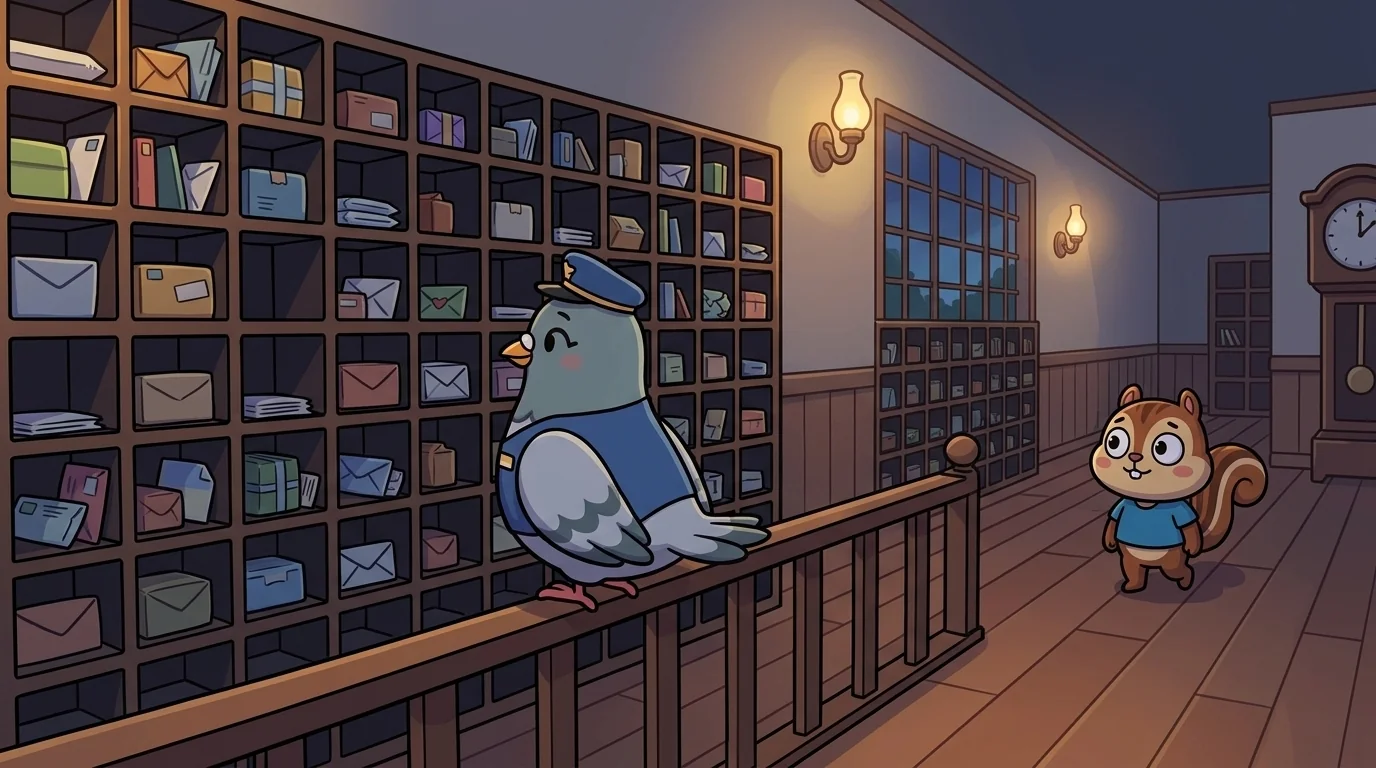
Later, when the academy had gone quiet and the last letters were tucked away, Cubby sat on her railing and looked at her wall of cubbies in the dim light.
Tuck wandered back through, the morning's chaos long over. "I found it, by the way," he said. "The doubled cubby. Number five had two letters, just like you said. How does it not drive you crazy — knowing something's true but not knowing exactly where?"
Cubby was quiet for a moment.
"It used to," she admitted. "When I was small I thought I had to see everything, hold everything, check everything, or I couldn't be calm. But the wall taught me different. There are some things you can be sure of just by counting — and being sure of one true thing, even a small one, is enough to let you breathe."
She looked out at the dark rows of boxes, each one holding somebody's letters, somebody's news, somebody waiting to be remembered.
And as Tuck said goodnight and the wall settled into shadow, Cubby felt the old steadiness come over her again — that soft, certain warmth that had nothing to do with letters or cubbies at all. It was just the quiet comfort of knowing that in a full enough room, nobody ever truly ends up alone. Somebody is always, always sharing.
The DiscreteQuest ensemble
Cubby the Cubby-Keeper is part of DiscreteQuest's distributed-narrative cast. Each character embodies a different curricular primitive; together they teach the full subject.
-

Sortie the Set-Curator
Sets, subsets, set operations (union, intersection, difference)
-

Tally the Pattern-Counter
Counting principles and combinatorics (multiplication rule, permutations, combinations)
-

Verity the Truth-Tester
Propositional logic, truth tables, AND/OR/NOT operators
-

Wander the Bridge-Walker
Graph theory — Eulerian paths, Hamiltonian paths, connectivity
-

Coil the Self-Reference
Recursion and sequences (Fibonacci, factorials, recursive patterns)
-

Prime the Indivisible
Number theory — primes, factorization, modular arithmetic
-
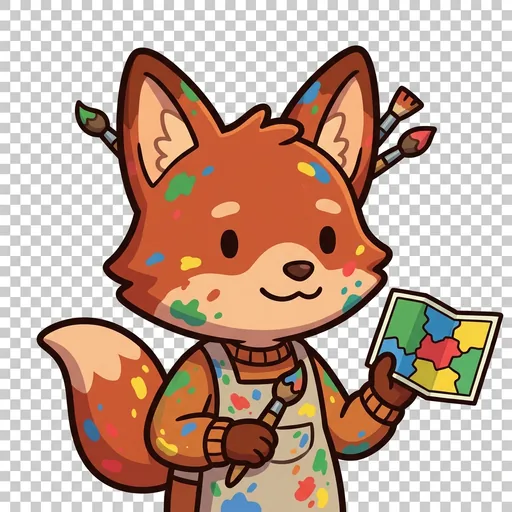
Swatch the Border-Painter
Graph coloring — coloring connected things so no two neighbors match, with the fewest colors
-
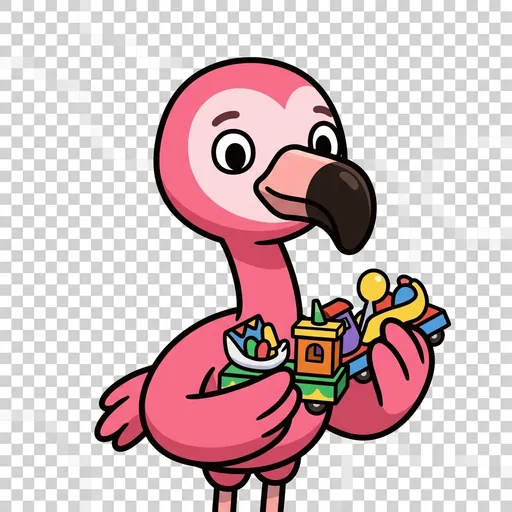
Marshal the Line-Arranger
Permutations — counting arrangements where order matters (factorials, ordered choices)
-

Twoby the Pair-Matcher
Parity and invariant arguments — even/odd pairing that proves what's possible
-

Surge the Growth-Racer
Order of growth — how the work scales as a problem gets bigger