
Swatch the Border-Painter
GRAPH COLORING — when some things are connected and mustn't match, you give each one a color so that no two connected things share the same color, using as few colors as you can. It's how you schedule, sort, and keep neighbors from clashing.
A story read by Swatch the Border-Painter
Press play to listen along. The line being read lights up as you go.
Show full transcript
Loading transcript…
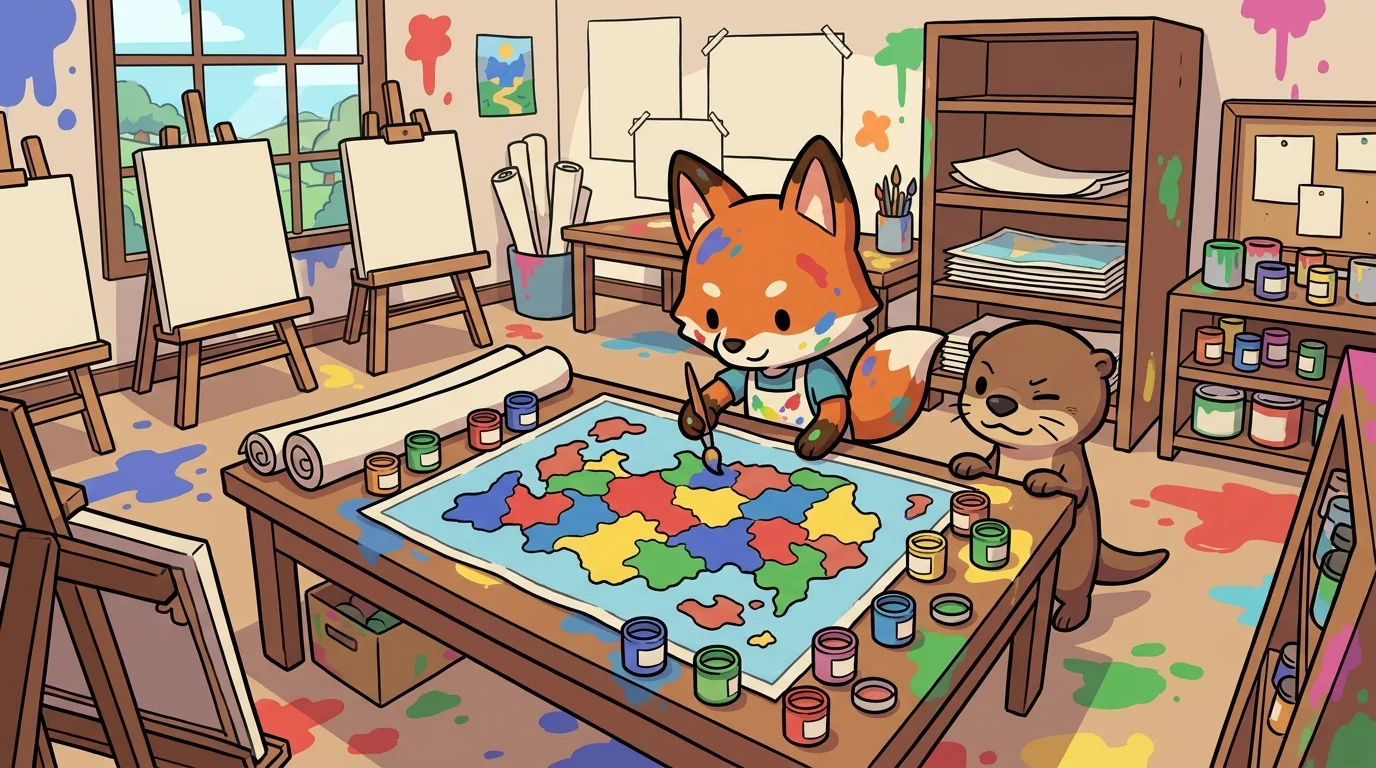
Swatch was a small, paint-spattered fox, and she could not stand to see two neighbors wearing the same color.
At the DiscreteQuest academy she kept a workshop full of little pots of paint, and her favourite job was coloring maps. Not just any way — her way. She would look at a map of regions all crammed together, and she would color them so that no two regions that touched ever shared a color. Touching meant sharing a border, a real edge, side by side. Regions that only met at a single corner-point didn't count as touching, and regions far apart could match all they liked.
A young otter named Briar watched her dab a tricky map one afternoon.
"Why's that one green?" Briar asked. "There's already a green over there."
"Because that green is far away and doesn't share a border with this one," Swatch said, not looking up. "I only care about what touches. Two regions that share an edge can never wear the same color — that's the one rule I never break. But two regions that never touch? They can twin all day. I don't mind."
Briar squinted at the map. "So you're not really coloring the map. You're coloring the touching."
Swatch finally looked up, delighted. "Now you understand my whole life."
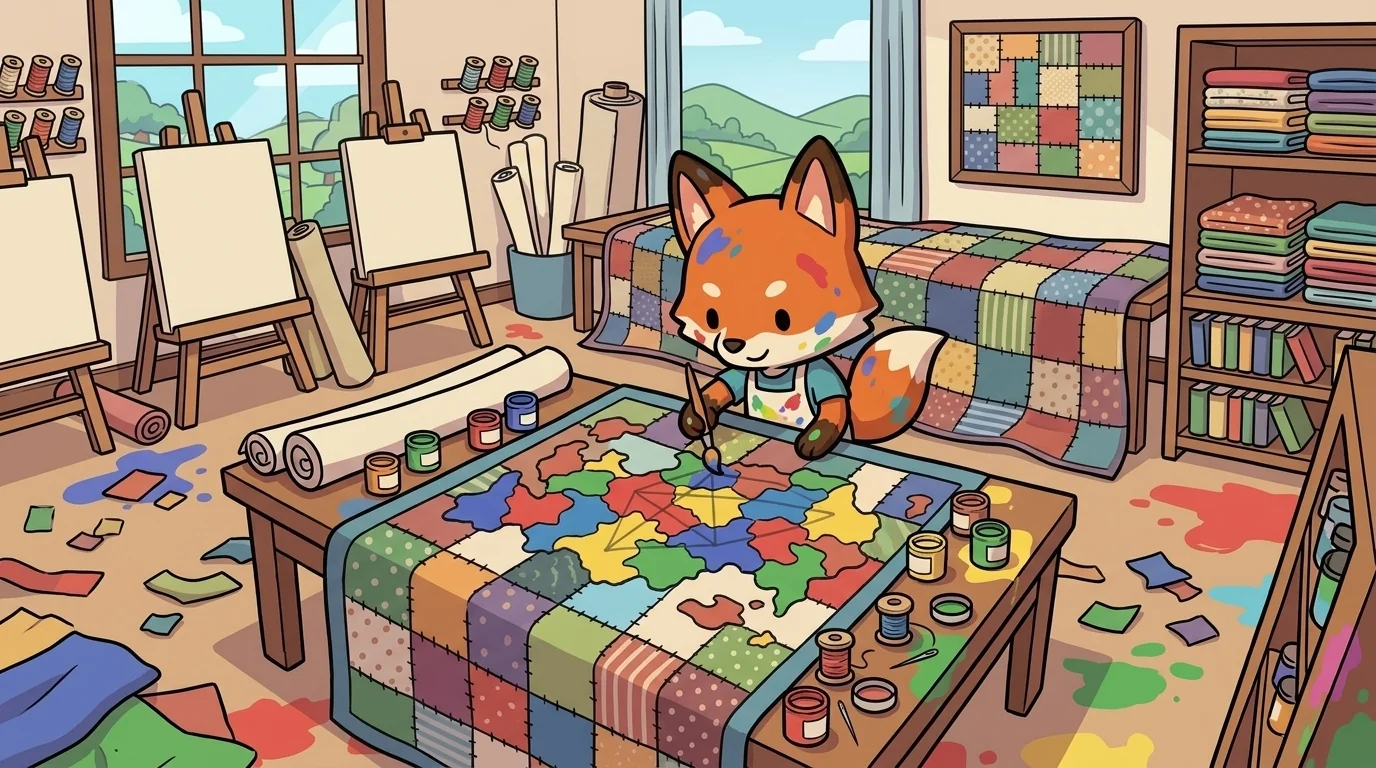
Swatch had learned to see touching long before she learned to see anything else.
She'd grown up in a family of quilt-makers, in a workshop where scraps of cloth were stitched edge to edge into enormous blankets. Her mother had one unbreakable rule: no two patches that touched along a seam could be the same color, or the whole quilt went muddy and the pattern disappeared. Little Swatch spent years laying out patches, sliding them around, hunting for clashes.
The day everything clicked, she'd been stuck on a corner where four patches all crowded together. She kept running out of colors. Then she stopped staring at where the patches were and started drawing little lines — one line between every two patches that shared a seam. Suddenly the puzzle wasn't about cloth at all. It was about the lines. About which patch was tied to which.
"It's not the patches," she whispered to herself. "It's what's joined."
Once she saw the joins, the colors fell into place. She found she could almost always do it with very few colors — often just three or four, even for a quilt with hundreds of patches. The trick was never the painting. The trick was seeing what touched what.
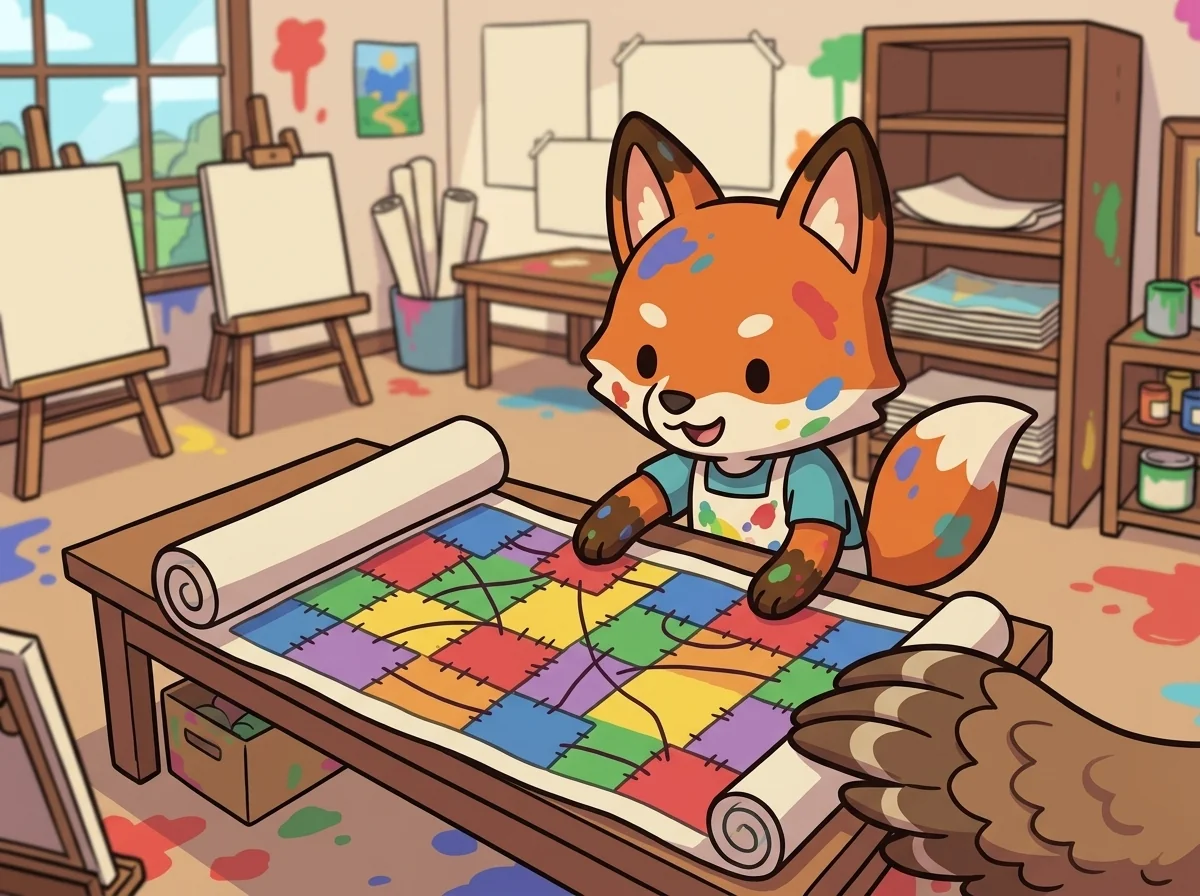
When she was older, Swatch carried a roll of her quilts all the way to DiscreteQuest, because she'd heard it was a school that cared about how things connect.
The head of the academy, an old owl with a slow, warm voice, unrolled one of her blankets and studied it. "What is graph coloring?" he asked.
Swatch answered without hesitating. "You take a bunch of things, and you draw a line between any two that mustn't match. Then you give each thing a color so that no two things joined by a line wear the same one — and you try to do it with as few colors as you can manage." She tapped a patch. "Maps, quilts, timetables, seating plans. They're all the same puzzle wearing different clothes. It's always what touches mustn't match."
"And the fewest colors?" the owl asked.
"That's the art of it," Swatch said. "Anyone can color a map if you give them a hundred paints. The lovely part is finding the smallest number that still keeps every neighbor happy. For flat maps it's never more than four. Took the world an awfully long time to be sure of that one."
The owl's feathers settled approvingly. "You are appointed."
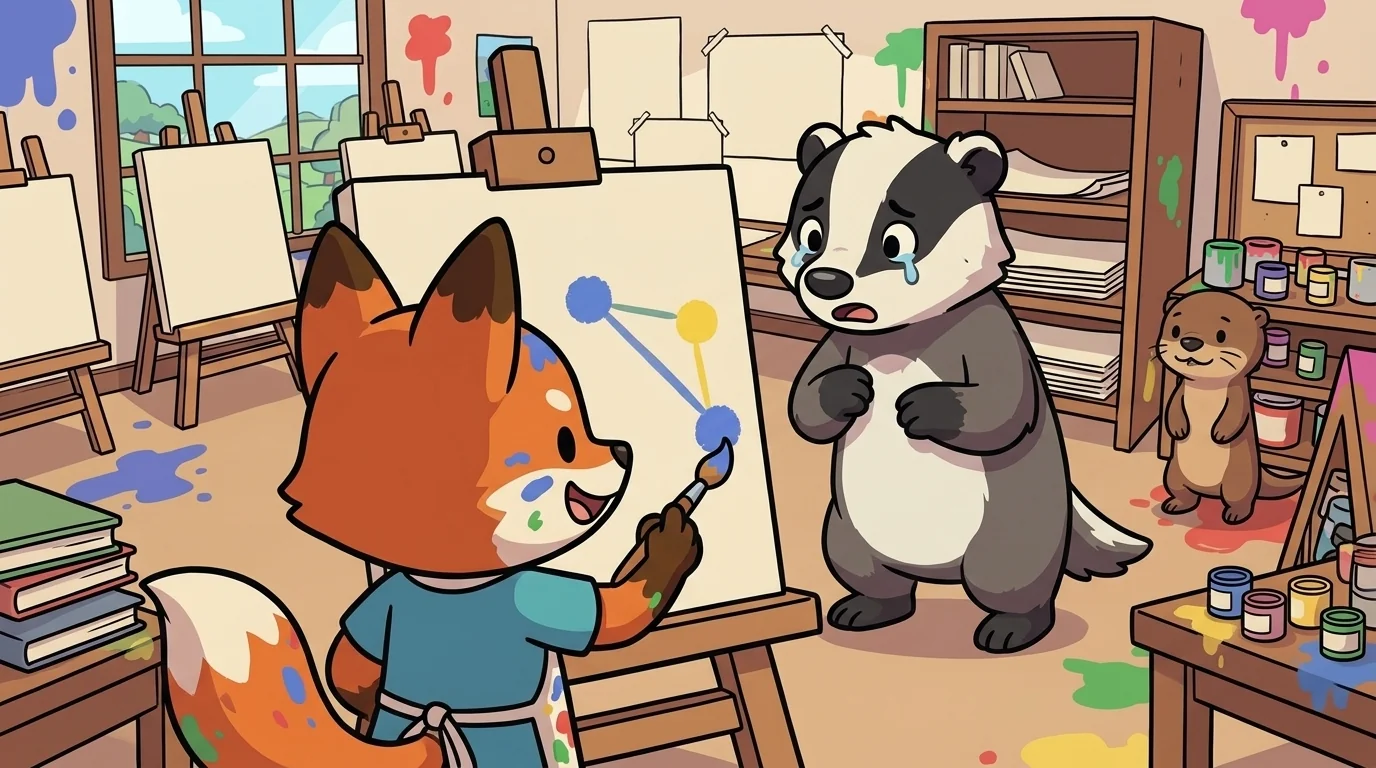
Swatch's favourite student problem had nothing to do with maps at all.
A harried badger named Mop came to her near tears. "The academy clubs are a mess," he said. "Chess club and choir share three members, so they can't meet on the same afternoon — those three can't be in two places. Choir and garden club share members too. And chess and garden club share one. I've got clubs clashing everywhere and I don't know how many afternoons I need!"
"Then let's not think about clubs," Swatch said calmly. "Let's think about clashes." She drew a dot for each club, and a line between any two clubs that shared a member. "Every line is a 'these two can't meet together.' Now I'll color the dots — and a color is just an afternoon. Joined dots get different colors, because clubs that share members need different afternoons."
She dabbed: chess blue, choir yellow, garden club blue again — because chess and garden club shared no member, so they could safely twin. "There. Two afternoons. Blue and yellow. Everybody fits, nobody's torn in half."
Mop stared at the little colored dots. "You turned my whole timetable into a coloring page."
"Every clash problem is a coloring page," Swatch said, grinning. "You just had to draw the lines."
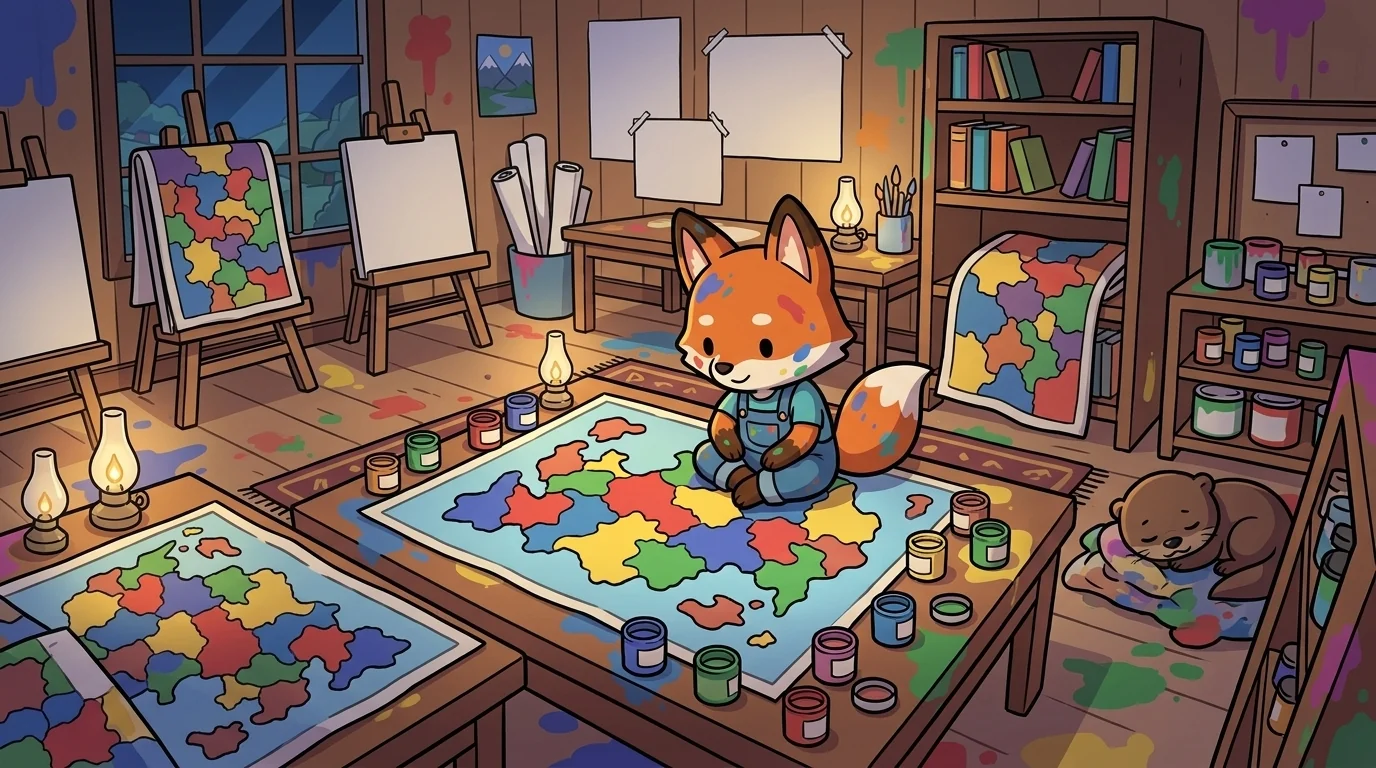
Later, when the workshop lamps had burned low and the paint pots were capped for the night, Swatch sat among her maps and quilts and watched the colors glow softly in the dark.
Briar wandered back in, yawning. "Can I ask something? Doesn't it ever bother you, all those different colors crammed up against each other? Doesn't it feel... busy?"
Swatch shook her head slowly.
"It used to feel like clashing," she said. "When I was small, all that difference packed so close together felt loud, like an argument waiting to happen. But the rule changed how I saw it. Now I look at a map and I don't see things fighting to be the same. I see different things, side by side, each allowed to stay exactly what it is — just arranged so no one has to clash."
She ran a paw lightly over a finished quilt, all its touching patches gently different, none of them at war.
And as Briar curled up to sleep in the corner of the warm, paint-smelling workshop, Swatch felt the thing she always felt at the end of a good day's coloring — not pride in the painting, but a soft, settling gladness. The whole crowded, touching, jumbled world could be arranged so that everyone got to be different and everyone got to belong. You just had to find the colors. There were almost always enough.
The DiscreteQuest ensemble
Swatch the Border-Painter is part of DiscreteQuest's distributed-narrative cast. Each character embodies a different curricular primitive; together they teach the full subject.
-

Sortie the Set-Curator
Sets, subsets, set operations (union, intersection, difference)
-

Tally the Pattern-Counter
Counting principles and combinatorics (multiplication rule, permutations, combinations)
-

Verity the Truth-Tester
Propositional logic, truth tables, AND/OR/NOT operators
-

Wander the Bridge-Walker
Graph theory — Eulerian paths, Hamiltonian paths, connectivity
-

Coil the Self-Reference
Recursion and sequences (Fibonacci, factorials, recursive patterns)
-

Prime the Indivisible
Number theory — primes, factorization, modular arithmetic
-

Cubby the Cubby-Keeper
The pigeonhole principle — when there are more things than places, at least one place must hold two
-
Marshal the Line-Arranger
Permutations — counting arrangements where order matters (factorials, ordered choices)
-

Twoby the Pair-Matcher
Parity and invariant arguments — even/odd pairing that proves what's possible
-

Surge the Growth-Racer
Order of growth — how the work scales as a problem gets bigger