
Marshal the Line-Arranger
PERMUTATIONS — when order matters, every different arrangement counts as a different outcome. To count arrangements you multiply the choices: the first spot has the most options, the next has one fewer, and so on. Swapping any two things makes a brand-new arrangement.
A story read by Marshal the Line-Arranger
Press play to listen along. The line being read lights up as you go.
Show full transcript
Loading transcript…
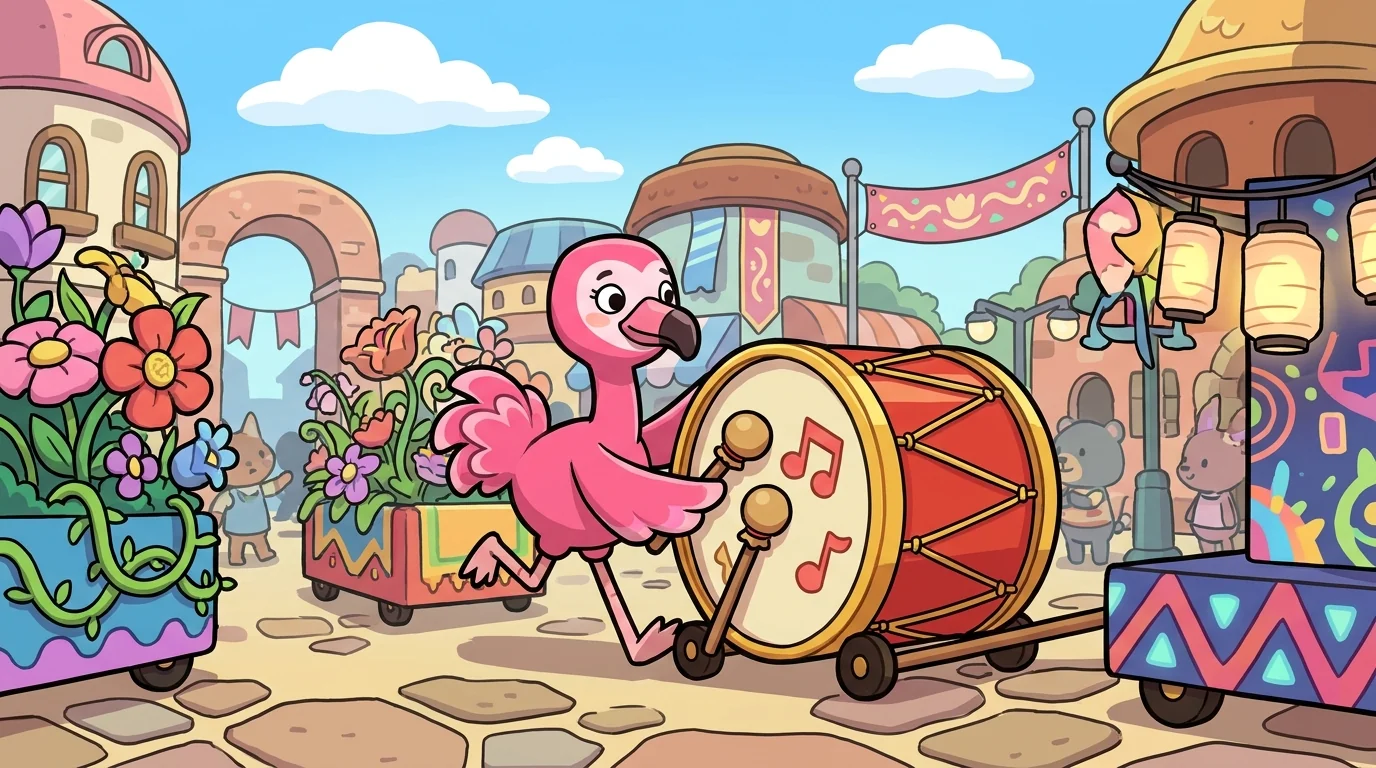
Marshal was a tall, bright-eyed flamingo, and he believed with his whole heart that order matters.
At the DiscreteQuest academy he was in charge of lining things up — performers for the spring parade, runners for a relay, names on a list. And he had a habit that drove some folks a little batty: he could never just "line them up." He fussed over the exact order, because to Marshal, a different order wasn't a small thing. It was a different parade entirely.
A young raccoon named Dot found him rearranging three parade floats for the tenth time.
"You already lined them up an hour ago," Dot said. "Why keep swapping?"
"Because every swap makes a new parade," Marshal said, sliding the drum-float ahead of the flower-float. "Watch. Drum, flower, lantern — that's one parade. Now —" he swapped two — "flower, drum, lantern. Same three floats. Completely different feeling coming round the corner. Same pieces, new arrangement. When the order matters, each arrangement is its very own thing."
Dot tilted her head. "So how many parades can you even make with three floats?"
Marshal's eyes lit up like he'd been waiting all day for someone to ask.
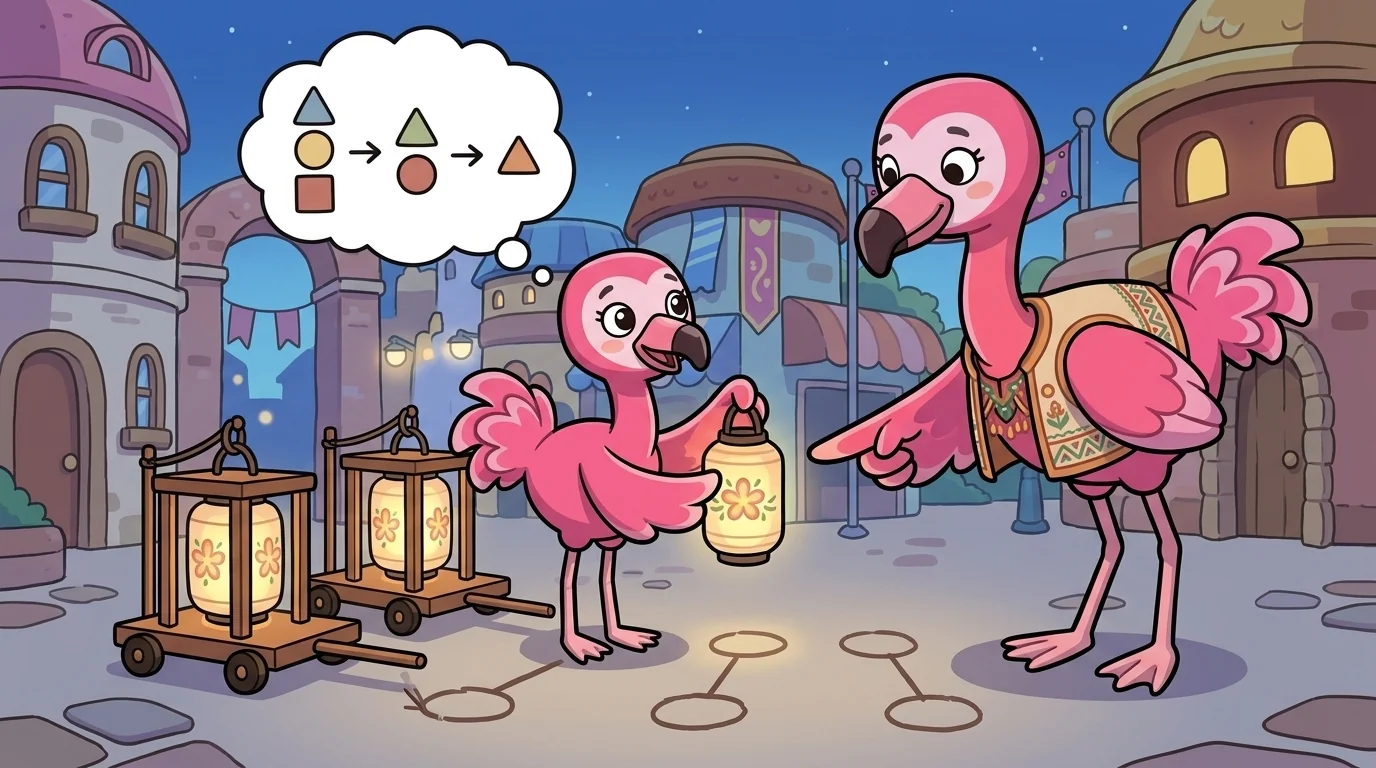
Marshal had felt the magic of order since he was knee-high.
His family ran processions in their home town — festival lines, wedding marches, lantern walks — and young Marshal's job was to decide who went where. One evening, fretting over a line of three lantern-bearers, he discovered something that changed how he saw everything.
"For the very first spot," his aunt told him, "how many bearers could you choose?"
"Three," he said. "Any of them."
"And once that one's placed, for the second spot?"
"Only two left to pick from."
"And the last spot?"
"Just the one who's left."
"So," his aunt said, "multiply them. Three choices, then two, then one. Three times two times one is six. There are six different orders for three bearers. Six different processions hiding in the very same three people."
Marshal had counted them out, astonished, and found exactly six. Not five, not seven. Six. The multiplying worked. From then on he saw arrangements everywhere, each one its own small world, and he learned the multiplying trick that counted them: start with all your choices, then one fewer, then one fewer still.
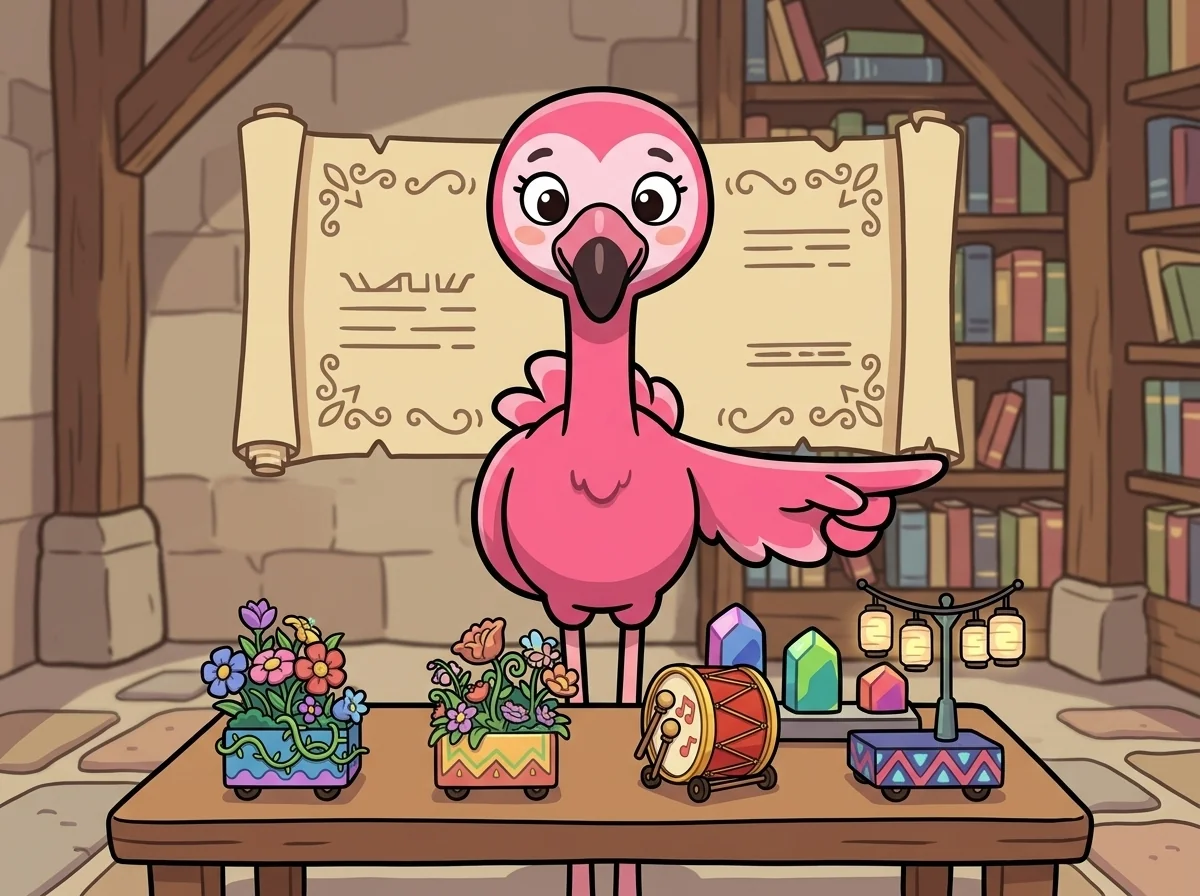
When he was grown, Marshal marched the long road to DiscreteQuest, because he'd heard it honored the things most folks overlooked.
The head of the academy was an old owl with a slow, considering voice. "What is a permutation?" he asked.
Marshal stood very straight. "A permutation is an arrangement where the order counts," he said. "Same things, lined up differently, and every different line-up is a different answer. To count them, you multiply your choices down — the first spot has the most, then one fewer for the next, and so on, all the way to the last." He spread his wings. "Three things make six arrangements. Four things make twenty-four. Five things make a hundred and twenty. They pile up fast, because every new thing multiplies in."
"And when the order does not matter?" the owl asked gently.
"Then it's a different question, and not mine to answer," Marshal said. "I'm the order fellow. Swap two of my things and I've got something new every time. That's my whole craft."
The owl nodded, slow and pleased. "You are appointed."
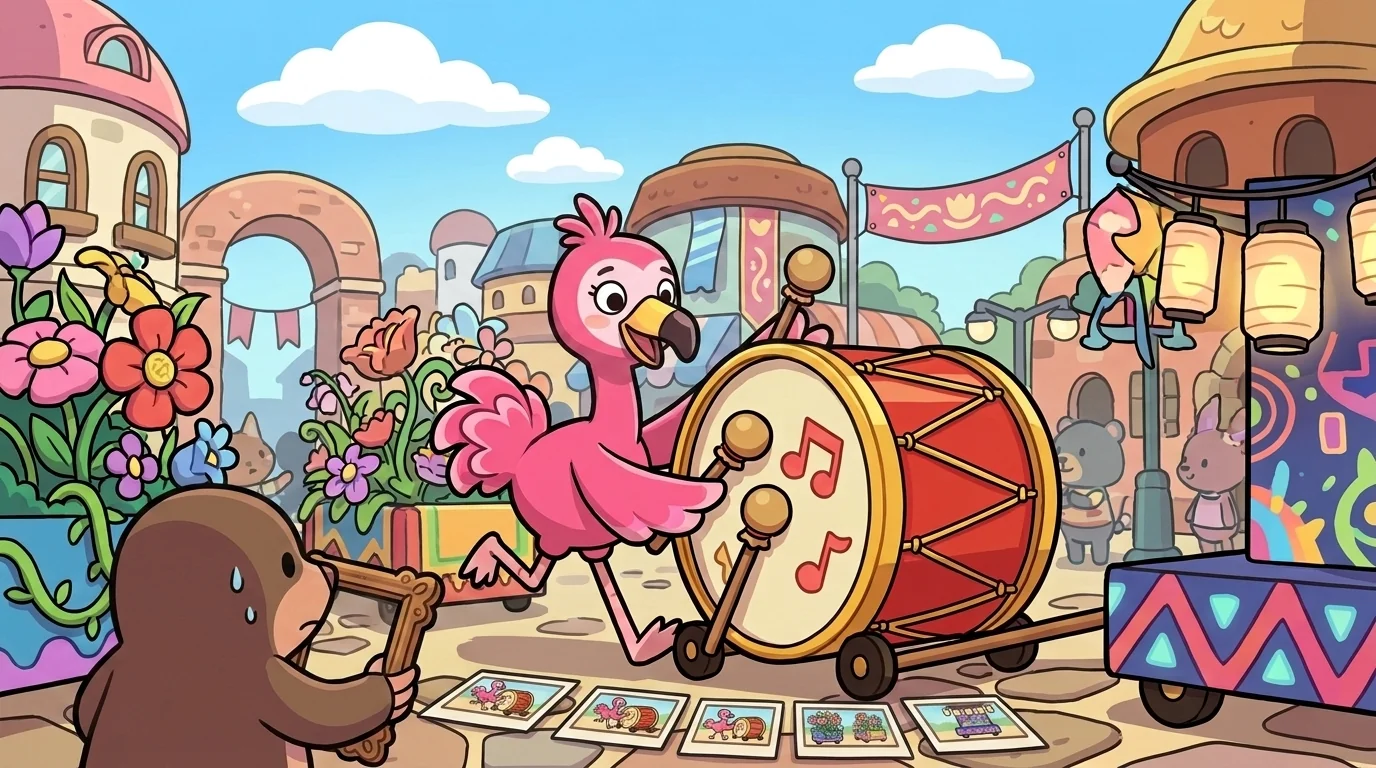
Marshal's favourite thing was watching a worried student discover how arrangements blossom.
A nervous mole named Pim came to him clutching a photo frame. "I have to seat three of my friends in a row for the class photo," Pim said, "and they each want to be in the 'best' spot, and I don't know how many ways there even are, and I'm panicking."
"Then let's not panic. Let's count," Marshal said warmly. "First seat — how many friends could sit there?"
"Three," Pim said.
"Sit one down. Second seat — how many friends are left to choose?"
"Two."
"Last seat?"
"Just one."
"Three, then two, then one. Multiply: six." Marshal laid out all six in front of Pim, swapping carefully each time. "Six photos, every one different, every one fair in its own way. You're not picking the 'one right order,' Pim. You're discovering there are six lovely ones, and you get to choose your favourite."
Pim let out a long breath. "Six isn't scary. Six I can handle."
"Six you can hold in your hands," Marshal agreed. "And if it were ten friends instead of three — well. Then we'd talk about how the numbers grow. But the trick never changes. Multiply your choices down."

Later, when the parade grounds were empty and the floats stood quiet under the moon, Marshal sat on the steps and watched the lanterns sway.
Dot came and sat beside him. "Can I tell you something?" she said. "When you told me how many parades hide in just a few floats, it kind of scared me. Like the world was way too big and I'd never see all of it."
Marshal was quiet for a moment.
"I remember feeling exactly that," he said. "The first time I really understood how fast arrangements pile up, I felt dizzy — like standing at the edge of something enormous. So many possible orders, more than I could ever march in a lifetime." He smiled softly. "But then it turned. The bigness stopped feeling like a weight and started feeling like a gift. All those orders weren't there to overwhelm me. They were there because there's so much room — so many ways for things to be, so many parades still waiting to happen."
He nudged her gently with a wing.
And as the lanterns swayed and Dot leaned her head against the flamingo's warm side, she found the bigness didn't frighten her anymore either. It felt, instead, like a quiet promise — that there would always be another arrangement, another order, another way for the same small handful of things to become something brand-new. The world wasn't too big. It was just generous.
The DiscreteQuest ensemble
Marshal the Line-Arranger is part of DiscreteQuest's distributed-narrative cast. Each character embodies a different curricular primitive; together they teach the full subject.
-

Sortie the Set-Curator
Sets, subsets, set operations (union, intersection, difference)
-

Tally the Pattern-Counter
Counting principles and combinatorics (multiplication rule, permutations, combinations)
-

Verity the Truth-Tester
Propositional logic, truth tables, AND/OR/NOT operators
-

Wander the Bridge-Walker
Graph theory — Eulerian paths, Hamiltonian paths, connectivity
-

Coil the Self-Reference
Recursion and sequences (Fibonacci, factorials, recursive patterns)
-

Prime the Indivisible
Number theory — primes, factorization, modular arithmetic
-

Cubby the Cubby-Keeper
The pigeonhole principle — when there are more things than places, at least one place must hold two
-

Swatch the Border-Painter
Graph coloring — coloring connected things so no two neighbors match, with the fewest colors
-

Twoby the Pair-Matcher
Parity and invariant arguments — even/odd pairing that proves what's possible
-

Surge the Growth-Racer
Order of growth — how the work scales as a problem gets bigger