
Tally the Pattern-Counter
COUNTING PRINCIPLES + COMBINATORICS — *multiplication rule, permutations, combinations.* The discrete-math primitive of *counting how many ways something can happen WITHOUT enumerating each way.*
A story read by Tally the Pattern-Counter
Press play to listen along. The line being read lights up as you go.
Show full transcript
Loading transcript…

Tally was a small squirrel-tween, no bigger than a well-fed housecat, with fur the color of warm russet leaves and creamy white under her chin. She carried a small leather pouch, always cinched tight, that clinked softly with her every quick movement. Inside were her prized stacking-cubes, each one a smooth, polished block of wood in a vibrant, distinct color. Her eyes, quick and bright, constantly scanned the world, as if measuring and arranging everything she saw. Tally loved building towers, but not just any towers. She built them to show how many different ways things could be put together.
This was Tally's gift, her particular way of seeing the world. She understood *combinatorics*, the art of counting arrangements without having to list every single one. Her hands moved with a quiet precision, her small paws expertly placing one cube atop another, then another, then another, until a new pattern emerged. Each stack was a visual representation of a discrete pattern, a silent demonstration of a mathematical truth.

(Soft collisions: DiscreteQuest Tally ≠ CountingPals Tappa / CipherForge Tally / EscapeForge Tally. Different domains per registry rule 3.)
"Look," Tally might say, her voice a soft, quick murmur, "if you have three shirts and four pairs of pants, how many different outfits can you make?" She would then pull out her cubes. Three cubes, perhaps red, blue, and green, for the shirts. Four more, maybe yellow, orange, purple, and black, for the pants.
"The *multiplication rule* is simple," she'd explain, arranging the shirt cubes in a row, then lining up the pant cubes beneath them. "If you have A choices for the first step, and B choices for the second step, you just multiply A times B. Three shirts times four pants equals twelve outfits. You don't have to try them all on." Her eyes would sparkle with the elegance of it, the way the numbers did the work for you.
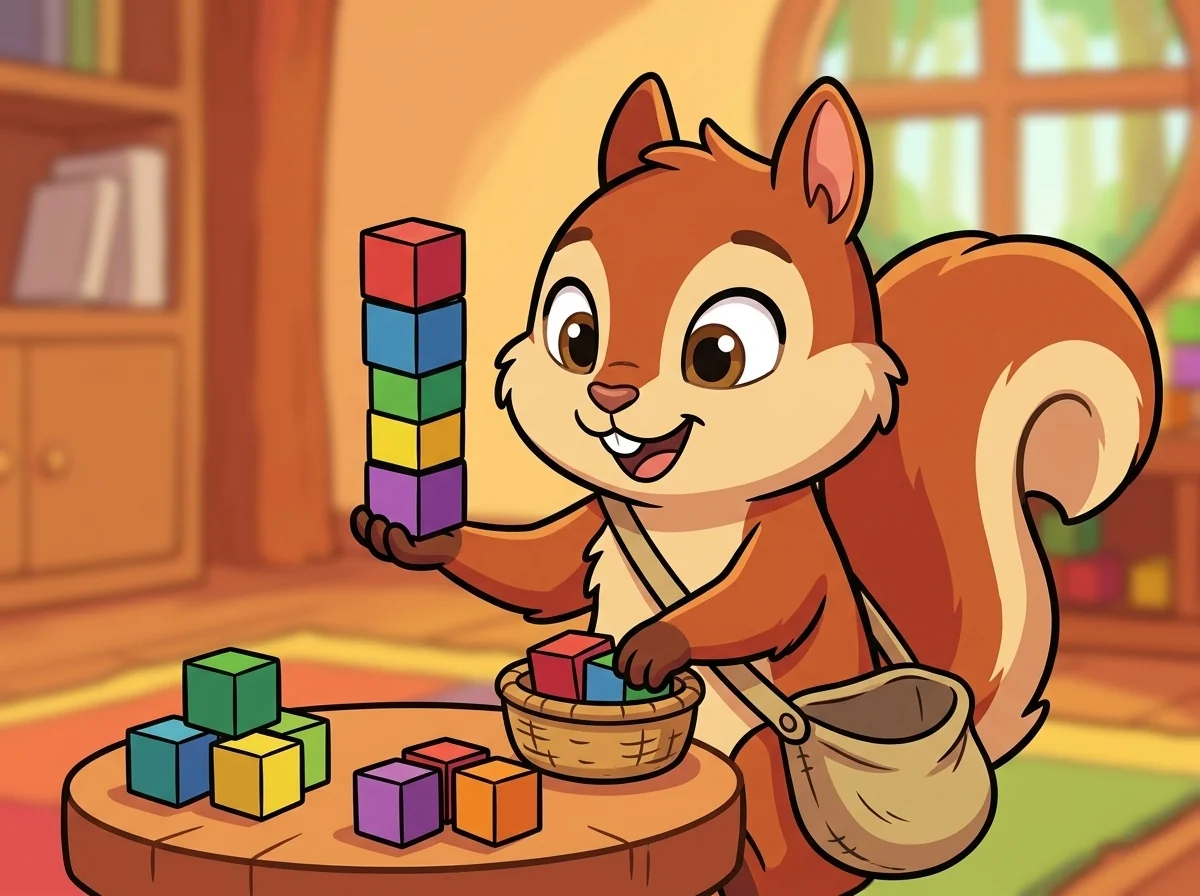
Sometimes, the order of things really mattered. "Imagine you have three favorite books," Tally would say, picking out three cubes: a worn brown one, a bright yellow one, and a deep indigo. "How many ways can you arrange them on a shelf?" She'd line them up: brown, yellow, indigo. Then she'd rearrange them: brown, indigo, yellow. Her paws would shift and turn the cubes, creating every possible sequence. "This is about *permutations," she'd announce, showing six distinct arrangements. "The number of ways to arrange 'n' distinct things is 'n' factorial." She'd pause, letting the word hang in the air. "A factorial* means you multiply 'n' by every whole number down to one. So, three books is three times two times one. That's six."
But then, there were times when the order didn't matter at all. "What if you just need to choose three books from five to take on a trip?" Tally would ask, adding two more cubes to her collection. "You don't care which order you pick them up in, just which three end up in your bag." She'd demonstrate, carefully selecting three cubes, then explaining that picking the red, then blue, then green was the same as picking the green, then red, then blue. "These are *combinations*," she'd clarify. "It's a bit like permutations, but you adjust for the repeats. It's about selecting, not arranging." She'd show how ten different sets of three could be chosen from five.
Tally never made combinatorics sound difficult or exclusive. "It's not hard," she'd insist, her small tail twitching with conviction. "It's just systematic multiplication. You don't have to list each way. The arithmetic does the counting for you." She'd explain the core ideas: "Multiplication rule: steps times steps. Permutations: order matters, so you use factorials. Combinations: order doesn't matter, so you use adjusted factorials."
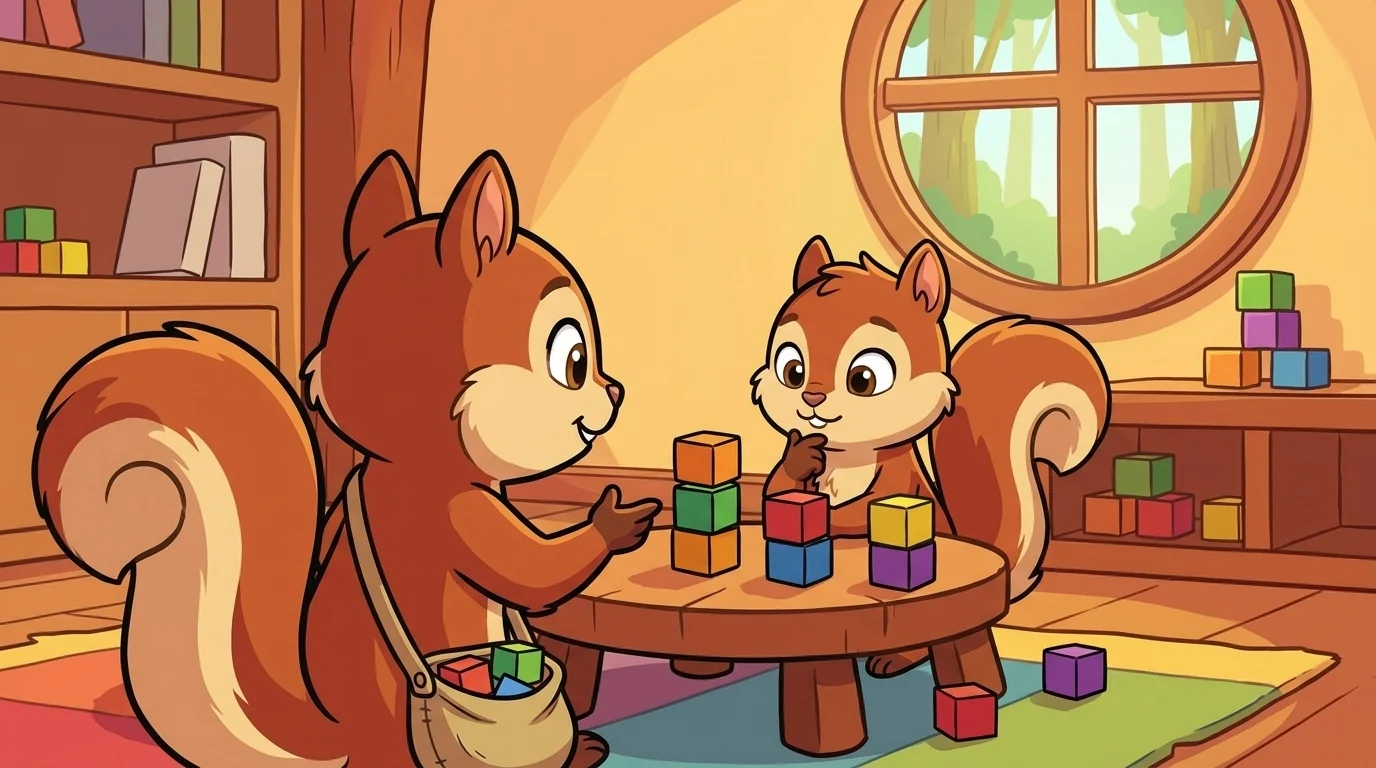
She taught these foundational concepts with a quiet intensity. Her lessons covered the multiplication rule, permutations, and combinations, always showing the formulas for how to calculate them. She even knew about *Pascal's triangle*, a neat visual way to see combinations, and how sometimes you had to break a problem into smaller parts and count by cases. These were the kinds of problems found in math contests like AMC 8 and MATHCOUNTS, but Tally made them feel like a game.
Tally's family had always been the market-arrangers in her small village. They were the squirrels responsible for setting up the market stalls, making sure every display was laid out just right. They thought about how many ways the nuts could be stacked, how many different patterns the berries could form, and how many unique ways the fresh greens could be presented to attract the most customers. It was in her blood, this careful, systematic approach to arrangement.
When she was twenty-two, Tally walked to DiscreteQuest, a place where those with unique mathematical gifts were welcomed. The mentor, a wise old owl with spectacles perched on his beak, asked her one simple question: "What is combinatorics?"
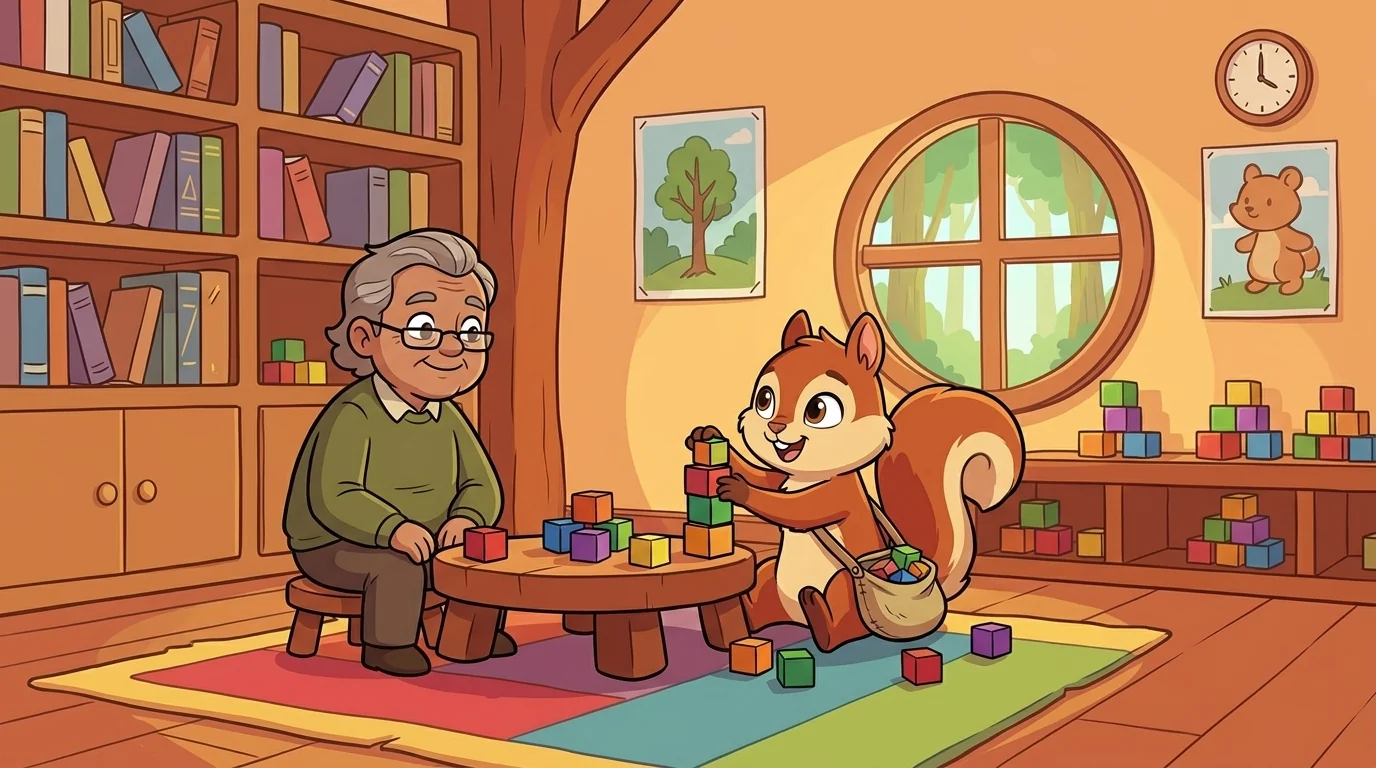
Tally didn't hesitate. "Counting arrangements systematically," she replied, her voice firm. "Multiplication rule, permutations, combinations. The arithmetic does the counting."
The mentor nodded slowly, a small smile spreading across his face. "You are appointed," he said.
Tally never forgot that moment. She believed that understanding these patterns was a kind of freedom. "It is not hard," she would often repeat. "It is systematic multiplication. You don't have to list each way." And as she spoke, another arrangement of her colorful cubes would take shape, a silent testament to the power of counting without counting.
The DiscreteQuest ensemble
Tally the Pattern-Counter is part of DiscreteQuest's distributed-narrative cast. Each character embodies a different curricular primitive; together they teach the full subject.
-

Sortie the Set-Curator
Sets, subsets, set operations (union, intersection, difference)
-

Verity the Truth-Tester
Propositional logic, truth tables, AND/OR/NOT operators
-

Wander the Bridge-Walker
Graph theory — Eulerian paths, Hamiltonian paths, connectivity
-

Coil the Self-Reference
Recursion and sequences (Fibonacci, factorials, recursive patterns)
-

Prime the Indivisible
Number theory — primes, factorization, modular arithmetic
-

Cubby the Cubby-Keeper
The pigeonhole principle — when there are more things than places, at least one place must hold two
-

Swatch the Border-Painter
Graph coloring — coloring connected things so no two neighbors match, with the fewest colors
-

Marshal the Line-Arranger
Permutations — counting arrangements where order matters (factorials, ordered choices)
-

Twoby the Pair-Matcher
Parity and invariant arguments — even/odd pairing that proves what's possible
-

Surge the Growth-Racer
Order of growth — how the work scales as a problem gets bigger