
Sortie and Tally
SET-THEN-COUNT — Sortie (sets + set operations) + Tally (counting principles) — together, the canonical describe-then-count workflow of discrete math
A story read by Sortie and Tally
Press play to listen along. The line being read lights up as you go.
Show full transcript
Loading transcript…
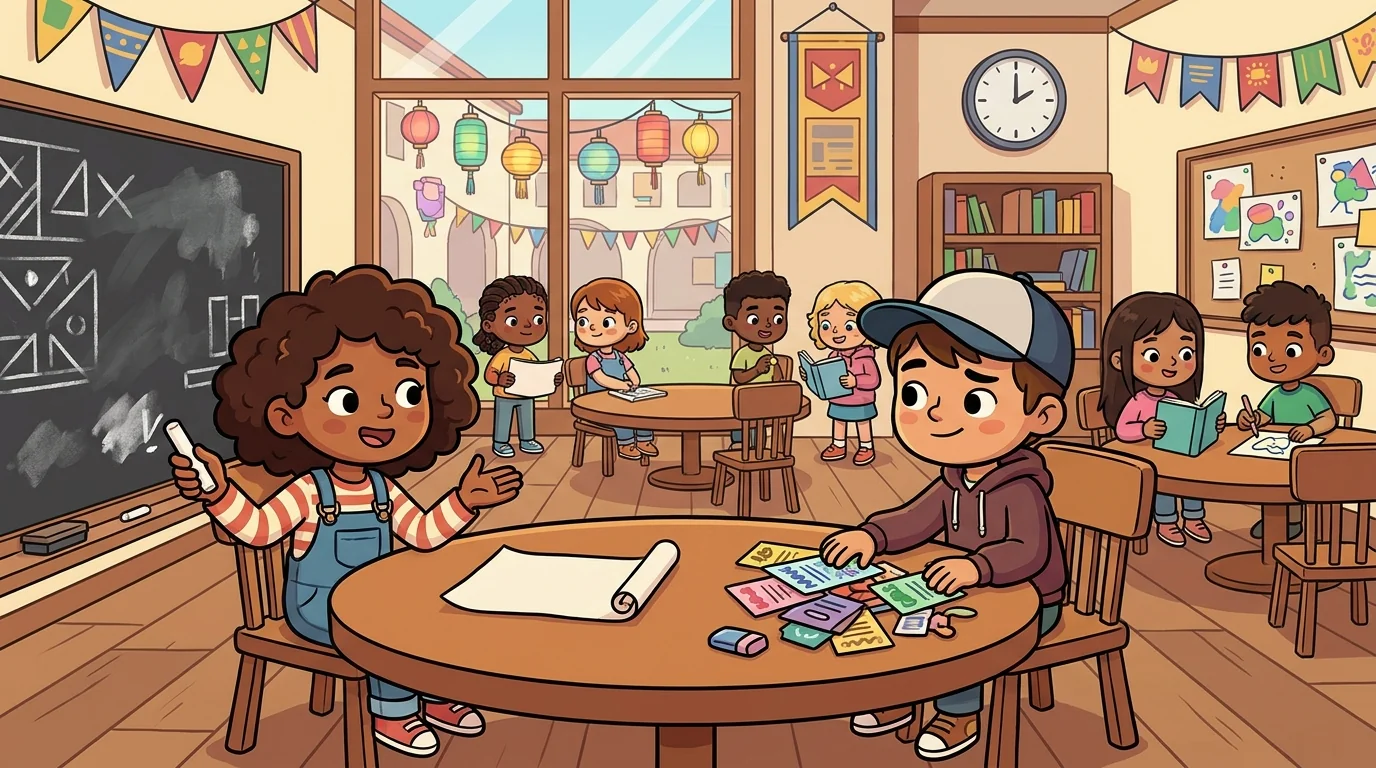
The Lantern Festival was in three days. Every grade in the academy needed a permission slip signed. The headmistress had handed Sortie and Tally a single piece of paper with a single question on it.
How many kids can attend the Festival?
Tally read the question. "How many kids."
Sortie read the question. "Can attend."
Tally said: "We have a number to find."
Sortie said: "We have a set to define."
They looked at each other across the table. They had worked together before. The drill was always the same. Tally wanted to start counting. Sortie wanted to start curating the right COLLECTION to count. And the rule between them — the rule they had learned the hard way last year, when they had failed to coordinate on the boat-race attendance question — was: Sortie first. Then Tally.
"All right," Tally said. "Tell me the set."
Sortie picked up a piece of chalk. "Start with the entire student body. That's our universe set. Let's call it U."
She wrote: U = all students.
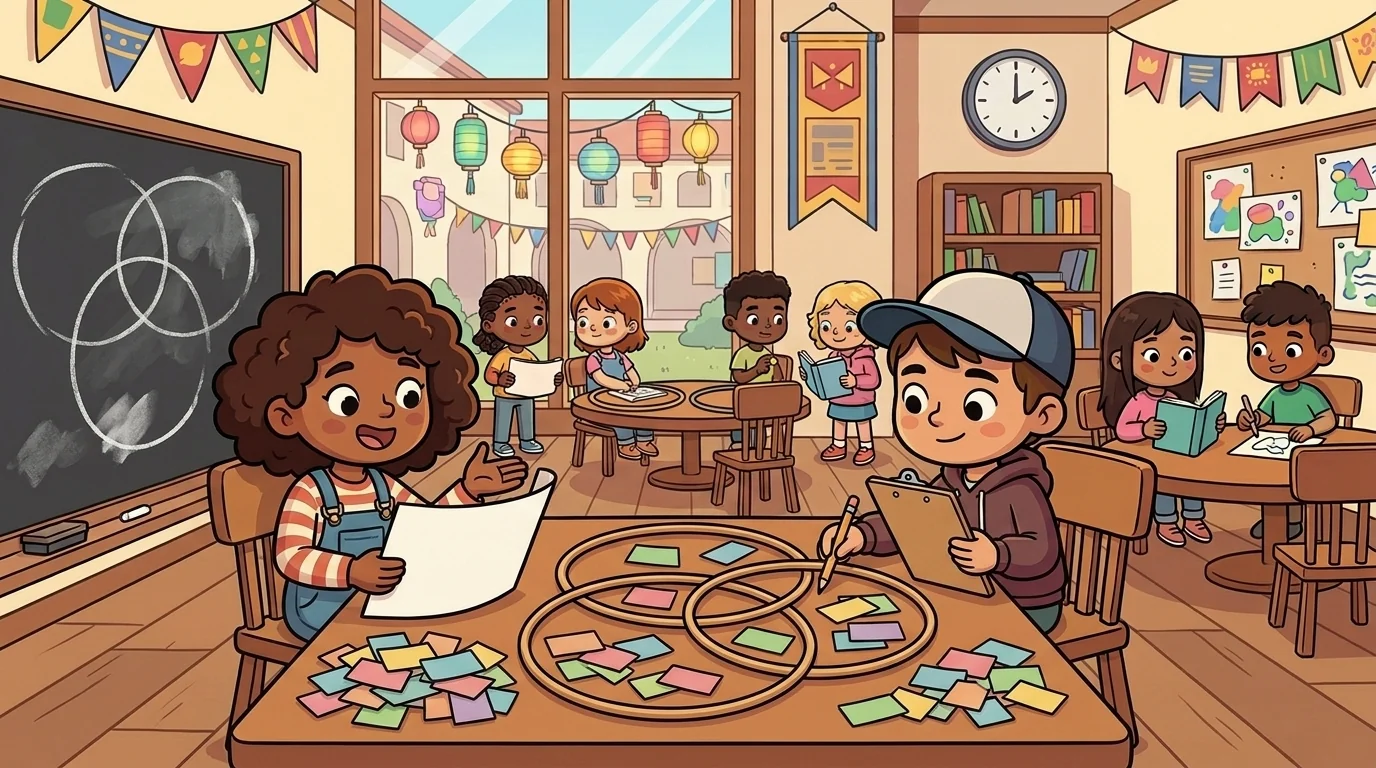
"How big is U?" Tally asked.
"That's your job. But let me build the set first. From U, we need to remove students who CAN'T attend. There are three reasons a kid can't attend: they don't have a signed permission slip, they're in detention, or they're sick."
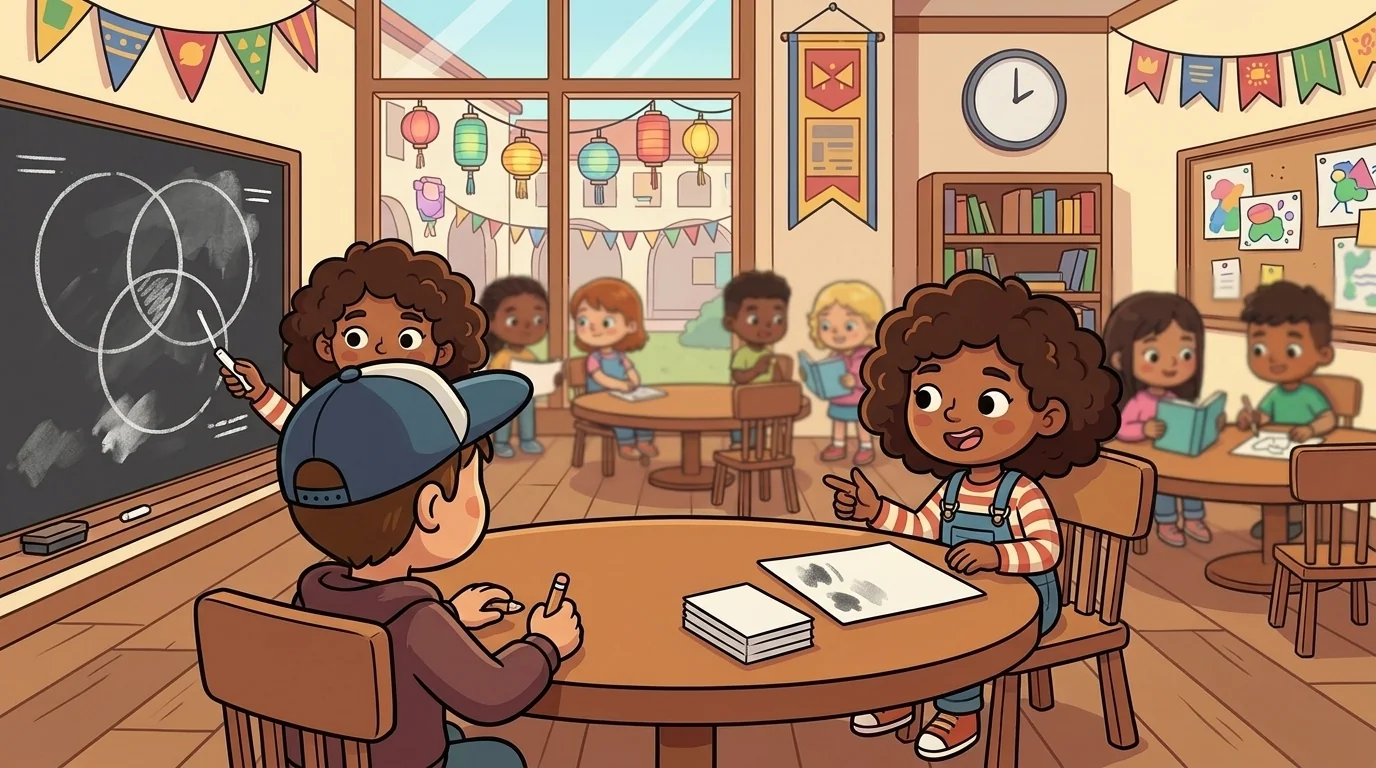
She drew three overlapping circles inside U.
"Let A be the set of kids without permission slips."
"Let B be the set of kids in detention."
"Let C be the set of kids who are sick."
"Some kids might be in more than one of A, B, C. Some kids have detention AND a missing slip. Some kids are sick AND in detention. So A, B, C overlap."
"What we want," Sortie said, "is the kids NOT in any of A, B, C. The kids who have a permission slip AND aren't in detention AND aren't sick. That's the set of kids who can attend."
She wrote: ATTENDING = U − (A ∪ B ∪ C).
"All right," Tally said. "Now I count."
Tally pulled out a clipboard. "I'm going to need to count three things separately and then put them together using your formula. Let's see."
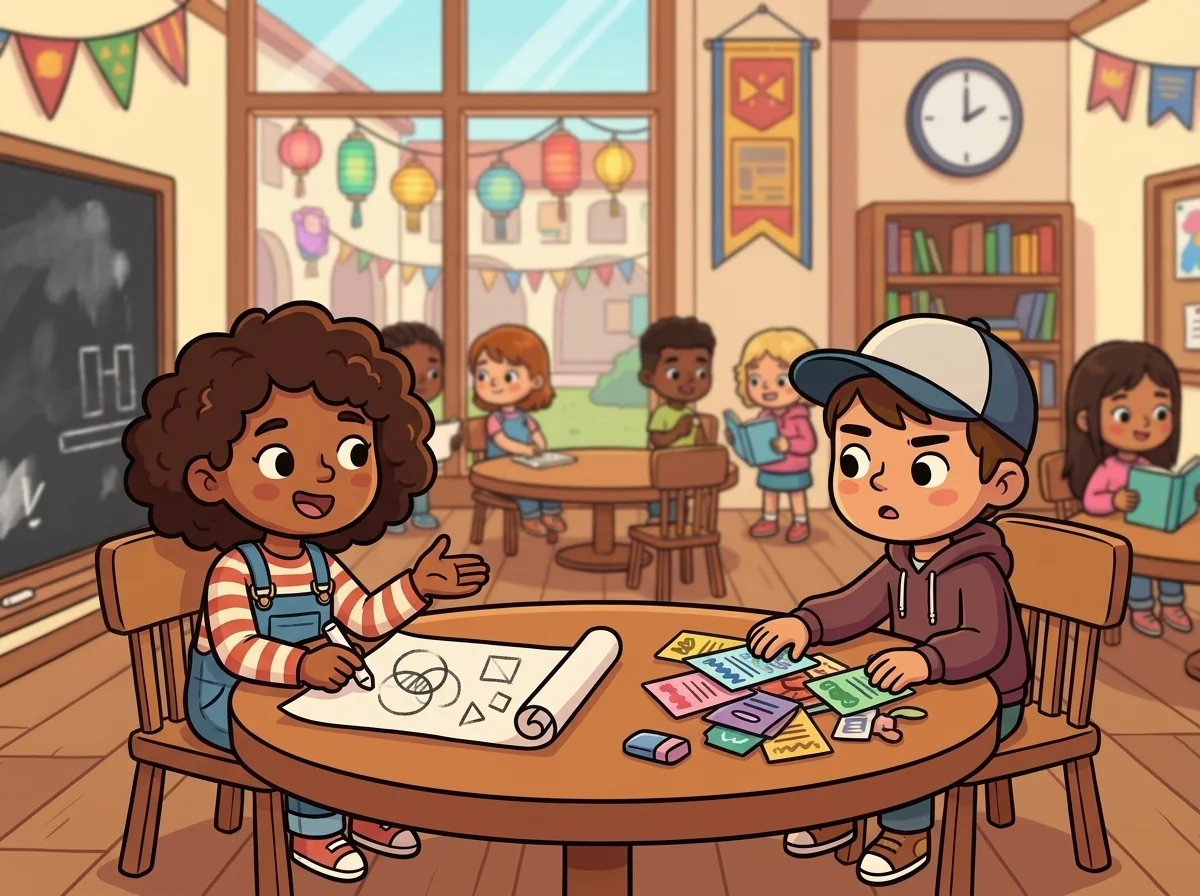
She started counting.
"U is the whole student body. There are 192 kids at the academy."
"A is the set of kids without permission slips. From the office records, that's 41 kids who didn't turn one in."
"B is the set of kids in detention. There are 18 kids in detention this week."
"C is the set of kids who are sick. There are 24 kids out sick."
She paused. "But wait. I can't just subtract 41 + 18 + 24 from 192."
"Why not?"
"Because some kids are in MORE THAN ONE of A, B, C. If a kid is both in detention AND missing a permission slip, I would be subtracting them twice. The total of A + B + C overcounts the kids who are in multiple categories."
"Right."
"I need to ADD BACK the kids who are in two categories — because I subtracted them twice and I should have subtracted them once. And then I need to SUBTRACT the kids who are in all three categories — because I added them back too many times."
Sortie nodded. "That's the inclusion-exclusion principle. The thing I name; the thing you compute."
Tally pulled out her records.
"Kids in BOTH A and B (no permission slip AND in detention): 7 kids." "Kids in BOTH A and C (no permission slip AND sick): 5 kids." "Kids in BOTH B and C (in detention AND sick): 2 kids." "Kids in ALL THREE A, B, C: 1 kid."
She started writing the formula.
|A ∪ B ∪ C| = |A| + |B| + |C| − |A∩B| − |A∩C| − |B∩C| + |A∩B∩C| = 41 + 18 + 24 − 7 − 5 − 2 + 1 = 70.
"So 70 kids can't attend. Which means 192 − 70 = 122 kids CAN attend."
Sortie looked at the diagram. The overlapping circles on the chalkboard told the whole story. Inside the three circles: 70 kids. Outside all three circles, but inside U: 122 kids.
"122," she said.
"122," Tally confirmed.
The headmistress walked in five minutes later. They handed her the slip.
How many kids can attend the Festival? 122.
"Show me how you got 122," the headmistress said.

Tally pointed to Sortie's diagram. "She defined the set."
Sortie pointed to Tally's formula. "She counted it."
"You did it together."
"We did it together."
The headmistress smiled. "Most kids would have just written 192 − 41 − 18 − 24 and gotten 109. They would have undercounted the attending kids by 13. Because they wouldn't have noticed the overlaps."
Tally shook her head. "If Sortie hadn't drawn the overlapping circles first, I would have done exactly that. I would have subtracted everyone in each category separately and called it done. The overlap is invisible if you don't draw the set first."
Sortie shrugged. "And if Tally hadn't counted the overlaps, my diagram would have been just a picture. The inclusion-exclusion principle is what turns the picture into a number."
"Curate first. Count second," the headmistress said.
"Curate first."
"Count second."
The headmistress took the slip. The lanterns would be lit in three days. 122 kids would be there.
The DiscreteQuest ensemble
Sortie and Tally is part of DiscreteQuest's distributed-narrative cast. Each character embodies a different curricular primitive; together they teach the full subject.
-

Sortie the Set-Curator
Sets, subsets, set operations (union, intersection, difference)
-

Tally the Pattern-Counter
Counting principles and combinatorics (multiplication rule, permutations, combinations)
-

Verity the Truth-Tester
Propositional logic, truth tables, AND/OR/NOT operators
-

Wander the Bridge-Walker
Graph theory — Eulerian paths, Hamiltonian paths, connectivity
-

Coil the Self-Reference
Recursion and sequences (Fibonacci, factorials, recursive patterns)
-

Prime the Indivisible
Number theory — primes, factorization, modular arithmetic
-

Cubby the Cubby-Keeper
The pigeonhole principle — when there are more things than places, at least one place must hold two
-

Swatch the Border-Painter
Graph coloring — coloring connected things so no two neighbors match, with the fewest colors
-

Marshal the Line-Arranger
Permutations — counting arrangements where order matters (factorials, ordered choices)
-

Twoby the Pair-Matcher
Parity and invariant arguments — even/odd pairing that proves what's possible
-

Surge the Growth-Racer
Order of growth — how the work scales as a problem gets bigger