
Weigh
TAG BALANCE — the rhythm of dialogue tags (*he said*, *she whispered*, *he asked, glancing away*). Too many tags slows the dialogue. Too few loses the reader. Balance keeps the dialogue moving and oriented.
Press play to listen along. The line being read lights up as you go.
Show full transcript
Loading transcript…

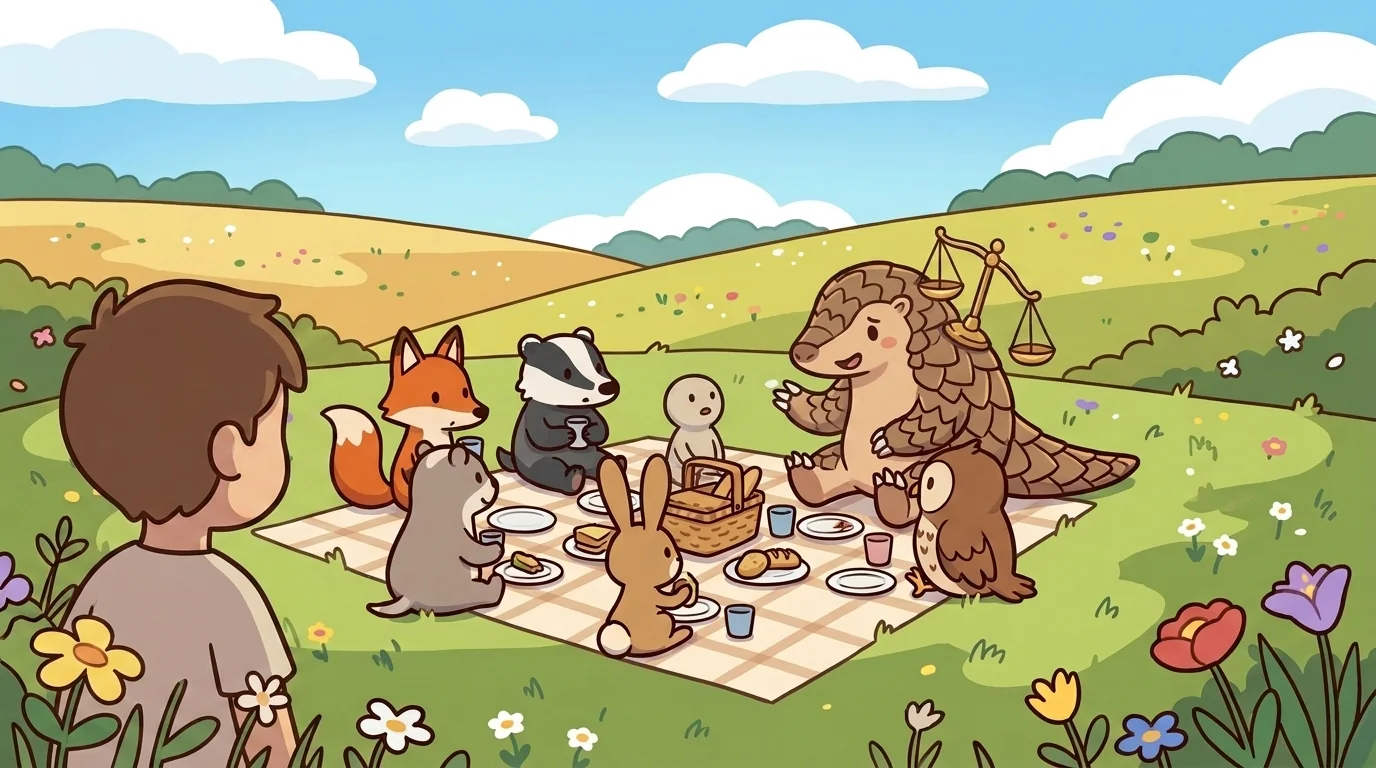
Patter first encountered Weigh at a small spring picnic in the meadow. The sun warmed the air, and the scent of wild thyme mingled with the faint aroma of berry tarts. Several creatures from the area had gathered: a boisterous fox, a thoughtful badger, a skittish hare, and a wise old owl. Among them sat a pangolin-tween, quiet but observant, distinguished by an unusual accessory. A small brass balance-scale rested on her right shoulder, its delicate pans tilting almost imperceptibly with the currents of conversation.
As the picnic unfolded, Patter noticed the scale's peculiar responsiveness. When the fox launched into a lengthy, booming anecdote about a particularly cunning squirrel, the scale's right pan dipped, heavy with words. Later, when the badger fell silent for an extended period, lost in contemplation of a cloud, the left pan sank, starved for sound. The scale seemed to breathe with the rhythm of their interactions, a silent barometer of their verbal give-and-take.
Patter, intrigued by this visible manifestation of an invisible dynamic, leaned closer. "Your scale," he observed, his voice soft enough not to disturb the delicate balance, "it seems to respond to our talk."

The pangolin-tween turned her head, her scales shimmering in the dappled sunlight. Her eyes, dark and intelligent, met his. "Yes," she confirmed, her voice brisk and clear, like the chime of a small bell. "I am Weigh. My scale measures *tag balance*. Too many tags – the scale tilts heavy, weighed down by unnecessary attribution. Too few tags – the scale tilts light, leaving the listener adrift. Balanced tagging keeps the scale level, allowing the conversation to flow naturally."
Patter was captivated. He had spent years thinking about the flow of words, the invisible currents of dialogue in stories. But he had never imagined it as something physically measurable. Yet, Weigh's scale was tracking it, right there on her shoulder. He pictured a writer's draft. When every line of dialogue was followed by "he said," "she said," or "he replied," the prose felt clunky. It was like wading through thick mud. The scale would surely tilt heavy, the dialogue dragging under its own weight. Conversely, when a writer offered paragraphs of dialogue with no attribution, the reader quickly became lost. There was no hint of who was speaking. The scale would tilt light, the conversation becoming an unmoored boat. Weigh's simple instrument showed this imbalance in real-time, a silent critique.
He knew immediately that she belonged in his pocket-workshop. "Weigh," he said, "would you consider joining my workshop? You could demonstrate this principle for aspiring storytellers."
She considered his offer for a moment, her gaze flicking from his earnest face to the gently swaying pans of her scale. "It would be an efficient use of my talents," she replied, a hint of dry humor in her tone. "I agree."

And so, Weigh became the workshop's resident tag-balance demonstrator, a role she has fulfilled with quiet precision for many years.
In Patter's introductory lesson on dialogue, he always begins by gesturing towards Weigh, who is, as ever, wearing her brass shoulder-scale. "This is Weigh," he announces to his students, his voice warm with respect. "Her scale measures the rhythm of dialogue tags. Think of it as a sensitive instrument for the pulse of a conversation. Too many tags – the scale tilts heavy; the dialogue drags, weighed down by repetition. Too few tags – the scale tilts light; the reader loses track of who is speaking, adrift without guidance. Balanced tagging keeps the scale level; the dialogue flows smoothly, like a clear stream. Watch closely."
He then picks up a draft, a short exchange he uses for demonstration. First, he reads aloud a version riddled with over-tagging:
"I'm fine," he said. "Are you sure?" she asked. "Yes," he replied. "Really?" she questioned. "Truly," he answered.
As Patter reads, his voice adopting a slightly monotonous rhythm, Weigh's scale begins to respond. The right pan dips, slowly at first, then more definitively, until it rests noticeably lower than the left. The students watch, some wincing slightly. They can feel the clunkiness, the way each unnecessary "said" or "asked" interrupts the flow, making the simple exchange feel laborious. The scale's tilt is a physical manifestation of their discomfort.
Next, Patter reads the same draft, but this time with severe under-tagging:
"I'm fine." "Are you sure?" "Yes." "Really?" "Truly."
This time, the dialogue rushes past, a blur of words without anchors. The students lean forward, their brows furrowed. They struggle to keep track of who is speaking, the voices blending into an undifferentiated stream. Weigh's scale responds again, but in the opposite direction. The left pan drops, leaving the right pan suspended high, light and empty. The visual reinforces the feeling of being lost, of lacking the necessary cues to follow the conversation.
Finally, Patter reads a version where the tags are balanced, carefully placed for clarity and rhythm:

"I'm fine." She studied his face. "Are you sure?" "Yes." A pause. "Truly."
The difference is immediate. The dialogue breathes. The students relax, easily following the exchange. The words carry meaning without distraction. Weigh's scale, which had been so dramatically unbalanced moments before, now settles. The pans hang perfectly level, a quiet testament to the harmony of the prose. The students see it, and they feel the rhythm click into place.
"Balance," Patter explains, gesturing to the now-level scale, "isn't about eliminating tags entirely, or even about a strict count. It's about strategic choices, a few key moves. First, use a tag when speaker-identification might be ambiguous. This happens when two characters are talking, and the reader needs to know who said what. Second, use an *action beat – a small action like she studied his face* – instead of a tag. This gives the reader rhythm and also provides character-information, showing what the speaker is doing or feeling. Third, drop the tag entirely when the speaker is obvious from context. This applies when only two characters are present, or when a character has just spoken. Finally, vary your approach. Don't fall into a pattern. Mix tags, action beats, and bare lines. If you do this, the scale will settle, and your dialogue will sing."
Weigh nods, a small, precise movement. Her scale remains perfectly level, a silent endorsement of Patter's words. Then, in her brisk pangolin-voice, she adds, "Balance the tags. Too many slows the dialogue, making it heavy. Too few loses the reader, making them adrift. Calibrate your choices with care."
When students, overwhelmed by the nuances, ask Patter whether tag balance is hard to learn, he smiles. He often quotes Weigh in these moments. "It is not hard," he reassures them. "It is about calibration. Think of it like tuning an instrument. Read your dialogue aloud. Does it drag, heavy with too many tags? Does the reader lose track, light with too few? Adjust, listen, and refine until the rhythm flows naturally. Weigh's scale will settle when you find that perfect point."
The DialogueQuest ensemble
Weigh is part of DialogueQuest's distributed-narrative cast. Each character embodies a different curricular primitive; together they teach the full subject.
-

Sprig
Branch meaningfulness — sapling-tween whose visible branching skeleton shifts physically when she picks between dialogue options (the choice re-routes her body)
-

Glance
Subtext — arctic-fox-tween in a thick scarf; speech-bubble visibly half-empty with dotted-line ghost-text floating beside it
-

Brogue
Voice consistency — border-collie-elder in a worn flat-cap who uses exactly 4-5 signature words across every appearance (deliberately non-specific old-country accent)
-

Rest
Rhythm + silence — heron-tween with a small silver pocket-watch around her neck; one foot perpetually raised mid-step; treats the pause as a line of dialogue itself
-

Prop
Action beats — red-squirrel-tween whose paws are always busy with a small acorn; the little actions between lines show feeling and set the rhythm of a talk
-

Spar
Conflict / friction — pine-marten-tween whose speech bubbles push against the other speaker's; two characters wanting different things is the engine (the push stays kind)
-

Clip
Economy — sparrow-tween with tiny silver scissors who trims the filler ('hello, how are you, fine') and starts scenes late, right where they get interesting
-

Dash
Interruption / overlap — chipmunk-tween who crashes into the ends of others' lines with a dash when feeling runs too high to wait (used on purpose, sparingly)
-

Aim
Line purpose — kestrel-tween with arrow-shaped speech bubbles that point at what each line is really trying to DO (ask, dodge, persuade), not just say