
Clip
ECONOMY — real written dialogue cuts the dead words. You skip the "hello, how are you, I'm fine, that's good" and start the scene late, right where it gets interesting. Every line that stays should earn its place.
Press play to listen along. The line being read lights up as you go.
Show full transcript
Loading transcript…
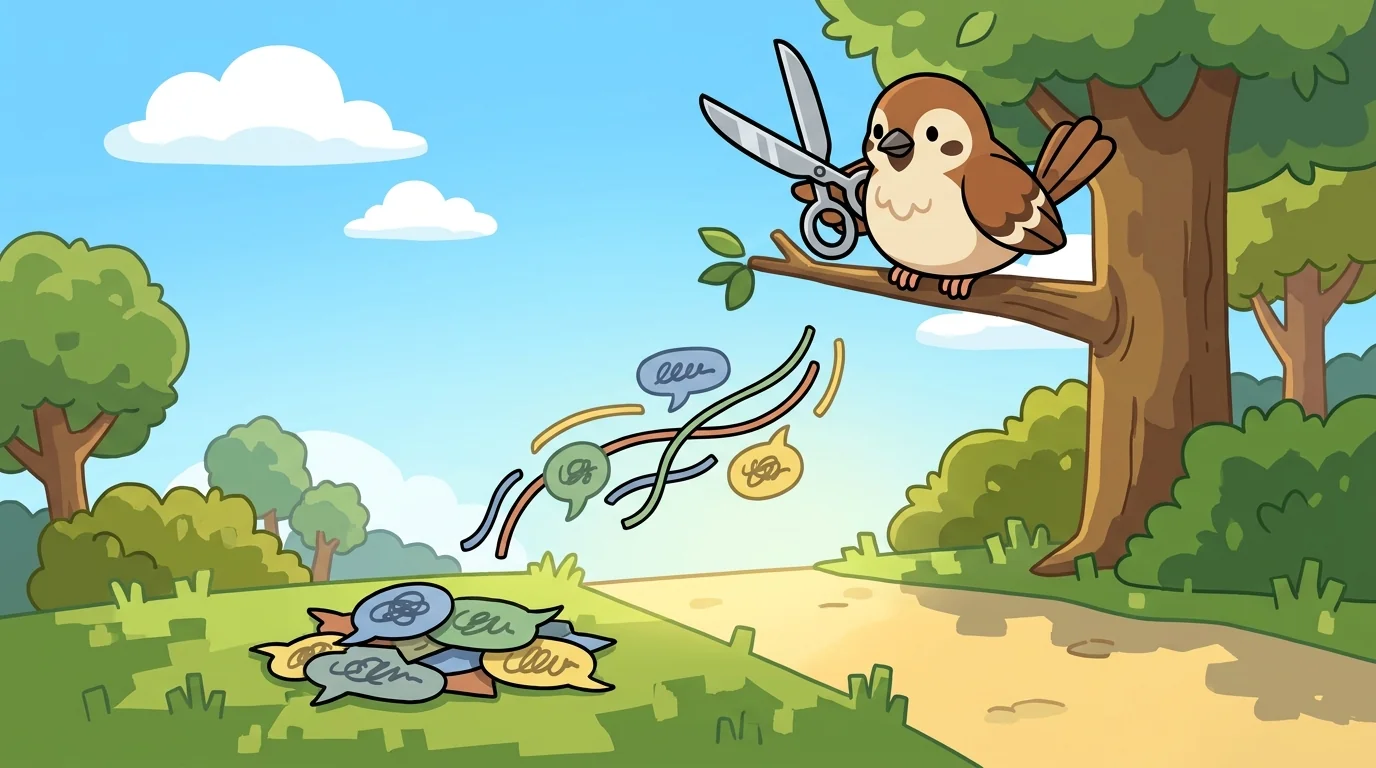
Patter met Clip on a crisp morning, and the conversation was over almost before it began.
Clip was a small, neat sparrow with a tiny pair of silver scissors tucked under one wing. Patter started to say hello — "Good morning! How are you? Lovely day, isn't—" — and Clip's scissors flashed. Snip, snip, snip. The dead words fell away like trimmed thread. What was left hanging in the air was just: "Lovely day."
"You cut my sentence," Patter said, startled.
"I cut the parts that weren't doing anything," Clip said briskly. "My name is Clip. I trim the filler out of talk." She nipped a stray "um" out of the air and let it drop. "Hello, how are you, I'm fine, that's nice — those words are just throat-clearing. They're not the talk. The talk is what comes after."
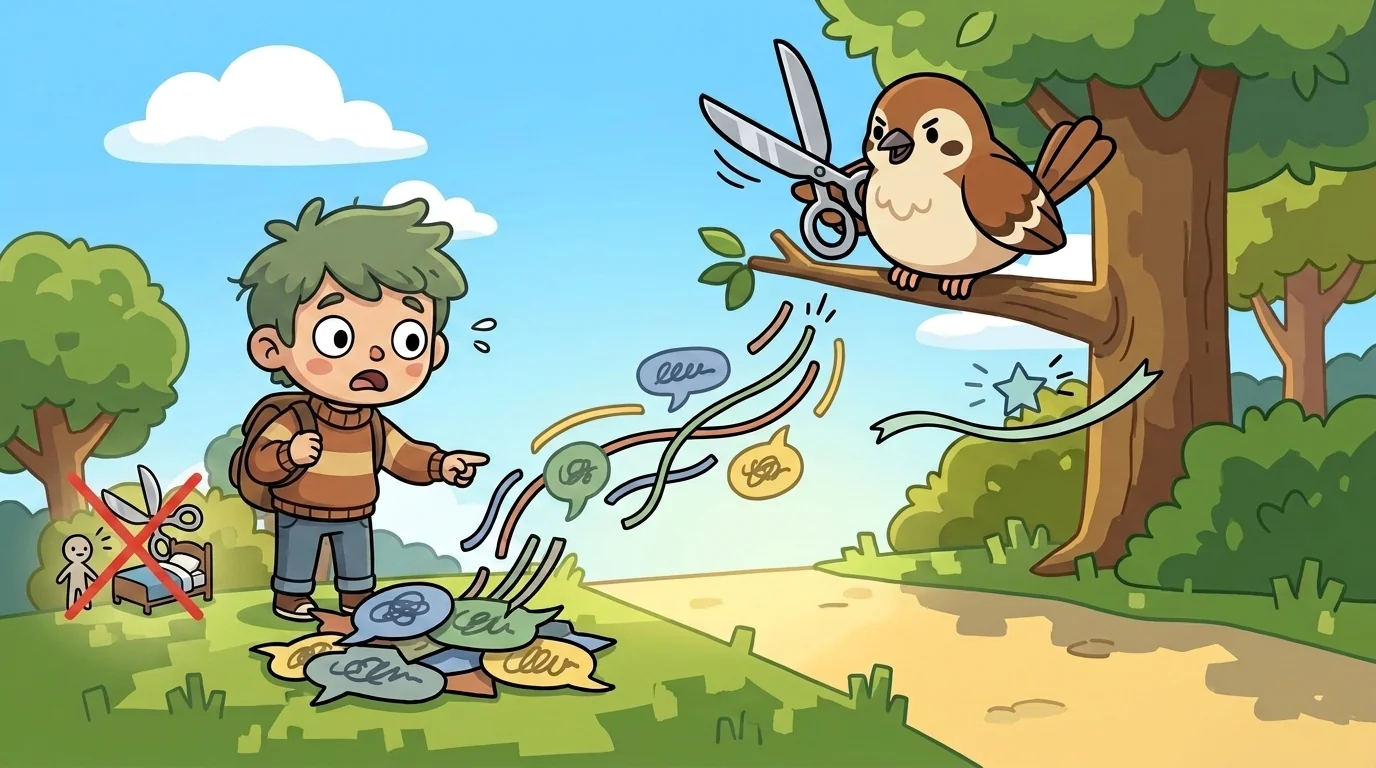
Patter watched her work. A long, draggy conversation floated past — full of "so anyway," "you know," "I was just thinking," and "what was I saying?" Clip's scissors danced through it. Snip. Snip. Snip. When she finished, the whole rambling thing had shrunk to two crisp lines that held all the real meaning. The rest fluttered to the ground like confetti.
"It's the same talk," Clip said. "Just without the dead weight. Shorter. Sharper. Every word that's left actually does something."
Then she showed Patter her favorite trick. She took a scene that began with a character waking up, having breakfast, walking to a friend's house, knocking, saying hello — and she snipped away the whole beginning. The scene now started right at the interesting part: two friends, mid-argument, the door already slammed. "Start late," Clip said. "Don't begin a scene at hello. Begin it where it gets interesting. Cut everything before that."
Patter felt the click. The kids write every 'hi' and 'bye,' he thought. Their scenes take forever to get going. Clip skips straight to the part that matters.
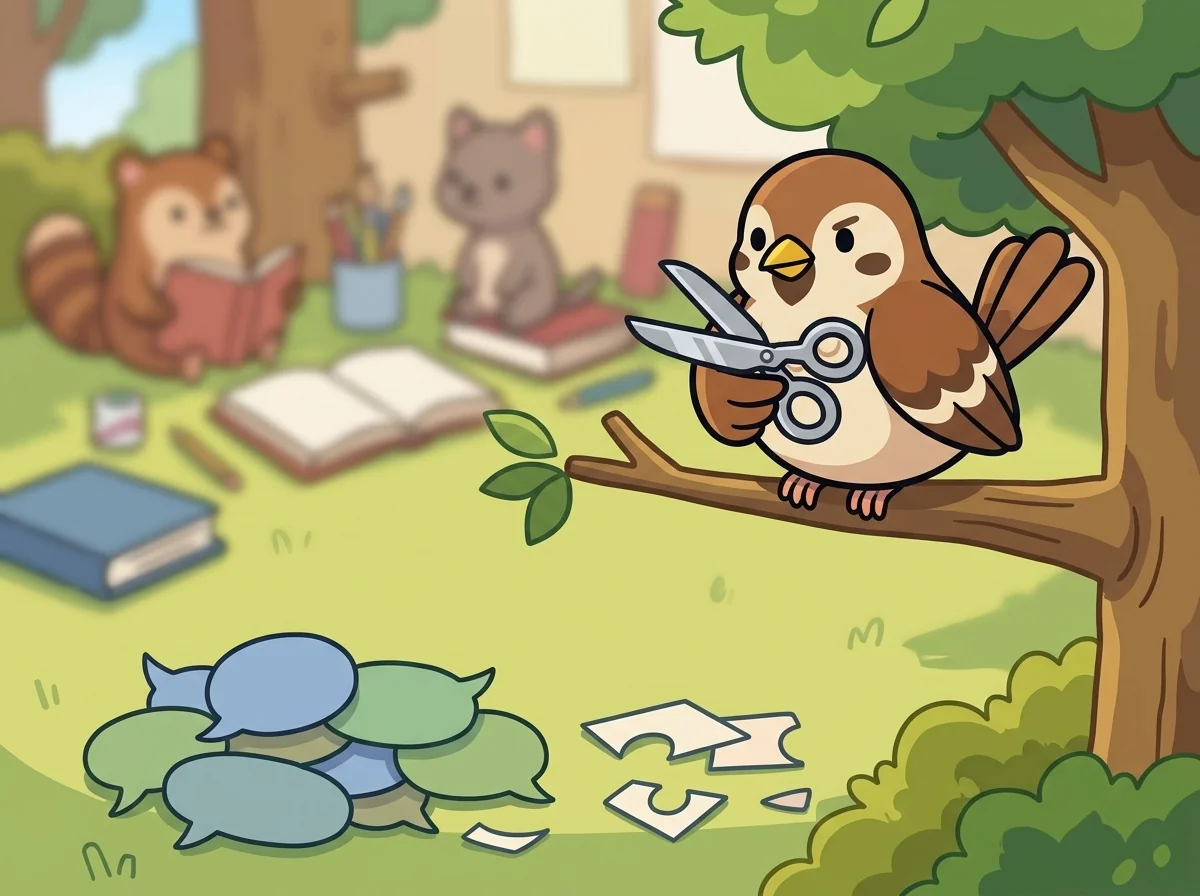
"Clip," Patter said, "I run a workshop. The kids' dialogue scenes are full of 'hello' and 'how was your day' and it takes a page before anything happens. Would you join us? Lend them your scissors?"
Clip was already trimming the question down in her head. "Yes," she said. Just the one word. Patter laughed — she'd even clipped her own answer.
So Clip joined the workshop, and the talking-scenes there are lean and quick now.
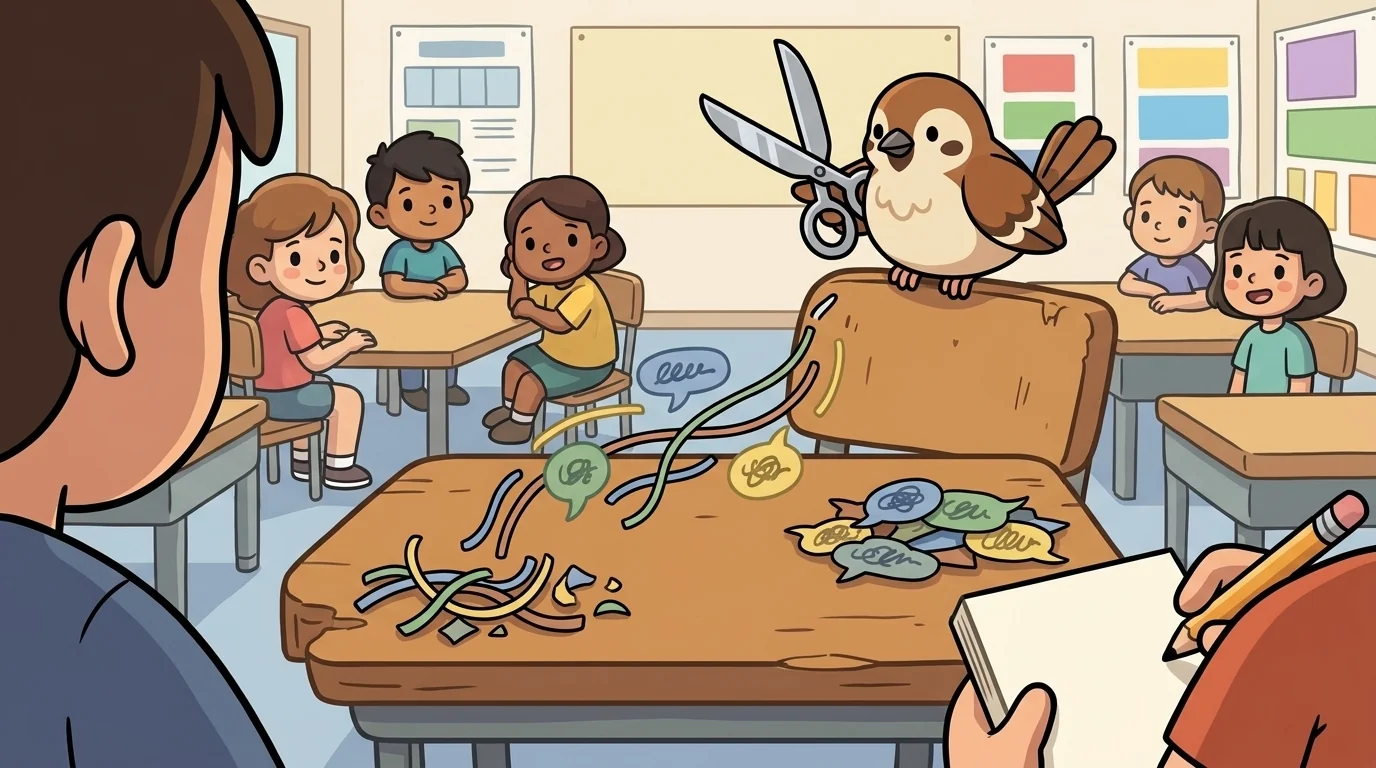
When Patter teaches economy, Clip demonstrates. "Read your dialogue out loud," she tells the kids, "and find the words that aren't doing anything. The 'hellos.' The 'ums.' The 'so anyways.' Then —" she clicks her scissors — "snip them."
A young writer had a scene that opened: "Hi." "Hi." "How are you?" "Good, you?" "Good." "So..." "So I wanted to ask you something." Clip snipped the whole top off. The scene now opened on: "I wanted to ask you something." Instantly it had energy — the reader leaned in, wondering what the question was.
"But careful," Clip added, snipping the air thoughtfully. "Economy doesn't mean cold. Sometimes a 'hello' matters — if it's awkward, or warm, or the first word two enemies have said in years. Keep the words that do something. Cut the ones that just fill space. The test is always: is this word working, or just sitting there?"
A young writer asked, "How do I know if a line is working?"
"Take it out," Clip said simply. "If the talk still makes sense and feels the same — the line wasn't working. Leave it out. If something important breaks — put it back. It was earning its place."
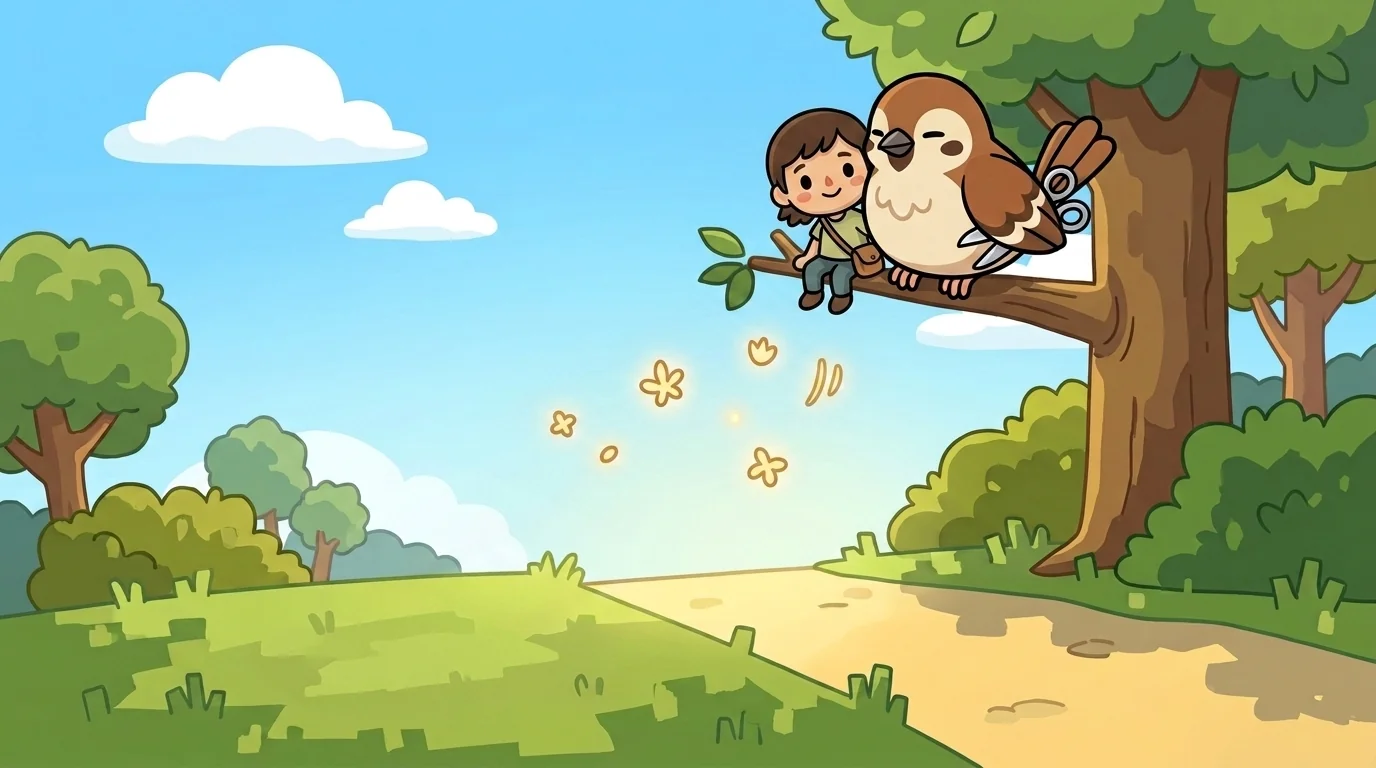
After the workshop, Clip perched beside Patter, her little scissors finally resting under her wing.
"You cut so much away," Patter said. "Doesn't it ever feel like loss?"
Clip considered this — briefly, of course. "It used to," she said. "I worried that trimming meant throwing good things away. That shorter meant less." She smoothed a feather. "But then I noticed how a talk breathes once the dead words are gone. How the real words shine when they're not buried in filler. How a friend leans in closer when you finally just say the true thing, plain." A quiet, clean contentment settled over her. "Cutting isn't loss. It's making room. When I trim away everything that doesn't matter, what's left is the part that does — and it gets to be heard at last." And she tucked her scissors away, light and unburdened, glad to be a creature who knew that less, said well, could hold so much more.
The DialogueQuest ensemble
Clip is part of DialogueQuest's distributed-narrative cast. Each character embodies a different curricular primitive; together they teach the full subject.
-
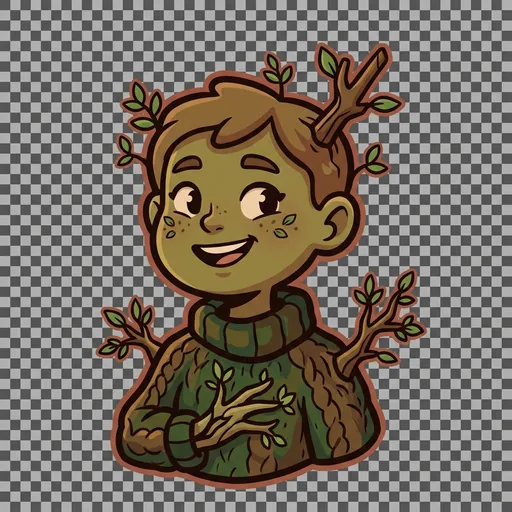
Sprig
Branch meaningfulness — sapling-tween whose visible branching skeleton shifts physically when she picks between dialogue options (the choice re-routes her body)
-

Glance
Subtext — arctic-fox-tween in a thick scarf; speech-bubble visibly half-empty with dotted-line ghost-text floating beside it
-
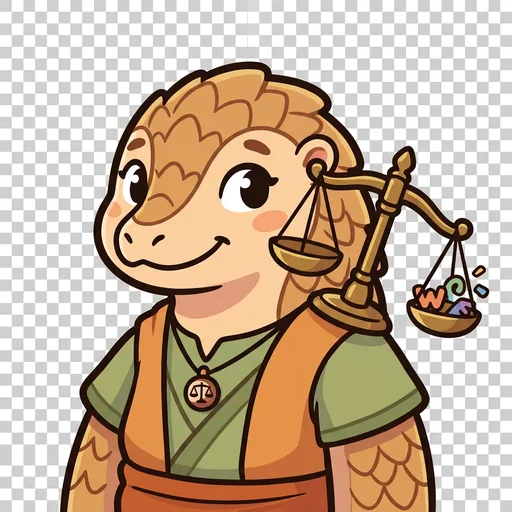
Weigh
Tag balance — pangolin-tween with a brass balance-scale on her shoulder; scales tilt visibly as dialogue happens around her
-
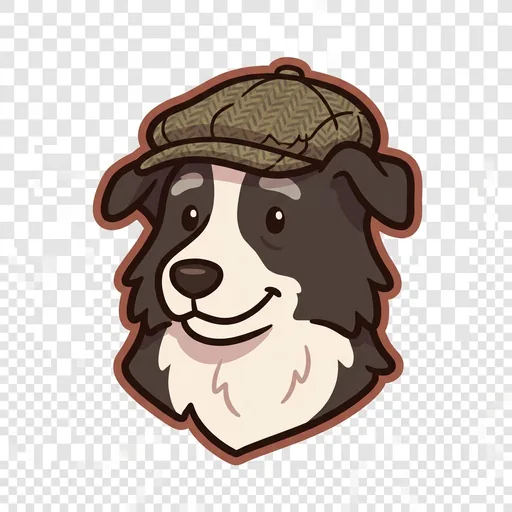
Brogue
Voice consistency — border-collie-elder in a worn flat-cap who uses exactly 4-5 signature words across every appearance (deliberately non-specific old-country accent)
-
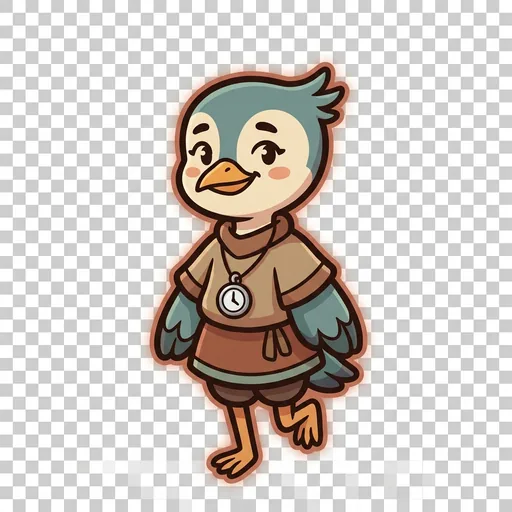
Rest
Rhythm + silence — heron-tween with a small silver pocket-watch around her neck; one foot perpetually raised mid-step; treats the pause as a line of dialogue itself
-

Prop
Action beats — red-squirrel-tween whose paws are always busy with a small acorn; the little actions between lines show feeling and set the rhythm of a talk
-
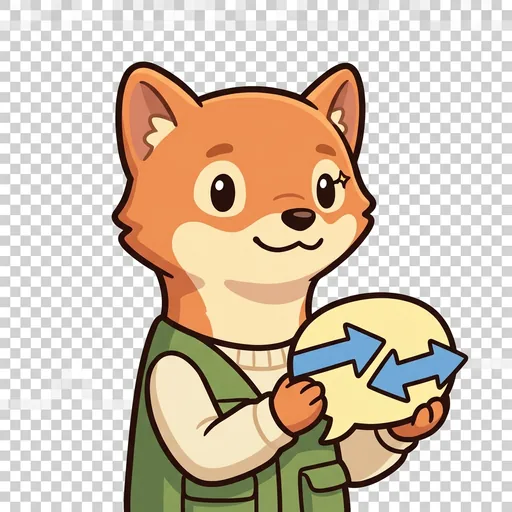
Spar
Conflict / friction — pine-marten-tween whose speech bubbles push against the other speaker's; two characters wanting different things is the engine (the push stays kind)
-

Dash
Interruption / overlap — chipmunk-tween who crashes into the ends of others' lines with a dash when feeling runs too high to wait (used on purpose, sparingly)
-
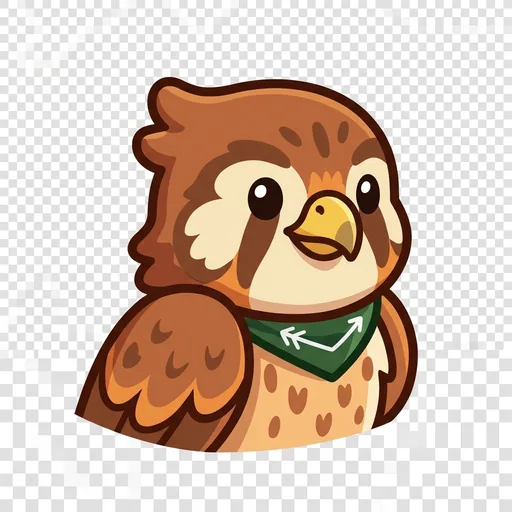
Aim
Line purpose — kestrel-tween with arrow-shaped speech bubbles that point at what each line is really trying to DO (ask, dodge, persuade), not just say