
Trail
TRAIL — *the floor-pattern shapes you draw moving through space.*
Listen along — Trail
Loading audio…
Press play to listen along. The line being read lights up as you go.
Show full transcript
Loading transcript…
Chapter 2 — Trail and the Invisible Patterns Dancers Draw on the Floor
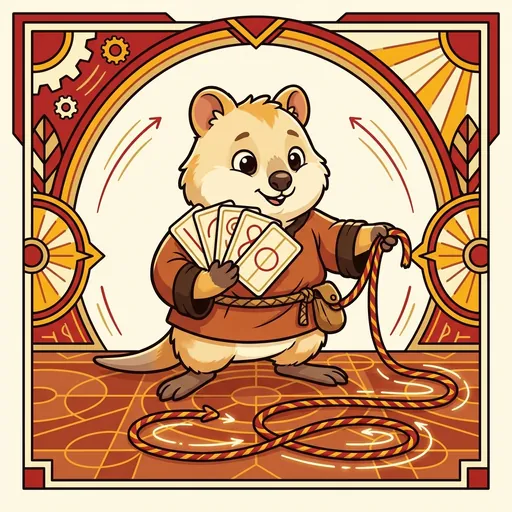
Trail was a small quokka-tween, built round and soft and strong, with warm-cream fur tipped with soft honey. He moved with a quiet purpose, his loose tunic rustling faintly as he walked. Today, he stood at the edge of the DanceQuest studio, a small set of floor-pattern cards tucked into his belt and a coil of space-mapping string looped over one shoulder. Trail was deeply curious about floor patterns. He often said, “The floor-pattern shapes you draw moving through space.”
Most people thought dance happened in the body. They focused on poses and individual moves. But Trail knew better. He knew that dance also happened through space, in the invisible drawings a dancer left on the floor. A line from one corner to another. A wide circle around the center. A slow, inward spiral. These were not random wanderings. They were deliberate choices, a secret language. Audiences saw these patterns, even if they couldn’t name them. They felt the choreography’s geometry.
Trail’s whole work was making these space-pathways visible. He wanted everyone to see them as a craft, not just accidental movement.
“The floor-pattern shapes you draw moving through space,” Trail explained to his new class, his voice earnest. “When you move from one corner of the stage to the other, you’ve drawn a diagonal line. When you circle the center, you’ve drawn a circle. When you spiral inward, you’ve drawn a spiral.”
He picked up a card showing a bold, sweeping arc. “The audience sees these shapes. They see them even when they’re invisible to your eye on the floor.” Trail held up another card, this one with a complex figure-eight. “A choreographer thinks in floor patterns. They might plan: ‘Enter from upstage-left, sweep a wide arc, gather center, then spiral inward to a stillness.’ That’s a composition. Floor patterns are language.”
He pointed to different areas of the studio. “This is upstage,” he said, gesturing to the back wall. “That’s downstage.” He moved his paw to the sides. “And these are stage-left and stage-right. Always from the dancer’s perspective, remember.” Knowing the stage’s geography, he explained, was the first step to planning movement. It wasn’t just a floor; it was a map.
Trail then laid out a long length of his space-mapping string. It stretched in a wide, gentle curve across the polished floor. “This is an arc,” he said, holding up the matching card. “Now, watch.”
He called on a student named Kiko, a lanky fox-tween with quick, nervous movements. “Kiko, walk this path slowly.”
Kiko stepped onto the string, moving with careful, deliberate steps. Her body swayed slightly as she followed the curve. “It feels… like I’m making a big, important decision,” she said, surprised.
“Exactly,” Trail nodded. “It feels like a deliberate gesture.” He then asked another student, a swift squirrel-tween named Pip, to run the same arc.
Pip darted along the string, light and quick. “Whoosh!” he exclaimed, reaching the end. “It feels like flying!”
“It does,” Trail agreed. “It feels like flight. Now, Maya,” he turned to a quiet badger-tween, “spin while you walk it.”
Maya moved with a graceful, unhurried twirl, her arms extended. “It’s like… growing,” she whispered, her eyes wide. “Like a vine reaching.”
“Yes!” Trail beamed. “Same path, three speeds, three feelings. That’s the power of intention. That’s space + floor pathways.”
He showed them how a dancer could use different level changes – moving from the floor, to mid-level, to high – to add dimension to their patterns. A spiral could rise or fall, changing its entire meaning. He also taught them about negative space. “Where the dancer isn’t also tells a story,” he emphasized. “An empty space can mean focus, or breath, or anticipation.”
Trail then arranged three dancers at different points along a string he had laid in a spiral, winding inward. “Where each dancer is on the spiral shows how the audience reads them,” he explained. “The choreographer paints with bodies on space.” He showed how group formations – lines, V-shapes, circles – were like sentences in this spatial language. Each formation spoke. He also explained spatial entries and exits: “Where you start tells the audience how to read your beginning; where you end frames your ending.”
“Some dancers,” Trail said, picking up a card that showed a messy, tangled scribble, “just move randomly. They wander. But random wandering reads as confusion. It lacks intention.” He laid down another card, this one blank. “And some stay in one spot. Sometimes that’s right, but often, it’s a missed opportunity. Space is one of the dancer’s most important instruments.”
Trail had grown up along the underbrush-trails, a path-tracer like his family before him. They were the quokkas whose careful trails through the bush had taught generations a simple truth: Every body that moves leaves a path. The path tells the story. The dancer just makes the path on purpose. Trail had carried that lesson forward.
He walked to DanceQuest when he was twelve. Rhythm, his mentor, had asked him, “What is space in dance?”
Trail hadn’t hesitated. “The floor-pattern shapes you draw moving through space. Path-craft.”
Rhythm had simply nodded. “You are appointed.”
In his workshop, Trail concluded, “Don’t think of dance as just bodies. Think of it as bodies moving through space. Train yourself to see the path. Train yourself to choreograph the path. Round and soft and strong and spatially aware – that makes a complete dancer-choreographer.”
“The floor-pattern shapes you draw moving through space.”
The DanceQuest ensemble
Trail is part of DanceQuest's distributed-narrative cast. Each character embodies a different curricular primitive; together they teach the full subject.
-

Pose
Body-awareness + position — listening to your own shape
-

Phrase
Time + tempo — how movement is organized in musical counts
-

Lift
Energy + effort + dynamics — quality of movement, not aesthetic judgment
-

Glide
Locomotion — the craft of going from here to there with whole attention
-

Flock
Formation — how a group of dancers arranges itself in space (lines, circles, clusters, wedges) and how that shape flows and changes; the group as one moving picture
-

Storey
Level — dancing in the vertical space: low on the floor, mid at standing, high in reaches and jumps; every height belongs to dance, no height better than another
-

Beckon
Call-and-response — one dancer or group makes a movement and another answers it; a movement conversation built on truly listening before you reply
-

Canon
Unison and canon — unison is everyone moving together as one; canon is the same move staggered one after another, rolling across the group like a wave
-

Bide
Stillness and the hold — the held, alive, motionless moment inside a dance; negative space made of time; a strong chosen pause, not tiredness or absence
-
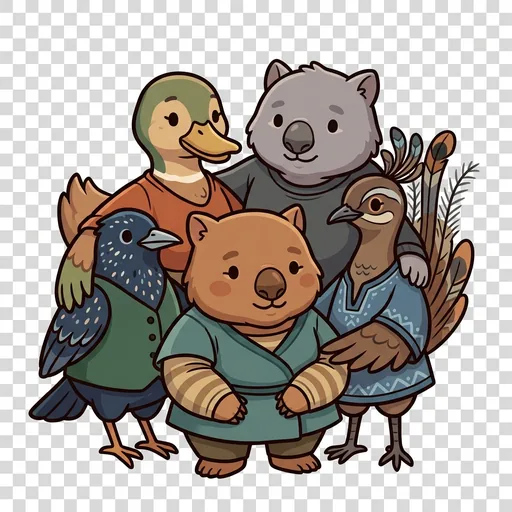
The Company
The whole group dancing as one — how formation, level, call-and-response, unison and canon, and stillness weave together so a group of dancers moves as a single living thing