
Lift
LIFT — *quality of movement, not aesthetic judgment. effort is the dancer's instrument.*
Listen along — Lift
Loading audio…
Press play to listen along. The line being read lights up as you go.
Show full transcript
Loading transcript…
Chapter 4 — Lift and the Eight Qualities of Movement
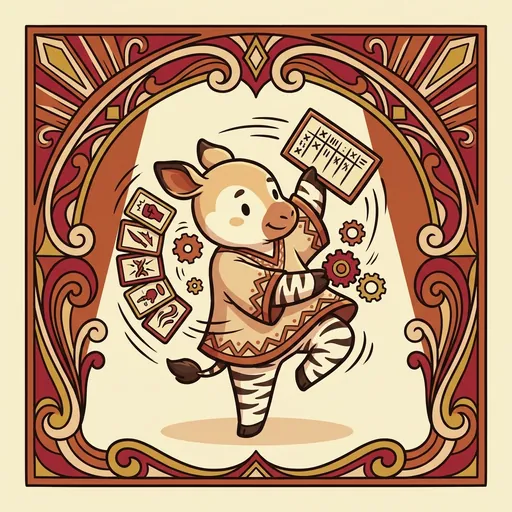
The morning light came sideways through the studio windows, and Lift was already reaching. She stood in the middle of the wooden floor, a small, round-and-strong okapi with warm cream fur and soft stripes running down her legs, her loose practice tunic swishing as she stretched one arm out into the air. She did it once, sharp and fast, and the whole room seemed to snap awake. Then she did the exact same reach again — slow this time, arm drifting up like it was floating on water — and the room went quiet and dreamy.
Same arm. Same shape. Two completely different feelings.
“Did you see that?” she said to the empty studio, grinning at her own reflection in the dark, un-mirrored glass. She didn’t need the mirror. She could feel the difference right in her shoulder — the tight electric snap of the first one, the warm slow drift of the second. That was the whole thing she loved. Not how the reach looked. How it felt, and how you got to choose the feeling.
Her little tally counter sat on the window ledge where she’d left it. She picked it up and clicked it once — the small sound she made every time her body changed the way it moved. Reach fast: click. Reach slow: click. Two feelings, two clicks, and she hadn’t changed the shape of her arm even a tiny bit.
Beside the counter lay her worn stack of movement cards, eight of them, each one with a single word: punch, slash, wring, press, dab, flick, glide, float. A dancer she’d read about long ago, named Rudolf Laban, had noticed that every movement carried one of these feelings inside it. Lift had memorized all eight when she was little, the way some kids memorize songs. She still whispered them to herself sometimes, like a warm-up.
She reached out one more time, letting the reach turn heavy and pushing, like moving her arm through thick honey. A press. Her shoulder felt strong and patient. She laughed out loud in the empty room, delighted, and the happy sound bounced off the walls.
Lift had grown up out past the edge of the grassland, where her family were known for one strange, wonderful thing: nobody moved quite like they did. Her aunties could graze slow and dreamy across a meadow, then freeze mid-step, utterly still, then break into a quick sideways dart — all in the space of a breath.
“Watch how the same body moves a hundred ways,” her grandmother used to say, walking Lift out into the tall grass at dusk. Grandmother would take one single step and make it feel gentle. Then take the very same step and make it feel like she meant business. “See? I didn’t get a new leg. I got a new feeling. The change between one feeling and the next — little one, that’s where the dance lives.”
Young Lift practiced for hours. She’d reach for a low branch as if she were angry, then reach for it again as if she were saying goodbye to a friend. Her body was small and soft and round, and none of that mattered one bit. The branch didn’t care what she looked like. Only the feeling changed, and she could feel each feeling settle somewhere deep in her chest.
One evening she sat with Grandmother, breathing hard and happy after a long practice, and asked why it felt so good. Grandmother pressed a warm hand to Lift’s shoulder. “Because you stopped worrying about how you seem,” she said, “and started listening to what you mean. That’s a quiet, steady kind of joy. It stays with you.” Lift never forgot the warmth of that hand, or the settled feeling that came with it.
She was twelve the day she walked up the long road to the dance studio, tally counter clicking in her pocket, cards tucked under her arm. The dance leader, Rhythm, met her at the door and asked a simple question.
“What do you know about energy and effort?”
Lift didn’t recite a rule. She just reached her arm out — sharp and sudden, like a spark — and then reached it out again, slow and drifting, like a cloud. “This,” she said. “Same body, two feelings. You don’t need a certain kind of body to make either one. You just have to choose the feeling and mean it.”
Rhythm’s eyes went soft and warm. She stepped aside and held the door open. “Welcome home,” she said quietly.
Inside, Lift found a workshop already waiting for her — a wide floor, windows with no mirrors, and a shelf just the right height for her cards. She set the counter down, ran her palm over the smooth wood, and felt something in her chest unclench and settle, like a held breath finally let go. This was a place where the feeling of a movement mattered more than the look of it. She was, she realized, exactly where she was supposed to be.
A quiet, worried kid named Pace lingered at the back of Lift’s first workshop, arms crossed tight. “I’m not built like a dancer,” Pace said. “I’m round. I’m not stretchy.”
Lift didn’t argue. She just held out her arm. “Reach with me,” she said. “Now — make it a spark. Fast and strong.” Pace reached, quick and sharp, and blinked, surprised. “Now make the same reach a feather. Slow. Soft.” Pace reached again, arm drifting down like something settling. A small startled smile crept onto Pace’s face.
“You just did two completely different things,” Lift said gently, “with the exact same arm. That’s the whole art, right there. Not stretchiness. Not a certain shape. Just choosing the feeling.”
She clicked her counter. “Watch — a whole tiny dance.” She floated her arms up soft for four slow counts, dreamy and light. Then, on the fifth count, she made them snap sharp and strong. Click. “Counts one to four, I’m dreaming,” she said. “Count five, I wake up. Same me. Two feelings. That’s a whole story about waking up, and I never once cared how it looked.”
Pace uncrossed their arms. “Can I try the waking-up one?”
“Every body can play every feeling,” Lift said, moving to stand beside Pace instead of in front. “Round, soft, tall, small — the feeling doesn’t check what shape you are first. Go on. Dream, then wake.”
Pace floated, then snapped awake. It was wobbly and imperfect and completely real, and Pace laughed out loud, a warm surprised laugh, hands pressed to a chest that felt suddenly light.
Later, when the workshop had emptied, Lift stayed behind in the slanting evening light and let her arms drift down into one last, slow float. She could feel it settle all through her — her shoulders going warm and easy, a happy little wiggle running down to her hooves, a proud grin spreading across her face that she could feel even without any mirror to show it.
That was the thing she loved most. Not looking a certain way. The soft glad hum of a body doing exactly what it meant to do.
“Feel that?” she murmured to no one, breathing slow and light. “That warm, easy feeling when what you mean and what you do finally agree.” Her chest felt steady and full. “That’s the whole reason I dance. And it feels wonderful.”
The DanceQuest ensemble
Lift is part of DanceQuest's distributed-narrative cast. Each character embodies a different curricular primitive; together they teach the full subject.
-

Pose
Body-awareness + position — listening to your own shape
-

Trail
Space + pathways — the floor-pattern shapes you draw moving through space
-

Phrase
Time + tempo — how movement is organized in musical counts
-

Glide
Locomotion — the craft of going from here to there with whole attention
-

Flock
Formation — how a group of dancers arranges itself in space (lines, circles, clusters, wedges) and how that shape flows and changes; the group as one moving picture
-

Storey
Level — dancing in the vertical space: low on the floor, mid at standing, high in reaches and jumps; every height belongs to dance, no height better than another
-

Beckon
Call-and-response — one dancer or group makes a movement and another answers it; a movement conversation built on truly listening before you reply
-

Canon
Unison and canon — unison is everyone moving together as one; canon is the same move staggered one after another, rolling across the group like a wave
-

Bide
Stillness and the hold — the held, alive, motionless moment inside a dance; negative space made of time; a strong chosen pause, not tiredness or absence
-
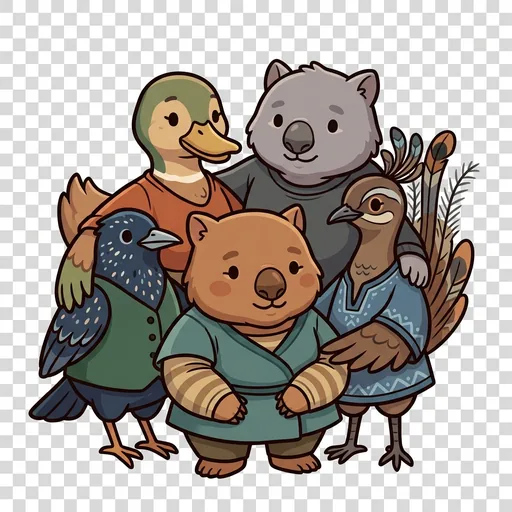
The Company
The whole group dancing as one — how formation, level, call-and-response, unison and canon, and stillness weave together so a group of dancers moves as a single living thing