
Bide
STILLNESS & THE HOLD — *the held, motionless moment inside a dance. the pause that frames the movement around it; negative space made of time. stillness as a choice, not an absence.*
Press play to listen along. The line being read lights up as you go.
Show full transcript
Loading transcript…

Bide was a heron-tween — but a very different heron from the restless kind. She was tall and calm and utterly comfortable holding perfectly still, and when she did, she wasn't empty or frozen; she was full, poised, breathing, alive, like a held note. She wore a soft draping wrap that settled around her when she stilled. She carried no busy tool, only a small smooth river-stone she'd cup in her wing, because a stone, she said, is never doing anything and is somehow always exactly enough.
"Stillness is a move too," Bide liked to say, holding motionless with her stone. "The held moment. The pause inside a dance. Everyone thinks dance is only the moving parts — but the stillnesses are where the moving parts get their meaning. A held moment right after a big movement lets the audience feel it. A stillness before a movement makes everyone lean in. It's not an absence. It's negative space made of time — and it's a choice, a strong, alive, chosen thing. Not stopping because you're tired. Holding, because you mean to."

Bide grew up in the still shallows, where her family were the patient fishers — herons who caught their food not by darting about but by holding utterly, gloriously still until the moment arrived. The shallows taught Bide what the busy creatures never understood: that stillness is not nothing. A held heron is not a stopped heron. She is coiled, breathing, completely present, full of readiness — and that fullness is its own kind of power.
Little Bide hated holding still at first; she felt like she was failing, just standing there while others splashed and darted. "I'm not doing anything," she fretted. Her grandmother, mid-hold, didn't stir. "You're doing the hardest thing," she murmured. "You're being completely here. A stillness that's alive — breathing, ready, present — is not the same as stopping. Feel it: you're not empty, you're full." Slowly Bide felt the difference between a dead stop and a living hold, and fell in love with the held moment — the way a pause could brim with meaning, the way being still could be the most present thing of all. She kept a smooth river-stone from that day, to remember that doing-nothing can be exactly enough.

At twelve, Bide walked calmly to DanceQuest, river-stone cupped in her wing. Rhythm met her and asked.
"What is stillness?"
Bide held perfectly still for a breath before answering, full and poised. "It's the held moment inside a dance," she said. "The pause that frames the movement around it. A held stillness after a big move lets the audience feel it; a stillness before makes them lean in. It's not an absence — it's negative space made of time. And it's a choice: holding because you mean to, not stopping because you're tired."
Rhythm smiled. "You are appointed."
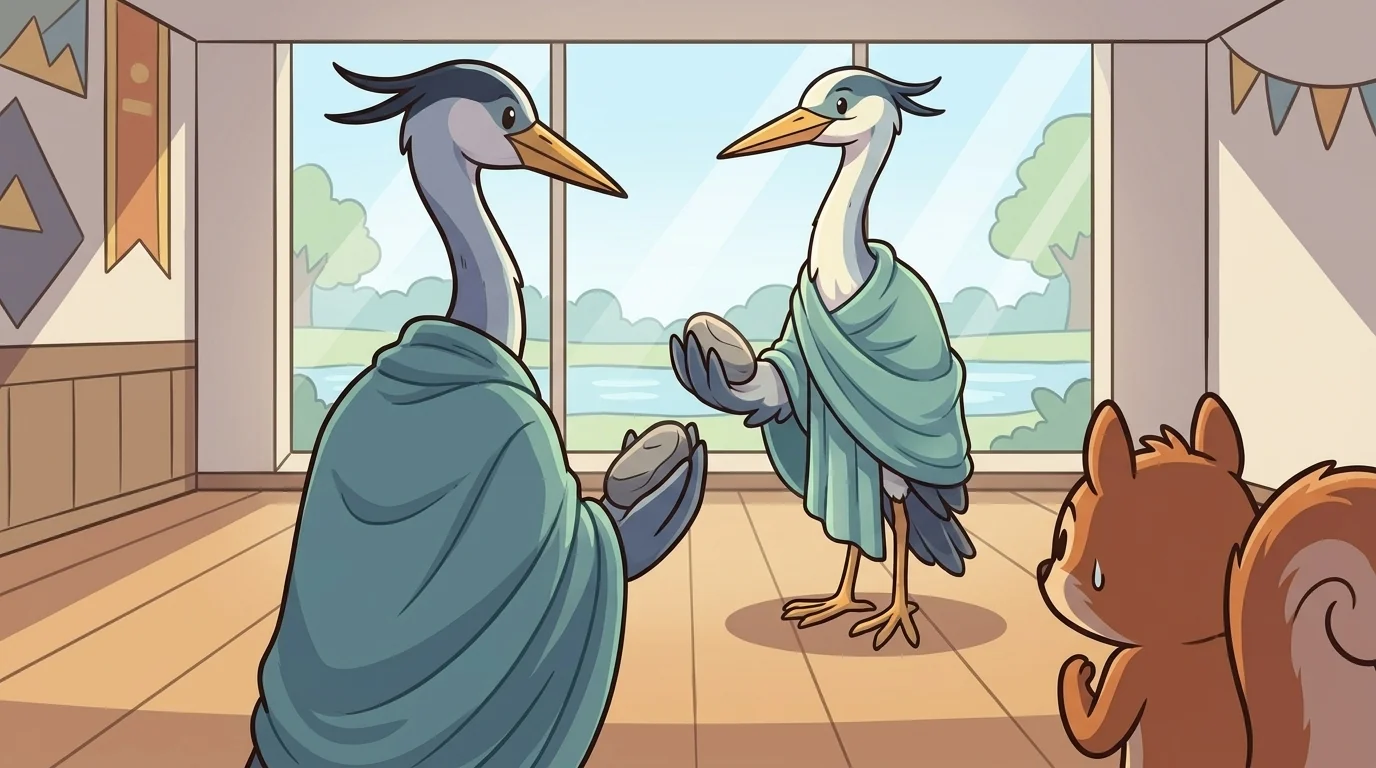
Bide's studio was calm and uncluttered, and today a fidgety squirrel-tween named Sumi was there, unable to stop moving.
"My dance never stops," Sumi said, bouncing. "It's move, move, move, the whole time, because if I stop it feels like I forgot what comes next, or like I'm just standing there being boring and everyone can see me not-dancing. Rhythm says it's 'exhausting to watch' and 'has no breath.' But stillness feels so... scary. Like a hole."
"Ah — a still moment feels like a hole you're falling into," Bide said gently. "Let's turn it into something you're holding instead. Watch." She did a big sweeping movement — and then stopped, held, perfectly still, but alive: breathing, poised, present, her whole body full of the movement that had just happened. She held it three long breaths. It wasn't boring at all. It was powerful. The stillness let the sweep she'd just done land. Then she flowed on.
"See? The held moment isn't nothing," Bide said. "It's where the movement you just did gets to be felt. Now you try. Do your move — then hold. Don't collapse, don't check out. Stay full: keep breathing, stay reaching, stay here. Hold three breaths. Trust it."
Sumi did her move and then — terrified — held. But Bide reminded her: stay full, keep breathing, stay here. And the hold wasn't a hole at all. It was strong. It gave her frantic dance, for the first time, a breath. The audience-in-her-mind leaned in instead of glazing over.
"It felt powerful," Sumi said, amazed. "Not boring. And I didn't fall in the hole."
"Because you held instead of stopping," Bide said. She gave the squirrel the rules, cupping her stone. Make stillness a choice — hold because you mean to, not because you froze. Stay full in the hold: breathe, stay reaching, stay present; a living hold is not a dead stop. Place a stillness where it counts — after a big move to let it land, before one to make them lean in. And don't fear the held moment; the pause that feels like forever to you is exactly the breath the dance needs.
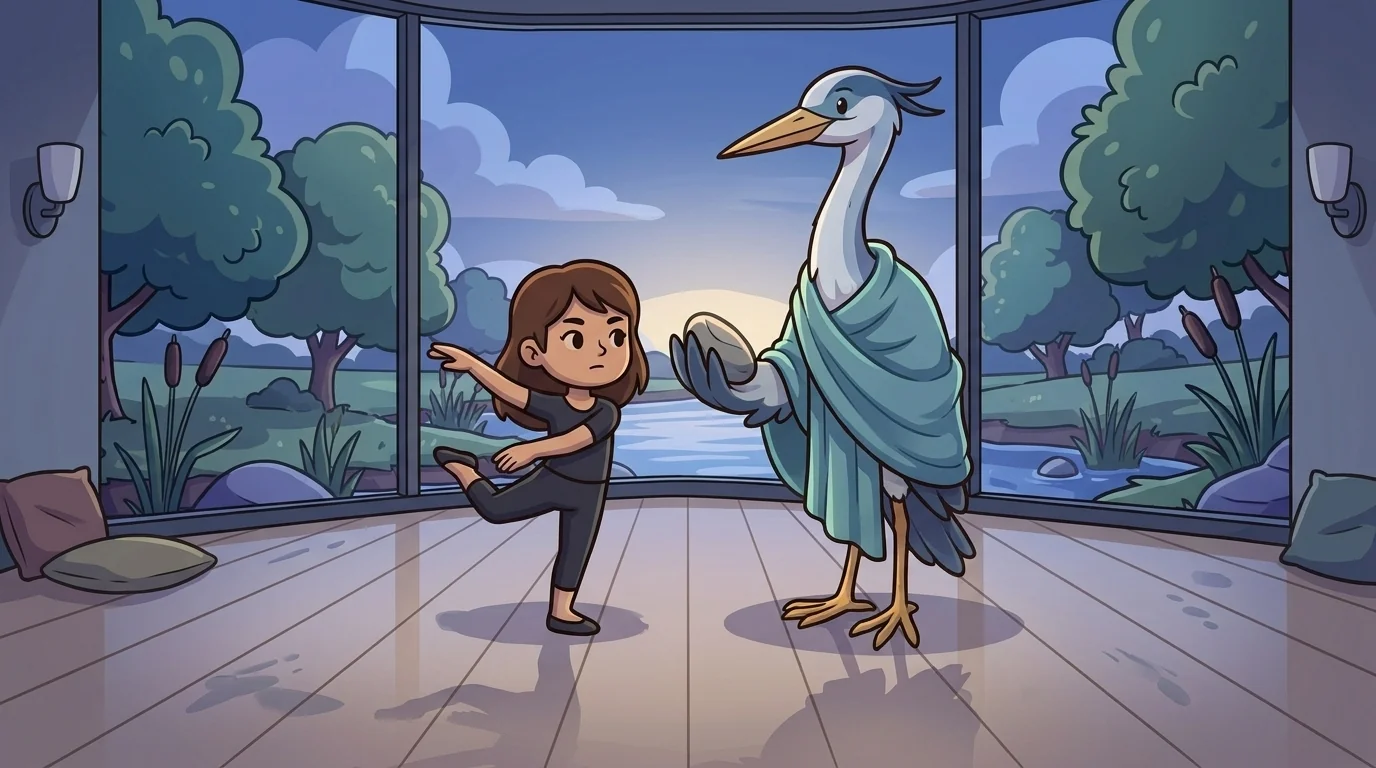
When the calm studio dimmed, Sumi stayed, practicing holding — one move, then a full, alive stillness.
"I move constantly because stopping scares me," she admitted. "Like if I'm still, I'm failing, or I'm boring, or everyone will notice me just standing there."
Bide settled into a serene stillness beside her, river-stone in wing. "So many dancers run from stillness for exactly that fear. But here's the truth the shallows taught me: a held stillness isn't you failing to dance. It's you dancing the pause. It's the most present thing you can do — fully here, breathing, alive, letting the moment matter. That's not boring. That's brave. And it has nothing to do with how you look standing there. It's about how present you are." She cupped her stone. "A stone does nothing, and is always exactly enough."
Sumi held one long, full, breathing stillness, and felt the fidgety fear of the hole settle into a calm, grounded fullness — the quiet strength of a moment chosen and held.
"Hold because you mean to. Stay full," Bide said, perfectly, powerfully still. "Doesn't the quiet feel strong, once it's yours?"
The DanceQuest ensemble
Bide is part of DanceQuest's distributed-narrative cast. Each character embodies a different curricular primitive; together they teach the full subject.
-

Pose
Body-awareness + position — listening to your own shape
-

Trail
Space + pathways — the floor-pattern shapes you draw moving through space
-

Phrase
Time + tempo — how movement is organized in musical counts
-

Lift
Energy + effort + dynamics — quality of movement, not aesthetic judgment
-

Glide
Locomotion — the craft of going from here to there with whole attention
-

Flock
Formation — how a group of dancers arranges itself in space (lines, circles, clusters, wedges) and how that shape flows and changes; the group as one moving picture
-

Storey
Level — dancing in the vertical space: low on the floor, mid at standing, high in reaches and jumps; every height belongs to dance, no height better than another
-
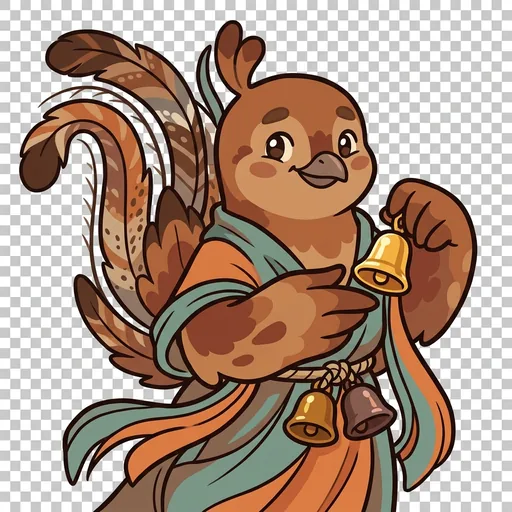
Beckon
Call-and-response — one dancer or group makes a movement and another answers it; a movement conversation built on truly listening before you reply
-

Canon
Unison and canon — unison is everyone moving together as one; canon is the same move staggered one after another, rolling across the group like a wave
-

The Company
The whole group dancing as one — how formation, level, call-and-response, unison and canon, and stillness weave together so a group of dancers moves as a single living thing