
Canon
UNISON & CANON — *unison is everyone doing the same movement at the same time; canon is everyone doing the same movement staggered, one after another, like a round. two ways a group shares one move.*
Press play to listen along. The line being read lights up as you go.
Show full transcript
Loading transcript…

Canon was a duck-tween, round and buoyant, with sleek water-repellent feathers and a calm, unflappable way about her. She wore a loose layered smock and moved with an even, unhurried steadiness, like she carried her own metronome inside. In her wing she carried a small paddle-wheel toy: spin it, and the little paddles rose and fell one after another in a rolling wave — then she could lock it so they all rose and fell together. "Two ways to share a move," she'd say, showing both. "All at once. Or one after another."
"Unison is when the whole group does the same movement at the exact same time," Canon liked to explain, locking her paddle-wheel so all the paddles moved together. "It's powerful — a wall of dancers moving as one. And canon" — she unlocked it, and the paddles rippled one after another — "is when everyone does the same movement but staggered, each dancer starting a beat or two after the one before. It rolls across the group like a wave, like a round in singing. Same move, two totally different feelings. Unison says we are one. Canon says watch it travel."

Canon grew up on the wide pond, where her family were the water-readers. When the whole flock landed together, they sent one big ring of ripples out at once — unison, a single powerful splash. But when they landed one after another down the length of the pond, the ripples rolled across the water in a traveling wave — canon. The pond taught Canon that the same action, timed together or timed staggered, made two completely different kinds of beauty.
Little Canon struggled with the staggered kind. Doing a wave-landing, she'd panic and try to splash at the same time as the duck ahead of her, ruining the rolling wave. "You're rushing to match her," her father said. "In a wave, you don't match — you wait your turn and keep your own steady count. Trust your count. If everyone holds their own timing, the wave rolls perfectly. The moment you rush to copy your neighbor, the wave collapses into a mess." Canon practiced holding her own inner count while the duck ahead moved first — trusting, waiting, then going — and the rolling wave appeared like magic. She learned that a canon isn't about watching and copying; it's about trusting your own steady time.

At twelve, Canon paddled her way to DanceQuest, paddle-wheel toy in wing. Rhythm met her and asked.
"What is unison and canon?"
Canon locked her wheel — all together — then unlocked it — one after another. "Two ways a group shares one movement," she said. "Unison is everyone doing it at the same time — a wall moving as one. Canon is everyone doing the same move staggered, one after another, so it rolls across the group like a wave. Same move; two feelings. And a canon only works if each dancer trusts their own count instead of rushing to match."
Rhythm smiled. "You are appointed."
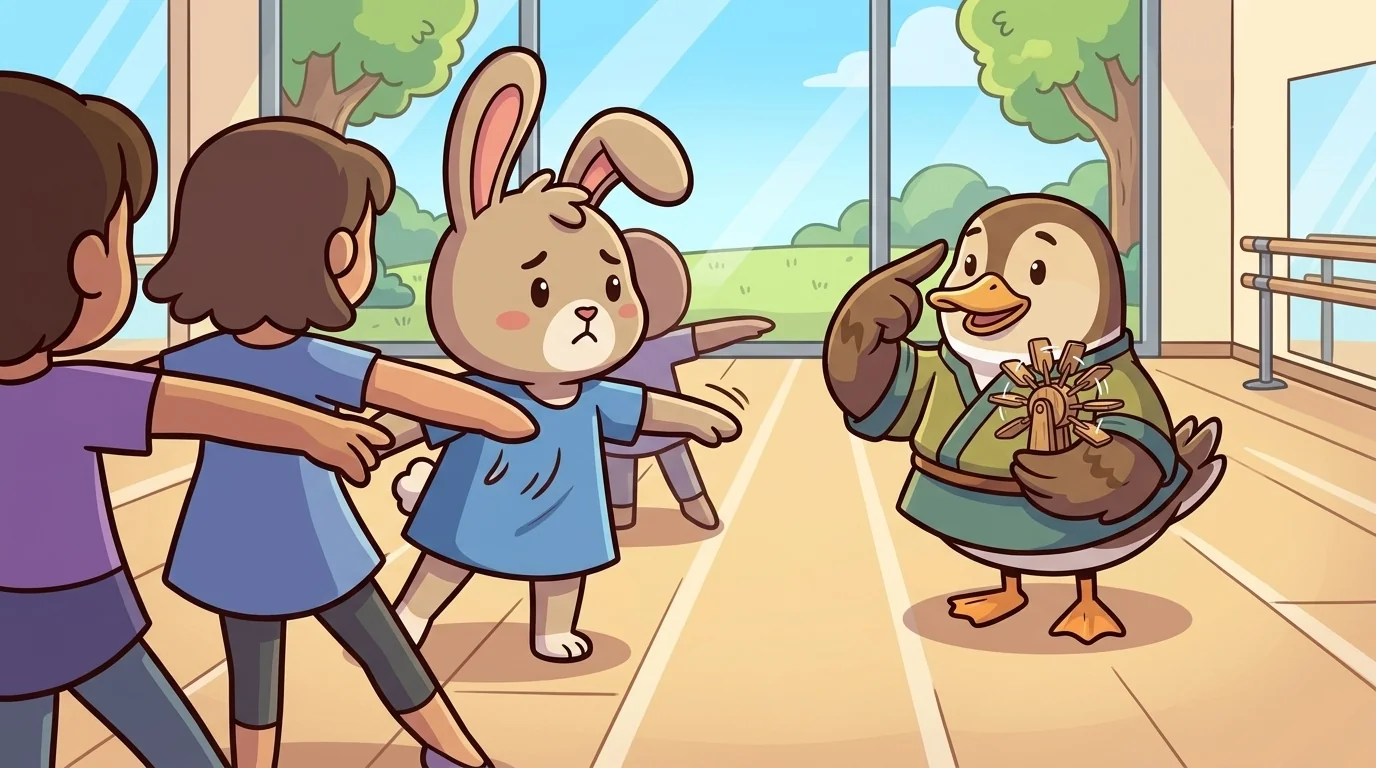
Canon's studio had a long floor, good for waves, and today an anxious rabbit-tween named Sumi stood in a line of dancers, twitchy.
"We're doing a canon," Sumi said, "where we each do the same arm-sweep one after another so it looks like a wave. But I keep messing it up! I watch the dancer next to me and try to match her and then we're both doing it at the same time and the wave disappears and it's my fault." Her ears drooped. "I feel like everyone's waiting to see me ruin it."
"Ah — you're watching your neighbor and rushing to copy her," Canon said, calm as still water. "That's exactly what breaks a canon. In unison you match; in a canon you don't. Watch." She set her paddle-wheel rolling. "Each paddle waits its turn and keeps its own steady time. It doesn't try to catch up to the one ahead. That's the whole trick — trust your own count." She stood Sumi in the line. "Count four in your head, steady, no matter what. When it's your turn — after the dancer ahead has started, on your own count — do your sweep. Don't watch her and copy. Trust your four."
Sumi took a breath and counted, steady, to herself. The dancer ahead swept; Sumi held her own count; then — on her count, not a rushed copy — she swept. And down the line the movement rolled, a clean traveling wave, because each dancer trusted their own timing.
"It made a wave!" Sumi said, ears up. "And I stopped watching everyone!"
"Because you trusted your own count instead of chasing hers," Canon said. She gave the rabbit the rules, spinning her wheel between each. Know which one you're doing: unison means match exactly; canon means stagger and don't match. In a canon, hold your own steady inner count — never rush to copy the dancer ahead. Start your move on your count, cleanly, and let the wave roll. And trust the group: if everyone keeps their own time, the wave takes care of itself.

When the long studio quieted, Sumi stayed, counting steady waves under her breath.
"I get so nervous I'll be the one who breaks it," she said. "So I stare at everyone else and try to copy, and that's what actually breaks it."
Canon settled beside her, calm and buoyant. "That's the gentle irony of a canon: the more you anxiously watch and copy, the worse it gets. The fix is the opposite of what fear wants — stop watching, go inward, trust your own steady count. You already have good timing inside you. A canon just asks you to trust it instead of chasing everyone else." She spun her paddle-wheel into a gentle rolling wave. "When a whole group each trusts their own time, something beautiful rolls right across the floor — and nobody had to copy anybody."
Sumi counted a slow, steady four, felt the anxious need-to-copy settle into calm self-trust, and the fear of breaking-it eased into the quiet confidence of holding her own time.
"Trust your count. Let the wave roll," Canon said, her paddle-wheel rippling one paddle after another. "Doesn't it feel steadying, trusting your own time?"
The DanceQuest ensemble
Canon is part of DanceQuest's distributed-narrative cast. Each character embodies a different curricular primitive; together they teach the full subject.
-

Pose
Body-awareness + position — listening to your own shape
-

Trail
Space + pathways — the floor-pattern shapes you draw moving through space
-

Phrase
Time + tempo — how movement is organized in musical counts
-

Lift
Energy + effort + dynamics — quality of movement, not aesthetic judgment
-

Glide
Locomotion — the craft of going from here to there with whole attention
-

Flock
Formation — how a group of dancers arranges itself in space (lines, circles, clusters, wedges) and how that shape flows and changes; the group as one moving picture
-

Storey
Level — dancing in the vertical space: low on the floor, mid at standing, high in reaches and jumps; every height belongs to dance, no height better than another
-
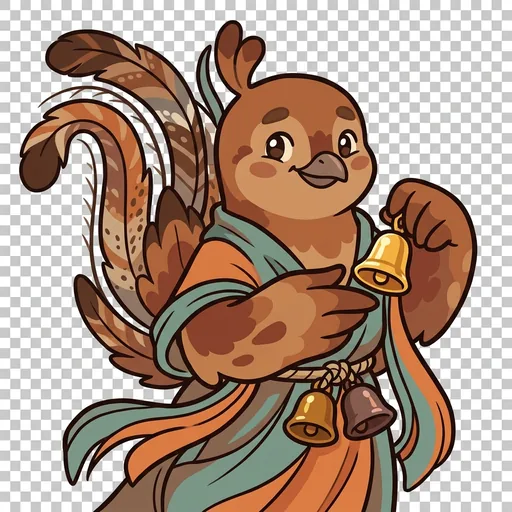
Beckon
Call-and-response — one dancer or group makes a movement and another answers it; a movement conversation built on truly listening before you reply
-

Bide
Stillness and the hold — the held, alive, motionless moment inside a dance; negative space made of time; a strong chosen pause, not tiredness or absence
-
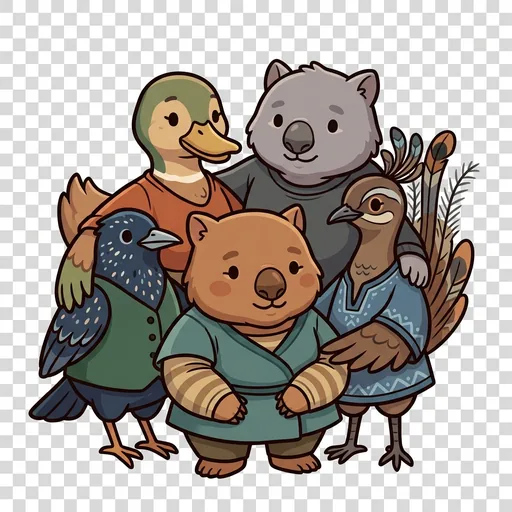
The Company
The whole group dancing as one — how formation, level, call-and-response, unison and canon, and stillness weave together so a group of dancers moves as a single living thing