
The Company
DANCING TOGETHER — *a group piece is not many solos at once. it is formation, level, call-and-response, unison, canon, and stillness woven so a whole group moves as one living thing.*
Press play to listen along. The line being read lights up as you go.
Show full transcript
Loading transcript…
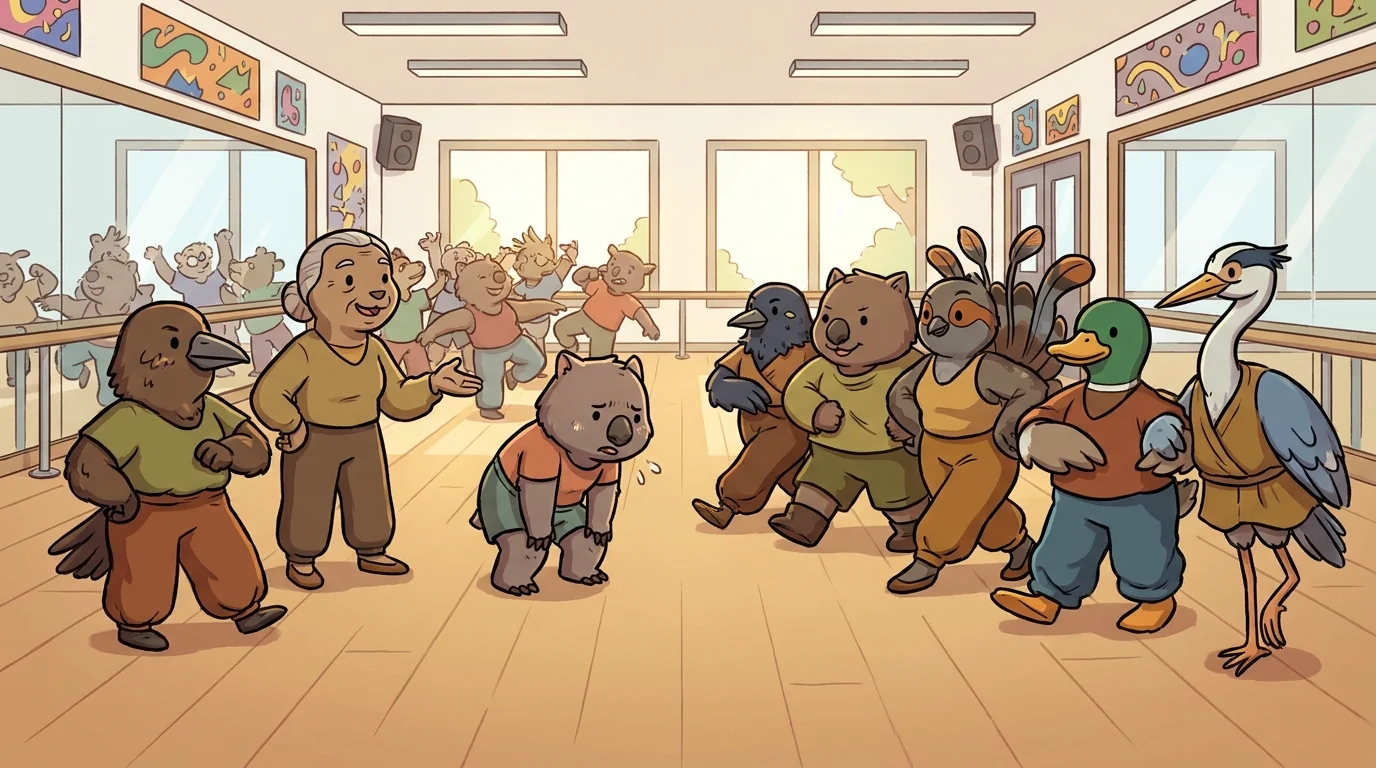
Sumi wanted the group dance to look amazing, so she'd tried to make herself the amazing part.
The wombat-tween stood in the DanceQuest studio, out of breath and frustrated, with a whole group of dancers milling behind her. "I worked so hard on my part," she said. "Big jumps, fast spins, everything I could do. And Rhythm says the group piece still looks like a 'mess of people all doing their own thing.' But I did my best moves! Isn't that what a good dancer does?"
Rhythm, the calm old dance-leader, shook her head with a warm smile. "In a solo, yes. In a company — no. A group dance isn't a bunch of dancers each being amazing at the same time. That just looks like chaos. A group dance is a whole group of dancers feeling each other, moving as one living thing. Nobody stands out. Everybody tunes in. Let me show you — with the five who know how a group breathes together."
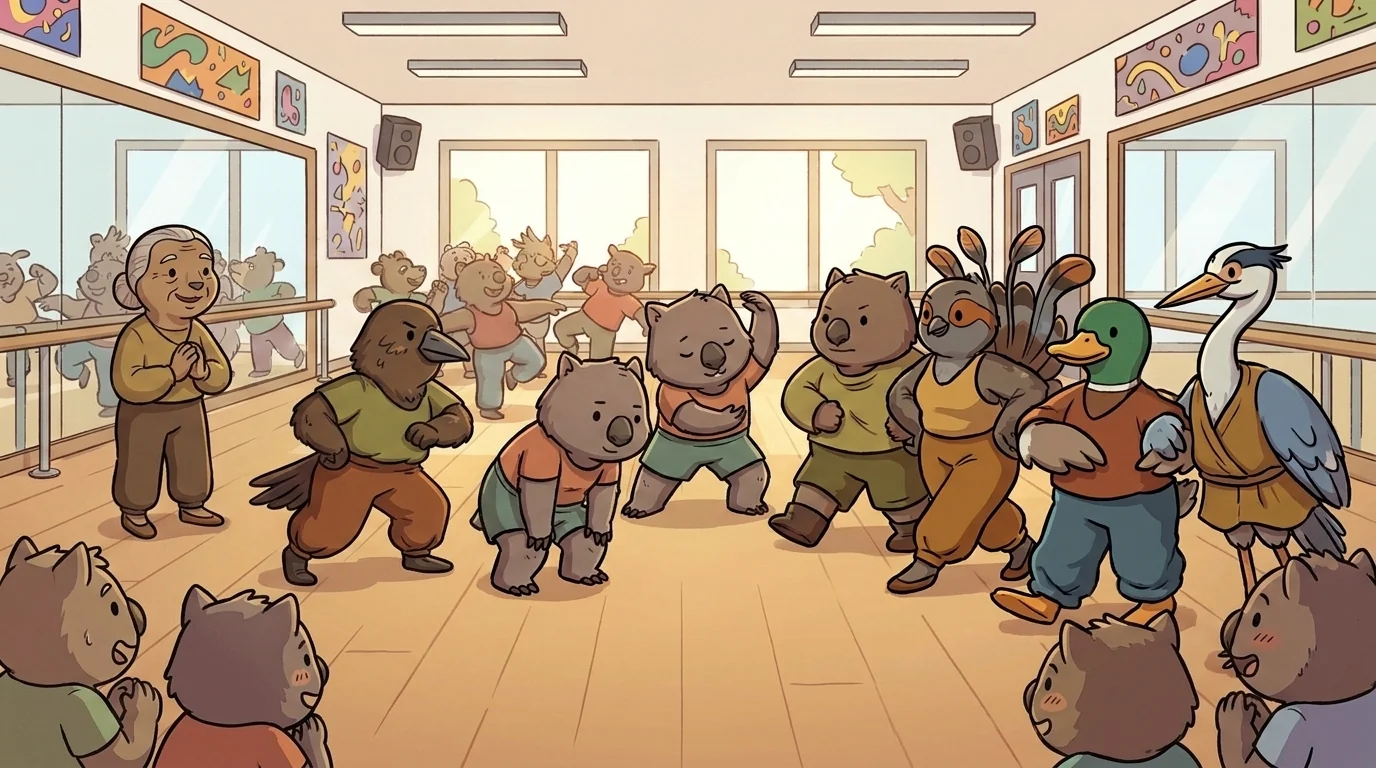
Five dancers stepped forward, none of them the lean, sleek sort — they were round and sturdy and soft and strong, in loose layered clothes made for moving: Flock the starling, Storey the wombat, Beckon the lyrebird, Canon the duck, and Bide the heron. "Watch what we make," said Rhythm, "when we stop trying to shine and start trying to listen."
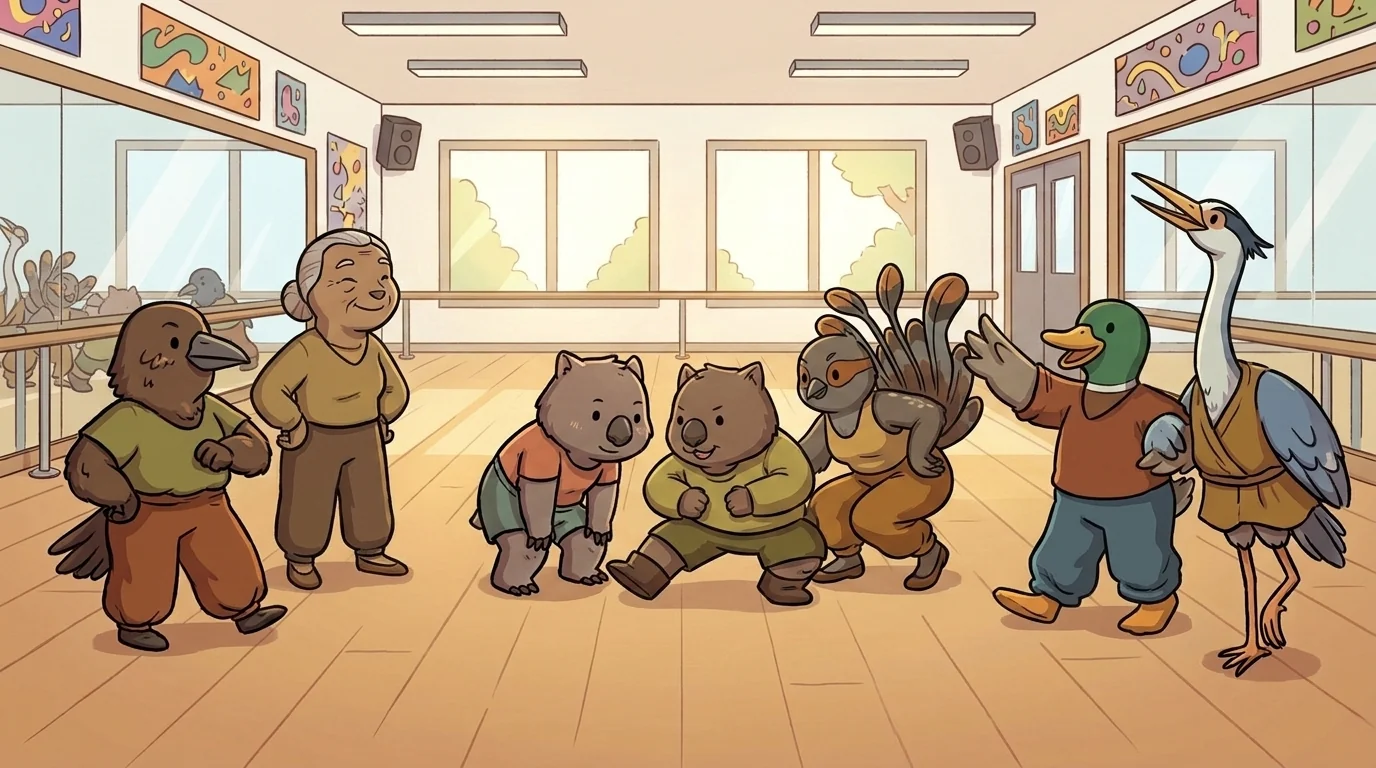
Flock the starling went first, gathering the dancers into shapes. "Before anyone moves fancy, we need a shape," she said. She arranged the group into a wide ring, then flowed it into a line, then a wedge. "Formation. Where everyone stands and how the group's shape changes. You don't watch the front — you feel the two dancers beside you and keep your spacing. That's how a blob becomes a clean shape." The dancers found their spots by feel, and suddenly the group looked like something — a shape, not a scatter.
But it was all at one height, flat. Storey the wombat dropped low. "Now give it depth," she said. She sent some dancers low to the floor, some at standing height, some reaching high — the same shape, but now rising and sinking through all three levels. "Every height belongs to the dance. Low isn't falling; high isn't better. A group that uses all the heights has dimension — it's a moving landscape instead of a flat line." Flock's shifting shapes now rose and fell, low and high, a group breathing in space.
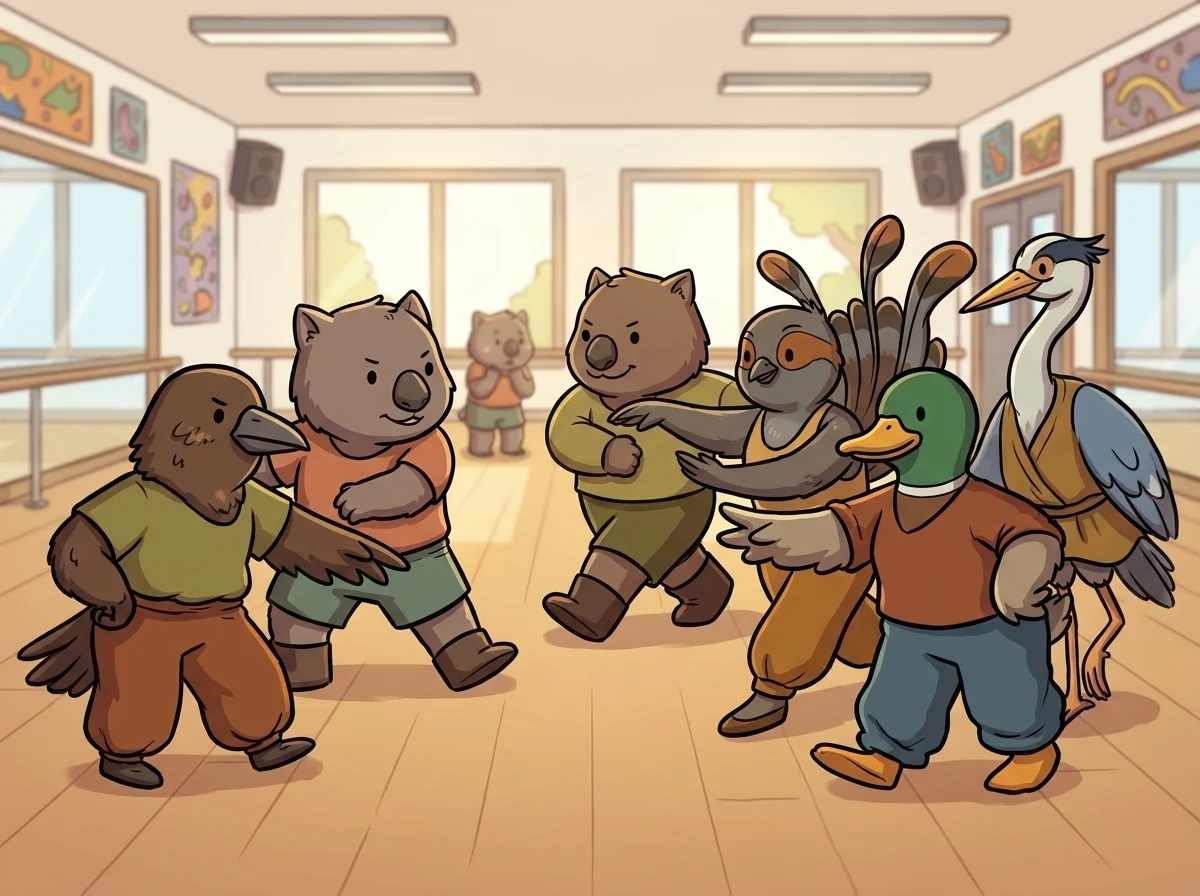
Then Beckon the lyrebird split the group in two and set them talking. One half swept an arm out — a call — and the other half answered it, echoing the movement back. "Call-and-response," Beckon said. "Half the group offers a movement; the other half truly watches, then answers it. It turns a dance into a conversation — but only if you really listen to what the other half gave you, instead of just doing your own thing on cue." The two halves began to talk in movement, back and forth, listening and answering.
And Canon the duck took that conversation and set its timing. "Now — do you all do it at the same time, or one after another?" She had them try both: first everyone sweeping in unison, one powerful wall of motion; then staggered, each dancer starting a beat after the one before, so the movement rolled across the whole group like a wave. "Unison says we are one. Canon says watch it travel. Trust your own count in a canon — don't rush to copy your neighbor — and the wave rolls perfectly." Flock's shapes and Canon's timing — Shape and Timing, the two of them a pair — made the group move like one designed, breathing thing.
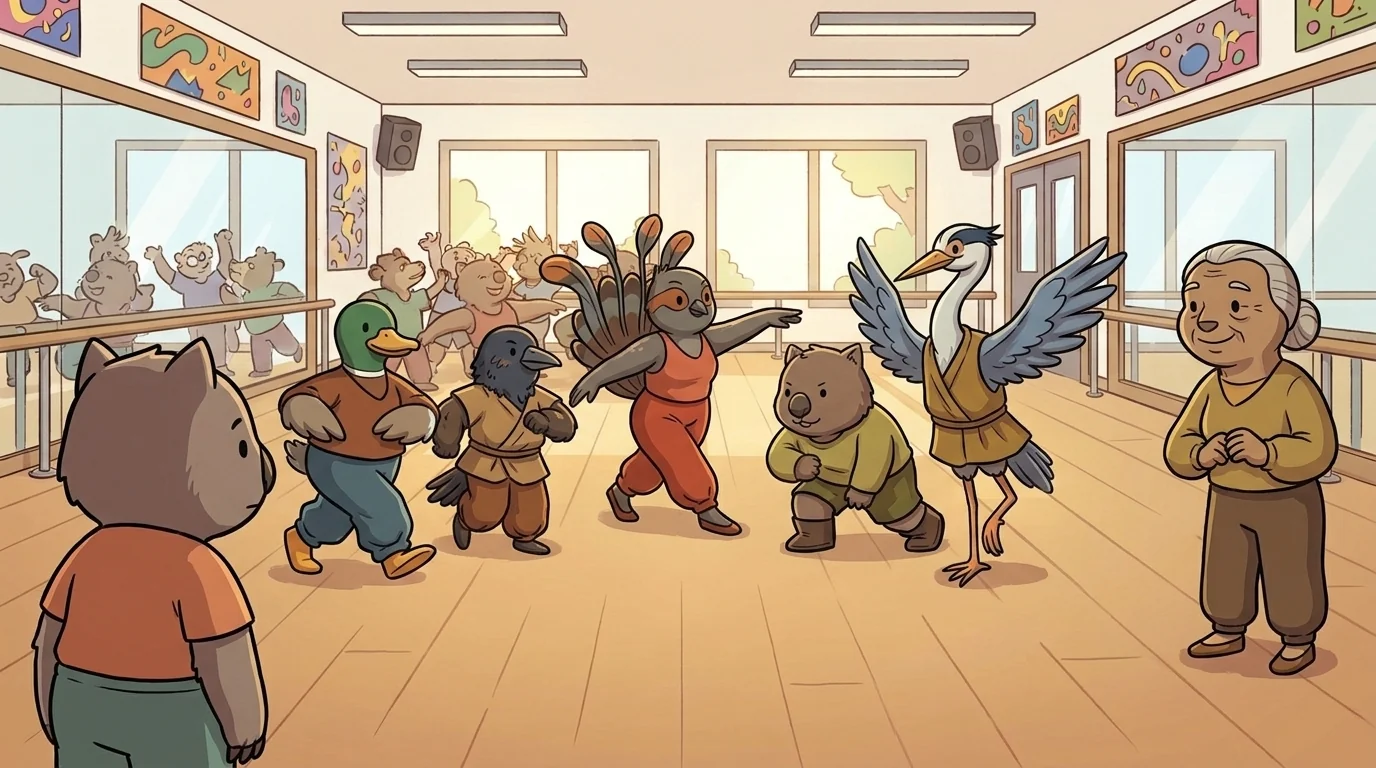
There was only one thing missing, and Bide the heron provided it by doing nothing at all. At the peak of the rolling wave, she raised one wing — and the whole company froze. Held. Perfectly still, all together, full and breathing, for three long beats. Then they melted back into motion.
"Stillness," Bide said softly. "The held moment. A group dance that never stops is exhausting to watch — it needs to breathe. When the whole company holds still together, all at once, the room seems to hold its breath with them. It's not the group failing to dance. It's the group dancing the pause." Beckon's flowing conversation and Bide's shared stillness — Conversation and Stillness, the two of them a pair — gave the piece both its voice and its breath.
And then Rhythm counted them in, and the whole company danced the piece together — all of it at once.
Flock's shifting shapes, rising and sinking through Storey's high and low, the two halves calling and answering in Beckon's conversation, the movements rolling across the group in Canon's staggered wave, and then — all together — the held, breathing stillness of Bide. Nobody stood out. Everybody tuned in. And the group of separate dancers became one living, breathing thing, moving as a single body across the floor.
Sumi, watching from the edge, forgot to be frustrated. "It's beautiful," she whispered. "And nobody's doing anything super fancy. It's just... together."
"That's the whole secret," said Rhythm. "Together is the fancy part."
Rhythm waved Sumi in. "Now stop trying to shine, and come tune in. Find your spot in the shape. Feel the dancers beside you. Match the timing. Trust your count. When it's still, be still with everyone. You don't have to be the amazing one. You just have to be with everyone." And Sumi joined the company — not doing her biggest jumps, just holding her shape, feeling her neighbors, riding the wave, freezing when they froze.
And she felt it: the click of the whole group locking in, the way the room seemed to breathe together, the way she was one part of something far bigger and more beautiful than her best solo could ever be. She wasn't performing at the group anymore. She was inside it, held by it, holding it up in return.
They danced the piece around once more, and Sumi stopped thinking about how she looked entirely — there was no room for that feeling, because she was too busy feeling everyone else, moving as one. The frustrated, trying-too-hard knot in her chest melted into a bright, buoyant belonging: the pure body-joy of moving as one with a whole company, of being one breath in a dance that breathed together.
"Nobody stands out. Everybody tunes in," said Rhythm, watching the company breathe as one. "Feel how good that feels — not how it looks. How it feels."
The DanceQuest ensemble
The Company is part of DanceQuest's distributed-narrative cast. Each character embodies a different curricular primitive; together they teach the full subject.
-

Pose
Body-awareness + position — listening to your own shape
-

Trail
Space + pathways — the floor-pattern shapes you draw moving through space
-

Phrase
Time + tempo — how movement is organized in musical counts
-

Lift
Energy + effort + dynamics — quality of movement, not aesthetic judgment
-

Glide
Locomotion — the craft of going from here to there with whole attention
-

Flock
Formation — how a group of dancers arranges itself in space (lines, circles, clusters, wedges) and how that shape flows and changes; the group as one moving picture
-

Storey
Level — dancing in the vertical space: low on the floor, mid at standing, high in reaches and jumps; every height belongs to dance, no height better than another
-

Beckon
Call-and-response — one dancer or group makes a movement and another answers it; a movement conversation built on truly listening before you reply
-

Canon
Unison and canon — unison is everyone moving together as one; canon is the same move staggered one after another, rolling across the group like a wave
-

Bide
Stillness and the hold — the held, alive, motionless moment inside a dance; negative space made of time; a strong chosen pause, not tiredness or absence