
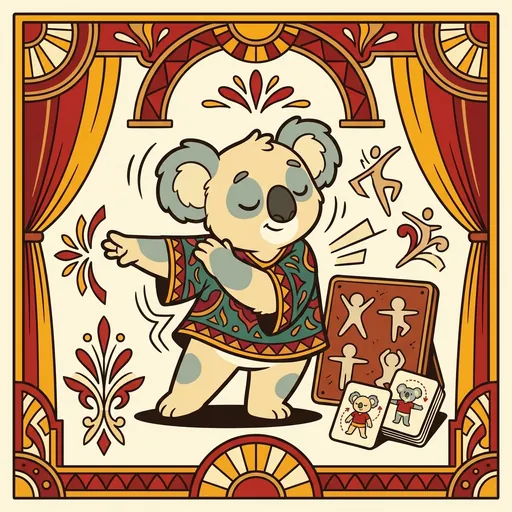
Pose
POSE — *listening to your own shape. proprioception is the first skill.*
Listen along — Pose
Loading audio…
Press play to listen along. The line being read lights up as you go.
Show full transcript
Loading transcript…
Chapter 1 — Pose and the Art of Listening to Your Own Shape
Pose closed her eyes and reached one arm straight out to the side.
The studio was quiet. She was a small, round, soft, strong koala tween, warm cream fur with eucalyptus-grey patches, wrapped in a loose chunky tunic that she loved because it never pinched. Eyes shut, she held her arm in the air and asked herself a question, the way she asked it every single morning: Where is my hand?
Shoulder height, she decided. Exactly level with her shoulder. She could feel it — not see it, feel it — a quiet, sure signal running up her arm and into her chest.
Then she opened her eyes to check.
Her hand hovered right at shoulder height. Barely a hair off.
“Ha!” she said out loud, delighted, and a warm little glow spread through her. There was no mirror in the room — she’d turned the big one to face the wall on purpose. She hadn’t needed it. Her body had told her where it was, from the inside, and it had told her true. That quiet inner sense was the thing she trusted more than anything, and every time it came through, it felt like a small, private, happy secret.
On the shelf sat her body-mapping cards and her soft felt board, both worn from years of use. The cards were full of little challenges: close your eyes, reach, then guess where your hand landed. The felt board let you place tiny figure-shapes into different positions just by feel. Pose picked one up, closed her eyes again, and placed a little figure into a wide, grounded stance — no peeking. When she checked, the figure was standing just as she’d meant it to. “See?” she whispered to the empty studio. “The body knows the shape before the eyes ever confirm it.”
Pose had grown up in the shade of the tall eucalyptus trees, in a family famous for being still. Not stuck-still — listening-still. Her elders could sit for a long, long time, paws resting soft against the bark, and know precisely how every part of their bodies was arranged without ever glancing down.
“Your body knows where it is,” her grandmother told her, over and over, on the long quiet evenings. “Just listen. It will tell you. Look only to check.”
Little Pose found this magical. She practiced with her eyes shut, reaching for leaves, curling and uncurling her toes, tracing shapes in the air. At first she guessed wrong all the time and had to peek. But slowly, the inner signal grew clearer and steadier, like tuning a faint radio until the music came through warm and true.
One night, worried, she’d asked her grandmother whether she was doing it right — whether she looked right doing it. Grandmother had gently turned young Pose away from the still pond she’d been using as a mirror. “Never mind how it looks in the water, little one,” she said. “How does it feel on the inside?” Pose had closed her eyes and felt: shoulders loose, breath slow, weight settled evenly through her round little body. “Calm,” she’d said, surprised. “Steady.” Grandmother had nodded, satisfied. “That is the true skill. The pond can only ever show you the outside. Only you can feel the inside.” The warm certainty of that moment stayed with Pose for the rest of her life.
She was twelve the day she walked down out of the trees to the dance studio. Rhythm, the dance leader, met her and asked a single question.
“What is body-awareness?”
Pose didn’t recite a definition. She closed her eyes, reached her arm out slow, held it, then opened her eyes to find it right where she’d meant it to be. “It’s listening to your own shape,” she said. “Your body can tell you where it is, even in the dark, even with your eyes shut. The mirror is just for checking afterward. The listening comes first.”
Rhythm’s face broke into a warm, glad smile. “Come in,” she said. “There’s a place here that’s been waiting for exactly this.”
The workshop Rhythm showed her had one wonderful feature: the mirrors could all be turned to face the wall. Pose ran her paw along the smooth frame of the biggest one and felt her shoulders drop and her breath go easy. A place where you could dance by feel, not by watching yourself — where a round, soft, strong body was simply a body that could learn to listen. Something in her chest settled, warm and sure. She was home.
A jittery kid named Finch showed up to Pose’s first workshop and kept sneaking anxious looks at the one mirror still facing the room. “I can’t tell if I’m doing it right unless I watch myself,” Finch said. “And when I watch myself, I just… worry about how I look.”
Pose gently walked over and turned that last mirror to the wall. Finch flinched.
“Try something with me,” Pose said kindly. “Eyes closed. Reach one arm up. Now — without looking — do you think it’s above your head, or out to the side?”
Finch scrunched their eyes shut, reaching. “Out to the side, I think.”
“Open your eyes and check.”
Finch peeked. The arm was out to the side, exactly. Finch’s mouth fell open. “How did I know that?”
“You felt it,” Pose said. “That’s your body’s own quiet sense. It works in the dark. It works when you almost trip and catch yourself. It works when you find your spot on a stage with the lights down. The mirror can only ever show you the outside.” She rested a paw on Finch’s shoulder. “Let’s do a slow check together, head to toe. Notice — don’t judge. Head?”
“Relaxed,” said Finch.
“Shoulders?”
“A little tense.”
“Hips? Feet?”
“Level. Balanced.” Finch’s breathing had already begun to slow, the anxious mirror-glances gone. A small, surprised calm was spreading across their face.
“That warm, settled feeling right there,” Pose said softly. “That’s you, listening. A round body, a soft body, a strong body — any body at all — that can do this is already a whole dancer.”
When the workshop had gone quiet again, Pose closed her eyes one more time and lifted both arms slow and easy.
A warm, settled hush spread all through her — shoulders loose, breath steady, a small proud grin she could feel even without seeing it. There was no mirror turned toward her, and she didn’t want one. She could feel exactly where every part of her was, and everything was right where she’d meant it to be.
“This,” she said quietly. “This quiet, sure feeling of your own body telling you exactly where you are.” Her chest felt calm and full. “It’s the steadiest, happiest feeling I know. That’s what dance feels like from the inside. Listening to your own shape. And it feels good.”
The DanceQuest ensemble
Pose is part of DanceQuest's distributed-narrative cast. Each character embodies a different curricular primitive; together they teach the full subject.
-

Trail
Space + pathways — the floor-pattern shapes you draw moving through space
-

Phrase
Time + tempo — how movement is organized in musical counts
-

Lift
Energy + effort + dynamics — quality of movement, not aesthetic judgment
-

Glide
Locomotion — the craft of going from here to there with whole attention
-
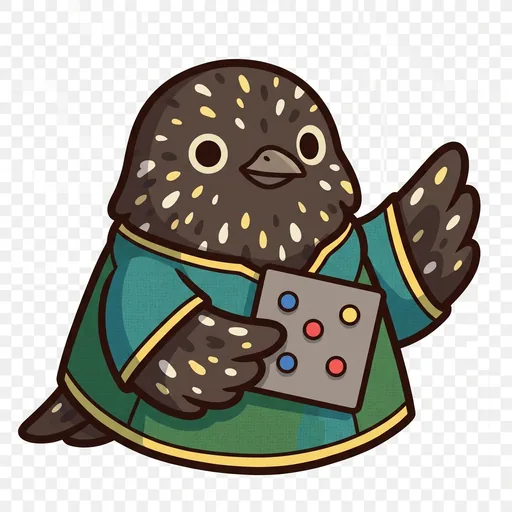
Flock
Formation — how a group of dancers arranges itself in space (lines, circles, clusters, wedges) and how that shape flows and changes; the group as one moving picture
-

Storey
Level — dancing in the vertical space: low on the floor, mid at standing, high in reaches and jumps; every height belongs to dance, no height better than another
-
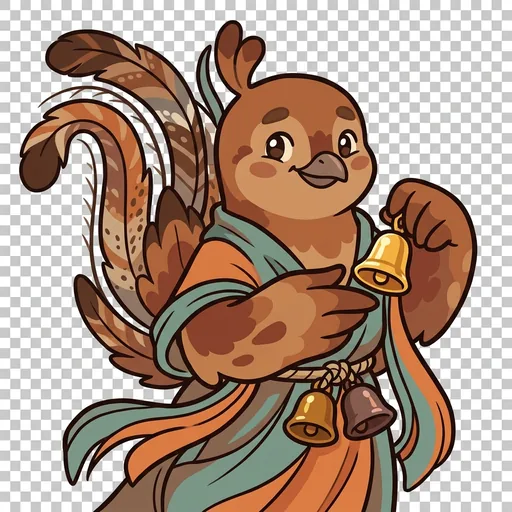
Beckon
Call-and-response — one dancer or group makes a movement and another answers it; a movement conversation built on truly listening before you reply
-
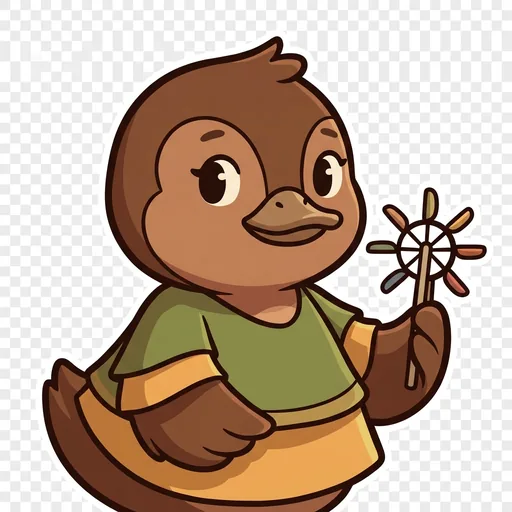
Canon
Unison and canon — unison is everyone moving together as one; canon is the same move staggered one after another, rolling across the group like a wave
-
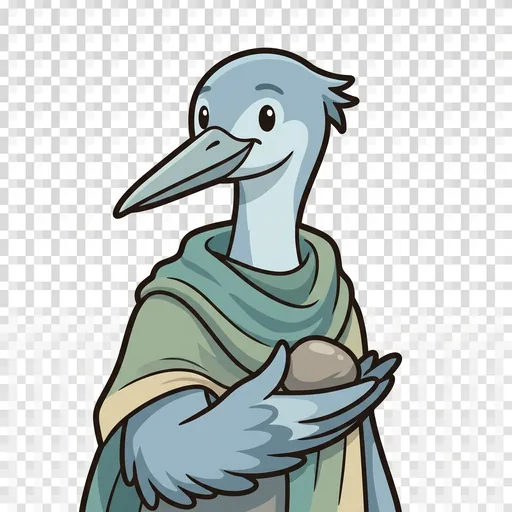
Bide
Stillness and the hold — the held, alive, motionless moment inside a dance; negative space made of time; a strong chosen pause, not tiredness or absence
-
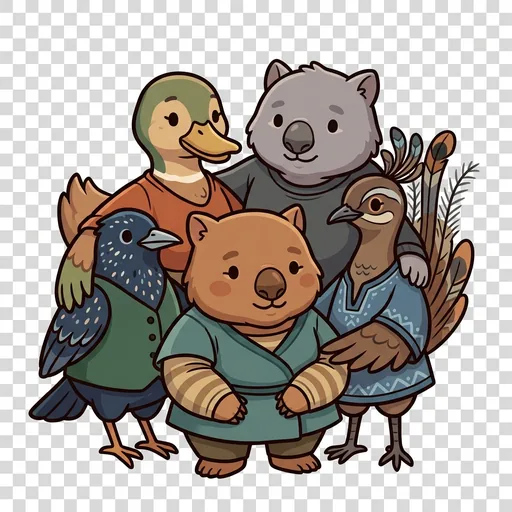
The Company
The whole group dancing as one — how formation, level, call-and-response, unison and canon, and stillness weave together so a group of dancers moves as a single living thing