
Flock
FORMATION — *how a group of dancers arranges itself in space — lines, circles, clusters, wedges — and how that shape changes and flows. the group as one moving picture.*
Press play to listen along. The line being read lights up as you go.
Show full transcript
Loading transcript…
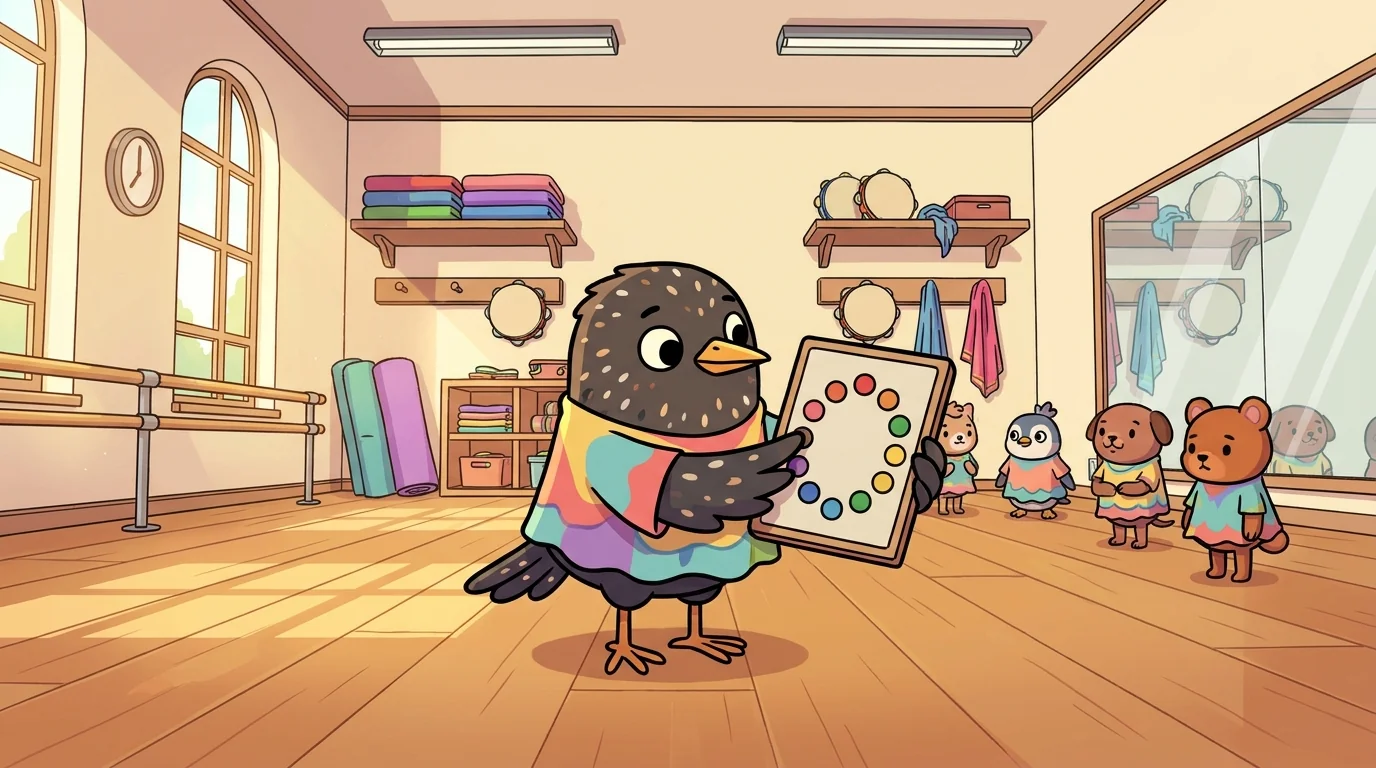
Flock was a starling-tween, small and round-bodied, with speckled feathers that caught the light in little flecks. She was soft and sturdy and moved with a bouncy, grounded joy, and she wore a big loose layered smock that flared when she turned. She never worried about looking sleek — she worried about where everyone else was. In her wing she carried a felt board covered in little movable dots, and she'd slide the dots into shapes — a line, a ring, a wedge, a scatter — to show how a whole group of dancers could become one moving picture.
"A formation is the shape a group makes together," Flock liked to say, sliding her dots into a circle. "One dancer is one dot. But a group can be a line sweeping across the floor, a ring closing in, a wedge pointing forward, a cluster huddling close — and then it can flow into a new shape without stopping. The audience doesn't just watch bodies. They watch the shape all the bodies make. That's a whole new thing to dance with."
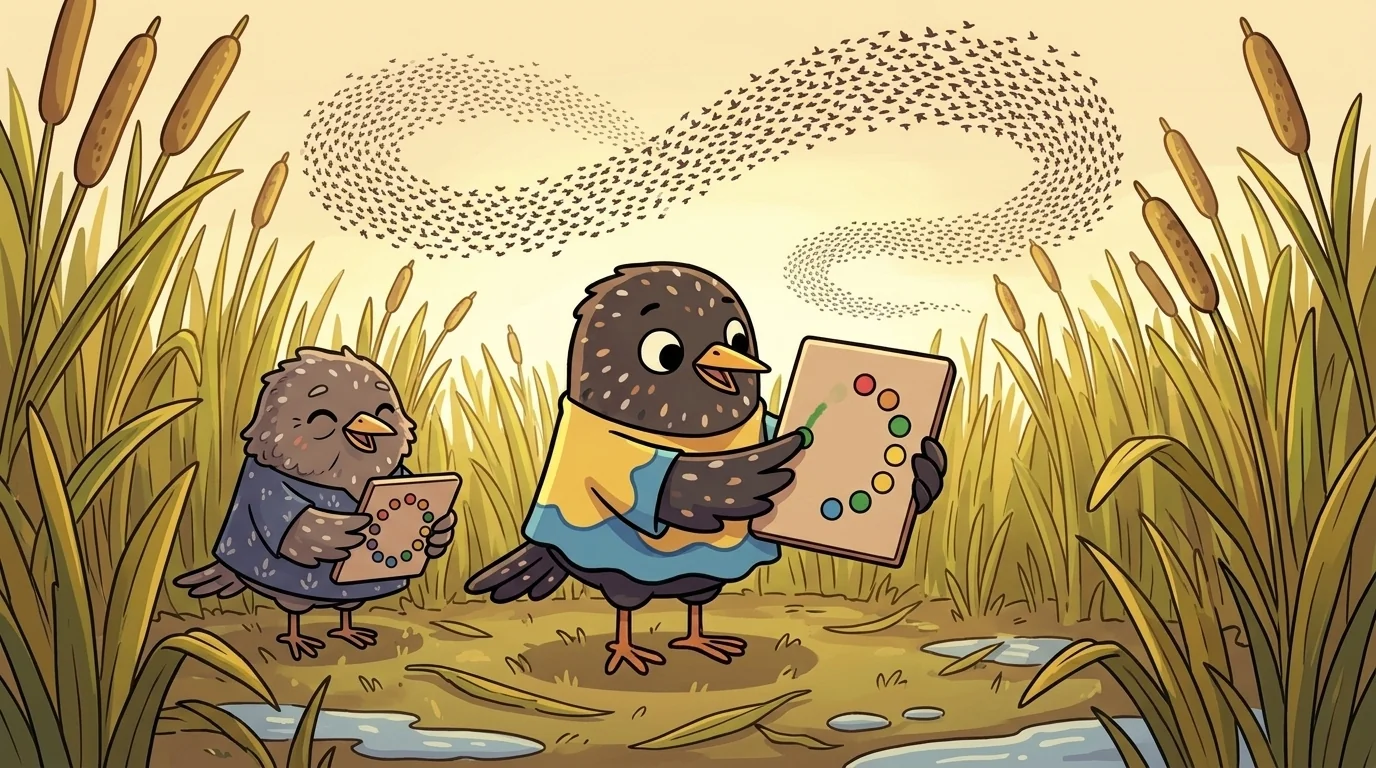
Flock grew up in the great reed-marsh, where her family were, of course, part of a starling flock — thousands of birds who rose at dusk and made shapes in the sky together. Not one bird was in charge. There was no leader shouting where to go. Yet the flock made great sweeping ribbons and spinning globes and rippling waves across the whole sky, and it was breathtaking — a shape far bigger and more beautiful than any single bird.
Little Flock asked her grandmother how they all knew what to do. "You don't watch the whole sky," her grandmother said, rising into the swirl. "You can't. You just feel the seven birds nearest you, and match them — keep your spacing, turn when they turn. Everyone doing that, all at once, makes the giant shape. The beauty isn't in any one of us. It's in what we make together, by each of us minding our little piece of it." Flock never forgot it: a formation isn't about being the best or the most-seen bird. It's about feeling your neighbors and holding your place, so the whole shape can be beautiful.
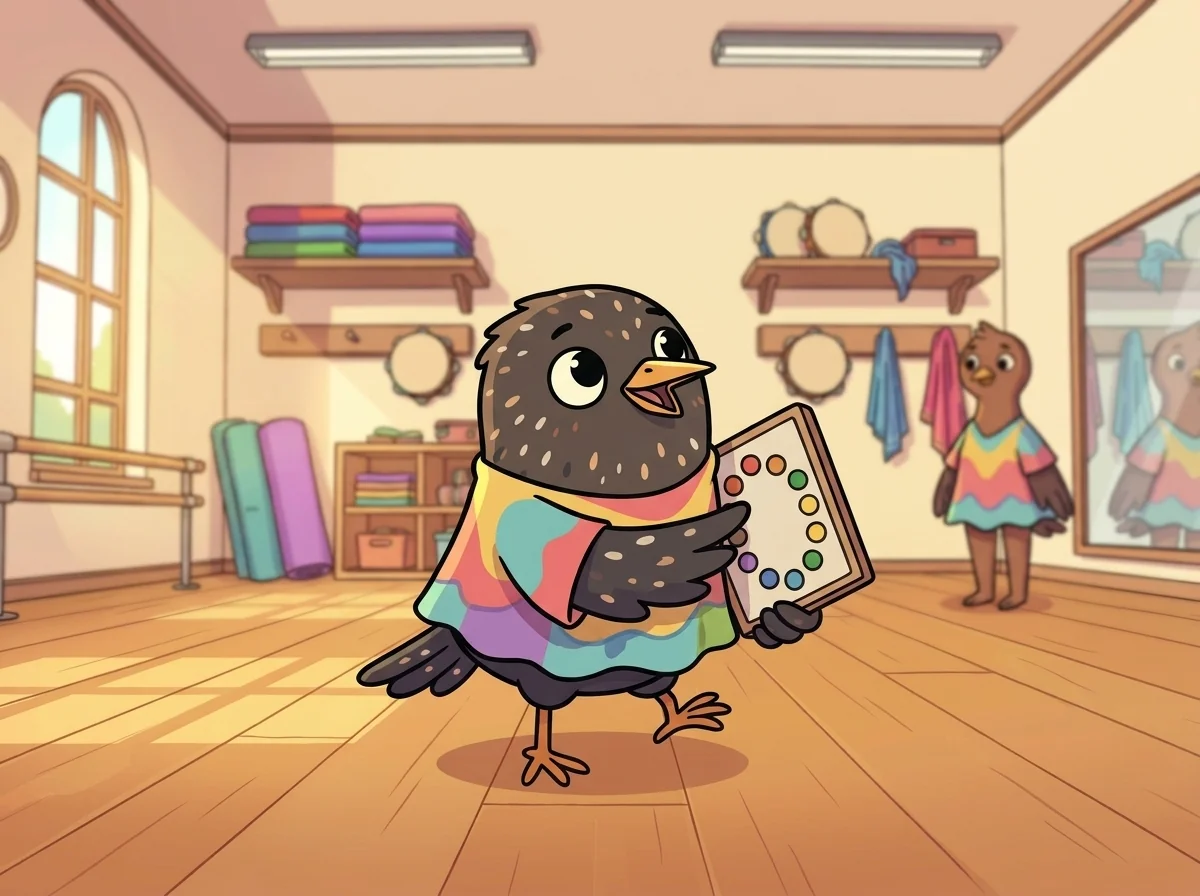
At twelve, Flock made her bouncy way to DanceQuest, felt board of dots under her wing. Rhythm, the dance leader, met her and asked.
"What is formation?"
Flock slid her dots from a line into a ring. "It's the shape a group of dancers makes together," she said, "and how that shape flows into the next one. Lines, circles, wedges, clusters. One dancer is a dot; the group is the picture. And you hold the shape not by watching the front, but by feeling the dancers near you and keeping your spacing." She looked up. "The beauty is in what we make together."
Rhythm smiled. "You are appointed."
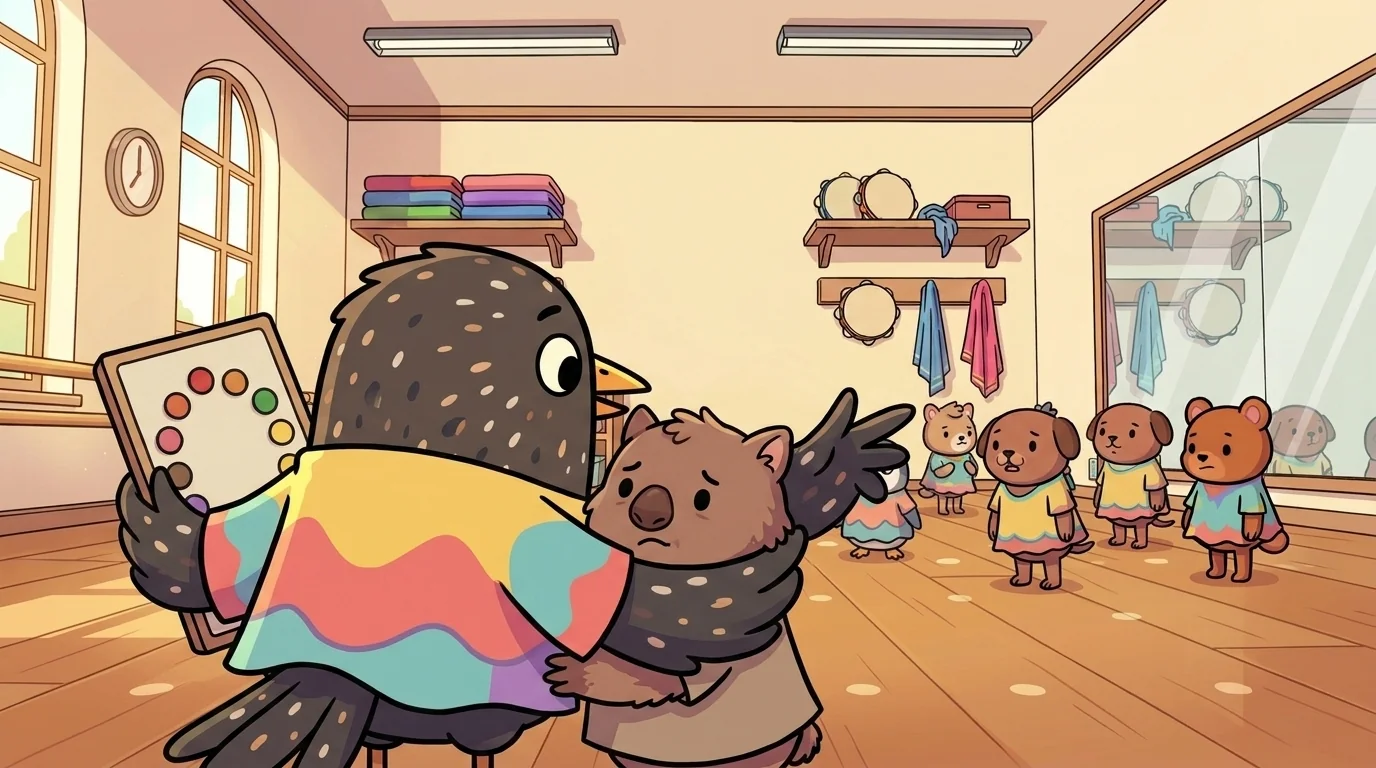
Flock's studio had a floor marked with faint dots, and today a small, worried wombat-tween named Sumi stood in a clump of other dancers, craning her neck.
"We're supposed to make a circle and then open into a line," Sumi said, "but it keeps turning into a blob. And I keep twisting around to look at everybody to figure out where I go, and Rhythm says I'm 'losing the shape.' I don't get it — how am I supposed to know where the circle is if I don't look?"
"Ah — you're trying to see the whole shape," Flock said warmly, sliding a wing around her. "You can't. Nobody can see the shape they're standing inside of. The birds never see the whole flock either. Here's the secret: don't watch the front, and don't crane around to check everyone. Just feel the two dancers on either side of you. Keep an even, arm's-length space from each. That's your only job." She stepped Sumi into the ring. "Feel the dancer on your left. Feel the one on your right. Even spacing. Now everyone do only that — and open outward, keeping your two neighbors — now."
The clump breathed outward. Because every dancer minded only their two neighbors and their even spacing, the blob smoothed into a clean circle, then unfurled into a graceful line — one flowing picture. Sumi hadn't looked around once.
"It made a line!" Sumi gasped. "And I wasn't even watching!"
"Because you felt your place instead of hunting for it," Flock said. She gave the little wombat the rules, sliding her dots between each. Mind your spacing — even gaps make clean shapes; bunching makes blobs. Feel your neighbors, don't watch the front; a floor full of dancers craning at the audience falls apart. Know your simple job in the change — "I slide left as we open" — and trust everyone else to know theirs. And remember the shape belongs to everyone; no dancer carries it alone, and no dancer is left out of it.
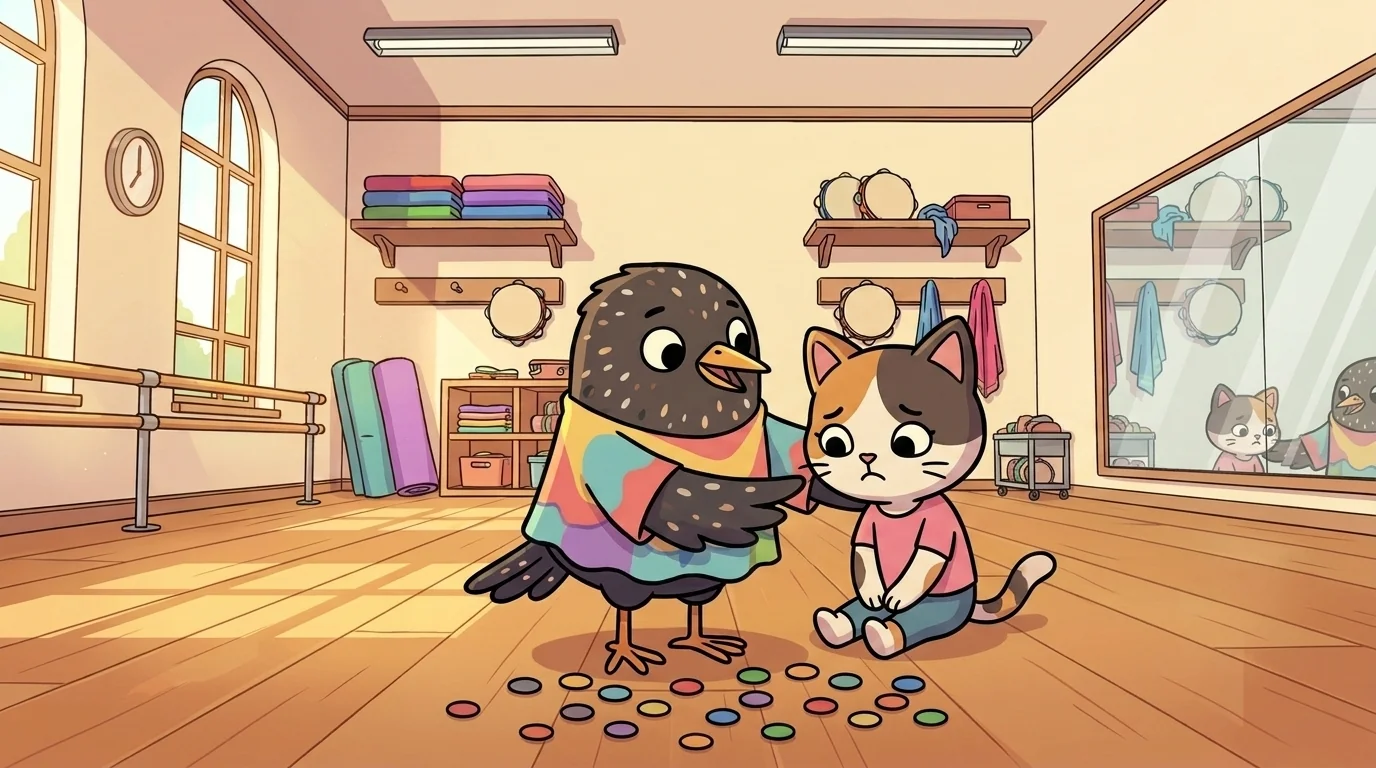
When the studio quieted, Sumi stayed, stepping through the dots on the floor.
"I always feel like I'm going to be the one who ruins the group shape," she admitted. "Like everyone's depending on me and I'll mess it up and it'll be my fault the circle's a blob."
Flock settled beside her, speckled feathers ruffling. "Here's the kind thing about a formation: it doesn't rest on any one dancer. If your spacing drifts a little, the dancers around you feel it and adjust, the way the flock always does. You hold your small piece; they hold theirs; the shape holds itself. You're not carrying the group — you're held by it, same as you're holding it." She bumped Sumi gently, wing to shoulder. "That's the best feeling in dance, I think. Not being the one everyone watches. Being one of the many who make something big and beautiful together."
Sumi looked at the dots on the floor and felt the lonely fear of ruining-it soften into something warm and steady — the quiet belonging of being one held piece of a bigger shape.
"Feel your neighbors. Hold your place," Flock said, sliding her dots into a wide, open ring. "Doesn't it feel good, being part of the shape?"
The DanceQuest ensemble
Flock is part of DanceQuest's distributed-narrative cast. Each character embodies a different curricular primitive; together they teach the full subject.
-
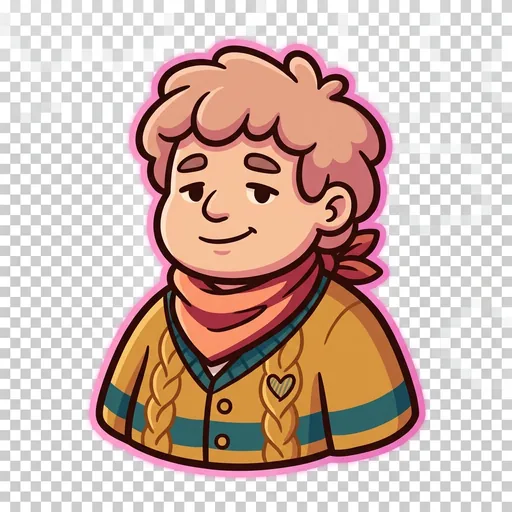
Pose
Body-awareness + position — listening to your own shape
-

Trail
Space + pathways — the floor-pattern shapes you draw moving through space
-

Phrase
Time + tempo — how movement is organized in musical counts
-

Lift
Energy + effort + dynamics — quality of movement, not aesthetic judgment
-

Glide
Locomotion — the craft of going from here to there with whole attention
-

Storey
Level — dancing in the vertical space: low on the floor, mid at standing, high in reaches and jumps; every height belongs to dance, no height better than another
-
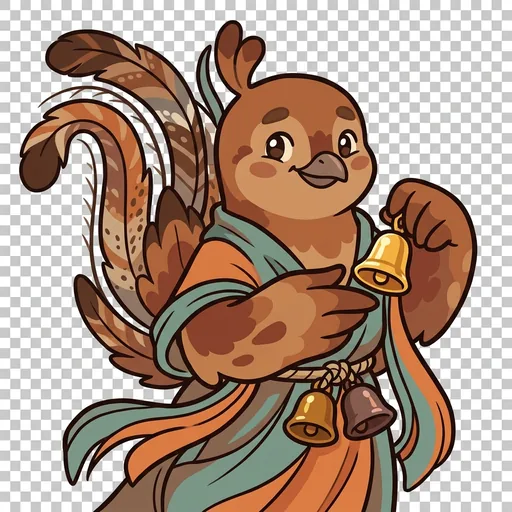
Beckon
Call-and-response — one dancer or group makes a movement and another answers it; a movement conversation built on truly listening before you reply
-

Canon
Unison and canon — unison is everyone moving together as one; canon is the same move staggered one after another, rolling across the group like a wave
-
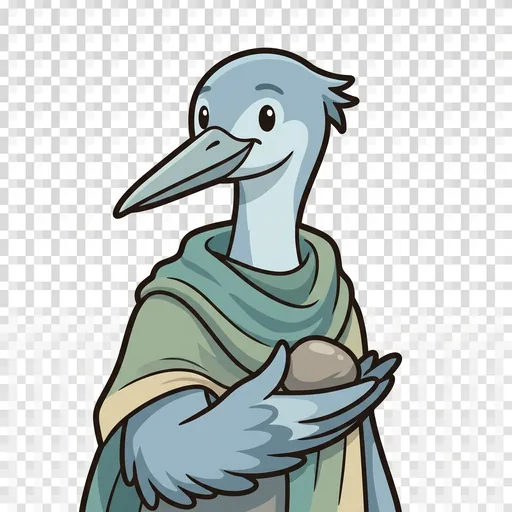
Bide
Stillness and the hold — the held, alive, motionless moment inside a dance; negative space made of time; a strong chosen pause, not tiredness or absence
-
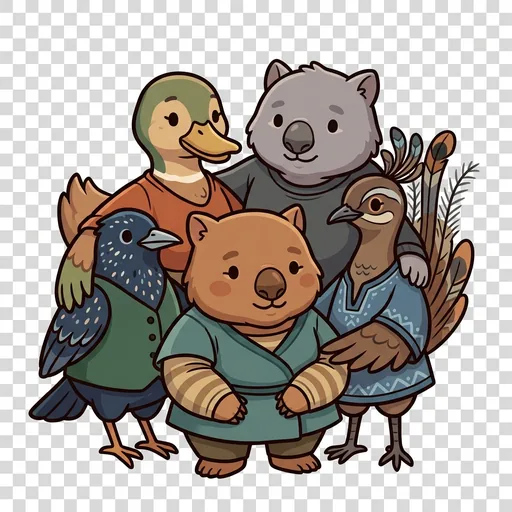
The Company
The whole group dancing as one — how formation, level, call-and-response, unison and canon, and stillness weave together so a group of dancers moves as a single living thing