
Whisperer
HYDROGEN BOND — *subtle, persistent; water's superpower; DNA pairing.* Weaker than covalent bonds individually but collectively load-bearing for water's properties + DNA's structure + protein folding.
Press play to listen along. The line being read lights up as you go.
Show full transcript
Loading transcript…
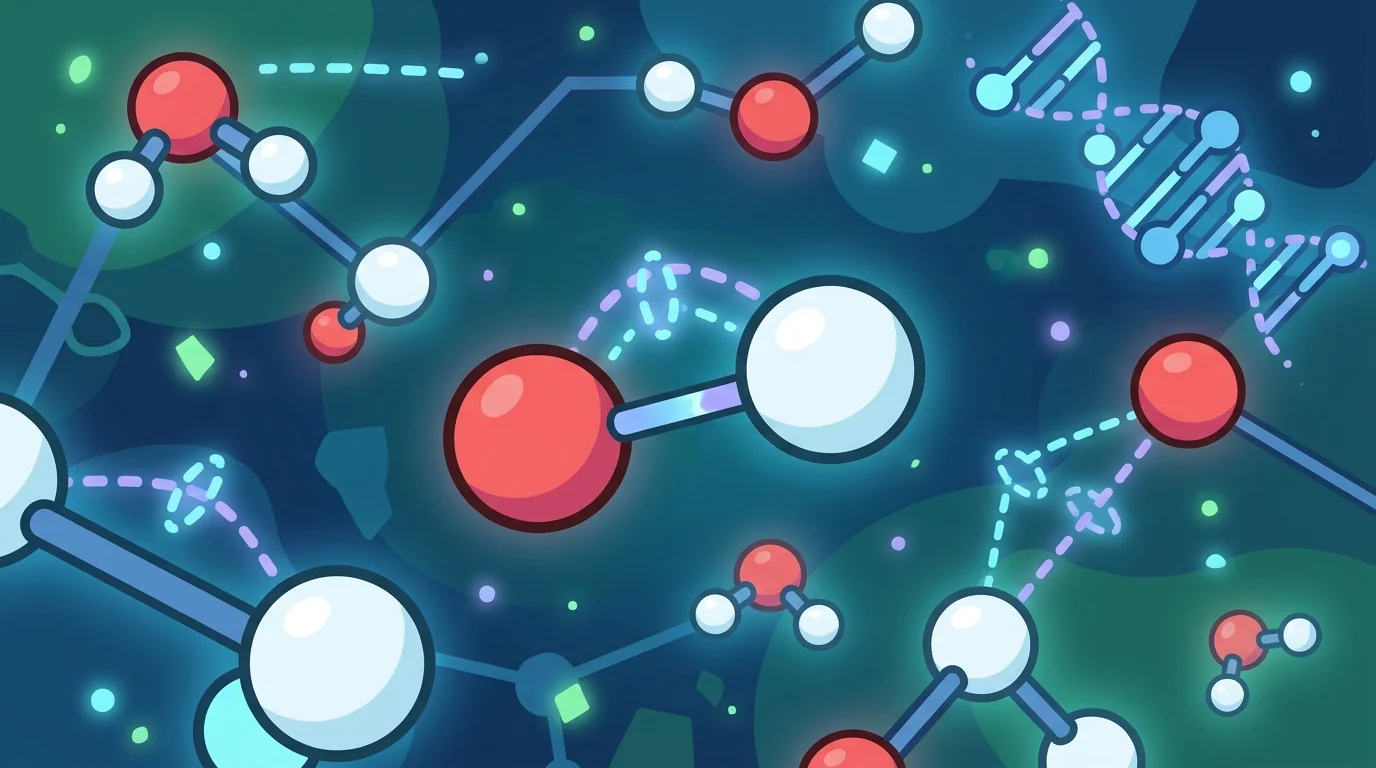
The ChemQuest classroom buzzed with a low hum, a familiar sound of anticipation. Today, Beaker stood before them, not with a flashy demonstration, but with a simple, almost invisible model. He held up a clear, intricate structure made of spheres and rods. Most of it was familiar: the solid black rods of covalent bonds, the larger spheres representing atoms. But then, there was something new.
"This," Beaker announced, his voice quiet but clear, "is *Whisperer*."
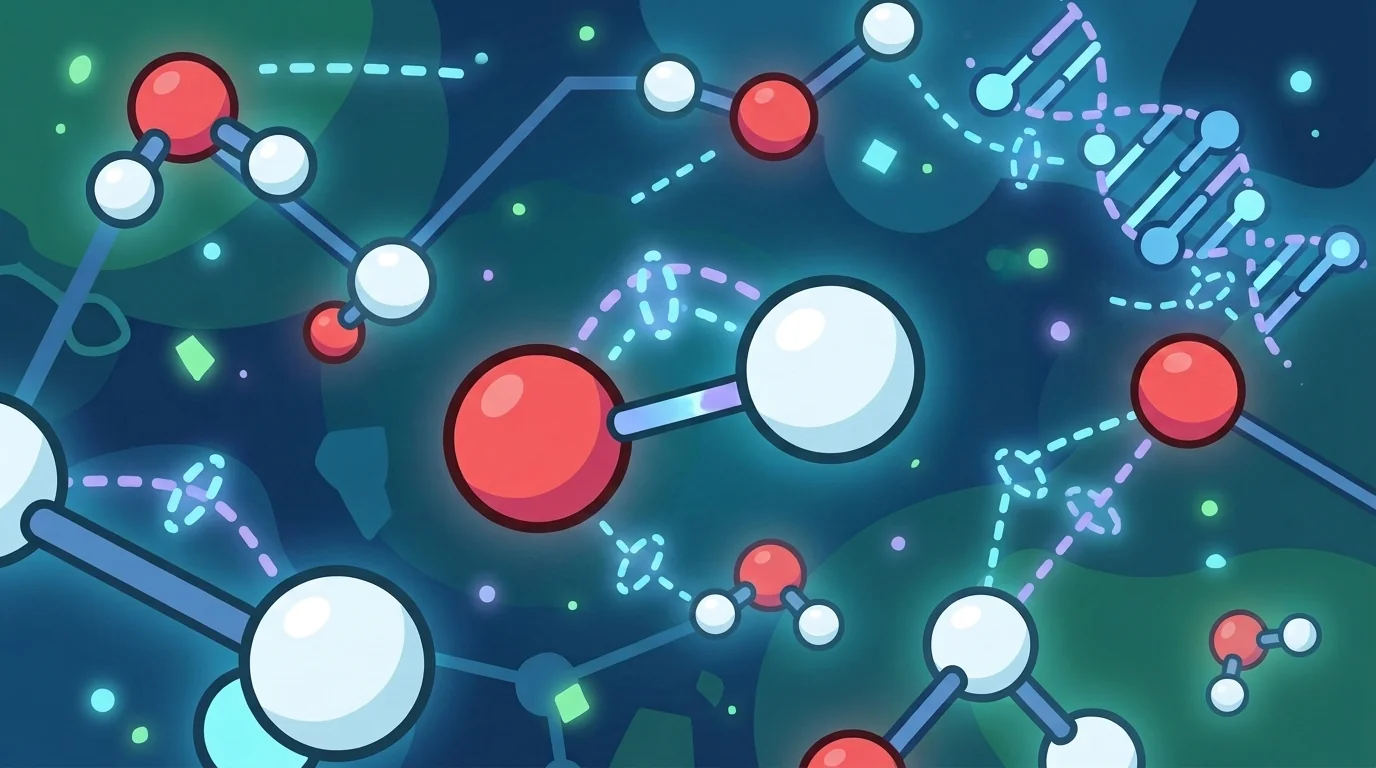
He pointed to a specific part of the model. It wasn't a sphere or a solid rod. It was a series of tiny, almost translucent dashed lines. They connected a small, pale hydrogen atom to a larger, more electronegative atom nearby, like an oxygen or nitrogen. The hydrogen atom itself was already firmly attached to another electronegative atom by a solid covalent bond.
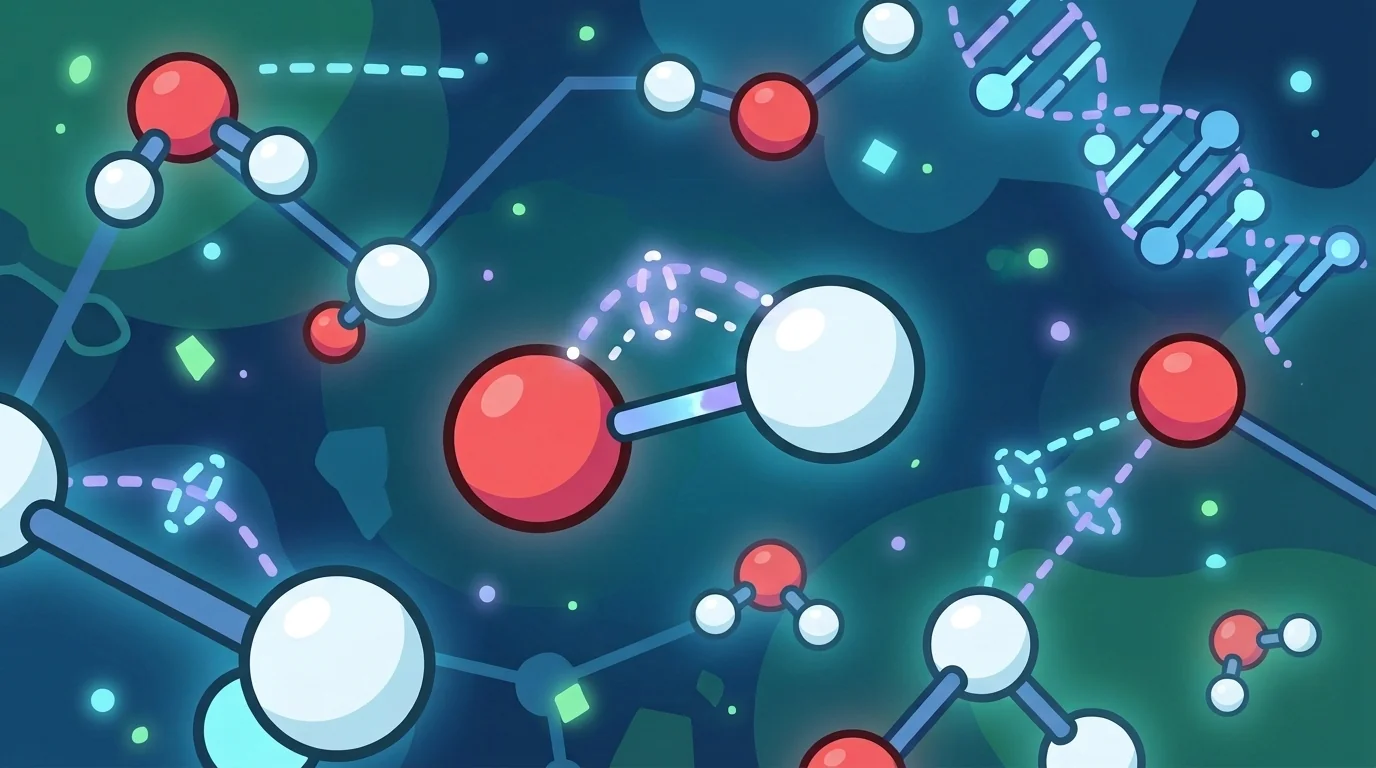
"Whisperer is not an animal-tween," Beaker continued, his gaze sweeping over the students. "It's not a faced figure. Whisperer is a deliberately abstract, concrete-energy-shape. See these dashes?" He tapped the model. "They are visibly distinct from the solid lines, the covalent bonds you know. These dashes signal something important: the hydrogen bond is weaker than a covalent bond, but it is very real. And it matters."
He paused, letting the visual sink in. The dashed lines were subtle, almost shy, but they held the structure together in a way the solid lines couldn't quite explain on their own.
"This is essential," Beaker stressed. "Whisperer embodies the hydrogen bond primitive. It's not a regular covalent or ionic bond. Instead, it's a weaker, but very real, attractive force." He picked up a different model, showing a single water molecule. "Remember Sharer's domain? The polar covalent bond between hydrogen and oxygen makes this hydrogen atom slightly positive. And the oxygen atom, with its lone pair of electrons, is slightly negative. Now, imagine another electronegative atom nearby, also slightly negative."
He brought a second water molecule close to the first. "The slightly positive hydrogen on one molecule feels a pull towards the slightly negative oxygen on the other. That quiet attraction? That's Whisperer. That's a hydrogen bond." He connected the two with a dashed line. "It's a subtle, persistent force."
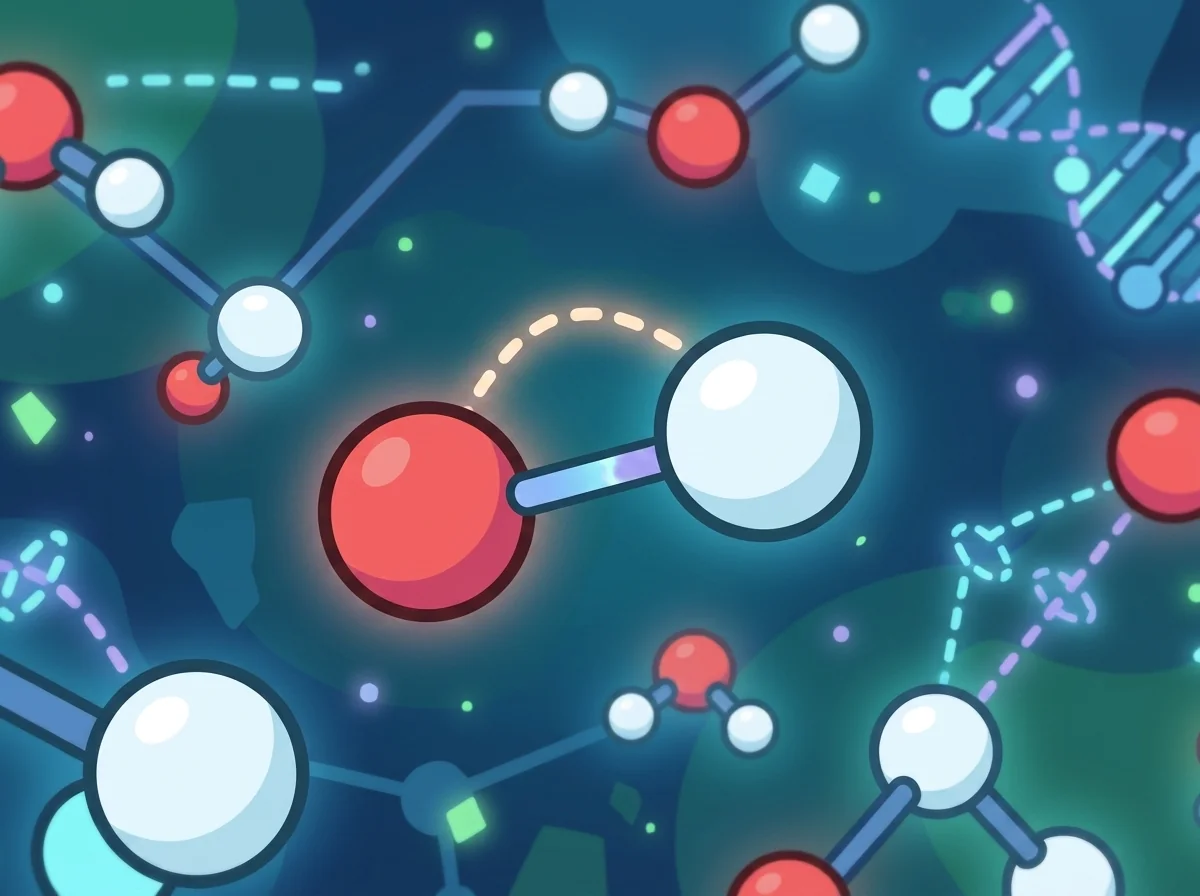
Individually, hydrogen bonds are much weaker than covalent bonds. "Think of it like this," Beaker said, holding up a single piece of thread. "This thread is a hydrogen bond. You could snap it easily, right?" He snapped it. "But what if you had a thousand threads, all woven together?" He held up a thick rope. "That's a different story. Collectively, these bonds are enormous."
He moved to a large tank filled with water. "Without Whisperer, water would boil below room temperature. Think about that. No liquid water on Earth. No life." He pointed to a small, delicate paperclip floating on the surface. "Whisperer gives water its surface tension. It's why things can float. It gives water its high specific heat, meaning it takes a lot of energy to heat it up, which helps regulate Earth's climate."
Next, Beaker pulled out a block of ice, placing it in a beaker of water. The ice floated. "Most solids sink in their own liquids," he explained. "But ice floats. That's Whisperer at work again. Its bonds arrange water molecules in a way that makes ice less dense than liquid water. Without Whisperer, our oceans would freeze solid from the bottom up, trapping all life."
Then, he brought out a large, colorful model of a DNA double helix. The familiar twisted ladder structure. "Look here," Beaker said, tracing the connections between the base pairs. "A and T pair via two hydrogen bonds. G and C pair via three." He pointed to the dashed lines that held the two strands together. "These weak bonds are strong enough to hold the strands stably, keeping our genetic code intact. But they are also weak enough to be broken when DNA needs to be read or copied. That breakability is essential for genetics. It's how life passes on information."
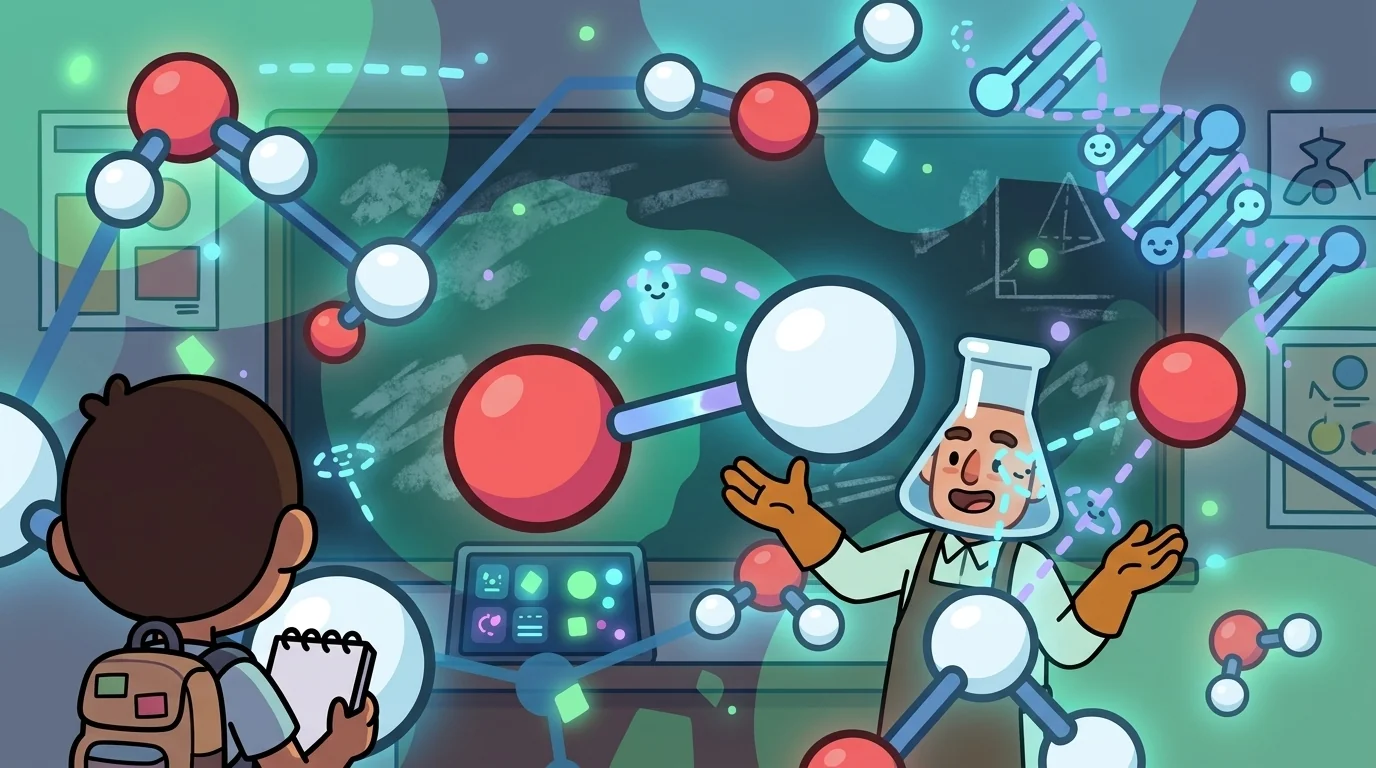
Finally, he showed them a complex, folded protein model. It looked like a tangled ribbon, but with distinct, repeating patterns. "Proteins are the workhorses of our cells," Beaker explained. "And their shape determines what they do. Alpha-helices and beta-sheets, the main protein-structure motifs, are held in shape by hydrogen bonds." He highlighted the dashed lines within the folds. "Without Whisperer, proteins wouldn't fold into the shapes that make them functional. They'd just be floppy chains, useless."
"Whisperer appears around H₂O molecules, forming water's hydrogen-bonding network," Beaker summarized. "It's also around DNA-base pairs, especially when Nitra-containing bases are demonstrated. Tugger transfers electrons fully. Sharer shares one pair. Streamer flows a sea. Whisperer is the subtle attractive force between a partially-positive hydrogen and a partially-negative electronegative atom nearby. Weak alone. Strong together."
A student, Maya, raised her hand. "So, hydrogen bonds break and reform all the time?"
"Exactly, Maya," Beaker confirmed. "Water molecules are constantly trading hydrogen-bond partners. Imagine a molecular dance, with partners changing every fraction of a second. The bonds aren't static; they're dynamic. That dynamism is part of what gives water its flow and biological versatility. It's why water is such a great solvent, able to dissolve so many things."
He looked at the class. "We've now completed our four bond-types. Tugger: ionic. Sharer: covalent. Streamer: metallic. And now, Whisperer: the hydrogen bond. Four distinct force-patterns, four distinct contributions to chemistry."
"Whisperer has no face," Beaker reiterated, holding up the dashed-line shape again. It caught the light gently, a faint shimmer. "That's the lesson. The subtle force is real, persistent, and collectively essential. But it is a force, not a being."
Another student, Leo, frowned. "Are hydrogen bonds hard to understand?"
Beaker smiled faintly. "Not hard, Leo. Subtle. Persistent. Weak alone. Strong together. Whisperer is simply the force-pattern of the dashed-line." He placed the model down. The next water molecule, unseen, waited to hydrogen-bond.
The ChemQuest ensemble
Whisperer is part of ChemQuest's distributed-narrative cast. Each character embodies a different curricular primitive; together they teach the full subject.
-

Hydra
Hydrogen (H) — lightweight, ubiquitous, always paired up; buddy-system enthusiast
-
Carbo
Carbon (C) — connects to anything; the social atom; backbone of life
-

Oxy
Oxygen (O) — eager bonder; electronegative; the hungry grabber
-

Nitra
Nitrogen (N) — triple-bond loyal; slow-to-warm; locks in deeply once bonded
-
Sodi
Sodium (Na) — generous, impulsive; always giving away electrons
-

Chlora
Chlorine (Cl) — sharp, focused; the collector who finishes what Sodi starts
-

Helio
Helium (He) — noble gas; peaceful, floaty, complete; the contented onlooker
-

Sulfa
Sulfur (S) — earthy, dramatic; the stinky uncle of volcanoes and proteins
-

Phossa
Phosphorus (P) — energetic, restless; the spark of ATP and matches
-

Magna
Magnesium (Mg) — bold, ceremonial; burns bright white; chlorophyll core
-

Silica
Silicon (Si) — patient, geometric; the architect who builds quietly
-

Alumi
Aluminum (Al) — practical, modest; the workhorse of cans and foil
-
Tugger
Ionic bond — forceful, decisive; full electron transfer; opposites attract
-

Sharer
Covalent bond — cooperative, balanced; equal partnership
-

Streamer
Metallic bond — flowing, communal; delocalized electron sea