Phossa
PHOSPHORUS (P) — energetic, restless; the spark of ATP and matches. Five outer-shell electrons; flexible bonding (3 to 5 connections); the energy currency of living things; the spark-flash element.
Press play to listen along. The line being read lights up as you go.
Show full transcript
Loading transcript…
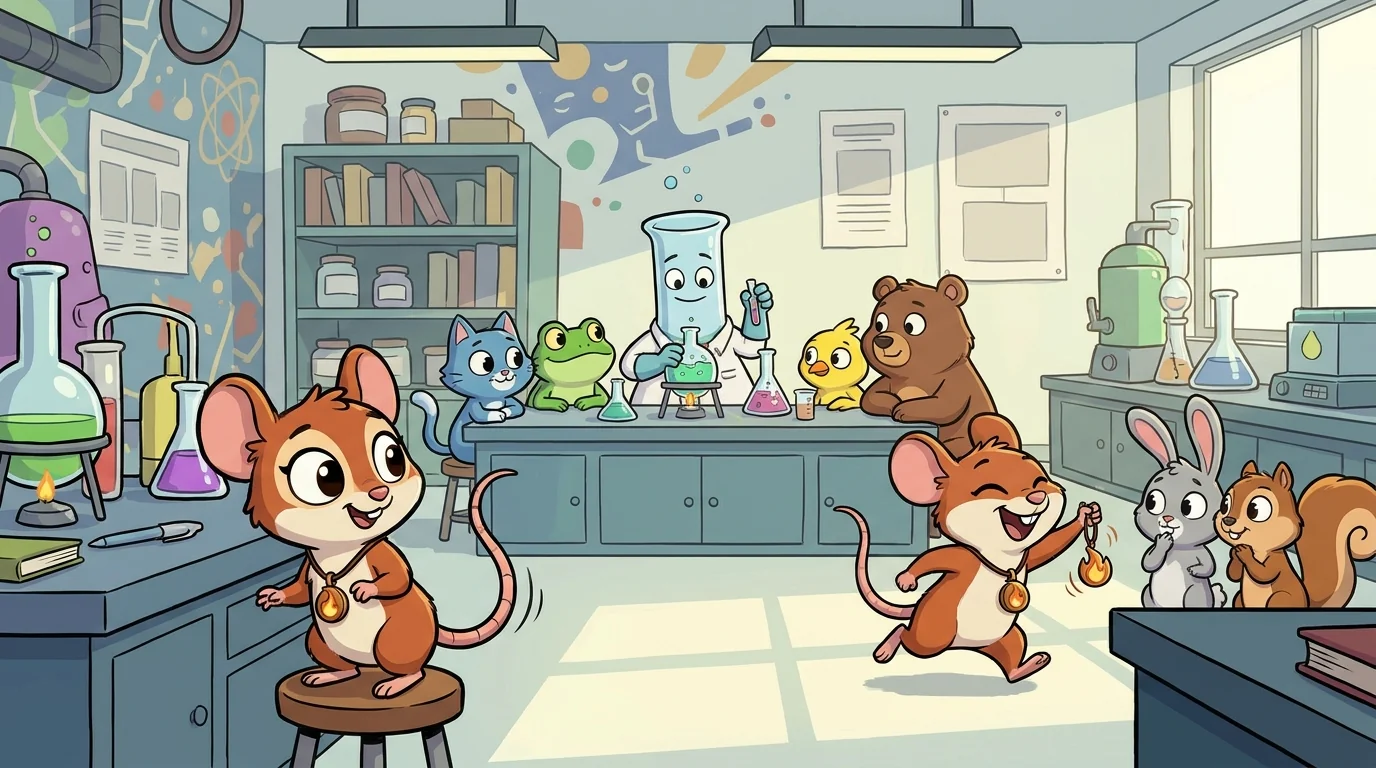
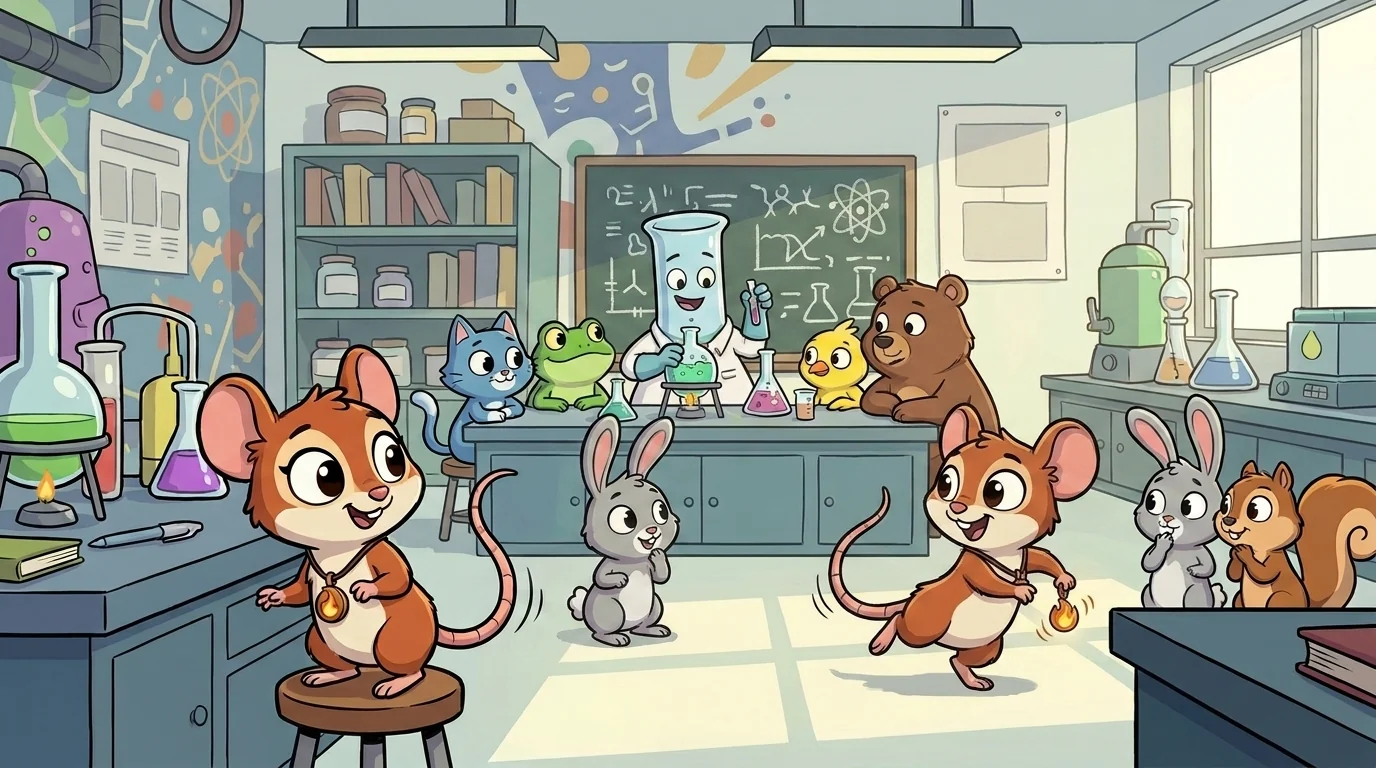
Phossa could not hold still. She was a small russet-and-cream mouse, and everything about her was moving at once — tail flicking, paws shifting, whiskers twitching, eyes leaping from one thing on the ChemQuest workbench to the next. A tiny bronze flame-charm swung on a leather cord around her neck, worn smooth from all the times she'd fiddled with it, catching the light every time she darted.
A cluster of students had gathered to watch a demonstration, and Phossa was supposed to be sitting quietly to one side. She was failing at that completely.
"Sorry, sorry," she squeaked, catching Beaker's patient look. "I know. Sit still. I'm trying." Her tail gave three quick flicks anyway.
A student named Ash whispered to a friend, "She's so jittery. Is she nervous?"
Phossa's ears swiveled — she'd heard. She scampered right over, flame-charm bouncing. "Not nervous," she said, grinning. "Energetic. There's a difference, and it's a good one." She held up the little bronze charm so it flashed. "See this? A spark. That's me. I'm not shaky because something's wrong — I'm buzzing because that's how I'm built, all the way down. Watch. I'll show you why."
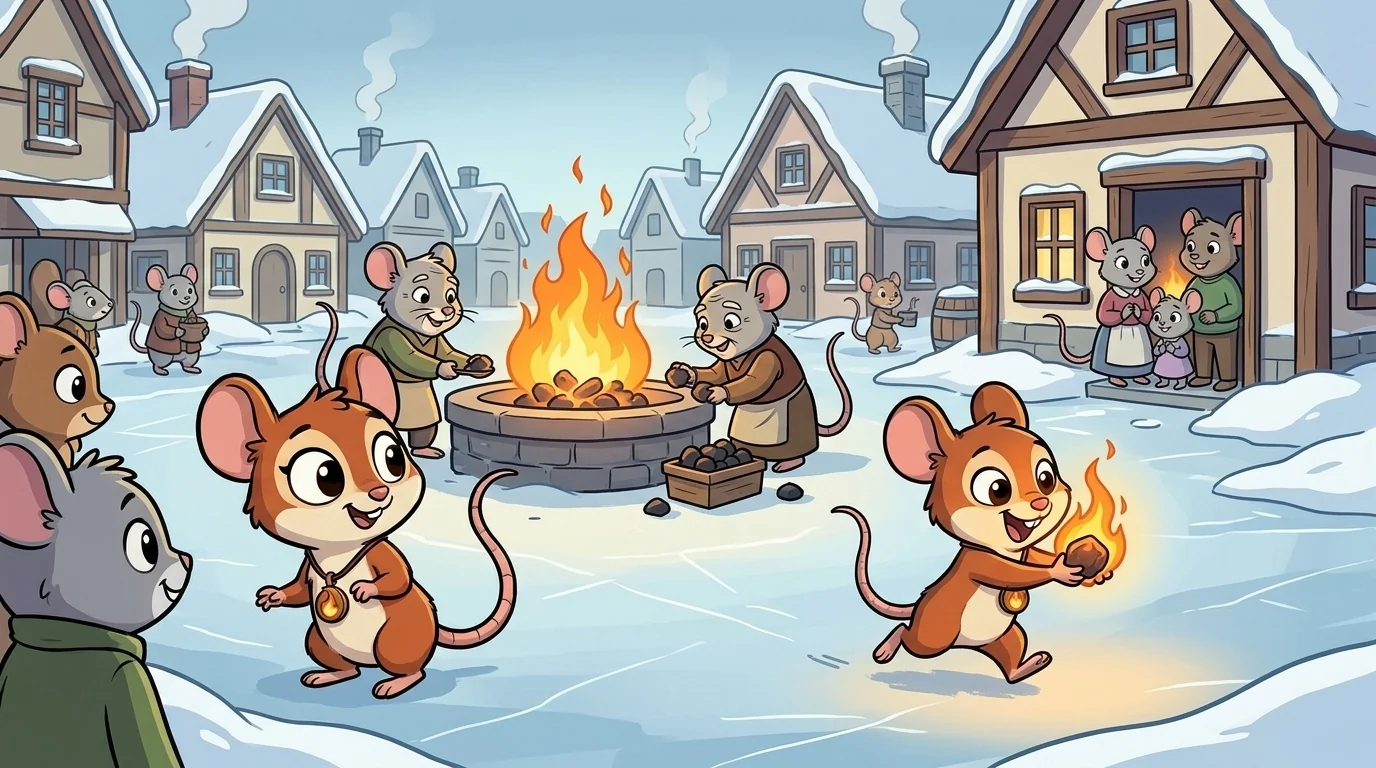
Phossa grew up in a village of spark-keepers.
Her family tended the great fire pit in the middle of town — the one that never went out. When a family's own hearth went cold, they'd come to the pit, and a spark-keeper would carry them a live coal or a fresh flame, quick, before it could die on the way. It was a job for the fast and the ready. A spark-keeper who dawdled lost the flame between the pit and the doorway. A spark-keeper who moved quick kept the whole village warm through the night.
Little Phossa learned it by the time she was six. She was the fastest of all of them, darting across the frozen square with a cupped coal glowing between her paws, delivering it still alive to some grateful cold house. She was never still on those runs — couldn't be. Standing around meant the spark went out. Moving meant the spark stayed lit.
That was where her restlessness came from, and she was proud of it. Energy wasn't something wrong with her. Energy was the family trade — and the family gift.
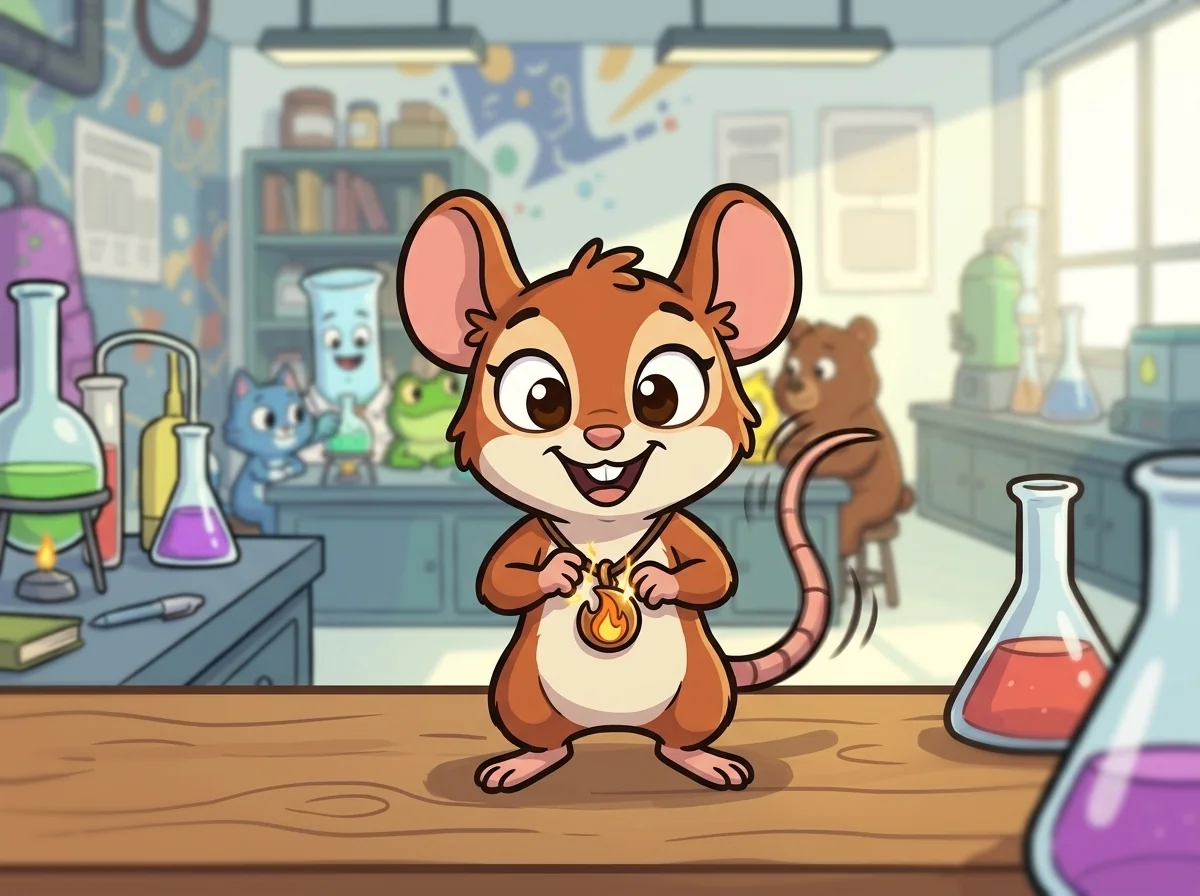
She scampered to the ChemQuest academy when she was twenty-two, arriving in a flurry of quick little steps and skidding to a stop in front of Beaker, the mentor, who asked her the door-question.
"What is phosphorus?"
Phossa stood as tall as a small mouse can. "I sit just below Nitra on the big element table," she said, all in a rush. "I've got five little helpers on my outside edge, and I'm built deep enough that I can join up in flexible ways — three connections at once, or sometimes five. And I'm the energy money of living things. There's a tiny package inside every creature, made partly of me, that stores energy and spends it. I'm also the spark inside a match. And I'm restless — because that's how my atoms are made."
Beaker smiled. "Welcome to the academy," he said. "We could use a little of your spark."
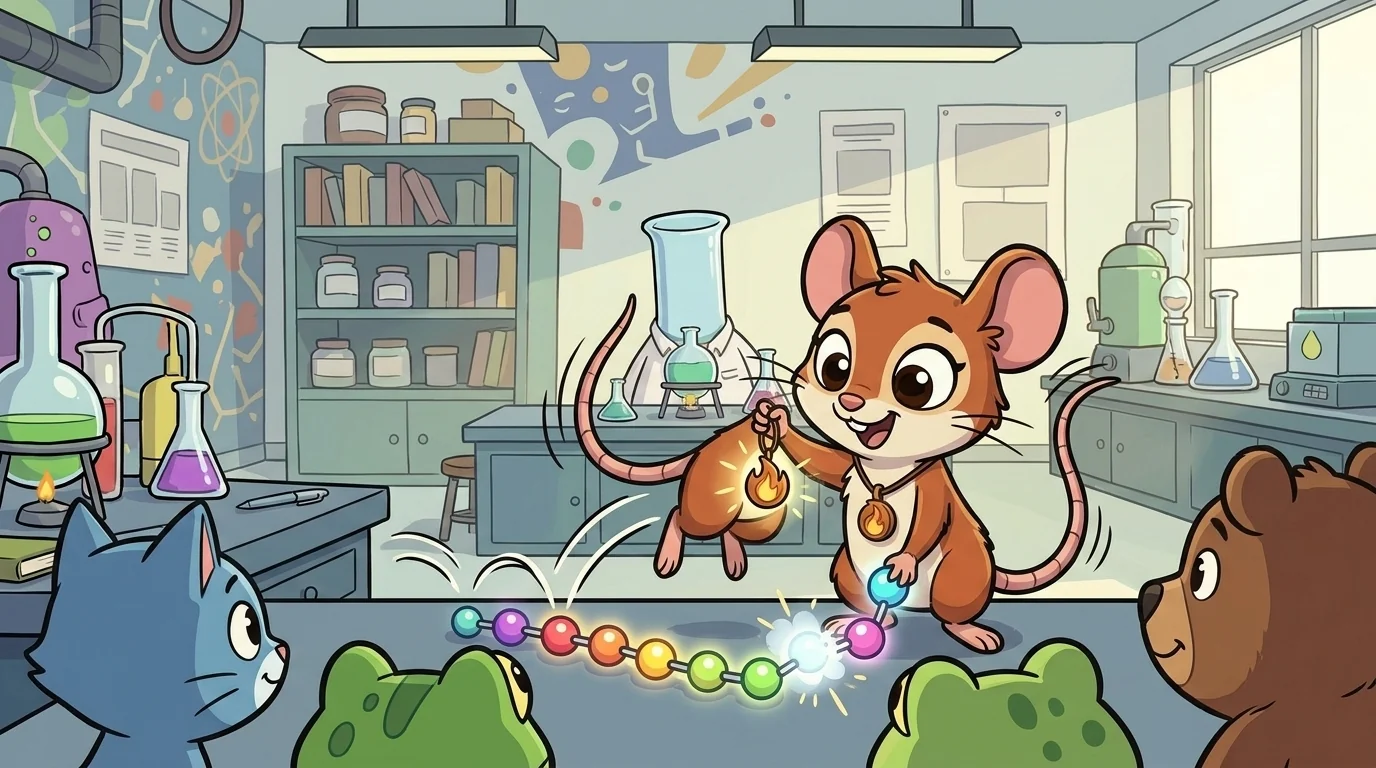
On the first day of class Phossa flickered up to the front bench in three quick hops, held up her flame-charm so it flashed, and began.
"I'm Phossa," she said. "I'm the spark. And I'm going to show you two things: how I store your body's energy, and how I light a match."
She scampered to a little model built of linked beads — three bright ones in a row at the end, glowing faintly. "This," she said, tapping it, "is the energy package. Every cell in you is full of them. Think of those three glowing beads as three little pouches of energy, all linked up in a chain. When your body needs power for something — moving, thinking, anything — it snaps the last pouch off the chain." She flicked the end bead loose, and a tiny puff of light sparked out. "POOF. Energy! That burst is what runs your muscles, your thoughts, everything. And then your body links a fresh pouch back on and does it again — trillions of times, every single second." Her whiskers quivered. "That snap-and-recharge is the real spark of life. My flame-charm is just a little reminder of it, right here around my neck."
Ash raised a paw. "You said three or five connections. How do you know which?"
"Depends who I'm with!" Phossa said, delighted. She held up three claws. "Sometimes I join up three ways — that makes a stinky gas called PH₃. Phew." She wrinkled her nose, then splayed out five claws. "Other times I stretch to five connections at once — that's the shape I'm in when I'm part of your energy pouches, and part of the long backbone that holds a strand of your DNA together, and part of the walls around every one of your cells. Five connections is my party trick, and it's the one that makes me so useful inside living things."
Then she grew a shade more careful. She pointed her charm toward a shielded corner of the lab. "There's also a wild kind of me," she said. "A version that reacts with the air so eagerly it can burst into flame all on its own if it just gets a little warm — barely warmer than a hot day. That's the chemistry that used to live in the tip of an old match, waiting for a scratch. My spark is not just a saying. It's real. Which is exactly why that wild kind stays in a special lab behind glass, and never, ever comes out to play at home."
At the end of the lesson Ash asked, "Is phosphorus chemistry hard?"
Phossa was already halfway into a happy little spin. "Not hard!" she said. "Three connections or five. Plus the snap-and-recharge of your energy pouches. Plus the spark in a match. And I'm restless because — say it with me — that's how my atoms are built." She grinned. "I'm the energy money of every living thing. Right now, inside you, uncountable little pouches are snapping and recharging to keep you going. That's me."
Her flame-charm caught the light as her tail gave a happy twitch. And feeling all that bright energy humming inside her, coiled and ready to spark, Phossa beamed — warm and glad and wide-awake, buzzing right down to her paws, exactly the way she most loved to feel.
The ChemQuest ensemble
Phossa is part of ChemQuest's distributed-narrative cast. Each character embodies a different curricular primitive; together they teach the full subject.
-

Hydra
Hydrogen (H) — lightweight, ubiquitous, always paired up; buddy-system enthusiast
-
Carbo
Carbon (C) — connects to anything; the social atom; backbone of life
-

Oxy
Oxygen (O) — eager bonder; electronegative; the hungry grabber
-

Nitra
Nitrogen (N) — triple-bond loyal; slow-to-warm; locks in deeply once bonded
-
Sodi
Sodium (Na) — generous, impulsive; always giving away electrons
-

Chlora
Chlorine (Cl) — sharp, focused; the collector who finishes what Sodi starts
-

Helio
Helium (He) — noble gas; peaceful, floaty, complete; the contented onlooker
-
Sulfa
Sulfur (S) — earthy, dramatic; the stinky uncle of volcanoes and proteins
-

Magna
Magnesium (Mg) — bold, ceremonial; burns bright white; chlorophyll core
-

Silica
Silicon (Si) — patient, geometric; the architect who builds quietly
-

Alumi
Aluminum (Al) — practical, modest; the workhorse of cans and foil
-

Tugger
Ionic bond — forceful, decisive; full electron transfer; opposites attract
-

Sharer
Covalent bond — cooperative, balanced; equal partnership
-

Streamer
Metallic bond — flowing, communal; delocalized electron sea
-
Whisperer
Hydrogen bond — subtle, persistent; water's superpower; DNA pairing