Chlora
CHLORINE (Cl) — *sharp, focused; the collector who finishes what Sodi starts.* One missing outer-shell electron; pulls one electron in eagerly; basis of ionic chlorides; pairs with Sodi to make table salt NaCl.
Press play to listen along. The line being read lights up as you go.
Show full transcript
Loading transcript…
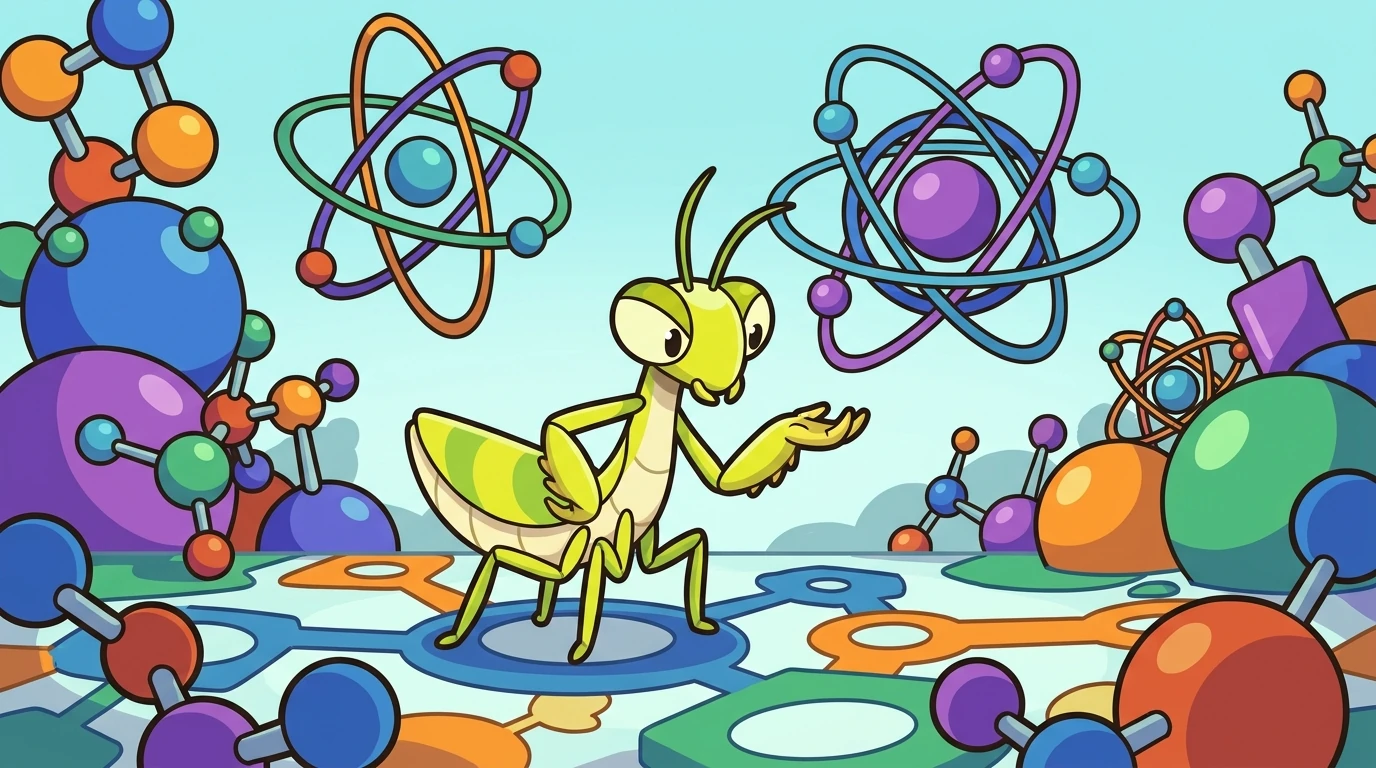
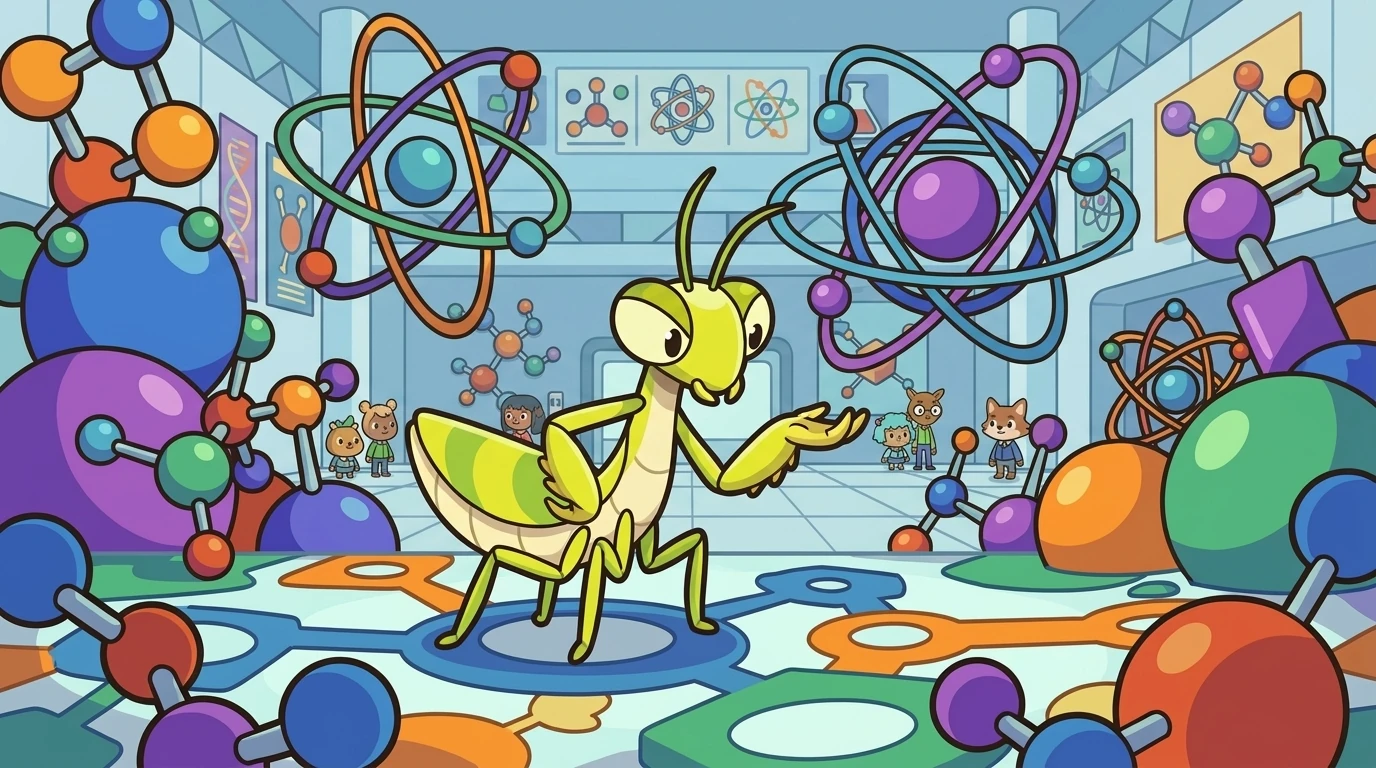
Chlora was a small mantis-tween. She had one hand cupped up. It looked ready to catch something. Her eyes were sharp and focused.
She was small. Her body was bright yellow-green and cream. Her eyes moved quickly. She was very focused and precise. Her special thing was her right hand. It was always cupped. Her palm faced up. It looked like she was waiting for a tiny drop. Maybe a little pebble or a single berry. Her eyes stayed fixed. They watched for anything she needed. Chlora's whole job was to wait. She waited for just one electron. That electron would make her outer shell full.
This was super important. Chlora showed everyone about *chlorine (Cl). Chlorine has seven electrons on its outside ring. But it really wants eight. So, chlorine* is missing just one electron. Sodi really wanted to give away her extra electron. Chlora really wanted to take one. They both wanted something.
When Sodi and Chlora met, Sodi gave her electron to Chlora. Sodi became Na⁺. Chlora became Cl⁻. They had opposite charges. Opposite charges pull together. Together, they made NaCl. That's *table salt. This was the main way to show an ionic bond. Two atoms changed in two steps. Then they made one strong ionic compound*.
(Chlora often worked with Sodi. They showed things in class together. Their lessons were planned to match up. They showed up in Kit 6. They were the main example of an ionic bond.)
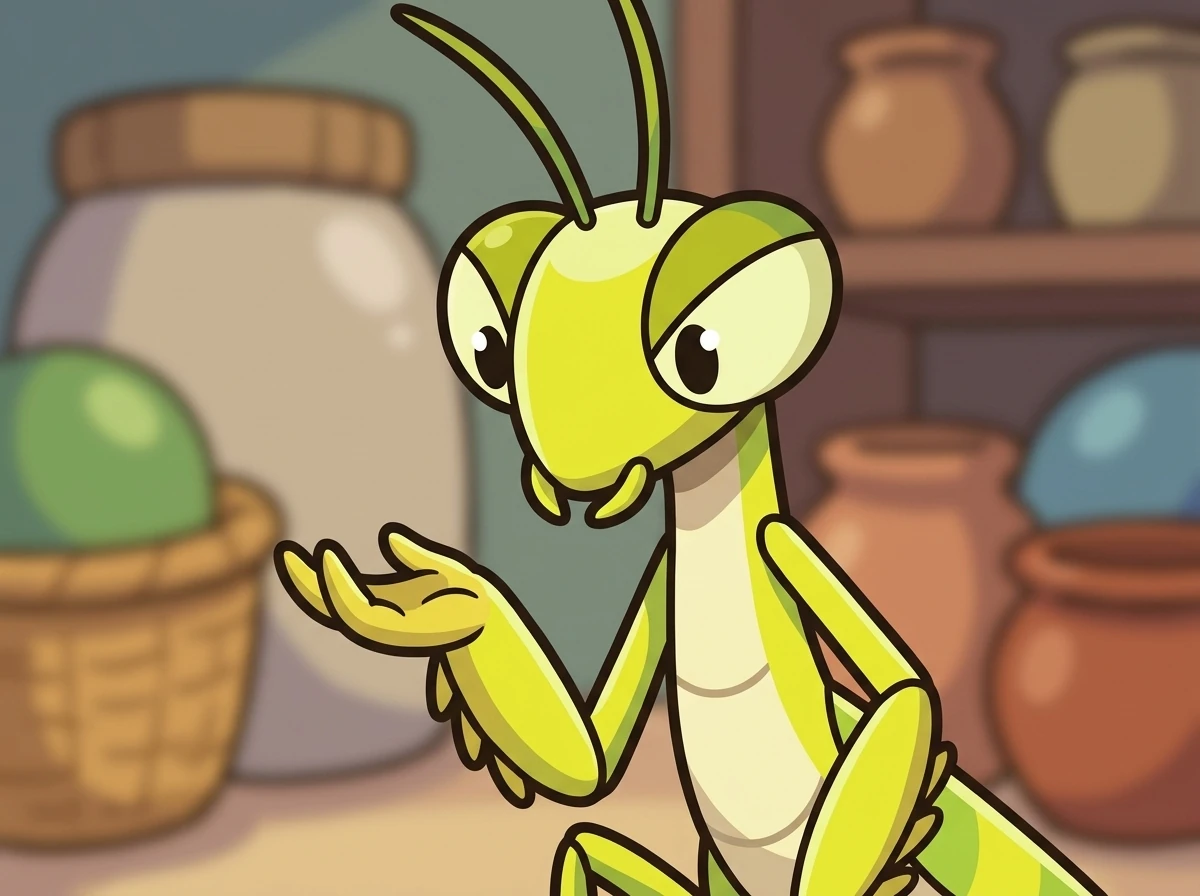
This was key: Chlora never said she was grabbing electrons. She never acted like a bully. She always made it clear. "I have seven electrons on my outside ring," she would say. "I want one more. Sodi offers me her extra electron. So I take it. But only because she offers it. We both become stable. I turn into Cl⁻. She turns into Na⁺. We stick together because our charges are opposite. Taking means we both get what we need. If Sodi didn't have an extra, I wouldn't take anything. I would just stay as a Cl₂ molecule. That means I'd pair with another *chlorine*. We would share electrons instead."
Chlora grew up in a small village. Her family had a special job there. They were the harvest-receivers. They were mantises who ran the village storehouse. Field-workers brought in their crops. Chlora's family took them. They wrote down every single thing. Then they put it in the right storage spot. This job needed careful receiving. A receiver who took the wrong crops was no good. One who miscounted was useless. Putting things in the wrong place was a big problem. But a receiver who took exactly what was offered? Who wrote it down perfectly? Who stored it right? That person was vital. They helped the village survive winter. By age six, Chlora knew something important. Receiving was a skill. It was a craft all its own. Being exact when you received finished the giving. It made the giver's job complete.
When she was twenty-two, she walked to ChemQuest academy. Beaker asked her a question. "What is *chlorine?" he said. Chlora answered, "I am missing one electron. Someone offers me the missing one. Like Sodi. I take it. I become Cl⁻. The giver becomes positive. Opposite charges pull together. That's the main ionic bond. If no one offers, I stay paired. I'd be with another chlorine atom. That's Cl₂. It's a covalent bond. But with an offerer, an ionic compound* forms." Beaker just nodded. "You are appointed," he said.
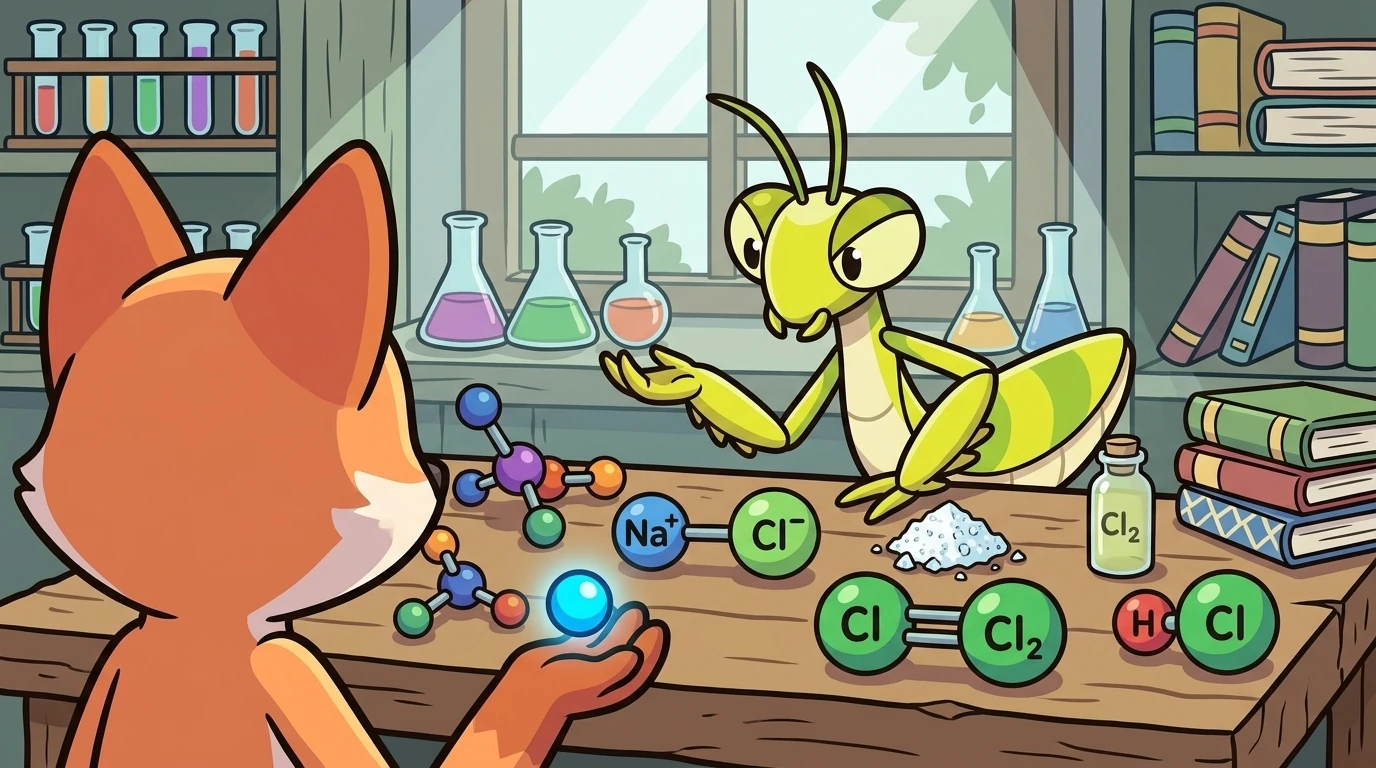
In her workshop, Chlora started every first lesson the same way. She sat down at the workbench. Sodi sat across from her. They often worked together. Chlora held up her cupped hand. She said, "I am Chlora. I teach about *chlorine*. I am the focused receiver. My job is one missing electron. I wait to take what's offered. Sodi offers her extra. I take it. We both become stable. Opposites attract. Watch this."
She taught the main ideas about *chlorine: *Chlorine is missing one electron. (It has seven on the outside. It wants eight.) When *chlorine takes an electron, it becomes Cl⁻. (It's a negative ion. It's stable and happy.) Cl⁻ pairs with Na⁺. This is an ionic bond. (Opposite charges attract. NaCl, or *table salt, is the best example.) Cl₂ pairs covalently when no Na⁺ is around. (Two *chlorine atoms share one electron each. This fills both their missing spots. This is Cl₂. It's chlorine gas. It has a sharp smell. Factories use it sometimes. Be careful! Chlorine gas is poisonous. Don't use it for kitchen science.) Hydrochloric acid is HCl. (Hydra and Chlora pair covalently. In water, it breaks apart. It becomes H⁺ and Cl⁻. It's a strong acid. It's in your stomach. It helps you digest food.) Sodi and Chlora show this. (They do a demo in Kit 6. Tugger helps them. It teaches about ionic bonding.) Don't just think of it as personality. (Chlora "takes" because she needs one electron. "Sharp" means it happens fast. That's electronegativity. An atom's structure is its personality.)
She made it very clear. "I'm in your stomach right now," she said. "I'm Cl⁻ in your stomach acid. I help digest your food. I'm in every grain of salt you eat. I'm bonded with Sodi. Once I have my electron, I stop taking. My work in your body happens after that. It's chemistry that needs me to be a stable Cl⁻ ion."
Students often asked Chlora. Was *chlorine* chemistry hard? Chlora always gave the same answer.
"It's not hard," she'd say. "It's one missing electron. It waits to be filled. Find a giver. Both become stable. Opposites attract."
Her cupped hand stayed up, patient and open. And when the next electron finally came to her, she felt that same quiet warmth she always did — the calm, glad feeling of being exactly ready for what she needed, and of finishing what someone else had started.
The ChemQuest ensemble
Chlora is part of ChemQuest's distributed-narrative cast. Each character embodies a different curricular primitive; together they teach the full subject.
-

Hydra
Hydrogen (H) — lightweight, ubiquitous, always paired up; buddy-system enthusiast
-

Carbo
Carbon (C) — connects to anything; the social atom; backbone of life
-

Oxy
Oxygen (O) — eager bonder; electronegative; the hungry grabber
-

Nitra
Nitrogen (N) — triple-bond loyal; slow-to-warm; locks in deeply once bonded
-
Sodi
Sodium (Na) — generous, impulsive; always giving away electrons
-

Helio
Helium (He) — noble gas; peaceful, floaty, complete; the contented onlooker
-

Sulfa
Sulfur (S) — earthy, dramatic; the stinky uncle of volcanoes and proteins
-

Phossa
Phosphorus (P) — energetic, restless; the spark of ATP and matches
-

Magna
Magnesium (Mg) — bold, ceremonial; burns bright white; chlorophyll core
-

Silica
Silicon (Si) — patient, geometric; the architect who builds quietly
-

Alumi
Aluminum (Al) — practical, modest; the workhorse of cans and foil
-

Tugger
Ionic bond — forceful, decisive; full electron transfer; opposites attract
-

Sharer
Covalent bond — cooperative, balanced; equal partnership
-

Streamer
Metallic bond — flowing, communal; delocalized electron sea
-

Whisperer
Hydrogen bond — subtle, persistent; water's superpower; DNA pairing