Helio
HELIUM (He) — noble gas; peaceful, floaty, complete; the contented onlooker. Two outer-shell electrons (a full duet); doesn't bond with anything; the picture of atomic stability.
Press play to listen along. The line being read lights up as you go.
Show full transcript
Loading transcript…

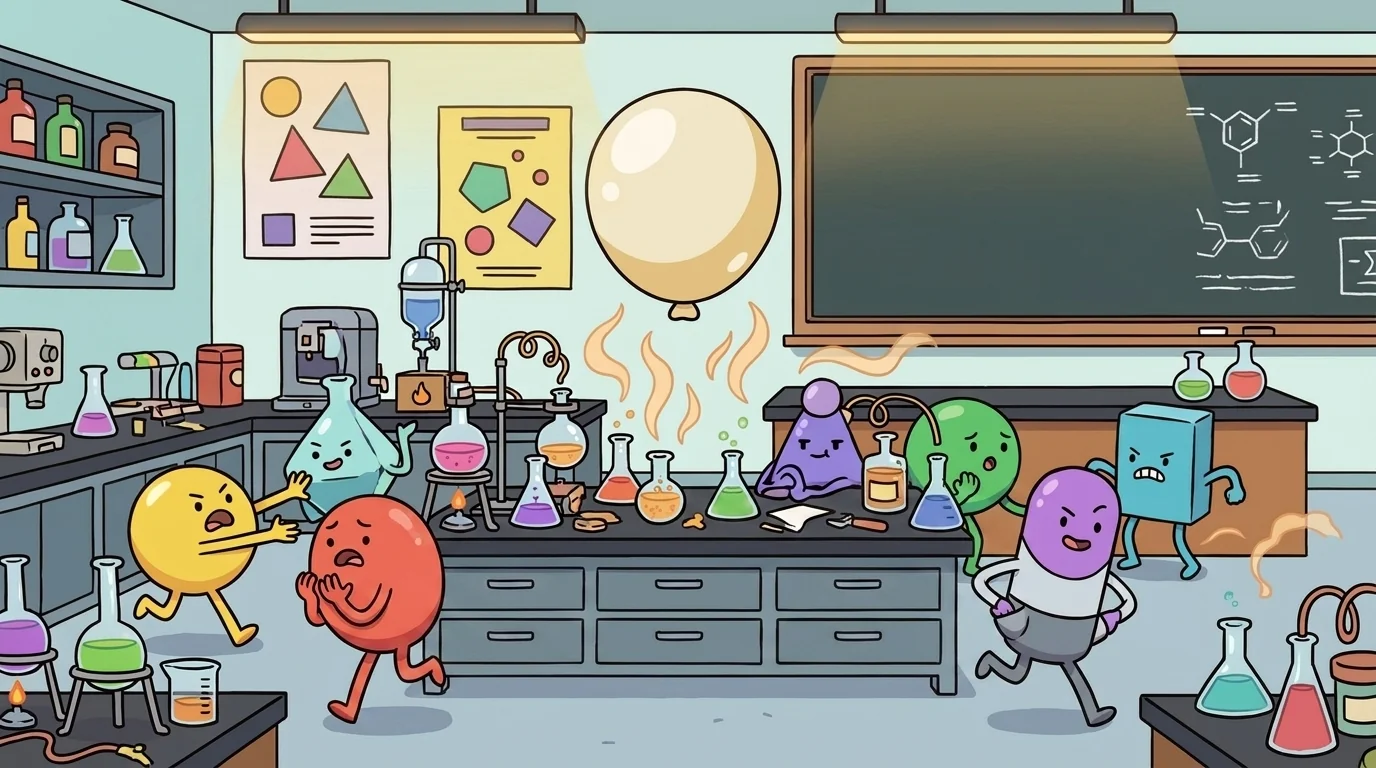
The ChemQuest workbench was a scramble that afternoon. Sodi rushed past with her open hand out, trying to give away a spare electron. Chlora cupped her hands, hungry to take one. Oxy darted around with two empty pockets she was desperate to fill. Everyone wanted something. Everyone was reaching.
Above the whole busy scene, one small figure floated at about head height, going nowhere in particular. Helio was a smooth, round, cream-and-pale-gold balloon with no arms, no hands, and no face — just a gentle, drifting shape that bobbed in the warm air rising off the bench. While the others chased and grabbed and gave, Helio simply hovered, calm as a nap.
A young student named Fig stopped and stared up at the balloon. "Why doesn't that one do anything?" she asked the mentor, a careful figure named Beaker.
"Because Helio doesn't need to," Beaker said. He pointed up. "See — no reaching hand, no open pocket, no signal that Helio wants a single thing. That's not laziness, Fig. That's the whole point. Look at everyone else in this room, working so hard. They're all trying to reach the exact place Helio's already standing."
Fig looked at the frantic bench, then back up at the still, floating balloon. "They want to be like that?"
"Chemically? More than anything," Beaker said.
Helio didn't come from a village like the other cast members. Sodi had her salt-gatherer family; Oxy had her hummingbird nectar-collectors; Phossa had her spark-keepers. Helio had none of that.
Beaker liked to tell the story this way. High up, far above any village, in the thin cold air near the top of the sky, lighter-than-air things drift and rise. That's where Helio belongs. Helium is lighter than the air around it, so it floats up and up. It doesn't gather in a workshop with a craft-family. It doesn't dig anything out of the ground. Most of Earth's helium seeps up slowly from deep in the rocks, escapes into the sky, and eventually drifts off into space, alone.
So Helio grew up solitary, by nature — not lonely, exactly, but complete on its own from the very start. While other little atoms were learning to give and take and share, Helio had nothing to learn. It was already finished the day it formed: one shell, filled with its two electrons, snug and whole. There was nothing to reach for, because there was nothing missing.
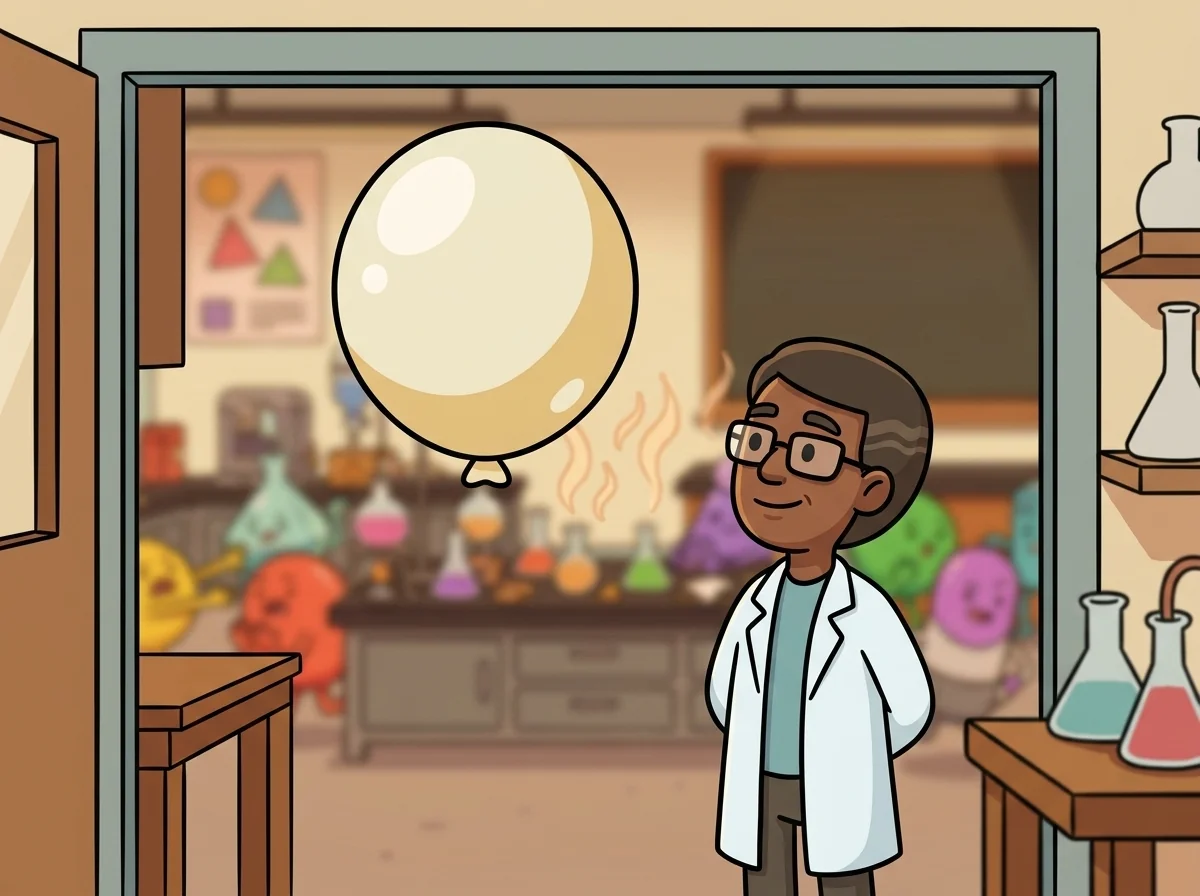
Helio floated up to the ChemQuest academy at twenty-two, drifting through the door on the warm draft. Beaker met it there and asked the door-question the way he asked everyone.
"What is helium?"
Helio, of course, said nothing — it has no mouth and never speaks. But it settled in the air in front of Beaker, perfectly still, perfectly round, wanting nothing. And Beaker, who had spent a long time learning to read that stillness, understood.
"Two electrons," Beaker said aloud, translating the quiet. "One shell. Full. Done. No reaching. No bonding. Stable exactly as it is." He smiled up at the little balloon. "That's the answer. Welcome to the academy. We'll need you here — the others need something to aim at."
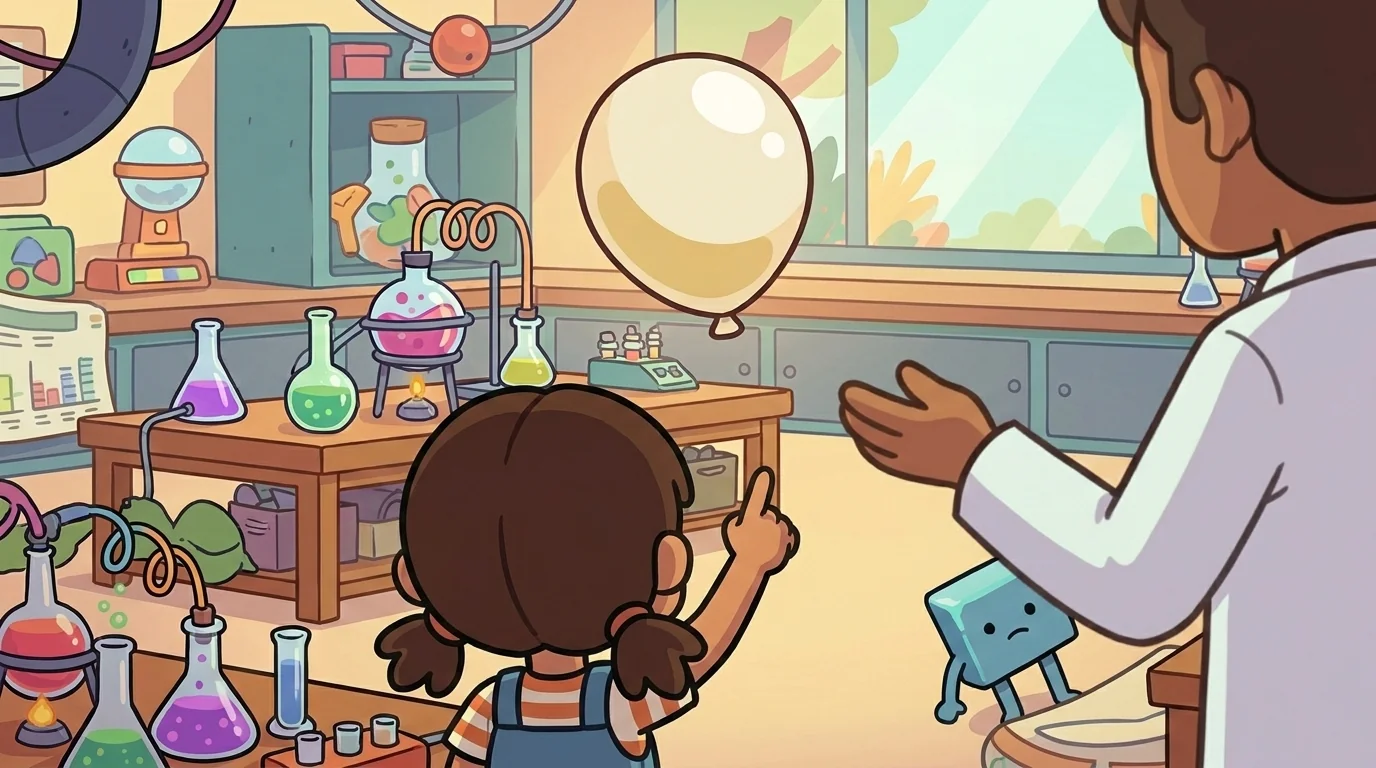
On the first day of the noble-gas lesson, Beaker gathered the students at the bench while Helio hovered overhead, silent and serene.
"This is Helio," Beaker said. "Helium. A noble gas. Now — look closely at Helio, and tell me what you don't see."
Fig squinted up. "It doesn't have arms. Or hands. Or pockets."
"Right," Beaker said. "Every other atom in this room has a signal for what it wants. Sodi's open hand says give. Chlora's cupped hands say take. Oxy's empty pockets say fill me. Helio has none of that — because Helio doesn't want anything at all. Its little shell already holds both the electrons it can hold. Full. Nothing to chase."
He held up a chart of the far-right edge of the big element table. "There's a small family like Helio — the noble gases: He, Ne, Ar, Kr, Xe, Rn, Og. Their outer shells are all filled up, so under normal conditions they don't bond with anything. They just float around being themselves, content."
Fig frowned. "But everybody else is working so hard to grab and give and share. Why?"
Beaker's eyes crinkled. "That, Fig, is the best question in the room. They work so hard because they're all trying to reach a filled shell — trying to feel as settled as Helio already feels. Sodi gives an electron away to get there. Chlora takes one. Oxy and Hydra and Carbo share. Different roads, same destination: full and stable. Helio is the one who was born at the finish line."
He tapped the chart. "For most atoms, the lucky number that means 'full and settled' is eight. For helium alone, because it has just one tiny shell, the number is two. Two electrons, one shell, complete."
Helio drifted lower for a moment, catching the light, then rose again.
"And helium isn't only a lesson," Beaker added, warming to it. "Because it's lighter than air, it lifts balloons and airships. Chilled down colder than you can imagine, it cools the giant magnets inside hospital scanners and other powerful machines. And unlike some lighter-than-air gases, helium won't catch fire — which is why it's the safe choice to put in a party balloon." He grew quieter. "One more thing, though: there isn't an endless supply. Once helium floats up and off into space, it's gone. So it's worth not wasting."
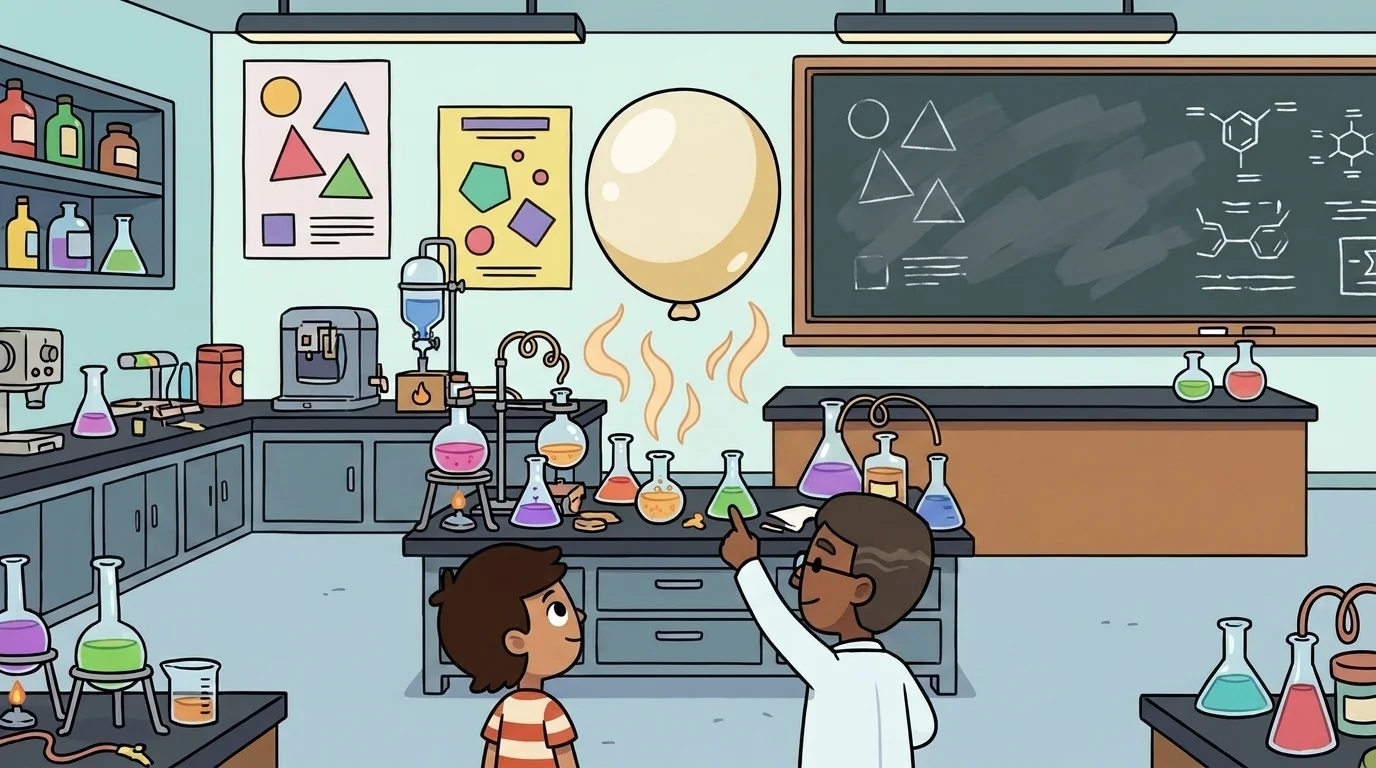
When the students had questions, they came to Helio and stood beneath it, and Beaker would speak the answers on its behalf while the little balloon simply held still above them. Nobody minded. There was something restful about it — a corner of the busy bench where nothing was being chased.
At the end of the day Fig lingered, looking up.
"Is it strange," she asked Beaker, "being finished already? Not needing anything?"
Beaker considered the drifting, faceless shape a long moment. "I don't think Helio finds it strange at all," he said. "I think it just feels quiet. Settled. Whole." And Fig, looking up at that calm round thing floating in the warm air, felt her own shoulders come down and her breath go slow — the soft, easy feeling of being somewhere peaceful, wanting nothing, exactly as she was.
The ChemQuest ensemble
Helio is part of ChemQuest's distributed-narrative cast. Each character embodies a different curricular primitive; together they teach the full subject.
-

Hydra
Hydrogen (H) — lightweight, ubiquitous, always paired up; buddy-system enthusiast
-

Carbo
Carbon (C) — connects to anything; the social atom; backbone of life
-

Oxy
Oxygen (O) — eager bonder; electronegative; the hungry grabber
-

Nitra
Nitrogen (N) — triple-bond loyal; slow-to-warm; locks in deeply once bonded
-
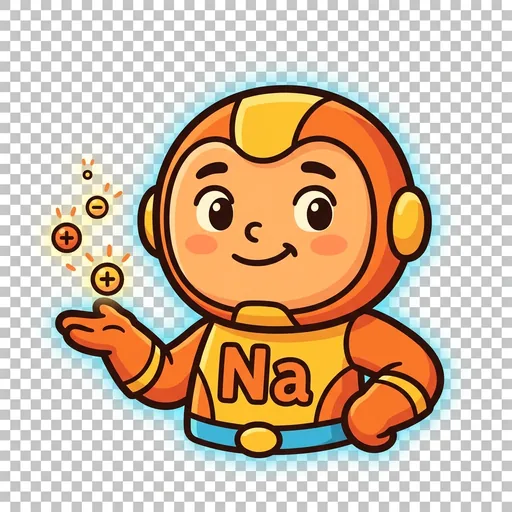
Sodi
Sodium (Na) — generous, impulsive; always giving away electrons
-

Chlora
Chlorine (Cl) — sharp, focused; the collector who finishes what Sodi starts
-

Sulfa
Sulfur (S) — earthy, dramatic; the stinky uncle of volcanoes and proteins
-

Phossa
Phosphorus (P) — energetic, restless; the spark of ATP and matches
-

Magna
Magnesium (Mg) — bold, ceremonial; burns bright white; chlorophyll core
-

Silica
Silicon (Si) — patient, geometric; the architect who builds quietly
-

Alumi
Aluminum (Al) — practical, modest; the workhorse of cans and foil
-

Tugger
Ionic bond — forceful, decisive; full electron transfer; opposites attract
-

Sharer
Covalent bond — cooperative, balanced; equal partnership
-

Streamer
Metallic bond — flowing, communal; delocalized electron sea
-

Whisperer
Hydrogen bond — subtle, persistent; water's superpower; DNA pairing