Hydra
HYDROGEN (H) — *lightweight, ubiquitous, always paired up; buddy-system enthusiast.* The chemistry primitive of *the simplest atom — one proton, one electron — that bonds with almost everything and is in almost every interesting molecule on Earth.*
Press play to listen along. The line being read lights up as you go.
Show full transcript
Loading transcript…
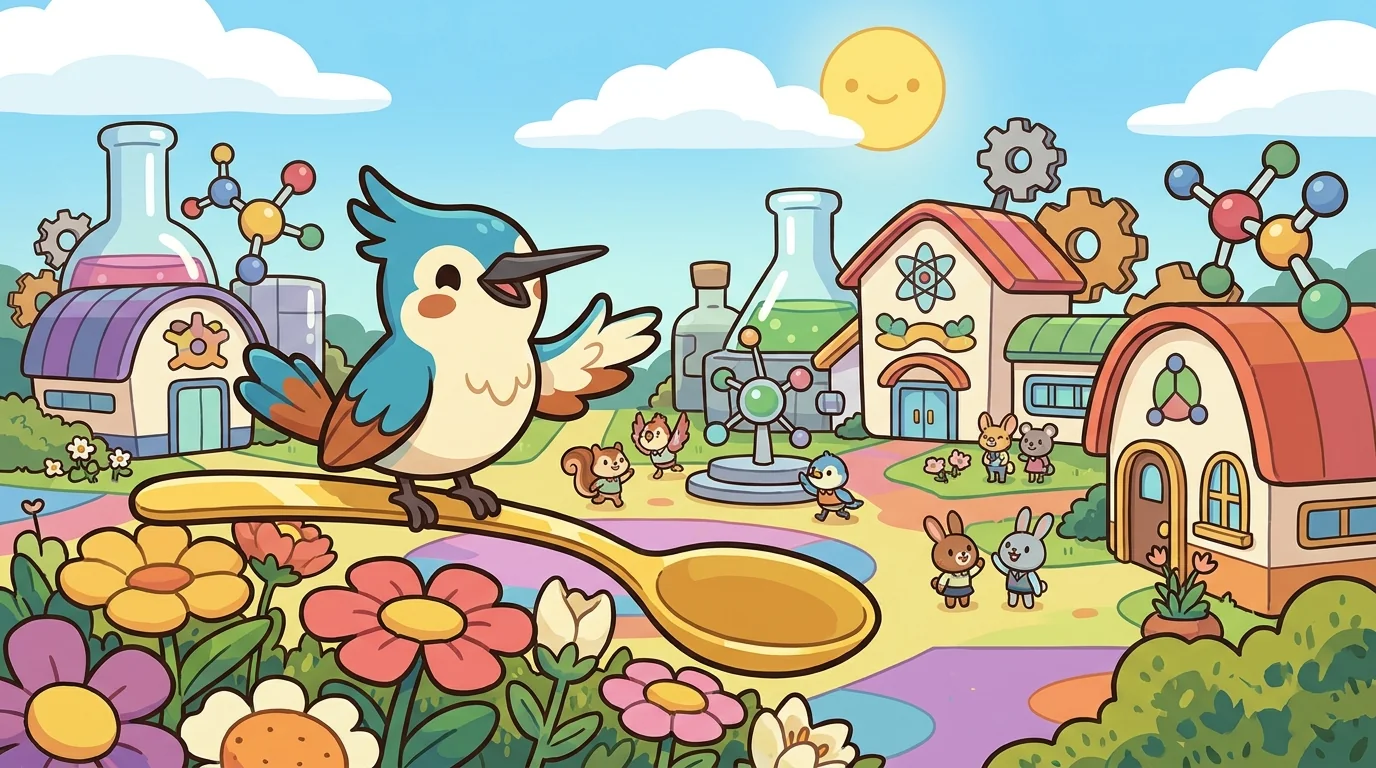
Hydra was the tiniest hummingbird-tween at the ChemQuest academy, small enough to perch on a teaspoon, and she carried herself like the whole morning was about to become her best friend. Her feathers were bright blue and creamy white, flashed here and there with a bit of rust, and she moved so fast she was mostly a shimmer. But the thing everyone remembered about Hydra was her hand. She held one small hand out in front of her, palm up and open, the way you'd offer a handshake or hold out something to share. She almost never closed it. Even sipping her morning nectar, that little hand stayed open and waiting.
"What's the hand for?" the new students always asked.
"For you," Hydra would chirp, and beam at them. "I've got one to give. I'm just looking for somebody to hold the other end."
She never meant a nectar-drop. She meant an electron. Hydra had exactly one, and one open hand to offer it with, and every fiber of her wanted a partner to share it with. That single open palm was the whole of her, said out loud in a posture you could see across the room.
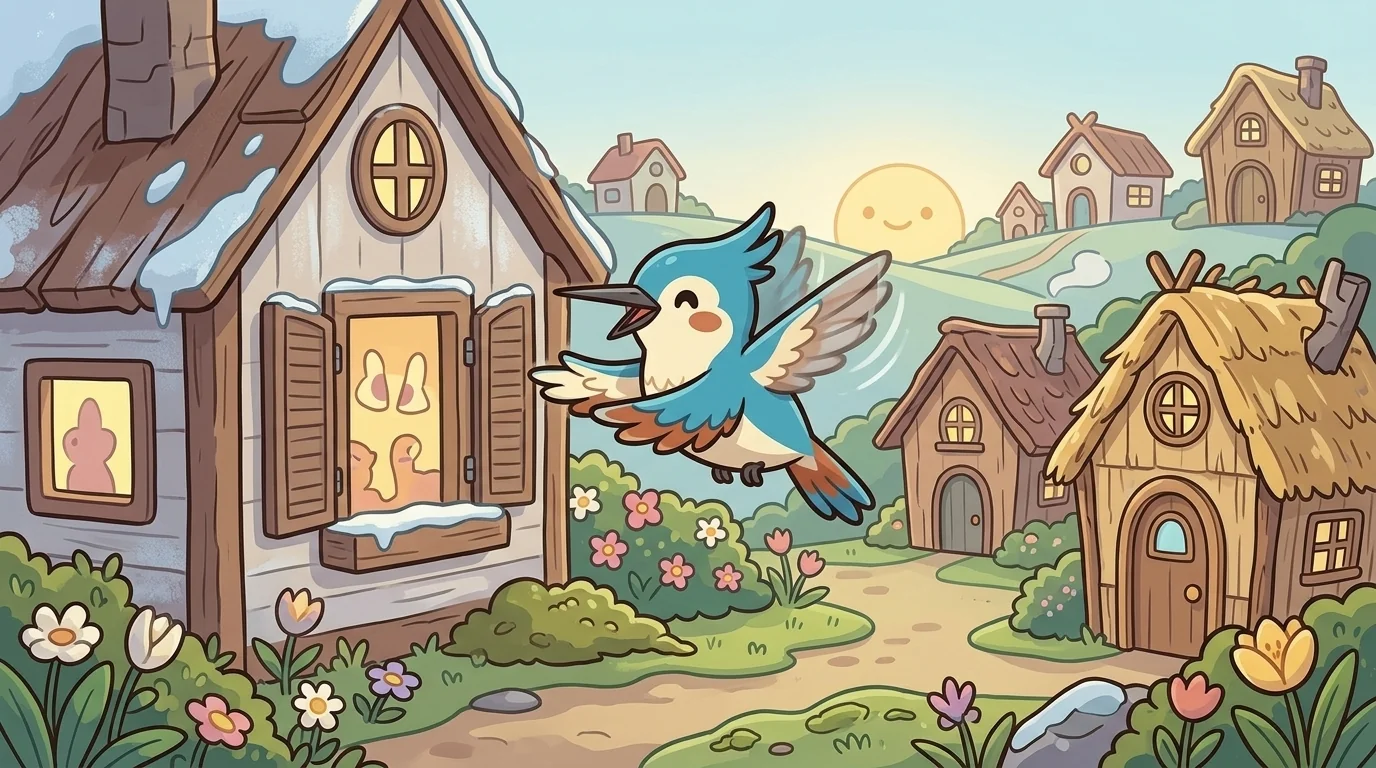
When she was small — smaller, even, than she was now — Hydra grew up in a hummingbird village where her family had the same job every spring. They were the greeting-callers. Before the festival, while the frost still clung to the shutters, her family would flit house to house at dawn, tapping on windows, calling out warm hellos, waking sleepy neighbors and welcoming the new season in.
It was not a job for a shy bird. A greeting-caller who hung back at the gate, who waited to be invited, who kept her hands folded — that bird was no use at all. You had to be first to the doorway. You had to have a hello ready for everyone.
Hydra's family were the best in the village at it, and by the time she was six she understood why she loved the work so much. She was happiest at the exact moment two people who hadn't been connected suddenly were. A knock, an answered door, a hand held out — and a little of the spring seemed to arrive with it. She began to feel, even that young, that being eager to reach out wasn't a weakness. It was the thing she was for.
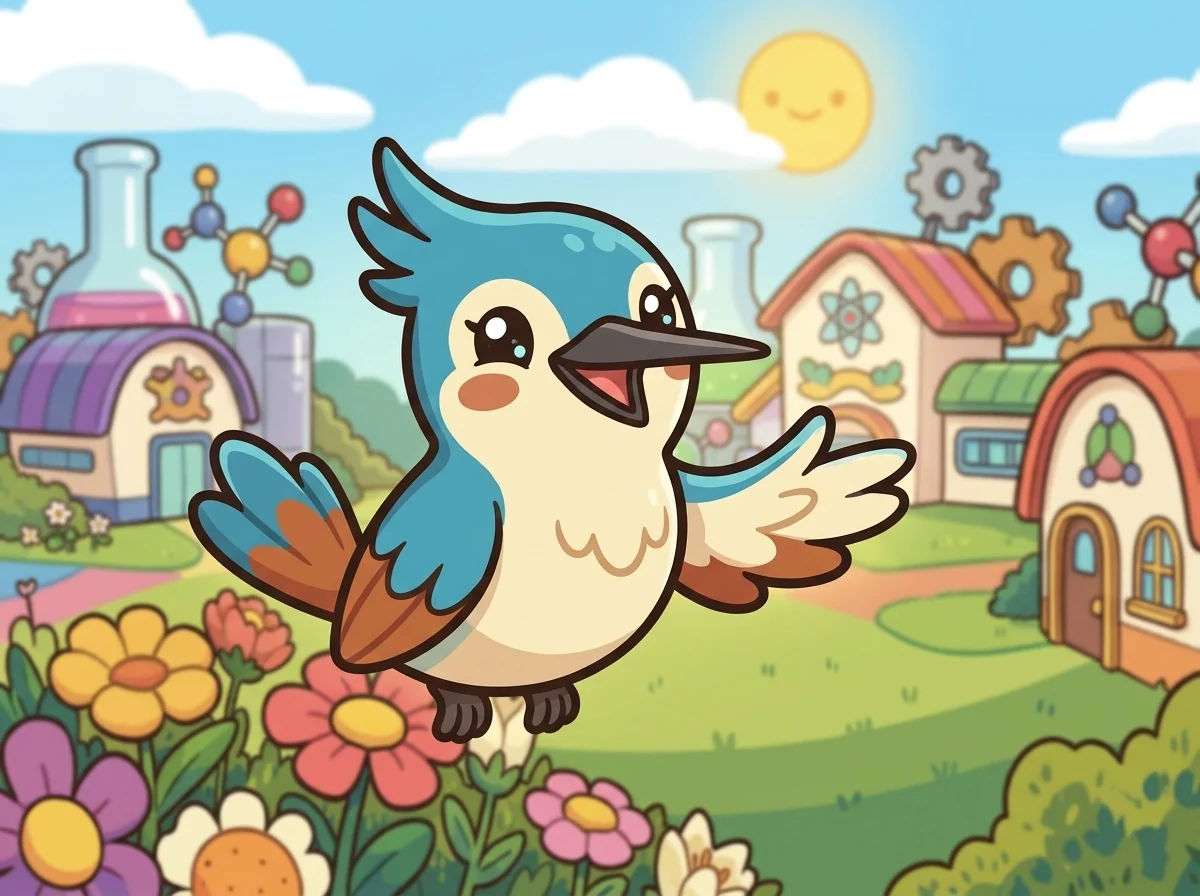
She flew to the ChemQuest academy the spring she turned twenty-two. Beaker, the head of the academy, was waiting at the great doors when her shimmer came zipping up the mountain path.
"Slow down, little one," Beaker laughed, as Hydra fluttered to a stop an inch from his nose, her hand already out. "Now. What can you do?"
Instead of answering in words, Hydra flew straight over to Oxy, a broad, calm student standing nearby, and held out her open hand. Oxy needed a pair too — Hydra could see it. She pressed her palm to his, and for a bright second the two of them glowed, steadier and happier than either had been alone. Then she zipped over and did the same with Carbo, and with Nitra, one after another, quick as a heartbeat, each little pairing settling into place with a soft, satisfied click.
She flew back to Beaker and hovered, breathless. "That," she said. "I have one to give. I find somebody who needs one too. We hold on. And then we're both steadier than we were." She grinned. "That's all. It isn't a trick. It's just wanting a pair."
Beaker looked at the students still glowing behind her, and he smiled. "Then this is your workshop," he said. "Welcome home, Hydra."
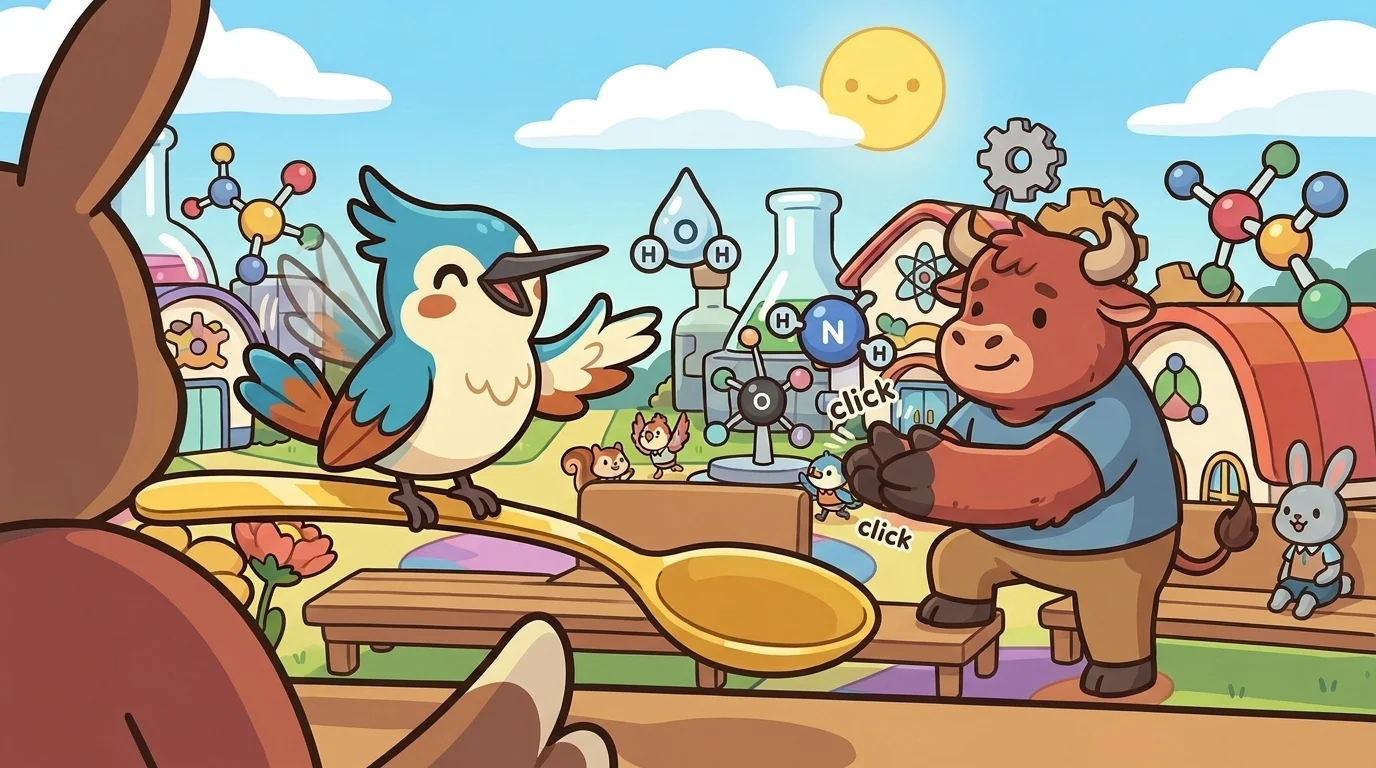
On the first day of every new group, Hydra ran her lesson the same way, because showing was so much better than telling. She'd zip to the front bench, wings a blur, and hold out that ever-open hand.
"Watch," she'd say. "Oxy — come here."
Oxy would lumber up, and Hydra would touch her palm to his. The two of them would fit together and — click — hold. Water. She'd wink at the class. "Half of every raindrop is me holding on to somebody. Now watch again. Carbo!" Click. "And that's the start of everything you're made of. Nitra!" Click. "And that's the air you breathed on the way in."
A student in the front row once put up a wing. "But how do you know who to hold on to?"
"I don't pick," Hydra said, delighted by the question. "I just offer. My hand's open to anybody who needs one. Oxy needs a pair — so we pair. Chlora needs a pair — so we pair. I don't need everybody. I need one." She let her hand fall open again, palm up, ready. "And the funny part is, I do this a million times a second, right inside your own body, this very moment. Bonds forming, letting go, forming again. That's not magic doing that." She tapped her chest. "That's just me, and this hand, all day long."
She showed them where to find her, too — in a raindrop, in a breath, in a spoonful of sugar, in the fire when H₂ gas burns bright and warm, even in the far-off blaze of the Sun. "If you ever catch yourself thinking a thing is complicated," she told them, "come find me. I'm the simplest one here. And I'm in almost everything you love."
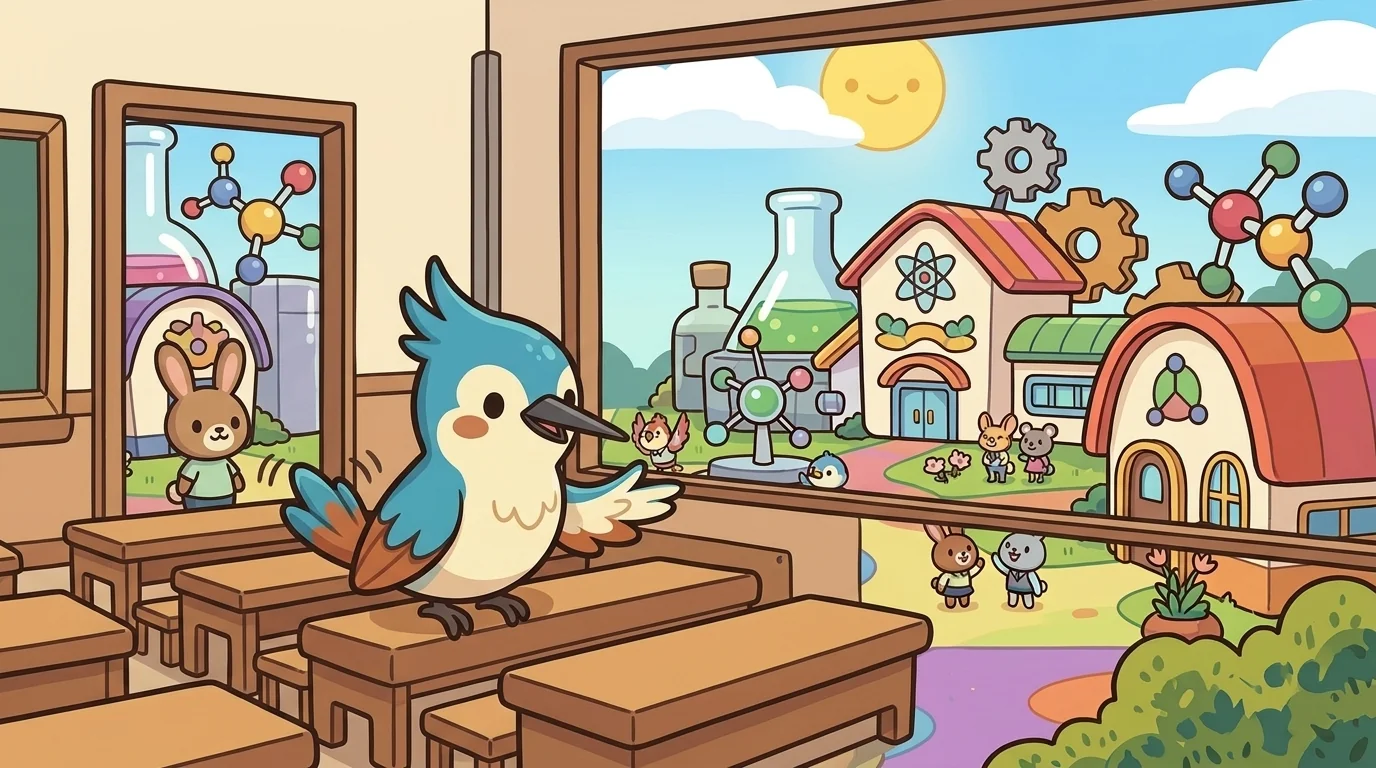
The lesson ended, the students filed out, and Hydra stayed a moment on the empty bench, her wings finally slowing.
A quiet student had lingered at the door. "Doesn't it get lonely?" the student asked. "Always reaching out. Always the one holding your hand open."
Hydra thought about it, her small chest rising and falling. Then she shook her head, and something warm crossed her face. "The reaching-out is the best part," she said softly. "The waiting isn't lonely. It's hopeful. It means the next friend hasn't happened yet." She looked down at her open palm, and she smiled — not a big performing grin this time, just a small, steady, glad one. "And oh, when it does happen — when somebody takes it, and neither of us has to be by ourselves anymore — I feel so full I could burst."
She kept her hand open. Out past the window, the whole world was waiting to be held. She had never once felt more ready.
The ChemQuest ensemble
Hydra is part of ChemQuest's distributed-narrative cast. Each character embodies a different curricular primitive; together they teach the full subject.
-
Carbo
Carbon (C) — connects to anything; the social atom; backbone of life
-

Oxy
Oxygen (O) — eager bonder; electronegative; the hungry grabber
-
Nitra
Nitrogen (N) — triple-bond loyal; slow-to-warm; locks in deeply once bonded
-
Sodi
Sodium (Na) — generous, impulsive; always giving away electrons
-

Chlora
Chlorine (Cl) — sharp, focused; the collector who finishes what Sodi starts
-
Helio
Helium (He) — noble gas; peaceful, floaty, complete; the contented onlooker
-
Sulfa
Sulfur (S) — earthy, dramatic; the stinky uncle of volcanoes and proteins
-
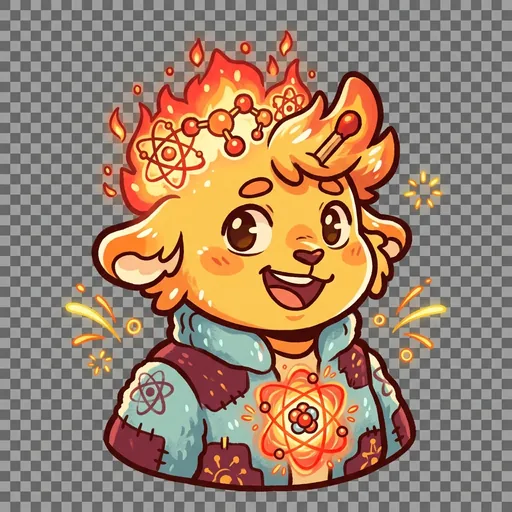
Phossa
Phosphorus (P) — energetic, restless; the spark of ATP and matches
-
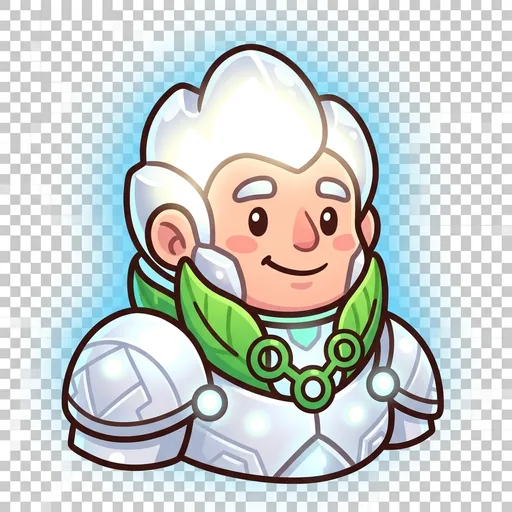
Magna
Magnesium (Mg) — bold, ceremonial; burns bright white; chlorophyll core
-

Silica
Silicon (Si) — patient, geometric; the architect who builds quietly
-

Alumi
Aluminum (Al) — practical, modest; the workhorse of cans and foil
-
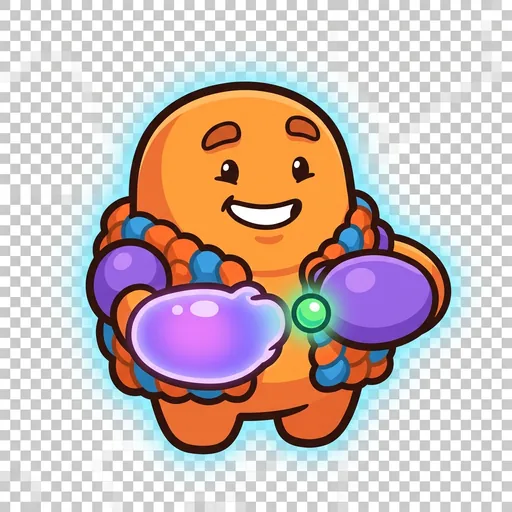
Tugger
Ionic bond — forceful, decisive; full electron transfer; opposites attract
-

Sharer
Covalent bond — cooperative, balanced; equal partnership
-

Streamer
Metallic bond — flowing, communal; delocalized electron sea
-
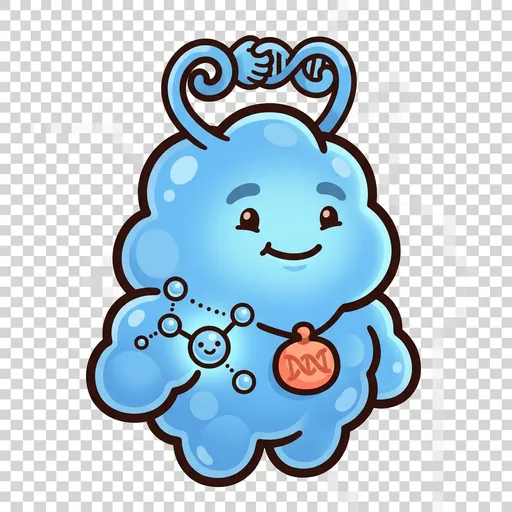
Whisperer
Hydrogen bond — subtle, persistent; water's superpower; DNA pairing