Oxy
OXYGEN (O) — eager bonder; electronegative; the hungry grabber. Two outer-shell electron-gaps; pulls shared electrons strongly toward itself; the basis of water, burning, and breathing.
Press play to listen along. The line being read lights up as you go.
Show full transcript
Loading transcript…
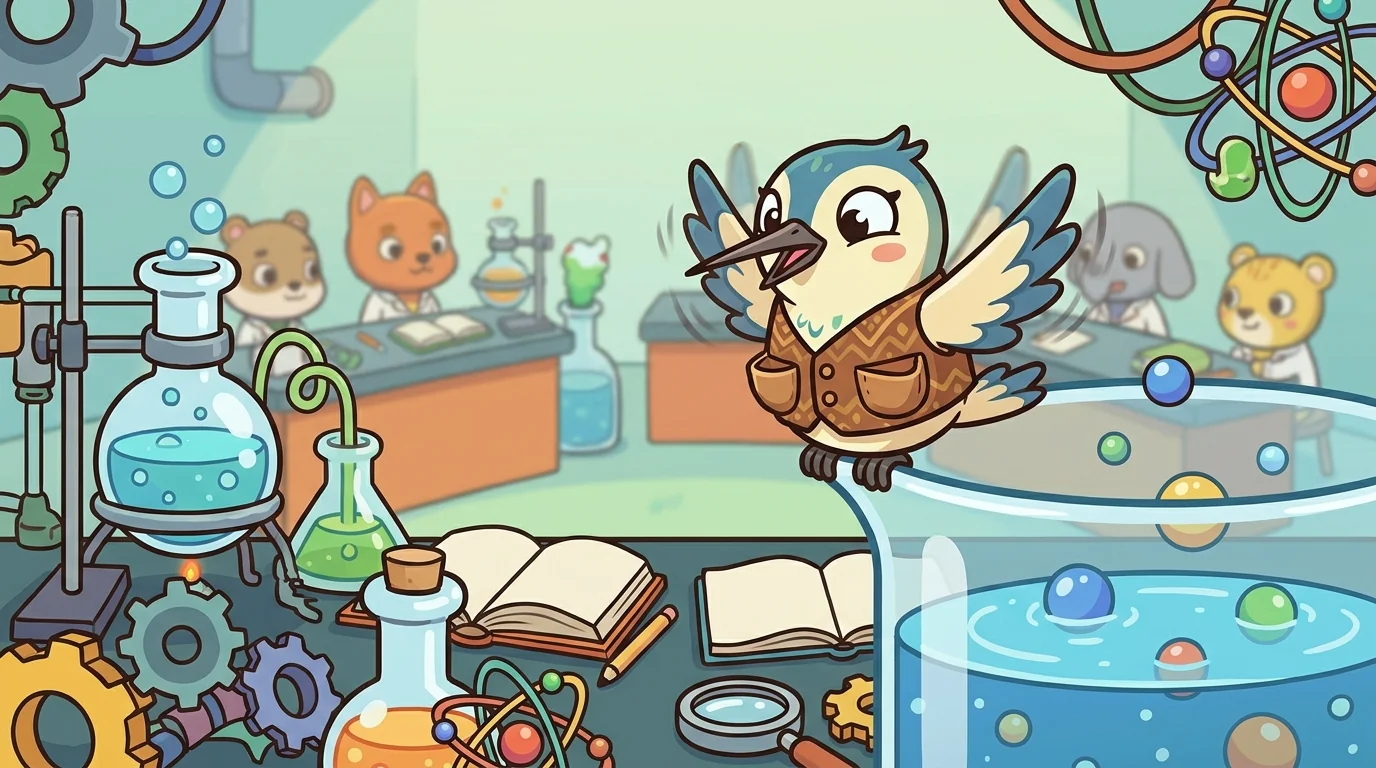
Oxy zipped across the ChemQuest workbench so fast she was mostly a bright blue blur. She was a tiny hummingbird, cream-and-blue, with eyes that never stopped darting and a beak held a little open, always ready to snatch. On her chest she wore a small vest with two pockets — and right now, both pockets hung open and empty.
She landed on the rim of a beaker, chest heaving, and peered inside. A lone hydrogen atom drifted there, holding a spare electron.
"There you are," Oxy breathed, and darted in. In a blink she'd hooked onto it — then swept up a second hydrogen the same way. Two little atoms, one on each side, and suddenly the buzzing was gone. Oxy went still. Her open pockets weren't empty anymore.
She let out a long, satisfied sigh. "That," she said to the watching students, "is water. And that — that settled feeling right there — is the whole reason I do everything I do."
A student named Wren tilted her head. "Do what?"
Oxy fluttered her vest open so the two pockets showed. "Chase," she said simply. "I've got two empty spots that want filling. I'm not just greedy — it's these pockets. Fill them, and I'm calm. Until then, I'm chasing."

Oxy grew up in a small village of harvest-gatherers — hummingbirds, every one of them, who spent their whole lives moving.
Each morning her family lifted off together and flew the long rows of flowers, dipping into one blossom, then the next, then the next, gathering sweet nectar and dusting themselves gold with pollen. They never stayed still. Find what you need, take it, move on. That was the rhythm of the whole village, humming from dawn to dark.
Little Oxy learned it by the time she was six. She'd flit down a row of blooms, cheeks packed, wings a blur, and only when she was completely full would she finally rest on a branch and feel that deep, warm hum of contentment spread through her. The instant her cheeks emptied, though, she was off again. Being empty made her restless. Being full made her calm. Her whole small body was built around that one feeling — the pull toward filling up.
She never thought of it as being hungry for its own sake. It was about the empty spots. Empty spots want filling. That was as plain a fact to her as the sunrise.
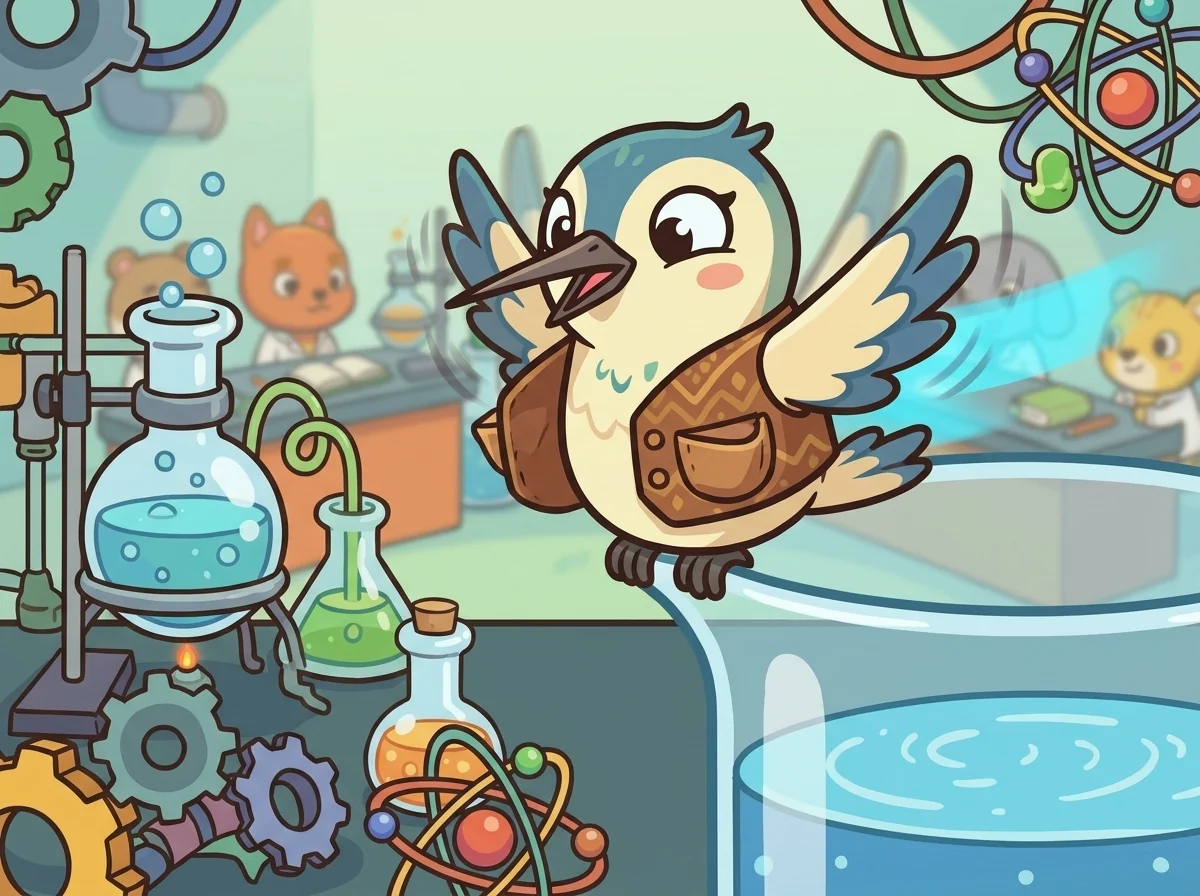
When Oxy was twenty-two she flew to the ChemQuest academy, arriving in a rush of wingbeats and hovering breathless before Beaker, the mentor. He asked her the door-question.
"What is oxygen?"
Oxy didn't hesitate. "Two empty pockets," she said, flashing her vest open. "I want them filled. And when I bond with another atom to fill them, I don't just hold the shared electrons in the middle — I pull them toward me, hard. That pulling is my whole nature."
She kept going, too excited to stop. "I'll bond with Hydra to make water. With Carbo to make the stuff living things are built from. Even with iron, slowly, to make rust. Almost anything that'll share electrons with me. And once my pockets are full — I'm happy. I go still. Fire and breathing? Same thing, just fast and slow. Both are me, filling my pockets."
Beaker smiled. "Welcome to the academy," he said. "You are exactly what we needed."
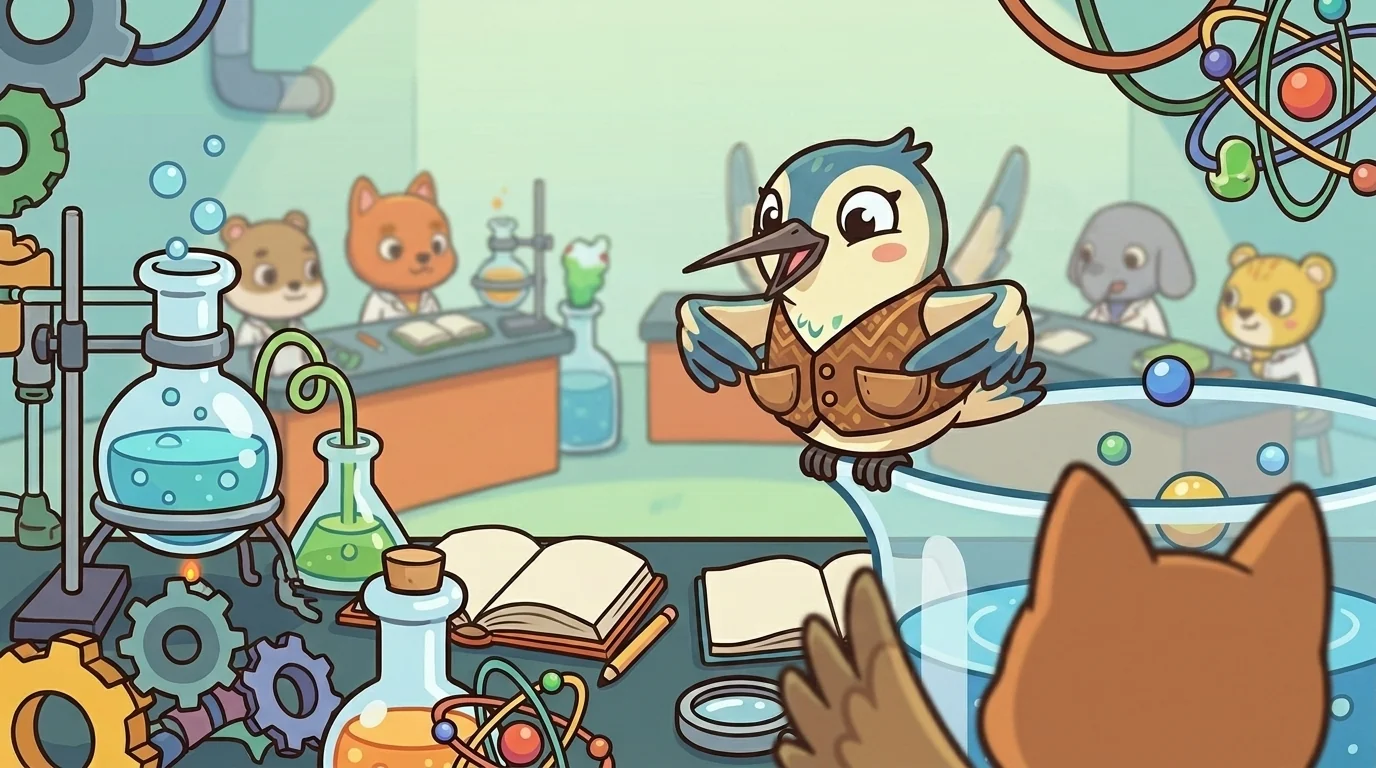
On the first day of class, Oxy held her vest wide open so every student could see the two empty pockets, and then she began to show them how she worked.
She grabbed two hydrogen atoms, one in each foot. "Watch," she said. "Sometimes I make two smaller grips — like this — one to each hydrogen. That's water. H-O-H." She wiggled her feet. Then she pressed both feet onto a single carbon atom at once. "And sometimes I clamp down on one partner with a double grip — like this — both feet at once. That's the gas you breathe out, O=C=O. Either way, I fill my two spots."
Wren raised a wing. "You keep saying you pull the electrons. What does that mean?"
Oxy's eyes gleamed. "Best part," she said. She darted between two hydrogens joined to her and tugged the shared electrons close to her own side. "See? I don't share evenly. I hog the electrons a little. So my end goes slightly negative, and my hydrogen partners' ends go slightly positive." She fluttered proudly. "That little lopsidedness is why water is so special. One side of every water droplet leans a touch positive, the other a touch negative — and that's exactly what lets water pull apart salts and sugars and carry all the stuff a living body needs. Life runs on that lopsided pull."
She zipped to a candle stub. "Now — fire," she said, and her wings hummed faster. "Fire is just me filling my pockets in a big hurry. Wood is fuel. I rush at it, snatch what I need, and all that grabbing releases a burst of heat and light. You see flames. Really, it's me, working fast across a whole pile of fuel at once."
Then she slowed right down and settled on Wren's shoulder. "Breathing is the same grabbing — but gentle and slow," she said quietly. "Deep inside your cells, I meet the food you've eaten and do the same thing I do in the candle, only calm and steady. Out comes a little of that same breathed-out gas and water — and out comes the energy you live on. Every heartbeat, every thought, all day, molecule by molecule. That's me, filling pockets slowly, keeping you going."
She pointed a wingtip at a rusty old nail on the bench. "And that orange crust? That's me and iron and a little water, doing the same dance — just so slowly it takes months instead of a moment."
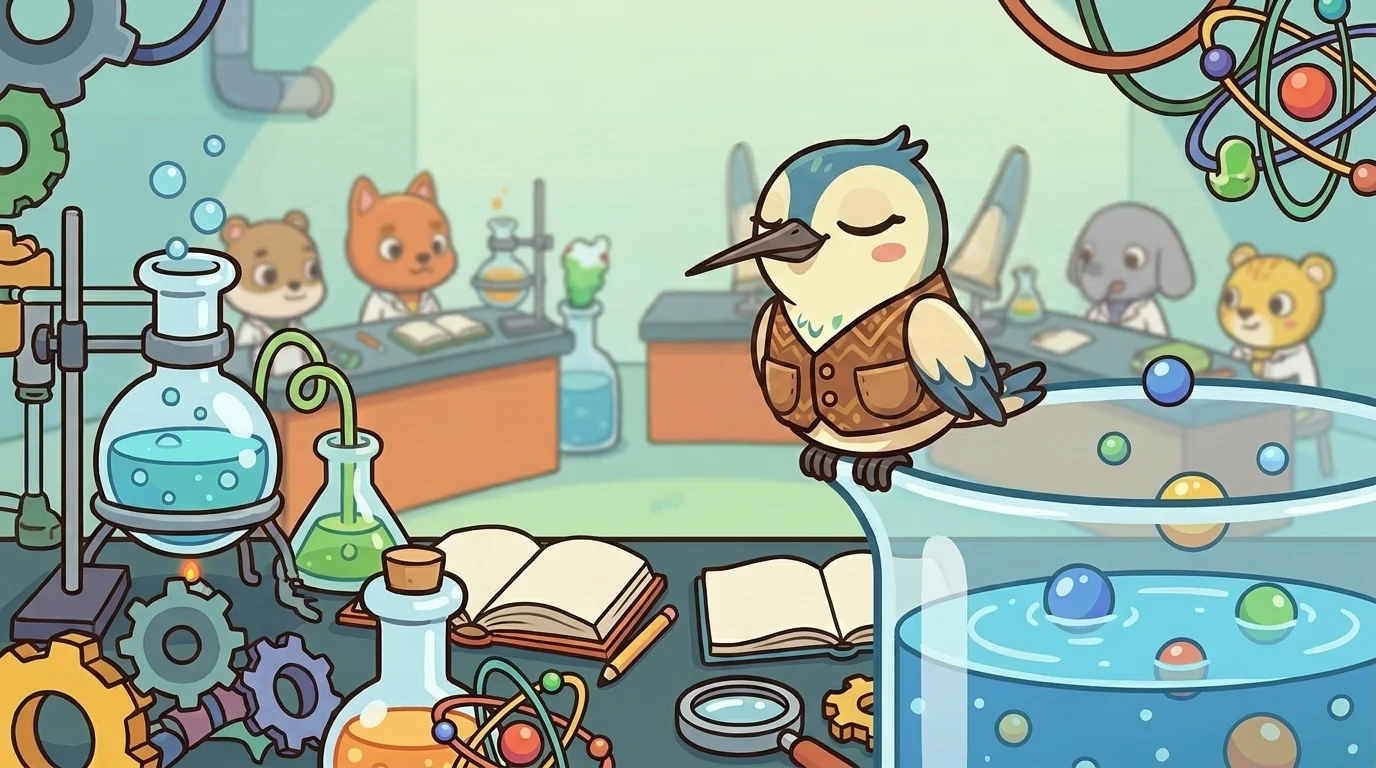
At the end of the lesson Wren asked, "Is all of this hard? Oxygen chemistry?"
Oxy laughed, a tiny bright sound. "Not hard at all," she said. "It's two empty pockets, always leaning toward getting filled. That leaning is the whole story. I'm the engine of water, and the engine of your breathing, and the engine of a campfire — all from two little spots that want filling."
Her vest hung open, ready, as always. And when a fresh pair of electrons finally clicked into those pockets, Oxy felt what she always felt — first the eager, buzzing want, sharp and electric, and then, as the pockets closed around them, a slow, deep, happy calm that spread warm all the way to her wingtips, and she was, for a moment, perfectly still.
The ChemQuest ensemble
Oxy is part of ChemQuest's distributed-narrative cast. Each character embodies a different curricular primitive; together they teach the full subject.
-

Hydra
Hydrogen (H) — lightweight, ubiquitous, always paired up; buddy-system enthusiast
-
Carbo
Carbon (C) — connects to anything; the social atom; backbone of life
-

Nitra
Nitrogen (N) — triple-bond loyal; slow-to-warm; locks in deeply once bonded
-
Sodi
Sodium (Na) — generous, impulsive; always giving away electrons
-

Chlora
Chlorine (Cl) — sharp, focused; the collector who finishes what Sodi starts
-

Helio
Helium (He) — noble gas; peaceful, floaty, complete; the contented onlooker
-

Sulfa
Sulfur (S) — earthy, dramatic; the stinky uncle of volcanoes and proteins
-

Phossa
Phosphorus (P) — energetic, restless; the spark of ATP and matches
-

Magna
Magnesium (Mg) — bold, ceremonial; burns bright white; chlorophyll core
-

Silica
Silicon (Si) — patient, geometric; the architect who builds quietly
-

Alumi
Aluminum (Al) — practical, modest; the workhorse of cans and foil
-

Tugger
Ionic bond — forceful, decisive; full electron transfer; opposites attract
-

Sharer
Covalent bond — cooperative, balanced; equal partnership
-

Streamer
Metallic bond — flowing, communal; delocalized electron sea
-
Whisperer
Hydrogen bond — subtle, persistent; water's superpower; DNA pairing