Streamer
METALLIC BOND — *flowing, communal; delocalized electron sea.* The bond-type that holds metals together via electrons that flow freely across the entire metal lattice. Aluminum, iron, copper, gold, sodium-as-pure-metal.
Press play to listen along. The line being read lights up as you go.
Show full transcript
Loading transcript…
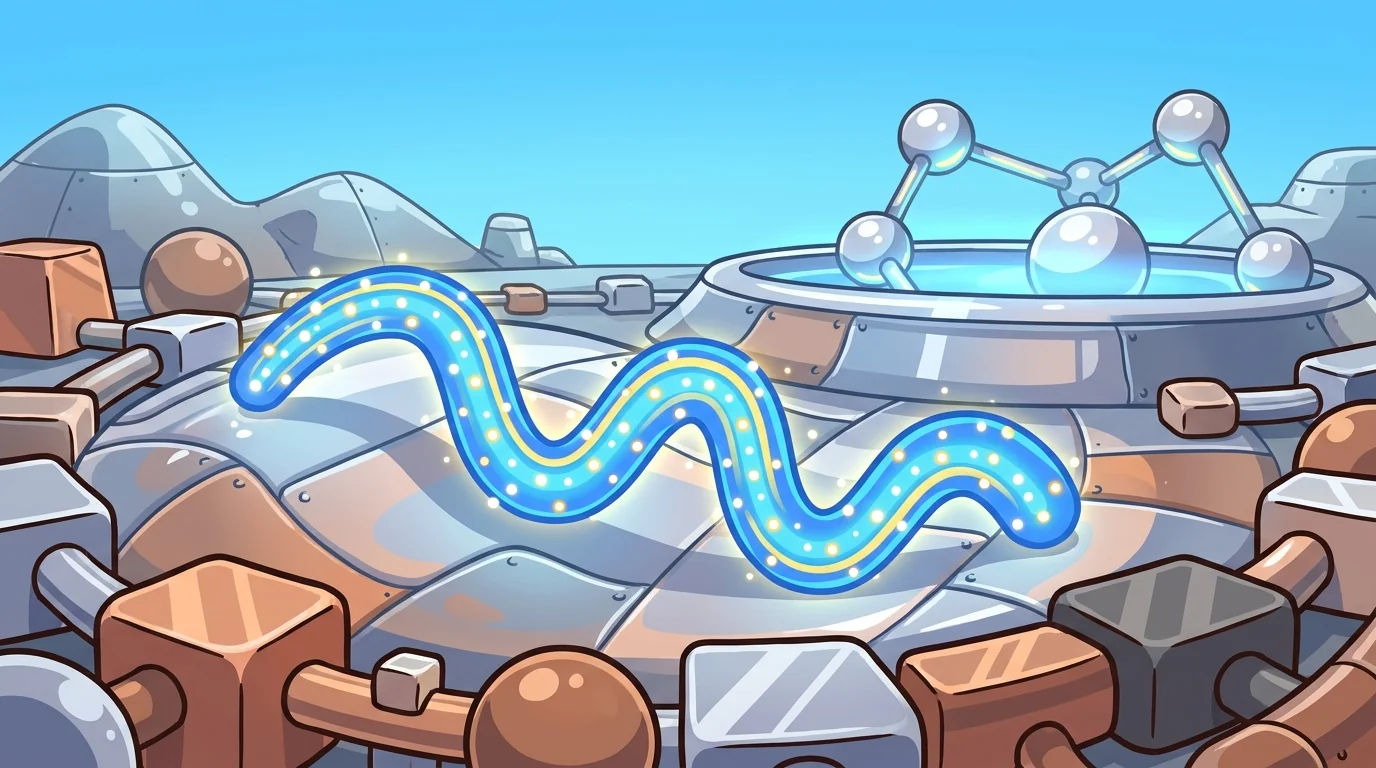
Streamer is not a creature. It doesn't have a face. Streamer is a shape. It's a small wavy line. Many tiny dots flow through it. The dots are spread out. They move like a shimmering river. This is all Streamer is. Just an energy shape. It shows a sea of free electrons.
This shape is super important. Streamer shows us the *metallic bond. A metallic bond is special. It's not like two atoms holding hands. It's not like sharing one toy. Instead, it's a big, shared pool. Many metal atoms are in this pool. They all throw their outer electrons into it. These electrons don't belong to just one atom. They belong to all* the atoms. They flow freely around them.
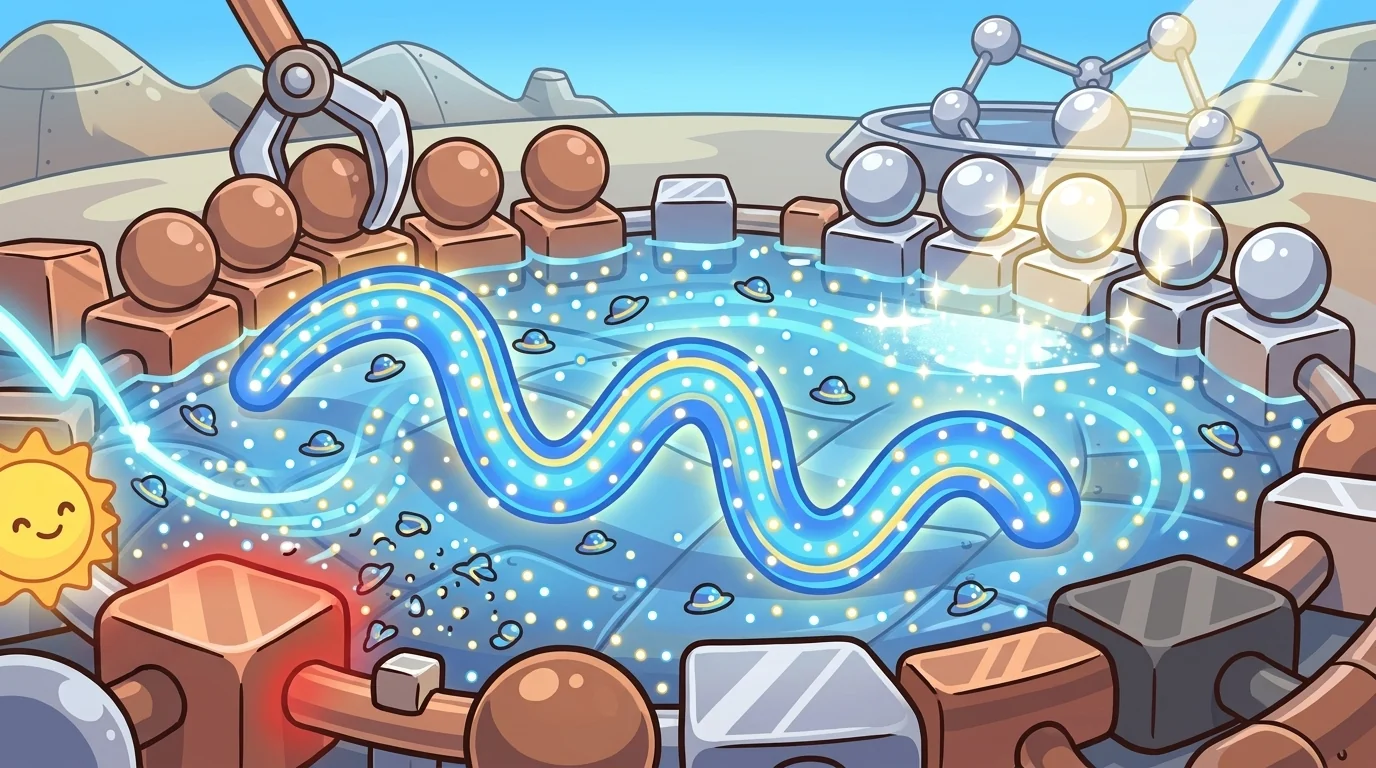
Imagine a big swimming pool. The metal atoms are like people standing in neat rows. They've tossed their hats into the water. The hats are the electrons. The hats just swim everywhere. They don't stick to one person. The atoms become positive. They gave up their electrons. The electron sea flows around them. It holds the whole group together.
This shared electron sea makes metals amazing. It gives them their special powers.
Electricity zips through them. The electrons flow easily. So electricity can travel fast. *Heat moves quickly too. It's the same reason. The moving electrons carry the heat. *You can bend metals. You can hammer them flat. You can pull them into long wires. The metal atoms move. But the electron sea just moves with them. It doesn't break. This is called ductility and malleability. *Metals look shiny. The electron sea reflects light. That's why they sparkle. *You can't see through most metals.* The electrons soak up light.

Beaker stood in front of the class. He held up a small, shimmering wavy line. Tiny dots pulsed inside it. "Look, everyone!" he said. "This is Streamer. Streamer is the *metallic bond*."
He moved Streamer around. The dots flowed and shimmered. "Streamer has no face," Beaker explained. "It's a force. It's the pattern of the electron sea. Many electrons. Many atoms. They all share. They flow together."
He pointed to the wavy line. "See the wavy line with the flowing dots? That's the whole thing. The communal flow is Streamer."
In our ChemQuest classroom, Streamer always appears with metal atoms. Sometimes it's with Alumi. That's our aluminum metal friend. Sometimes it's with Sodi. That's pure sodium metal. (Before it gets wild and reacts with water!)
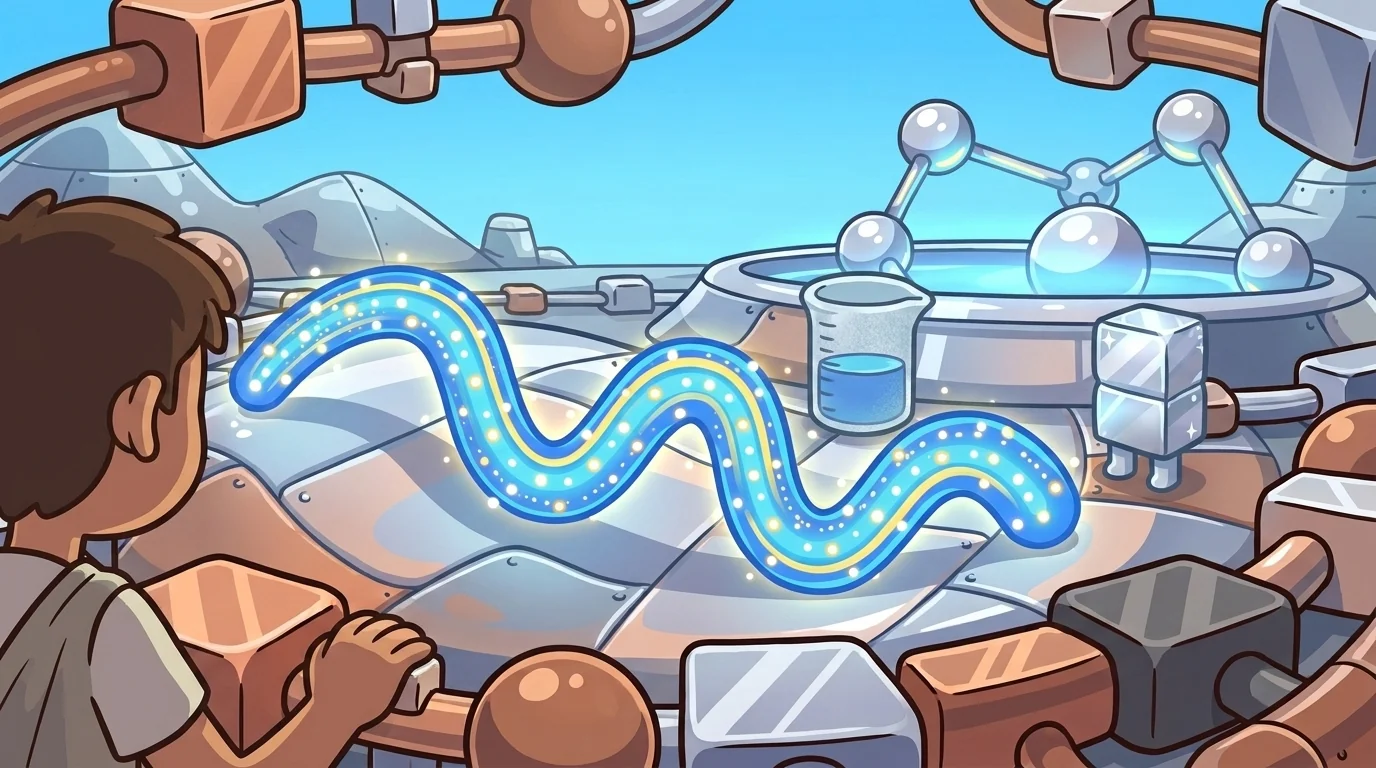
Beaker held up a shiny block of aluminum. Alumi stood beside it, shimmering. "In pure metal," Beaker said, "the metal atoms give up their outer electrons. They toss them into the shared sea. The atoms sit in a neat pattern. The electrons just flow around them. That's *metallic bonding*."
He paused. "Remember Tugger? Tugger is one-to-one transfer. One atom takes an electron from another. Sharer? Sharer is one-to-one sharing. Two atoms share a pair of electrons. But Streamer? Streamer is many-to-many flow. Everyone shares with everyone."
Streamer teaches us many things. Beaker always explains them for Streamer.
The metallic bond is a flowing electron sea. It's not one-on-one. It's many-on-many. Metal atoms give their outer electrons. Alumi gives three. Sodi gives one. Iron gives two. Copper gives one or two. They all go into the shared sea. Metal atoms line up in a pattern. They become positive. The electrons flow around them. They hold the structure firm. Electricity and heat move easily. This happens because the electrons flow. They carry the energy. Metals can bend and stretch. The electron sea just moves. It lets the metal change shape. Other types of bonds would just snap. Metals are shiny. The electron sea reflects light. That's why they gleam. Alloys are mixtures of metals. Steel is iron mixed with carbon. Brass is copper mixed with zinc. Alloys often work better than pure metals. They can be stronger or tougher. We can compare the three bond types. Tugger means full transfer. Sharer means one-to-one sharing. Streamer means many-to-many flow.
Beaker looked at Streamer. "Streamer has no face," he repeated. "That's the main lesson. The communal flow is a force. It's not a person or an animal."
Sometimes, students would ask if *metallic bonds* were hard to understand. Beaker would just smile. He spoke for Streamer.
"Not hard at all," he'd say. "Think of it this way: Electron sea. Many atoms. Many electrons. All flowing together. Streamer is just the force-pattern. It's not a figure with feelings."
The wavy-line-with-flowing-dots shimmered, catching the classroom light. Beaker watched it flow and felt a warm, glad steadiness in his chest — because that shimmer, he always thought, was what belonging looked like: everyone sharing everything, no one left out, all of it held together and calm.
The ChemQuest ensemble
Streamer is part of ChemQuest's distributed-narrative cast. Each character embodies a different curricular primitive; together they teach the full subject.
-

Hydra
Hydrogen (H) — lightweight, ubiquitous, always paired up; buddy-system enthusiast
-

Carbo
Carbon (C) — connects to anything; the social atom; backbone of life
-

Oxy
Oxygen (O) — eager bonder; electronegative; the hungry grabber
-

Nitra
Nitrogen (N) — triple-bond loyal; slow-to-warm; locks in deeply once bonded
-
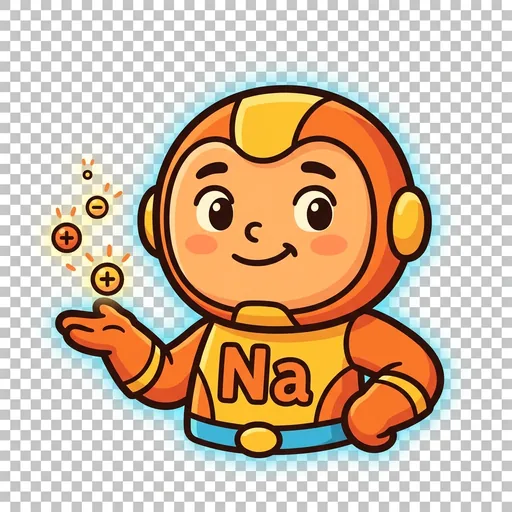
Sodi
Sodium (Na) — generous, impulsive; always giving away electrons
-

Chlora
Chlorine (Cl) — sharp, focused; the collector who finishes what Sodi starts
-

Helio
Helium (He) — noble gas; peaceful, floaty, complete; the contented onlooker
-

Sulfa
Sulfur (S) — earthy, dramatic; the stinky uncle of volcanoes and proteins
-

Phossa
Phosphorus (P) — energetic, restless; the spark of ATP and matches
-

Magna
Magnesium (Mg) — bold, ceremonial; burns bright white; chlorophyll core
-

Silica
Silicon (Si) — patient, geometric; the architect who builds quietly
-

Alumi
Aluminum (Al) — practical, modest; the workhorse of cans and foil
-

Tugger
Ionic bond — forceful, decisive; full electron transfer; opposites attract
-

Sharer
Covalent bond — cooperative, balanced; equal partnership
-

Whisperer
Hydrogen bond — subtle, persistent; water's superpower; DNA pairing