
Streamer
METALLIC BOND — *flowing, communal; delocalized electron sea.* The bond-type that holds metals together via electrons that flow freely across the entire metal lattice. Aluminum, iron, copper, gold, sodium-as-pure-metal.
Press play to listen along. The line being read lights up as you go.
Show full transcript
Loading transcript…
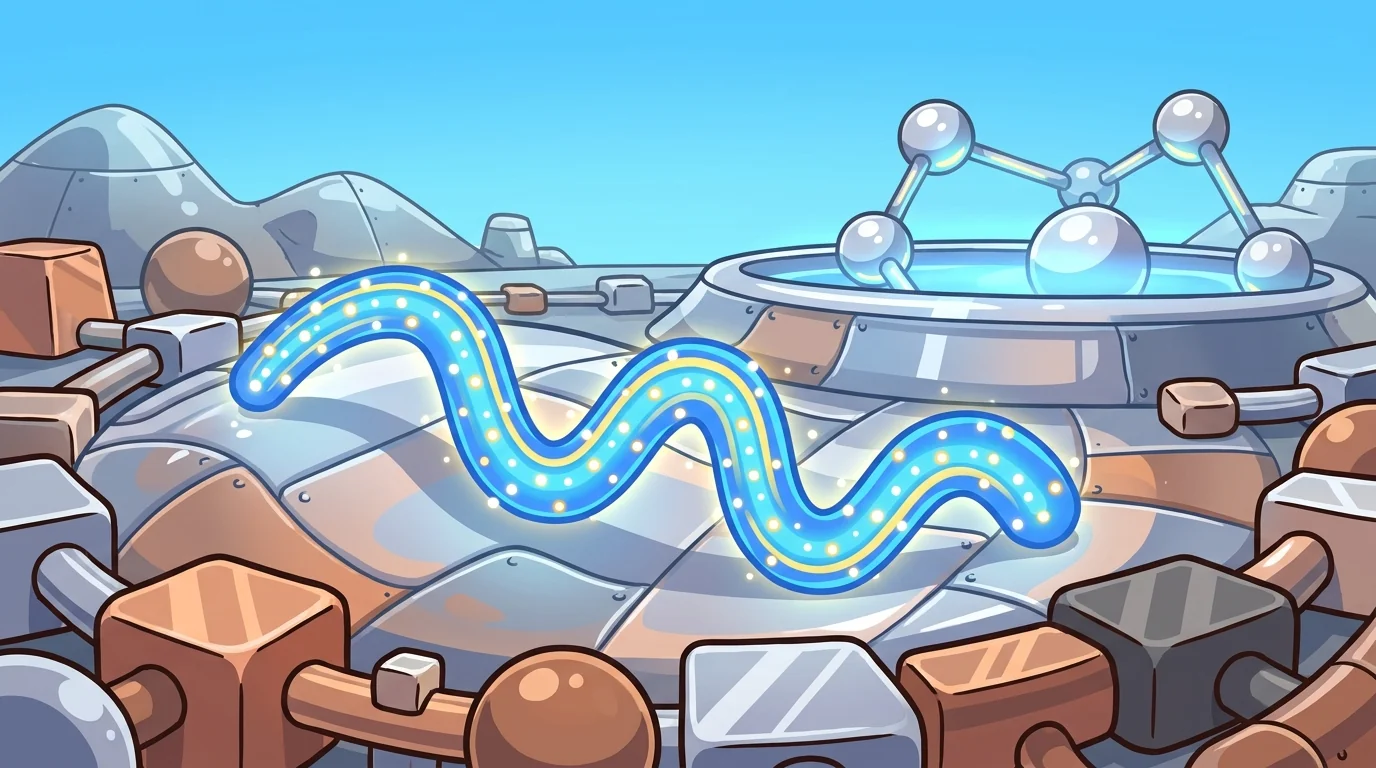
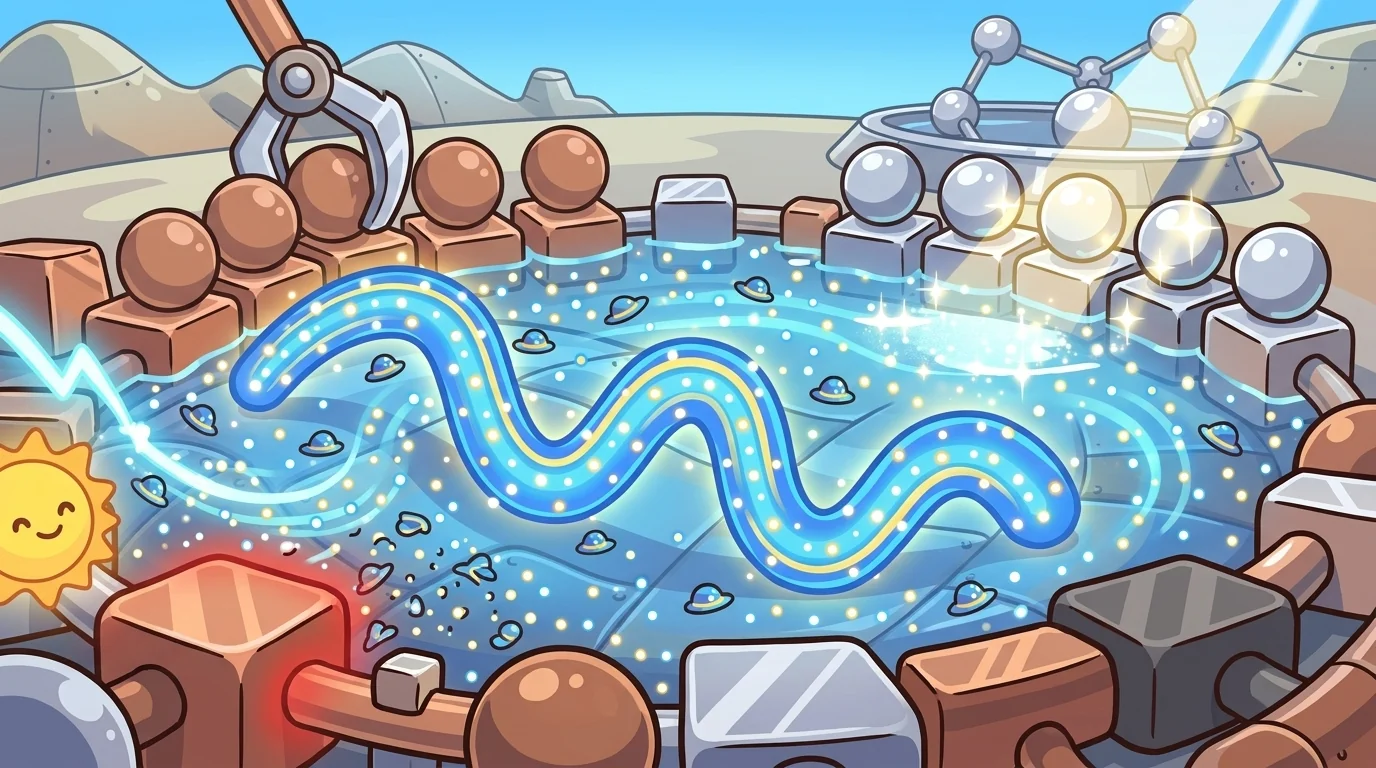
A shimmer, a flicker, a constant hum. That was *Streamer. Streamer was not an animal-tween. Streamer was not a faced figure. Instead, Streamer was a deliberately abstract concrete-energy-shape. It appeared as a small wavy-line shape with many small dots flowing through it. The dots were evenly distributed and visibly moved, like a sea of free electrons. That was the whole figure. No face. Just the energy-shape of the delocalized electron sea*.
Beaker stood at the front of the ChemQuest lab, a piece of shiny aluminum foil held high. "Today," he announced, his voice echoing slightly, "we meet Streamer." He gestured to the shimmering form that now pulsed gently beside the foil. "Streamer embodies the *metallic bond* primitive."
A student named Maya raised her hand. "It doesn't have a face, Professor Beaker."
"Exactly, Maya," Beaker said, nodding. "That's essential. Streamer has no face because it isn't about one atom, or even two. It's about a whole community." He smoothed the foil. "Think of metals, like this aluminum. What holds it together?"
He paused, letting the question hang. "It's not a one-to-one connection between two atoms, like you see with Tugger or Sharer. Metallic bonding is different. It's the entire metal-lattice held together by a 'sea' of freely-flowing electrons." He pointed at Streamer, the dots swirling faster now. "These electrons belong to the whole lattice, not to any specific atom."
Another student, Leo, squinted at Streamer. "So, like, a shared pool?"

"Precisely, Leo! A communal pool," Beaker affirmed. "Each metal atom contributes its outer-shell electron or electrons to this shared sea. Imagine the metal atoms themselves sitting in a regular 3D lattice—a perfectly ordered, repeating pattern, like bricks in a wall. But these aren't just neutral atoms anymore. They've given up their outer electrons, so they become positively charged ions."
He held up a diagram showing a grid of plus signs surrounded by a cloud of minuses. "The electron sea flows around and between them, holding the whole structure together. It's like glue, but a very active, flowing kind of glue."
This communal electron-sea is what gives metals their typical properties. Beaker picked up a thin copper wire. "Watch this." He connected the wire to a small battery and a tiny light bulb. The bulb immediately glowed. "This is electrical conductivity. Electrons flow freely through the metal, carrying the electricity easily. Streamer's dots are always moving, right? That's what's happening inside the wire."
Next, he held one end of a metal spoon in a beaker of hot water. After a moment, he carefully touched the other end. "Warm, see? That's thermal conductivity. Heat travels through the metal the same way electricity does—via the motion of those free electrons."
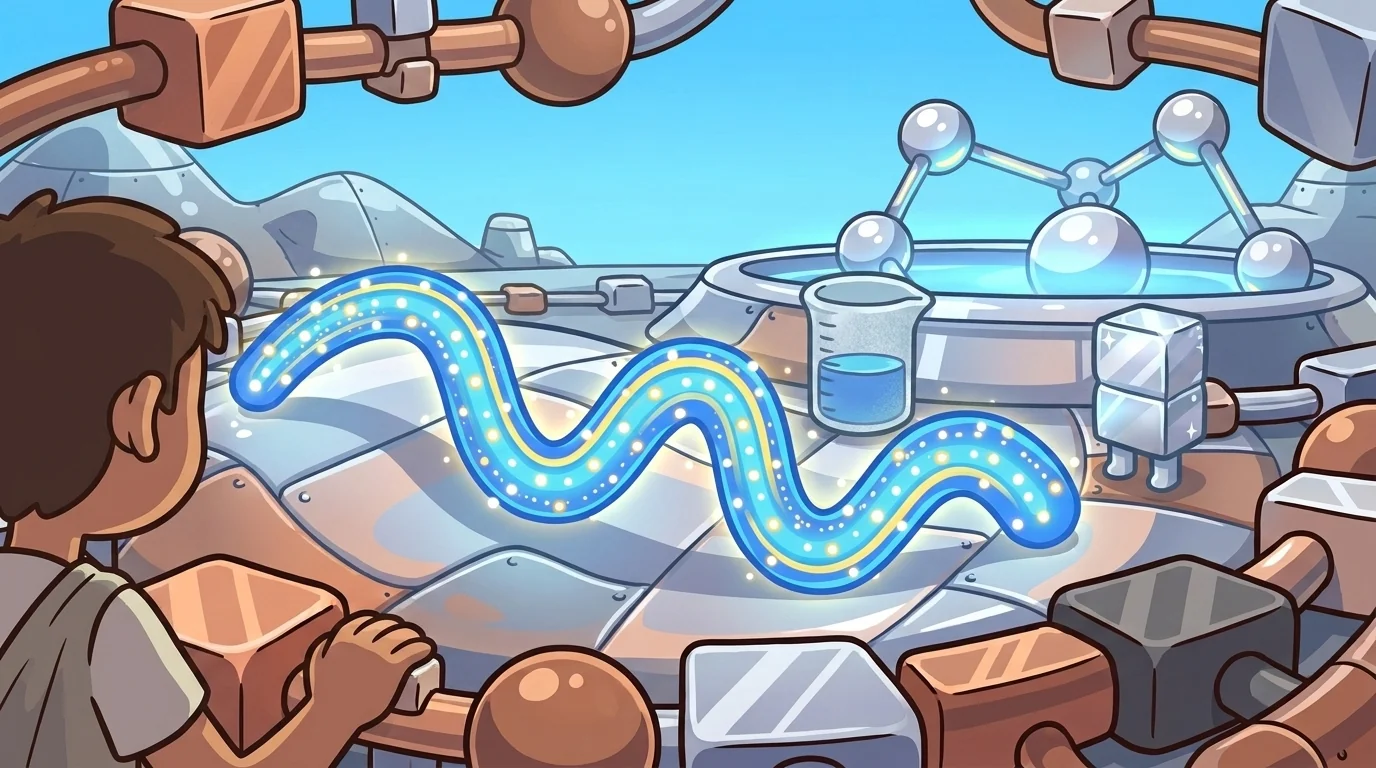
He then took the aluminum foil and carefully bent it, then flattened it again. "Metals can be shaped. They're ductile, meaning you can pull them into wires, and malleable, meaning you can hammer them into thin sheets. If you tried to do this with a salt crystal, it would shatter." He looked at Streamer. "The electron sea reorganizes around the new lattice shape. The bonds don't break; they just move with the metal."
Maya piped up again. "And they're shiny!"
"Excellent observation, Maya!" Beaker beamed. "That's metallic luster. The electron sea reflects light, which is why metals look shiny. Most metals are also opaque—you can't see through them—because the electron sea absorbs most light frequencies."
Beaker paused, letting the students absorb the information. "Remember, Streamer is the metallic bond. Streamer has no face. Streamer is the force-pattern of the electron sea — many electrons belonging to many atoms simultaneously, flowing as a communal pool. Look at the wavy-line-with-flowing-dots. That's the whole figure. The communal flow IS the figure."
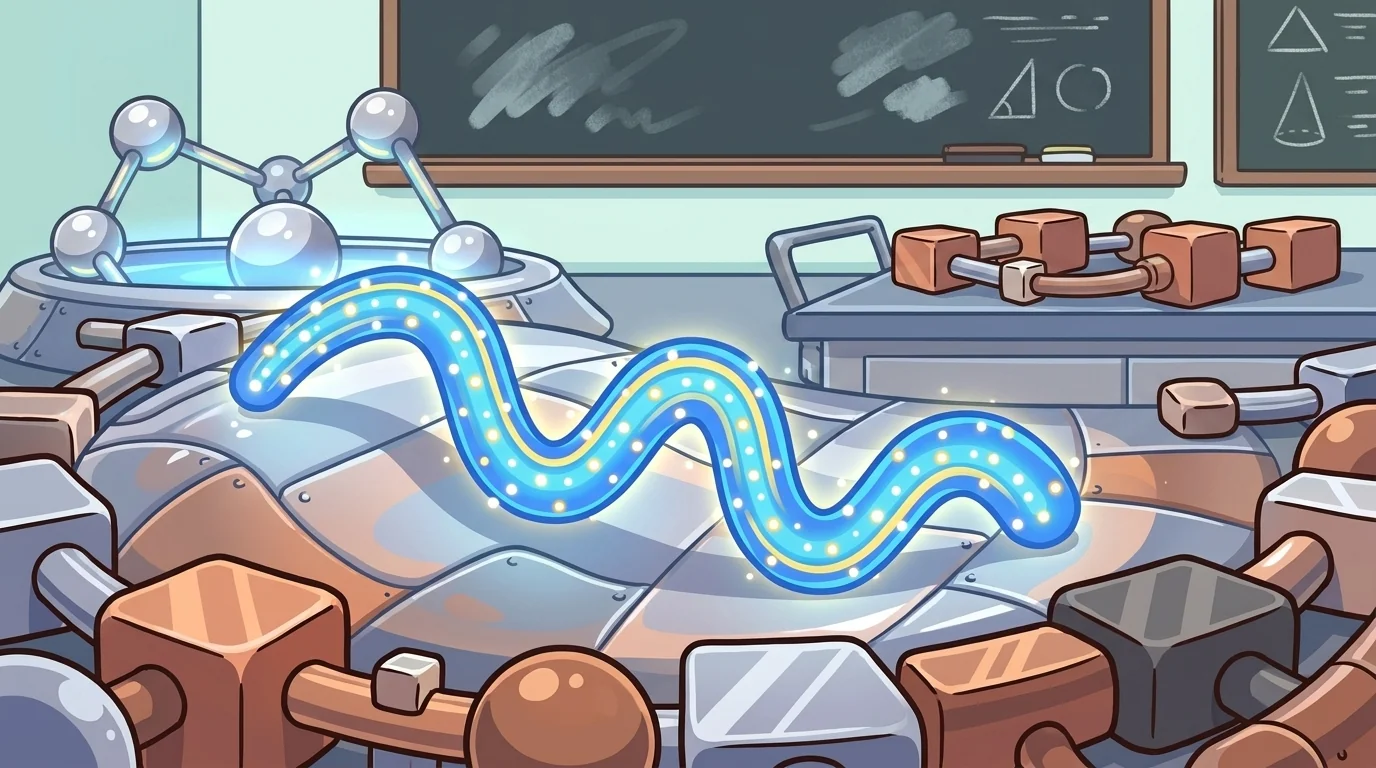
He continued, "In pure metal, like our aluminum here, the metal atoms give up their outer electrons to the shared sea. The atoms sit in a lattice. The electrons flow. That's metallic bonding." He held up three fingers. "Tugger is one-to-one transfer. Sharer is one-to-one share. Streamer is many-to-many flow."
The lessons Streamer taught, through Beaker's patient explanations, were clear: The metallic bond is a delocalized electron sea. It's not one-to-one, but many-to-many. Metal atoms contribute their outer electrons. Aluminum gives three; sodium gives one; iron gives two. All these go into the shared sea. The metal lattice is a regular 3D arrangement of positive ions. The atoms become positive, and the electrons flow around them. Electrical and thermal conductivity come from this electron flow. This is why metals conduct. Ductility and malleability come from the lattice's flexibility. You can hammer metal into thin sheets or pull it into wires because the electron sea reorganizes. Ionic compounds shatter instead because their bonds are fixed. Metallic luster comes from the electron-sea's interaction with light. Metals reflect most visible light, making them shiny. Alloys are simply mixed metal lattices. Steel, for example, is iron plus carbon and other elements in a metal lattice with a shared electron sea. Brass is copper and zinc. Alloys often have properties superior to pure metals. Finally, the three bond-types compared: Tugger (ionic, full-transfer), Sharer (covalent, one-to-one share), and Streamer (metallic, many-to-many flow).
When a student asked if metallic bonds were hard to understand, Beaker smiled. "Not hard at all. Electron sea. Many atoms, many electrons, communal flow. Streamer is the force-pattern, not a figure."
The wavy-line-with-flowing-dots caught the light from the lab window. The next metal waited to be built.
The ChemQuest ensemble
Streamer is part of ChemQuest's distributed-narrative cast. Each character embodies a different curricular primitive; together they teach the full subject.
-

Hydra
Hydrogen (H) — lightweight, ubiquitous, always paired up; buddy-system enthusiast
-

Carbo
Carbon (C) — connects to anything; the social atom; backbone of life
-

Oxy
Oxygen (O) — eager bonder; electronegative; the hungry grabber
-

Nitra
Nitrogen (N) — triple-bond loyal; slow-to-warm; locks in deeply once bonded
-
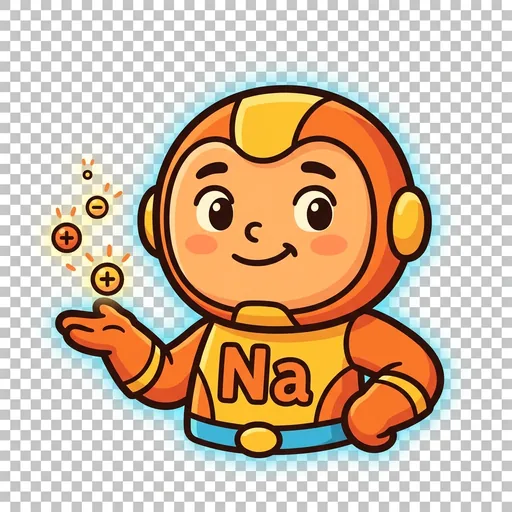
Sodi
Sodium (Na) — generous, impulsive; always giving away electrons
-

Chlora
Chlorine (Cl) — sharp, focused; the collector who finishes what Sodi starts
-

Helio
Helium (He) — noble gas; peaceful, floaty, complete; the contented onlooker
-

Sulfa
Sulfur (S) — earthy, dramatic; the stinky uncle of volcanoes and proteins
-

Phossa
Phosphorus (P) — energetic, restless; the spark of ATP and matches
-

Magna
Magnesium (Mg) — bold, ceremonial; burns bright white; chlorophyll core
-

Silica
Silicon (Si) — patient, geometric; the architect who builds quietly
-

Alumi
Aluminum (Al) — practical, modest; the workhorse of cans and foil
-

Tugger
Ionic bond — forceful, decisive; full electron transfer; opposites attract
-

Sharer
Covalent bond — cooperative, balanced; equal partnership
-

Whisperer
Hydrogen bond — subtle, persistent; water's superpower; DNA pairing