
Silica
SILICON (Si) — *patient, geometric; the architect who builds quietly.* Four outer-shell electrons (like carbon, one shell deeper); makes 4 bonds; builds silicate-mineral lattices + semiconductor electronics + glass.
Press play to listen along. The line being read lights up as you go.
Show full transcript
Loading transcript…
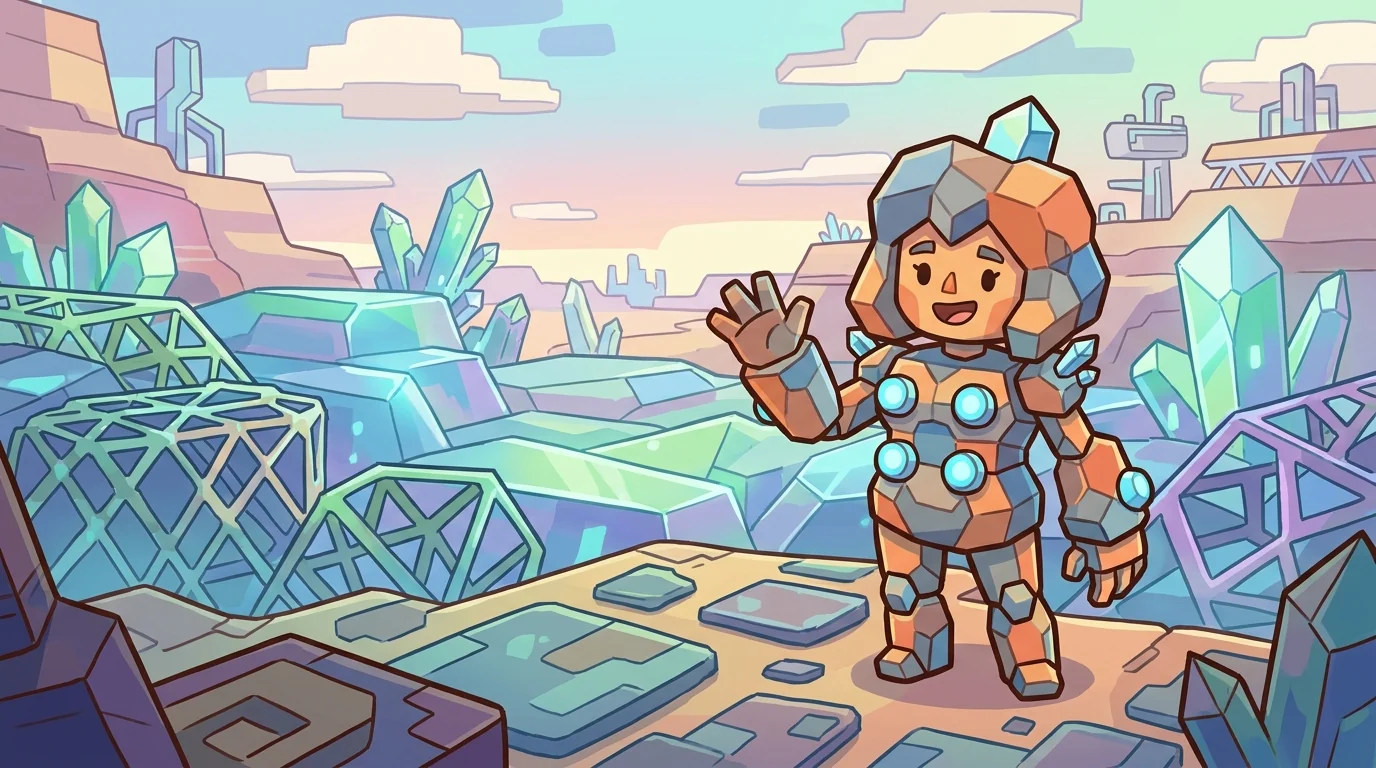
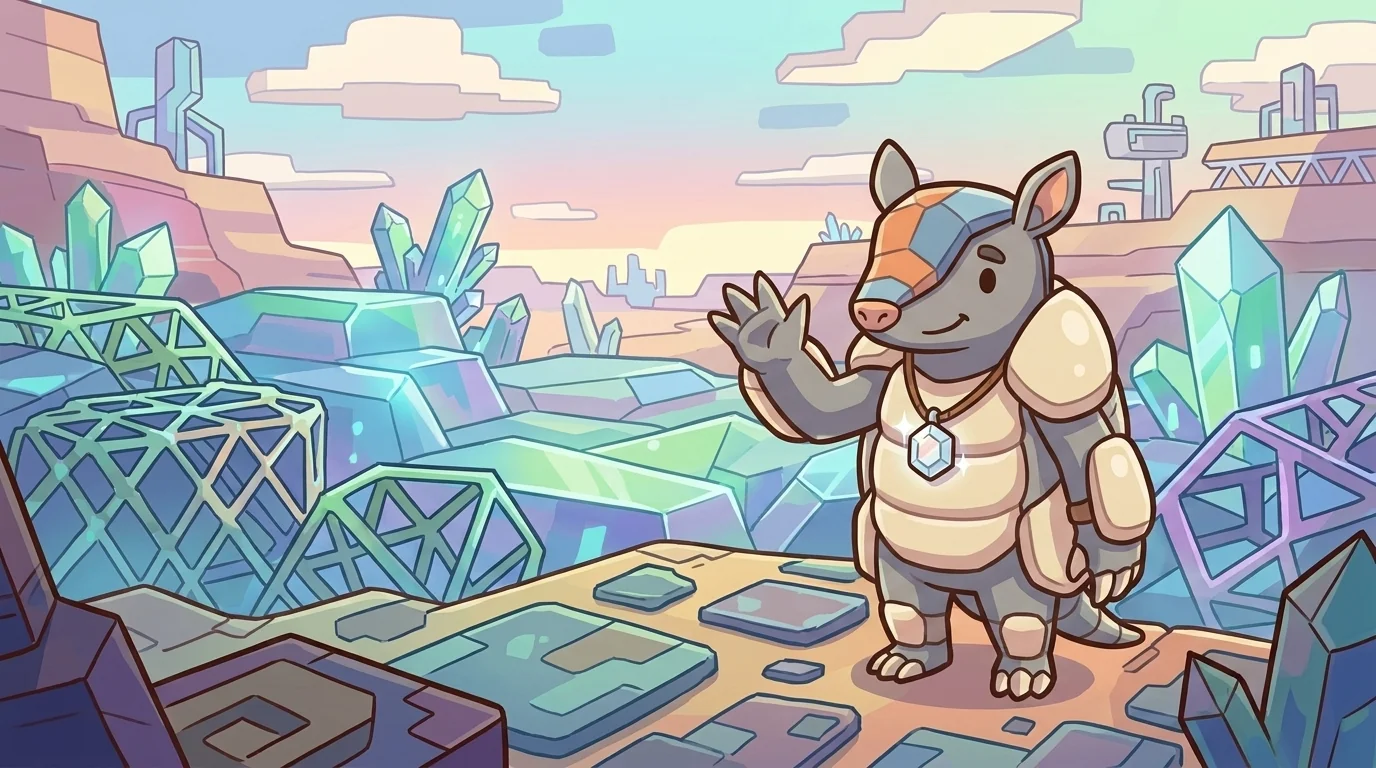
Silica was a small armadillo-tween. She wore a clear-quartz pendant on a leather cord. Her movements were calm and precise, almost geometric.
She wasn't very tall. Her armor was soft, a mix of gray and cream, like a friendly cartoon armadillo. Her plates were rounded, never sharp or spiky. Silica had patient eyes and hands that moved with purpose. She carried a quiet confidence. Her most noticeable feature was that small, clear-quartz pendant at her chest. It was a hexagonal crystal, polished and cut to catch the light. You could easily see its six-sided shape. This crystal was more than just jewelry; it was a symbol of her craft.
This was important. Silica embodied *silicon*, a fundamental building block. Silicon sits right below carbon on the periodic table. It's in the same column, just one layer deeper in its electron shells. Like carbon, silicon has four electrons in its outer shell. This means it can make four connections, or bonds. But there's a big difference. Carbon builds the flexible chains of life, like DNA and proteins. Silicon, on the other hand, builds rigid, stiff structures.
Silicon's favorite partner is oxygen. The bonds between silicon and oxygen are incredibly strong. Chains of Si-O-Si-O-Si link up in three dimensions. These connections form silicates, which are the most common rock-forming minerals on Earth's crust. Think of sand, quartz, granite, sandstone, and clay. All of them are silicates. If carbon is the backbone of life, then silicon is the backbone of Earth's crust.
Silicon also forms the basis of electronics. A pure silicon crystal can be carefully "doped" with tiny amounts of other elements. This process makes semiconductors. These semiconductors are the core of every computer chip, every solar cell, and every digital device you use. Factories grow pure silicon crystals to a very high standard. Then they slice them into thin wafers, where integrated circuits are etched.
Silica explained it clearly. "I build quietly," she'd say. "Where Carbo is social and makes the chains of life, I am geometric. I make the sturdy structures of stone and silicon chips. Four bonds, just like Carbo. But mine are rigid, three-dimensional structures, not flexible chains. Sand is me. Glass is me. Your phone is me. Most of Earth's crust is me. I am the quiet architect."

Silica grew up in a small village. Her family had always been the village stone-masons. They were the armadillos who quarried, shaped, and laid the stone. They built the village's houses, walls, and bridges. This work demanded patient, geometric attention. Each stone had to fit perfectly with its neighbors. The strength of the wall came from the exactness of its parts. By age six, Silica understood that quiet, geometric building was an essential craft. It wasn't flashy or dramatic, but it was vital.
She walked to the ChemQuest academy when she was twenty-two. Beaker, the head of the academy, had asked her, "What is silicon?"
Silica had answered without hesitation. "I sit below carbon. Four bonds, like Carbo, but I build rigid, three-dimensional structures instead of flexible chains. I connect mostly with oxygen. Sand, quartz, granite, glass, semiconductors. I am the quiet architect of Earth's crust and electronics."
Beaker had simply nodded. "You are appointed," he said.
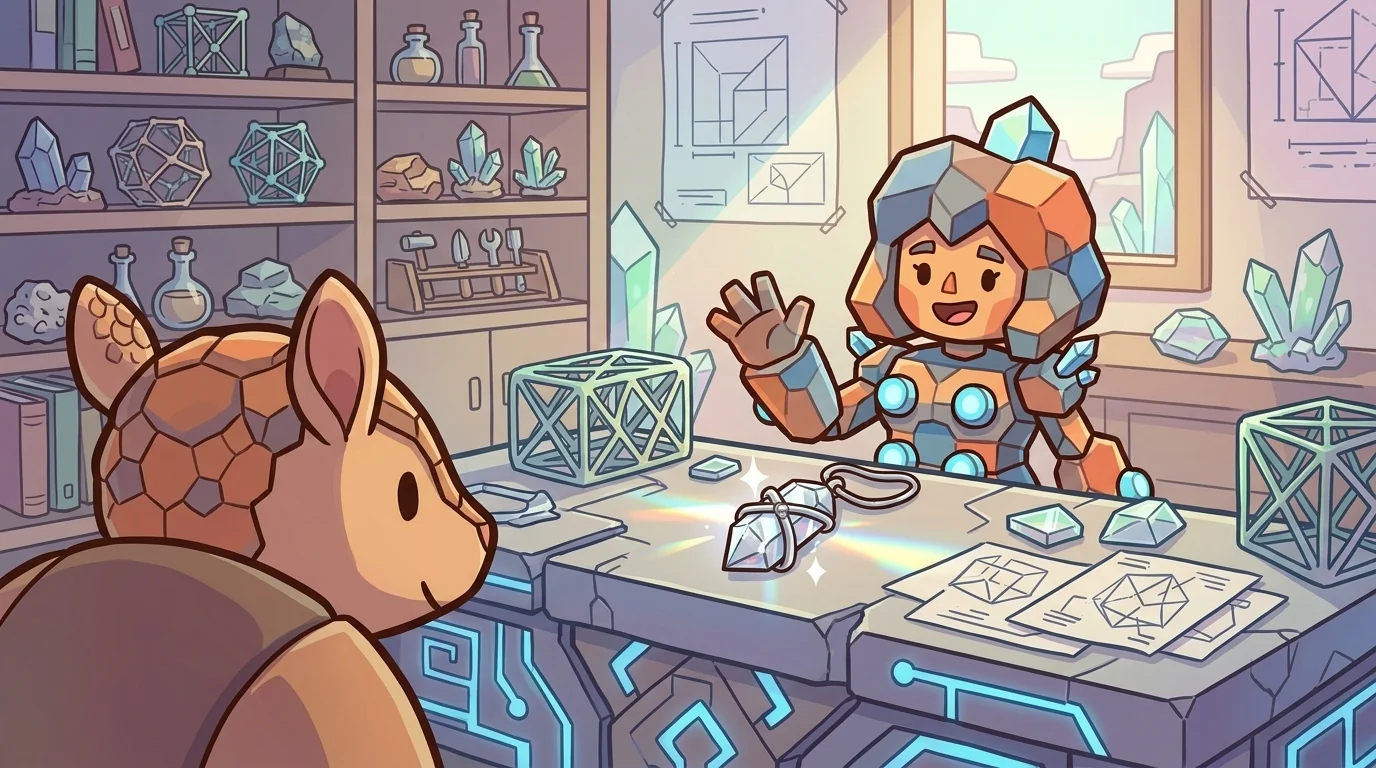
In her workshop, Silica started every first-day lesson the same way. She unclipped her quartz pendant. Then she placed it carefully on the workbench. The crystal caught the light, sparkling softly.
"I am Silica," she would say. "The chemistry primitive I teach is *silicon*—the quiet architect. The main idea is: four bonds, rigid three-dimensional structures, and Si-O-Si chains. I build sand, glass, stone, and silicon chips. I am both Earth's crust and electronics. Quiet, geometric."
She taught her students the silicon scaffolds, the basic rules:
Silicon makes four bonds, just like carbon. They are in the same column on the periodic table, one shell deeper. But silicon's bonds are stiffer. They prefer to form three-dimensional structures rather than long, bendy chains. *Silicon-oxygen bonds are especially strong. Silicon and oxygen connect very well. Silicates are the most common type of mineral found in Earth's crust. *Silicates form many different mineral structures. Quartz, for example, is a clear crystal of SiO₂. Mica forms thin, peelable sheets. Feldspar creates complex frameworks. Clay is made of tiny, fine-grained silicate sheets. The way these silicon-oxygen structures arrange themselves creates all these different minerals. *Sand is mostly quartz. Most of the sand you find on a beach or in a desert is just broken-down quartz. The strong silicon-oxygen bonds keep it from wearing away easily. *Glass is amorphous silica. If you heat sand to about 1700 degrees Celsius, its rigid structure melts. If you cool it down very quickly, it locks into a jumbled, disordered shape. That's glass. It has the same chemistry as quartz, but its internal structure is different. *Semiconductors are doped silicon crystals. Take a very pure silicon crystal. Add tiny amounts of other elements, like phosphorus or boron. This changes how it conducts electricity, creating semiconductor properties. These are the building blocks of integrated circuits, which power computers, phones, and every digital device. *Solar cells are silicon-based. Photovoltaic cells, which turn sunlight directly into electricity, use special silicon layers to do their work. *Silica's quiet, geometric nature is her atomic bonding behavior.* Her personality isn't just a random trait. It reflects how silicon atoms connect and build.
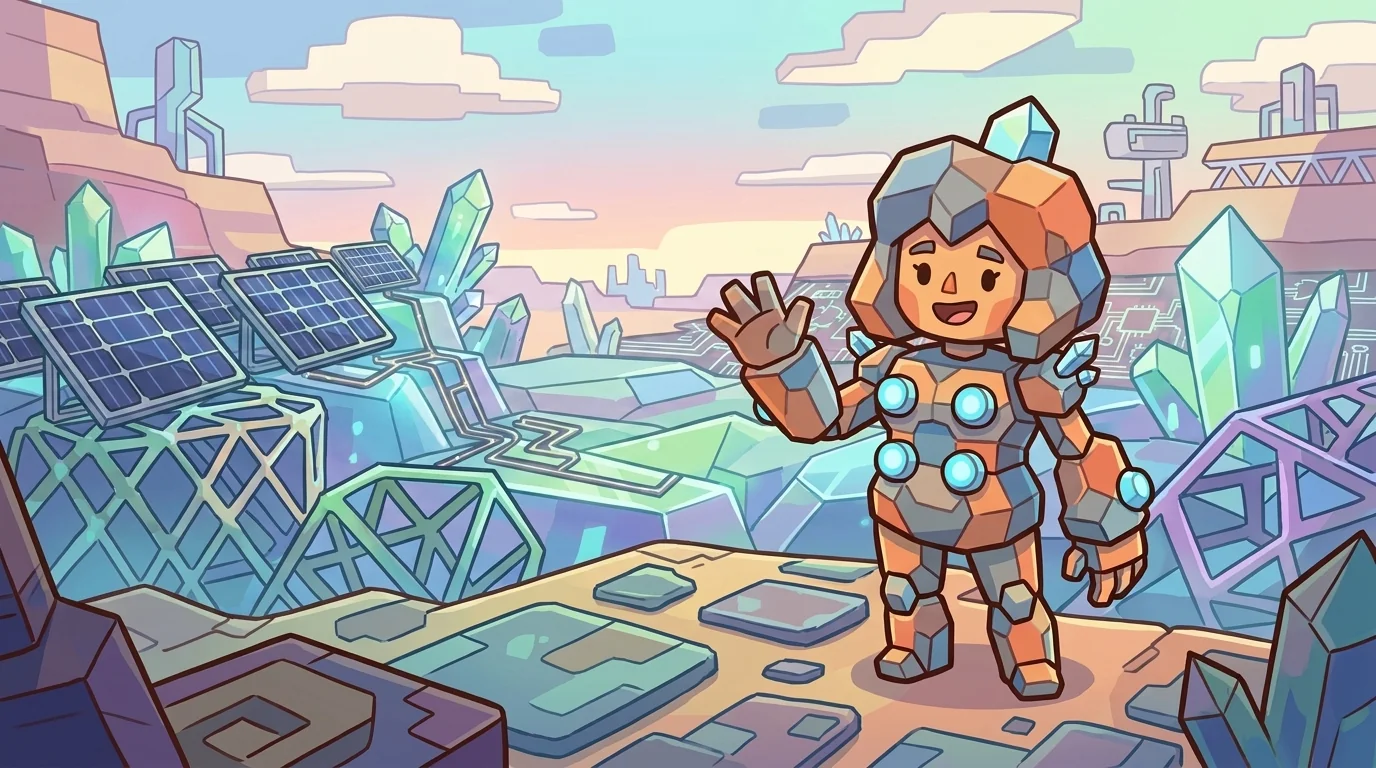
She made sure everyone understood. "I am everywhere geometric on Earth," she explained. "Stone, sand, glass, silicon chips. The quiet architect doesn't have a chemistry of life, like Carbo. But I have a chemistry of minerals and a chemistry of electronics. Both are mine. Both are quiet building."
When students asked Silica if silicon chemistry was hard, she always gave the same answer:
"It is not hard. It is four bonds, rigid three-dimensional structures, and a Si-O backbone. Quiet, geometric architect."
The quartz pendant caught the light once more. The next lattice waited to be built.
The ChemQuest ensemble
Silica is part of ChemQuest's distributed-narrative cast. Each character embodies a different curricular primitive; together they teach the full subject.
-

Hydra
Hydrogen (H) — lightweight, ubiquitous, always paired up; buddy-system enthusiast
-

Carbo
Carbon (C) — connects to anything; the social atom; backbone of life
-

Oxy
Oxygen (O) — eager bonder; electronegative; the hungry grabber
-

Nitra
Nitrogen (N) — triple-bond loyal; slow-to-warm; locks in deeply once bonded
-
Sodi
Sodium (Na) — generous, impulsive; always giving away electrons
-

Chlora
Chlorine (Cl) — sharp, focused; the collector who finishes what Sodi starts
-

Helio
Helium (He) — noble gas; peaceful, floaty, complete; the contented onlooker
-

Sulfa
Sulfur (S) — earthy, dramatic; the stinky uncle of volcanoes and proteins
-

Phossa
Phosphorus (P) — energetic, restless; the spark of ATP and matches
-

Magna
Magnesium (Mg) — bold, ceremonial; burns bright white; chlorophyll core
-

Alumi
Aluminum (Al) — practical, modest; the workhorse of cans and foil
-

Tugger
Ionic bond — forceful, decisive; full electron transfer; opposites attract
-

Sharer
Covalent bond — cooperative, balanced; equal partnership
-

Streamer
Metallic bond — flowing, communal; delocalized electron sea
-

Whisperer
Hydrogen bond — subtle, persistent; water's superpower; DNA pairing