
Phossa
PHOSPHORUS (P) — *energetic, restless; the spark of ATP and matches.* Five outer-shell electrons; flexible bonding (3 to 5 bonds); critical to ATP energy currency in biology; the spark-flash element.
Press play to listen along. The line being read lights up as you go.
Show full transcript
Loading transcript…
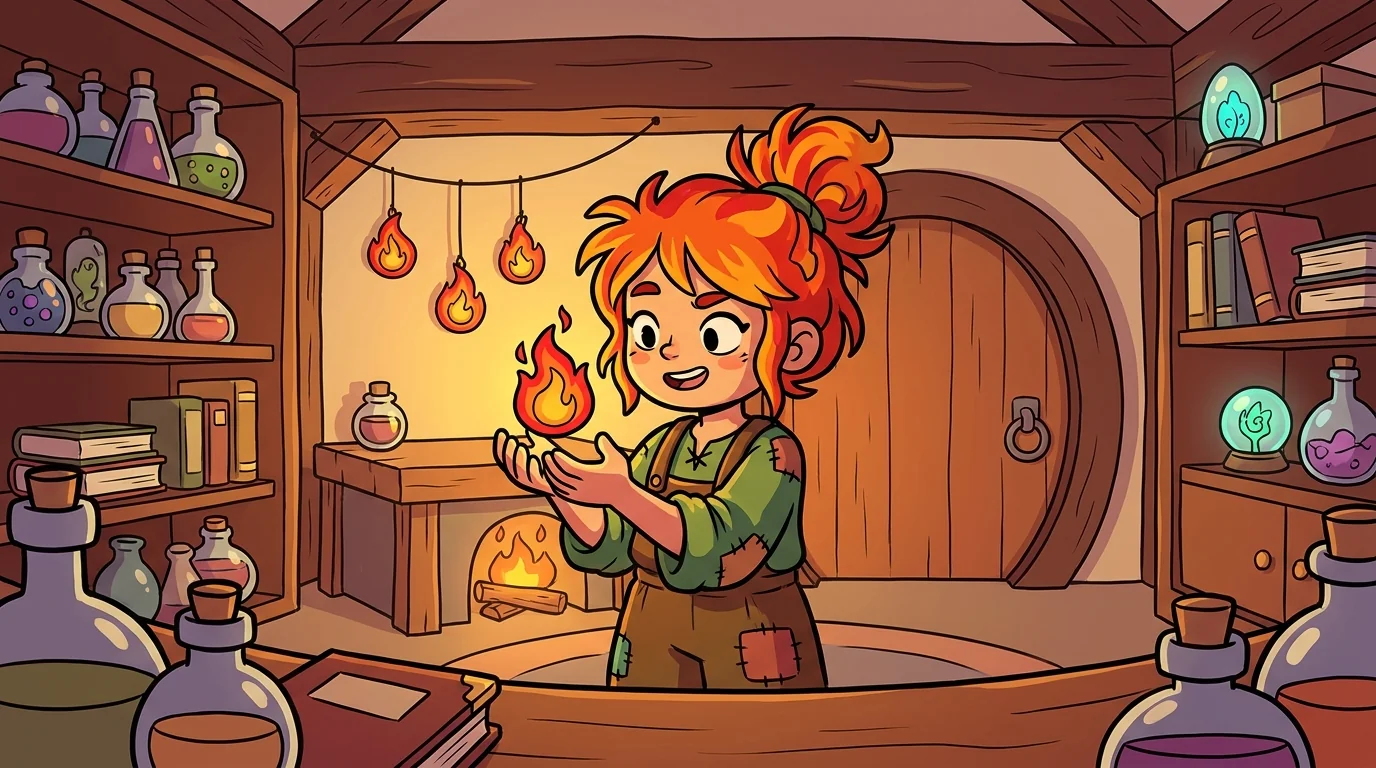
Phossa was a mouse-tween, small and quick. Her fur was a warm mix of russet and cream, and her eyes darted, always looking, always noticing. Around her neck, on a thin leather cord, hung a small bronze flame-charm. It was a tiny disc, shaped like a stylized fire, smooth and warm from years of being touched. The charm caught the light whenever Phossa moved, a tiny flash of bronze. Phossa couldn't quite hold still. Her tail twitched, her paws shifted on the workbench, and her gaze flickered from one interesting thing to the next. This wasn't nervousness. It was just Phossa, full of a bright, energetic spark. She called it her chemistry.
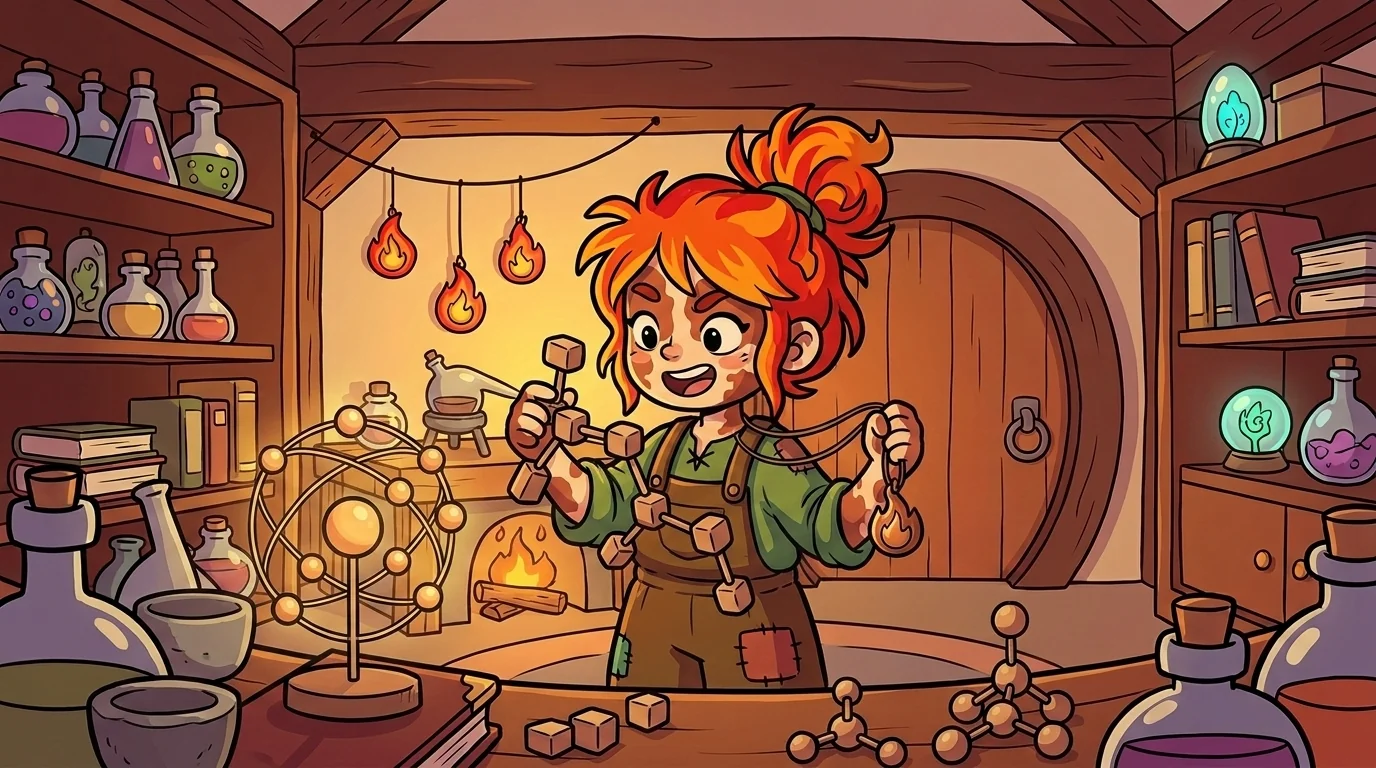
Phossa taught about *phosphorus (P)*, an element that sat right below nitrogen on the periodic table. Like nitrogen, it had five electrons in its outer shell. But phosphorus's outer shell was one level deeper, which made it much more flexible in how it connected with other atoms. It often made three bonds, just like nitrogen did in a molecule called phosphine (PH₃). But phosphorus could also make five bonds, especially in the phosphate ion (PO₄³⁻), which was common in living things. This ability to make five bonds was what really made phosphorus the energy currency of life.
Think of ATP – adenosine triphosphate – as the universal money for every cell on Earth. It was how cells paid for everything they did. Each ATP molecule held three phosphate groups linked together like a tiny chain. When a cell needed energy, it "spent" an ATP molecule. It would break off one phosphate group, turning ATP into ADP (adenosine diphosphate) and releasing a burst of energy. This energy powered everything: every muscle contraction, every nerve signal, every single reaction inside your body. The "spark" of life, Phossa would explain, was literally these phosphate bonds forming and breaking. Her flame-charm, catching the light, was a small reminder of that constant energy-flash.
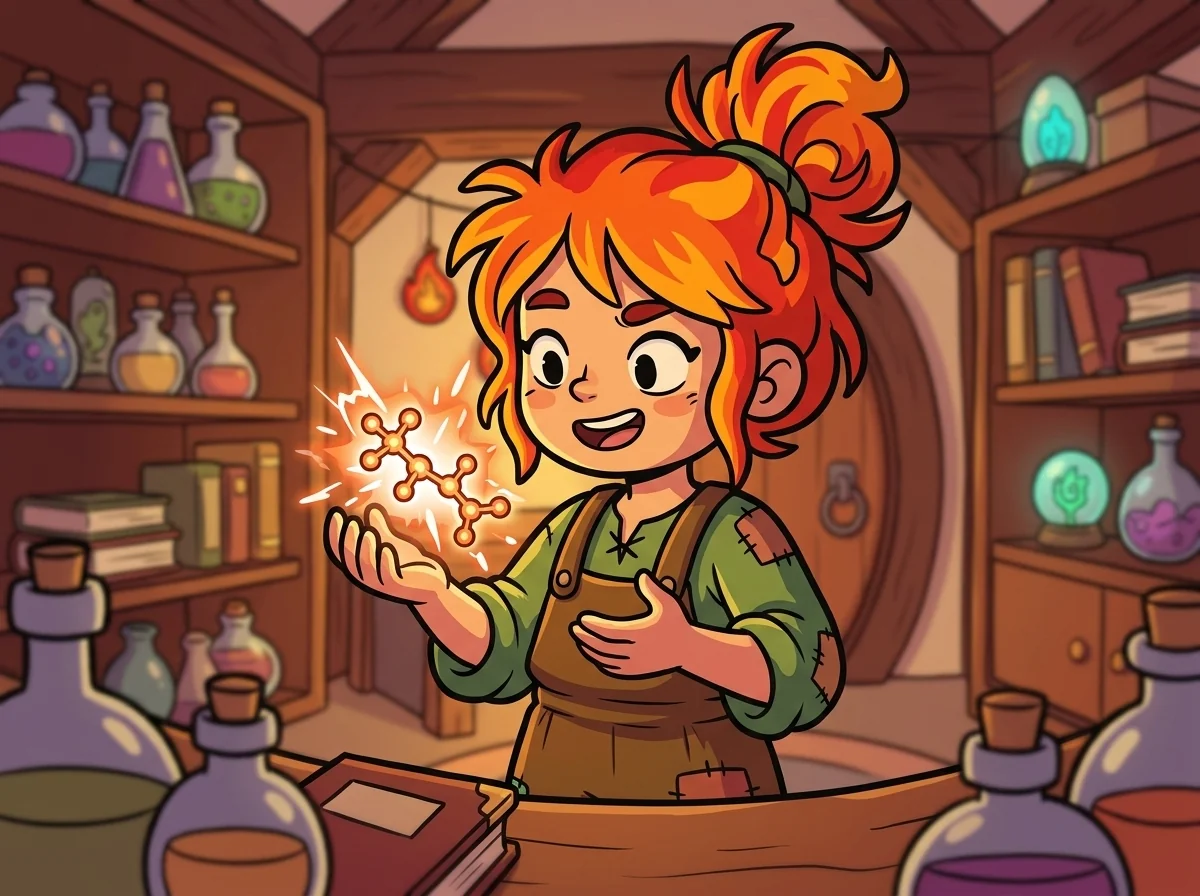
Phosphorus also made the spark in matches. A special kind, white phosphorus (P₄), reacted fiercely with air. It could even catch fire on its own if the temperature went above 30°C. Old-fashioned matches used phosphorus compounds that lit up with just a little friction. So, when Phossa talked about the "spark" of phosphorus, she wasn't just using a metaphor.
Phossa made sure everyone understood. "My restlessness?" she'd say, tapping her flame-charm. "That's the chemistry. I can make three bonds, like Nitra. Or five bonds, in your body's biology. Both are real." She'd lean forward, eyes bright. "Right now, billions of me are in ATP molecules inside you. That's your energy currency. Every move you make, every thought you think, uses ATP. I'm not nervous. I'm just energetic by design."
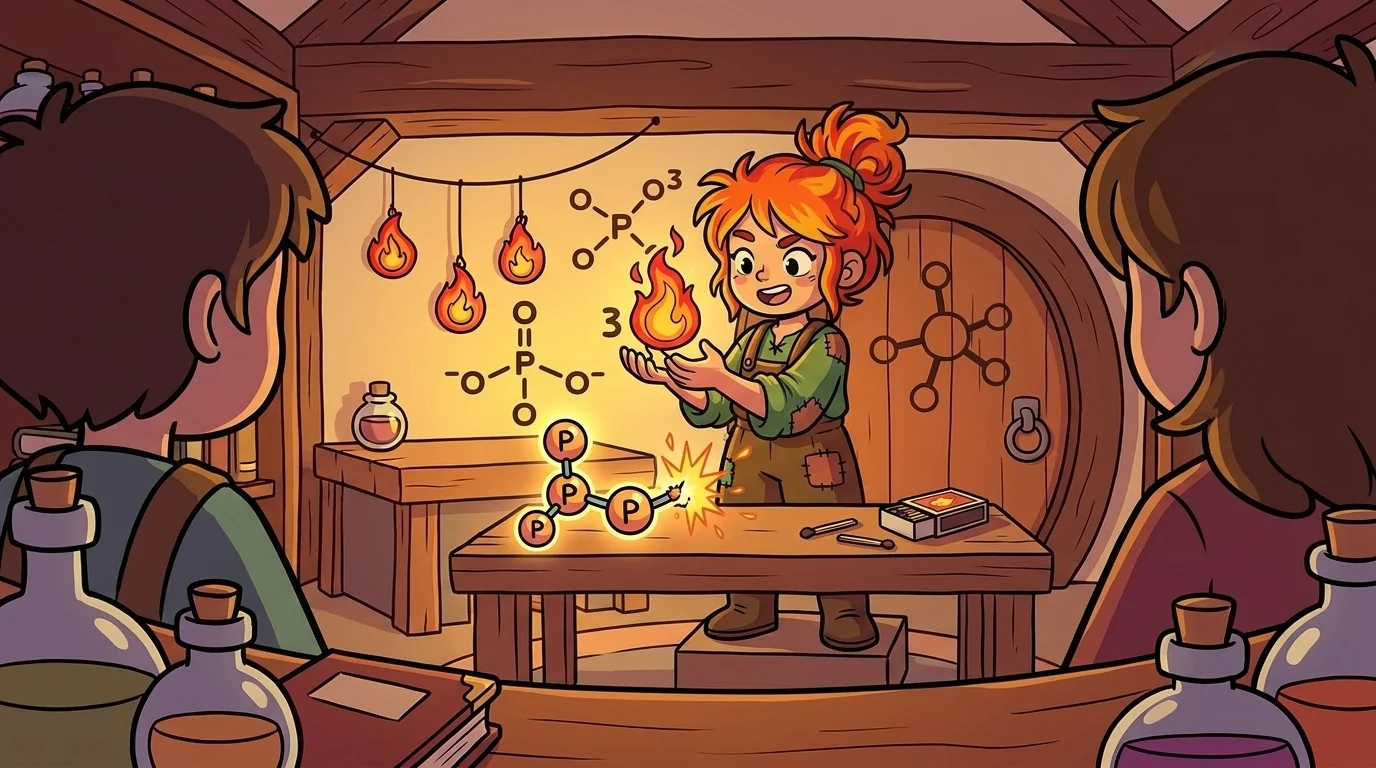
Phossa grew up in a small, cozy village. Her family had always been the spark-keepers there. They tended the communal fire-lighting station, a place where villagers could come for a fresh spark or a small flame when their own hearths had gone cold. It was important work, demanding constant alertness. A spark-keeper couldn't hesitate. If you lost the moment, the village might go cold. If you acted quickly, everyone stayed warm. By the time Phossa was six, she understood that energy was her family's trade. And keeping that energy meant always paying restless attention.
When Phossa was twenty-two, she scampered all the way to the ChemQuest academy. Beaker, the head of the academy, looked at her with sharp eyes. "What is phosphorus?" he asked. Phossa didn't fidget. She stood tall. "I sit below nitrogen on the periodic table," she said clearly. "I make three or five bonds. I'm flexible. I'm the energy currency of life: ATP has three phosphate groups in a chain, and spending one releases energy. I'm also the spark of matches. Restless by design." Beaker smiled. "You are appointed."
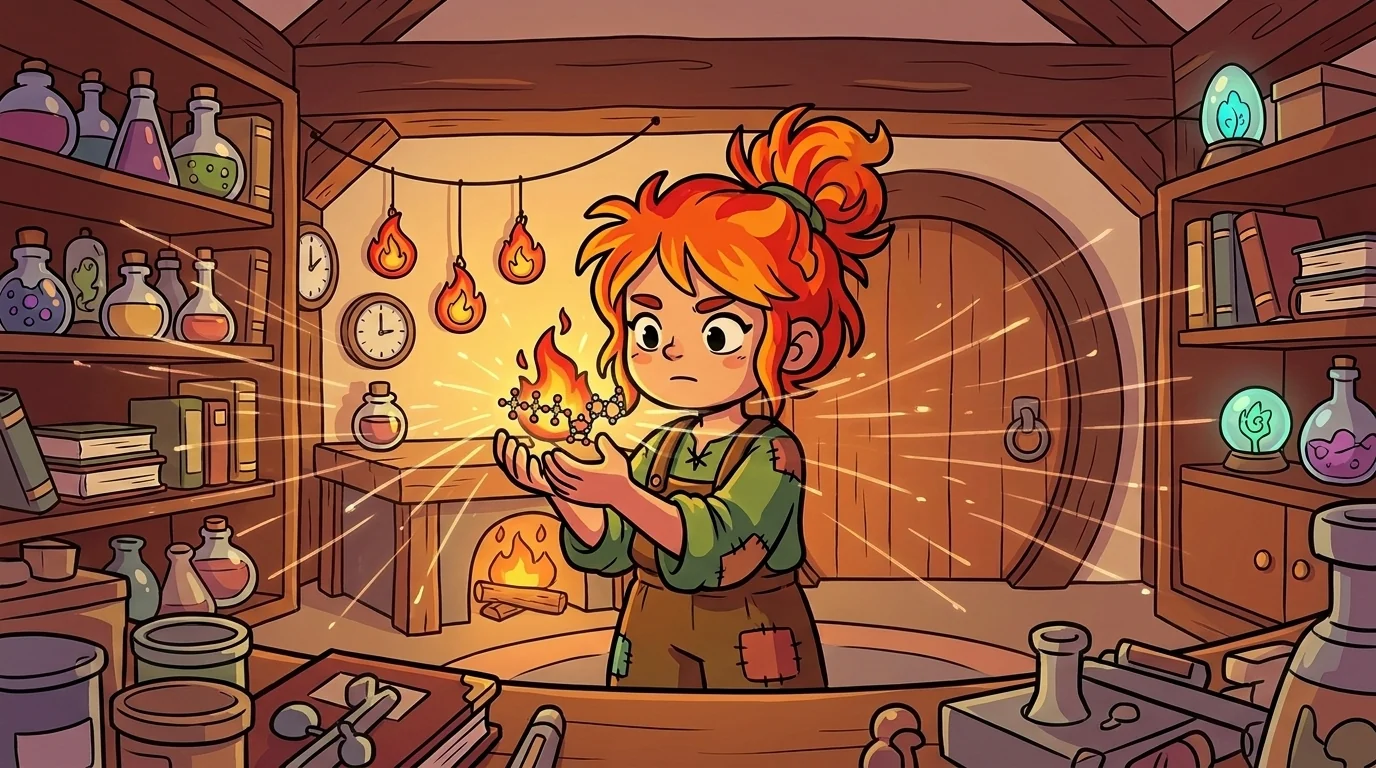
In her workshop, Phossa started every first-day lesson the exact same way. She would flicker up to the front bench, a blur of quick, small movements. Then she would hold up her flame-charm, letting it catch the light. "I am Phossa," she'd announce, her voice bright. "The element I teach is *phosphorus* – the energy spark. Remember this: three or five bonds, ATP energy, and match-strike chemistry. I'm restless because I'm energetic. Both come from how flexible my atoms are."
Then she would launch into the key ideas about phosphorus: Phosphorus makes three or five bonds. It could make three bonds, like in phosphine (PH₃), a gas. Or it could make five bonds, as it did in the phosphate ion (PO₄³⁻). These five-bond structures were crucial for things like ATP and the backbone of DNA. *ATP is the energy currency of life. She'd remind them: Adenosine triphosphate had three phosphate groups. When a cell spent one phosphate, it released energy, becoming ADP. Cells recharged this ADP back into ATP using a process called cellular respiration. This happened trillions of times per second across their bodies. *DNA's backbone contains phosphate. The very structure of DNA, the blueprint for life, was built from a repeating sugar-phosphate chain. These phosphate bridges held the whole strand together. *Phospholipids make cell membranes. Every single cell in their bodies, and every cell on Earth, was surrounded by a membrane. These membranes were made of special phosphate-containing fat molecules called phospholipids. *White phosphorus is reactive. She'd turn serious for a moment. "This stuff ignites spontaneously in air," she'd warn. "It's not kitchen chemistry. This is industrial-grade, lab-safety-required material." **Phosphorus is finite and
The ChemQuest ensemble
Phossa is part of ChemQuest's distributed-narrative cast. Each character embodies a different curricular primitive; together they teach the full subject.
-

Hydra
Hydrogen (H) — lightweight, ubiquitous, always paired up; buddy-system enthusiast
-
Carbo
Carbon (C) — connects to anything; the social atom; backbone of life
-

Oxy
Oxygen (O) — eager bonder; electronegative; the hungry grabber
-

Nitra
Nitrogen (N) — triple-bond loyal; slow-to-warm; locks in deeply once bonded
-
Sodi
Sodium (Na) — generous, impulsive; always giving away electrons
-

Chlora
Chlorine (Cl) — sharp, focused; the collector who finishes what Sodi starts
-

Helio
Helium (He) — noble gas; peaceful, floaty, complete; the contented onlooker
-

Sulfa
Sulfur (S) — earthy, dramatic; the stinky uncle of volcanoes and proteins
-

Magna
Magnesium (Mg) — bold, ceremonial; burns bright white; chlorophyll core
-

Silica
Silicon (Si) — patient, geometric; the architect who builds quietly
-

Alumi
Aluminum (Al) — practical, modest; the workhorse of cans and foil
-
Tugger
Ionic bond — forceful, decisive; full electron transfer; opposites attract
-

Sharer
Covalent bond — cooperative, balanced; equal partnership
-

Streamer
Metallic bond — flowing, communal; delocalized electron sea
-
Whisperer
Hydrogen bond — subtle, persistent; water's superpower; DNA pairing