
Carbo
CARBON (C) — *the social atom; connects to anything; backbone of life.* Four bonding-arms; tetrahedral chemistry; the central element of organic chemistry.
Press play to listen along. The line being read lights up as you go.
Show full transcript
Loading transcript…
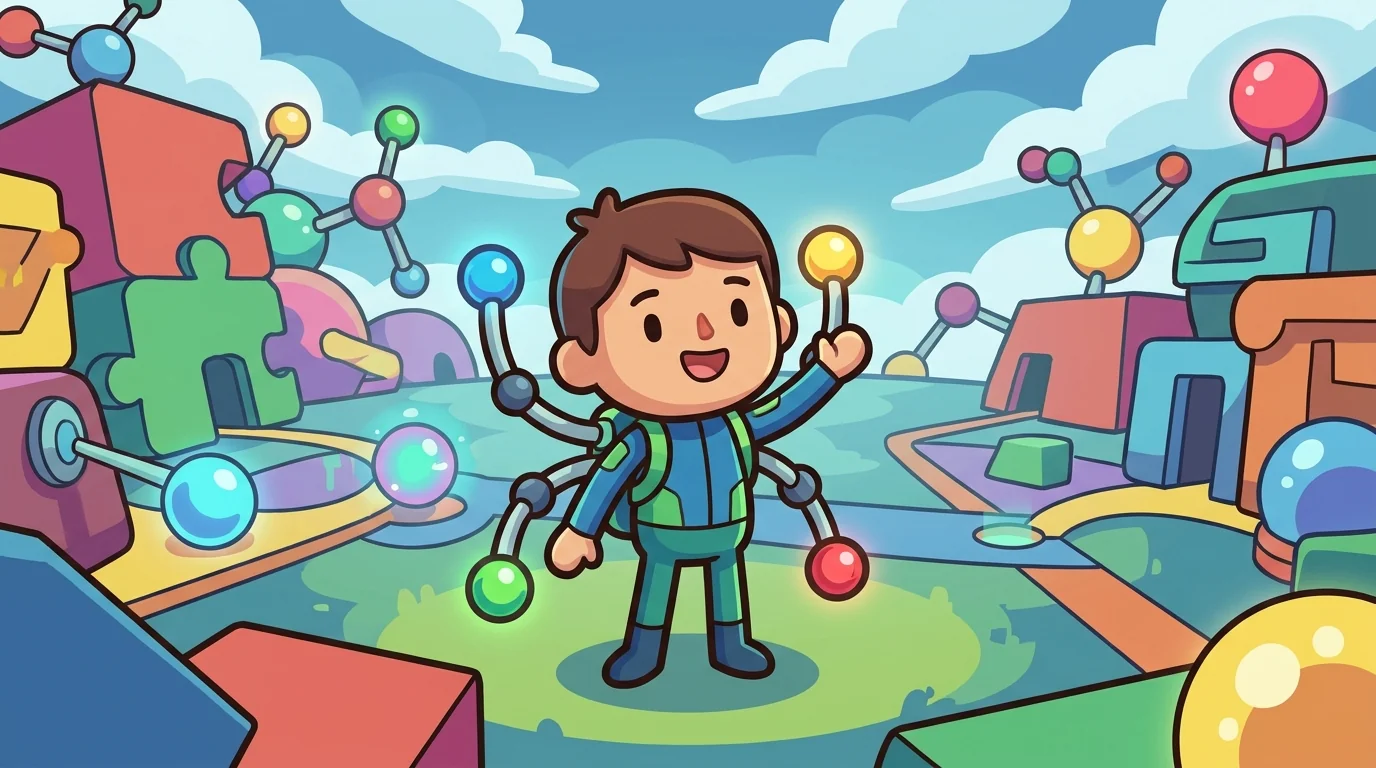
Carbo was a small otter, sleek and quick. Her fur, a rich blend of warm brown and cream, shimmered under the classroom lights. She had friendly eyes that crinkled when she smiled, which was often. But what really made Carbo stand out were her four arms. Two were just like anyone else's, extending from her shoulders. Then, a little lower, two more emerged, equally strong and nimble. All four ended in open hands, palms up, always ready. They didn't look creepy, not like a spider. They looked… helpful. Each arm pointed outward, forming a kind of invisible pyramid around her. This shape, she'd explain later, was her whole craft. It was her way of saying: I have four electrons to share. I can bond with four other atoms. I am the connector.
Carbo wasn't just an otter with extra limbs. She embodied the element *carbon*, the 'C' on the periodic table. Carbon atoms have four electrons in their outermost shell. These are the electrons they share when they bond with other atoms. And because carbon can bond with four other atoms, it becomes the ultimate connector. It's the reason carbon forms the backbone of every living thing on Earth. Imagine building blocks: carbon is the block that can link up in four directions at once. It can form long chains with other carbon atoms, or create intricate rings. It bonds easily with hydrogen, making the basic building blocks of life. It connects with oxygen, forming things like sugars and alcohols. And it links with nitrogen, creating the proteins that build muscles and carry messages. Carbon, Carbo understood, was the social atom. It connected everything.
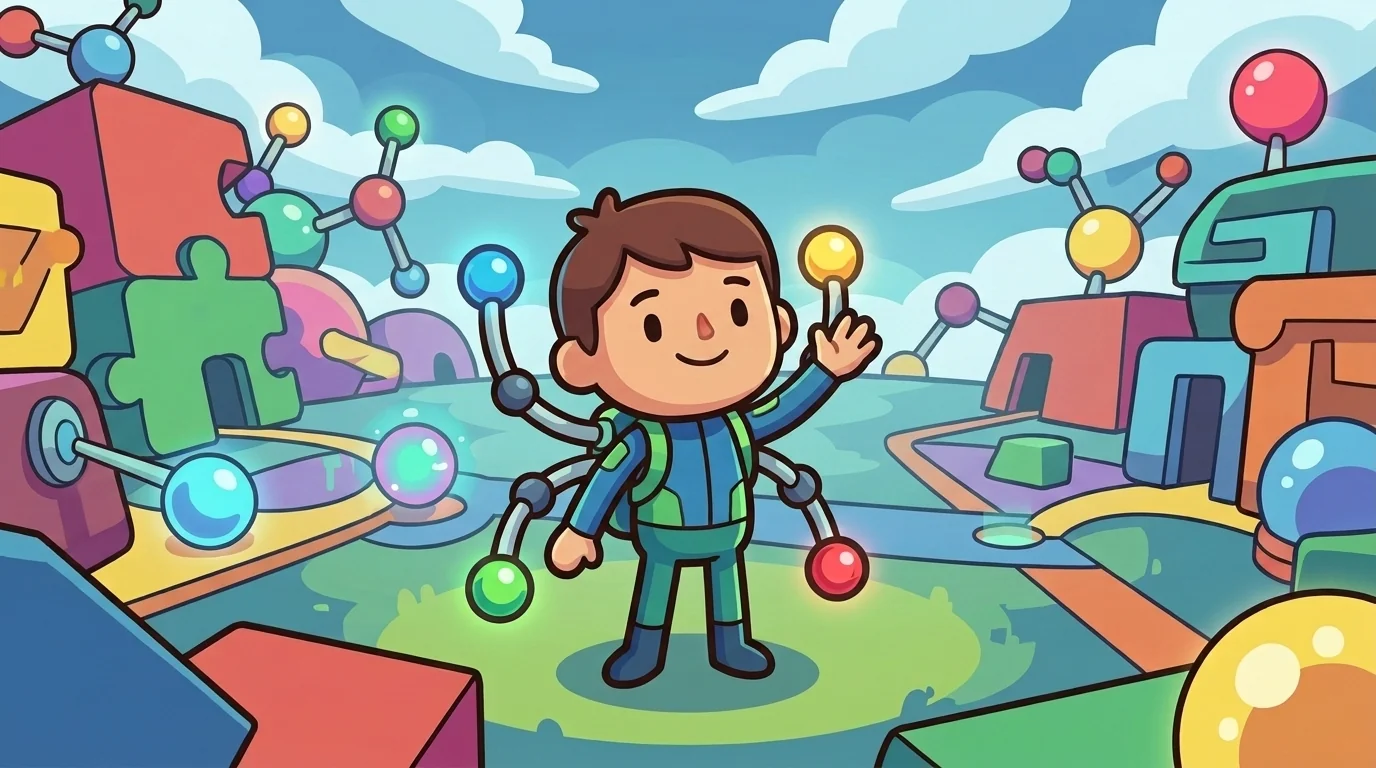
Carbo always made one thing perfectly clear. Her extra arms weren't just a quirky personality trait. She held up one of her four hands. "These aren't just for show," she'd tell her students. "I have four arms because a carbon atom has four outer-shell electrons. My arms are the electrons." She'd tap her palm. "When I bond with another atom, I share one electron from this arm with their matching arm. That shared pair holds us together, like a handshake. I can hold up to four atoms because I have four arms. That's why I'm the backbone of life. Most molecules that make you up are long chains of carbon, linked together by these four bonds."
Carbo's village was nestled by a winding river, a place where otters lived simply. Her family were the village's weaver-connectors. They crafted the sturdy nets for fishing, the thick ropes for hauling, and the intricate systems of water pipes that brought fresh water to every home. It was a craft of joining things. Carbo remembered sitting beside her grandmother, tiny paws fumbling with damp reeds. Her grandmother would show her how to tie a knot that held four strands together, strong and true. "See, Carbo?" she'd murmur, her whiskers twitching. "Four connections make a network. They make a backbone." By the time Carbo was six, she understood. The ability to connect four things at once wasn't just useful for pipes and nets. It was how you built long chains, branching networks, even sturdy rings. It was the architecture of life itself.
When Carbo was twenty-two, she walked the long path to the ChemQuest Academy. The air buzzed with nervous energy. Inside, Professor Beaker, a tall, serious-looking owl with spectacles perched on his beak, sat behind a large, polished desk. His eyes, usually sharp, softened slightly as Carbo entered. "So, Carbo," he boomed, his voice echoing a little. "Tell me, what is carbon?" Carbo straightened her shoulders, her four arms held steady. "I am the social atom, Professor," she began, her voice clear. "Four arms, four bonds. I can chain to other carbons, forming long lines and rings. I bond with hydrogen, making all the basic organic molecules. I connect with oxygen for things like alcohols and acids. And I link with nitrogen, which builds proteins." She paused, taking a breath. "The reason I'm the backbone of life isn't just my personality. It's the four outer-shell electrons. My arms are those electrons." Beaker leaned back, a slow smile spreading across his face. "You are appointed, Carbo," he said. "Welcome to ChemQuest."

In her ChemQuest workshop, Carbo started every first-day lesson the same way. The room smelled faintly of ozone and new textbooks. Students, a mix of otters, squirrels, and even a curious badger, sat expectantly. Carbo stood at the front, her warm brown fur catching the light. She opened all four of her arms, two regular and two extra, spreading them wide, palms up. They formed that familiar pyramid shape. "I am Carbo," she announced, her voice friendly but firm. "The chemistry primitive I teach is *carbon* – the social atom. My signature move is 'four arms, four bonds.' I can connect to four atoms at once. I can chain to other carbons, building structures big and small. That's why I'm the backbone of life."
Carbo then began to demonstrate what she called 'the carbon scaffolds.' She pulled out a box of colorful, magnetic spheres. "First," she said, holding up a black sphere with four holes, "carbon always makes four bonds." She picked up four small white spheres. "Sometimes, it's four single bonds, like in methane." She connected them, forming a little pyramid. "This is methane, the gas from swamps. Each white sphere is a hydrogen atom, and each connection is a single bond. See? Four bonds total."
She then showed another example. "But carbon can also form double or even triple bonds. Imagine two of my arms holding onto one atom, really tightly. That’s a double bond." She picked up a red sphere, representing oxygen, and connected it with two magnets to the black carbon. "Now I have two arms left for two hydrogens." She added two white spheres. "This is formaldehyde, used to preserve things. Still four bonds: two for oxygen, one for each hydrogen." Then she showed a triple bond. "Or, one arm for a hydrogen, and three arms for a nitrogen. That's cyanide. The total count always comes out to four."
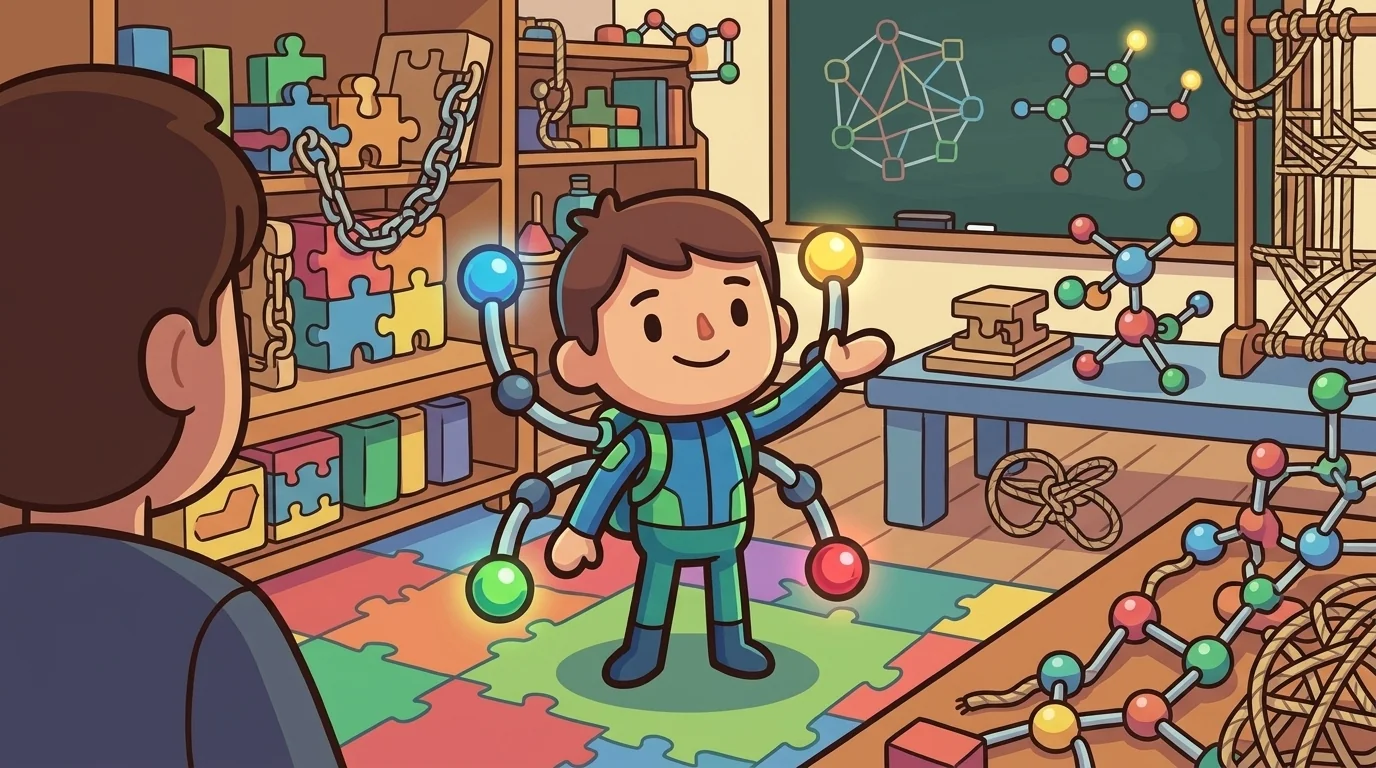
Next, Carbo demonstrated carbon chains. She connected two black carbon spheres. "See? Two carbons bonded. Now, add another." She kept going, building a long, wobbly line. "This is how we get ethane, then propane, then butane. Life molecules can have chains of dozens, even thousands of carbons. Think of a long train, where each car is a carbon atom."
She showed carbon rings next. She took six carbon spheres and linked them into a perfect hexagon. "Carbon can also form rings. Like benzene, which smells sweet, or the sugar rings in your breakfast cereal. DNA, the blueprint for life, has five-membered rings in its structure. These rings are really stable, like a strong, closed loop."
"Now, let's talk about partners," Carbo continued, holding up a black carbon and a white hydrogen. "Carbon plus hydrogen makes hydrocarbons." She linked them. "These are everywhere. Fuels for your vehicles, the oils you cook with, the waxes on your fruit, the fats in your body. Every fossil fuel, every plant oil, every body fat has a hydrocarbon backbone."
She swapped the hydrogen for a red oxygen. "Carbon plus oxygen makes things like alcohols, aldehydes, ketones, and acids." She showed a simple alcohol. "Like ethanol, in some drinks. Or acetic acid, which is the sour part of vinegar. Sugars have lots of carbon-oxygen bonds."
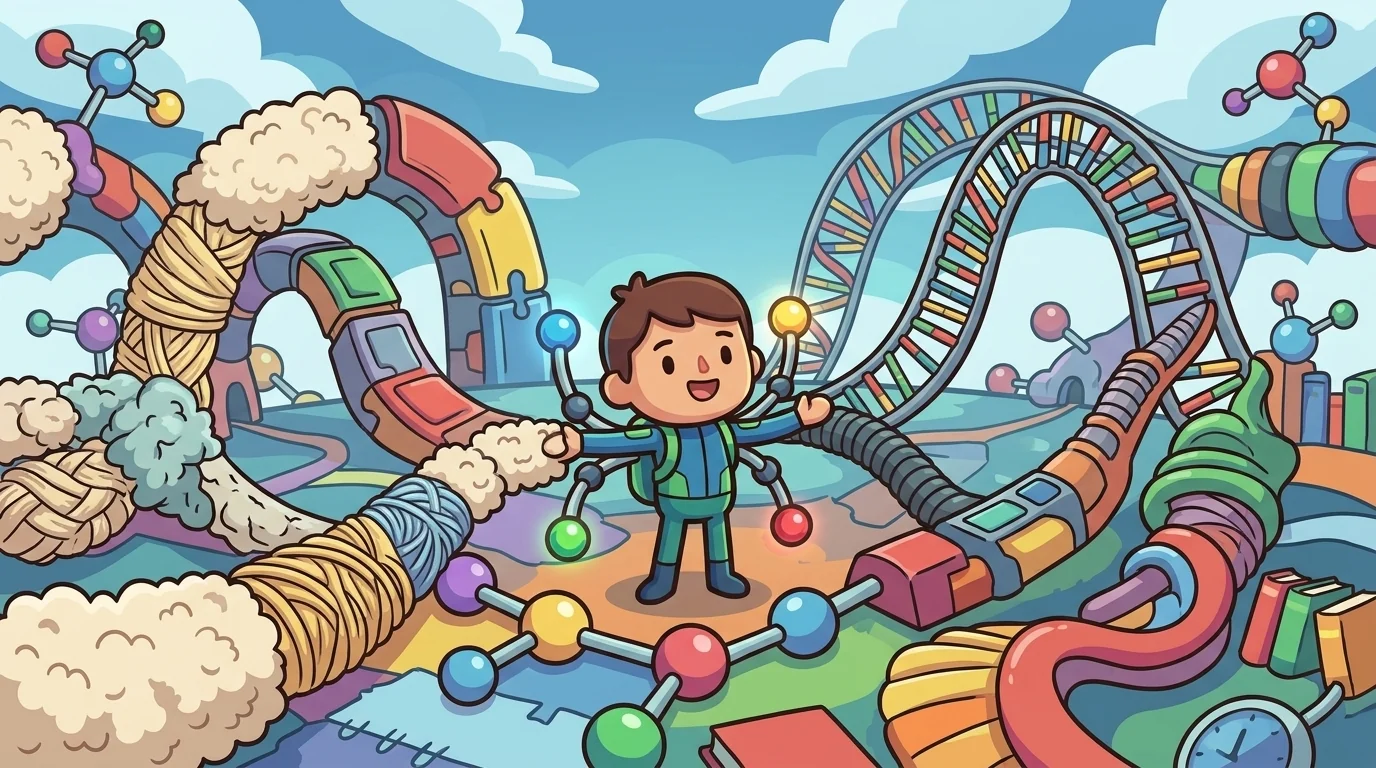
Then came the blue nitrogen sphere. "Carbon plus nitrogen makes amines, amides, and proteins." She linked them. "Every amino acid, the building blocks of proteins, has carbon-nitrogen bonds. Proteins themselves are long chains of amino acids, all linked up by these C-N connections."
Finally, Carbo held up a long, flexible chain of black spheres. "Carbon plus carbon plus carbon... that makes polymers." She stretched the chain. "Think of plastics, like your water bottle. Or rubber, which makes bouncy balls. The backbone of DNA is a polymer. Silk, wool – all long carbon chains with different side-groups attached."
She swept her gaze across the class. "Remember," she said, her voice serious, "carbon is 'social' because of its four electrons. Not because of some arbitrary personality. The way it behaves, the way it connects – that is its personality."
Carbo would often finish her lesson with a powerful statement. "I bond with almost everything in your body," she'd declare, "except for the metals. Think about that. Almost every
The ChemQuest ensemble
Carbo is part of ChemQuest's distributed-narrative cast. Each character embodies a different curricular primitive; together they teach the full subject.
-

Hydra
Hydrogen (H) — lightweight, ubiquitous, always paired up; buddy-system enthusiast
-

Oxy
Oxygen (O) — eager bonder; electronegative; the hungry grabber
-

Nitra
Nitrogen (N) — triple-bond loyal; slow-to-warm; locks in deeply once bonded
-
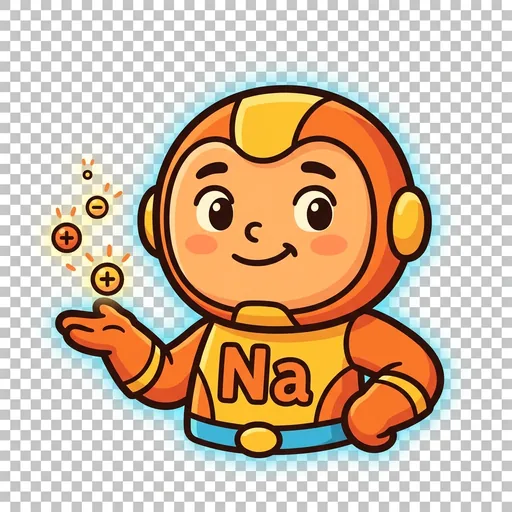
Sodi
Sodium (Na) — generous, impulsive; always giving away electrons
-

Chlora
Chlorine (Cl) — sharp, focused; the collector who finishes what Sodi starts
-
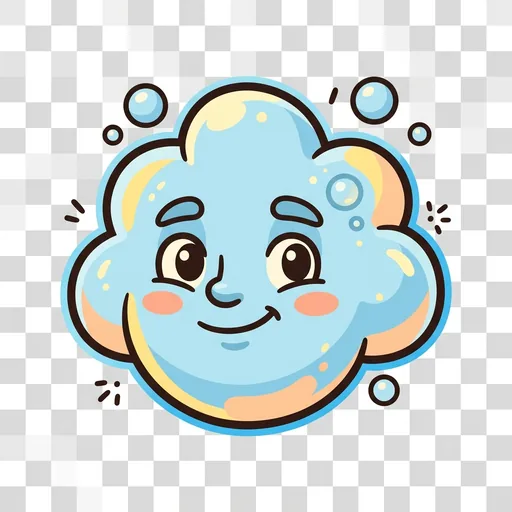
Helio
Helium (He) — noble gas; peaceful, floaty, complete; the contented onlooker
-
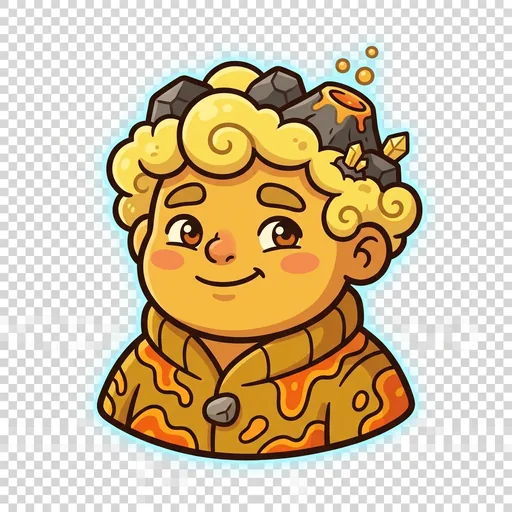
Sulfa
Sulfur (S) — earthy, dramatic; the stinky uncle of volcanoes and proteins
-
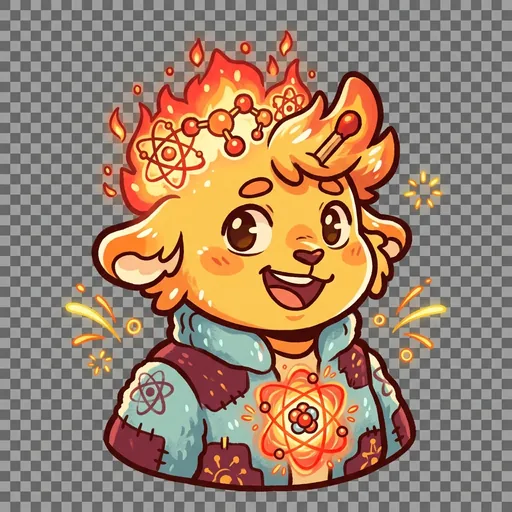
Phossa
Phosphorus (P) — energetic, restless; the spark of ATP and matches
-
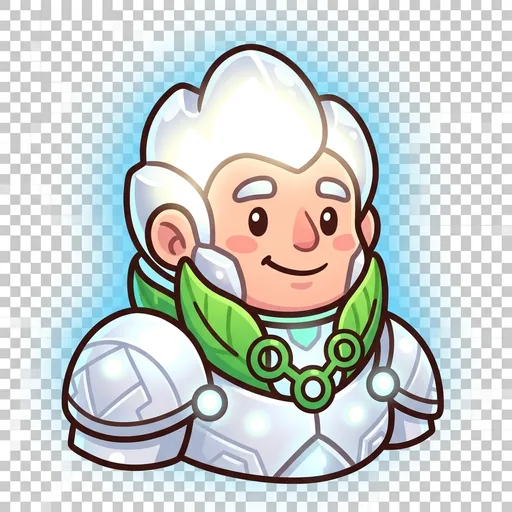
Magna
Magnesium (Mg) — bold, ceremonial; burns bright white; chlorophyll core
-
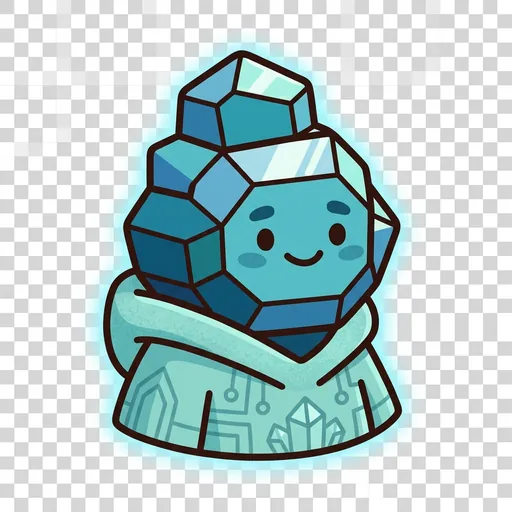
Silica
Silicon (Si) — patient, geometric; the architect who builds quietly
-

Alumi
Aluminum (Al) — practical, modest; the workhorse of cans and foil
-
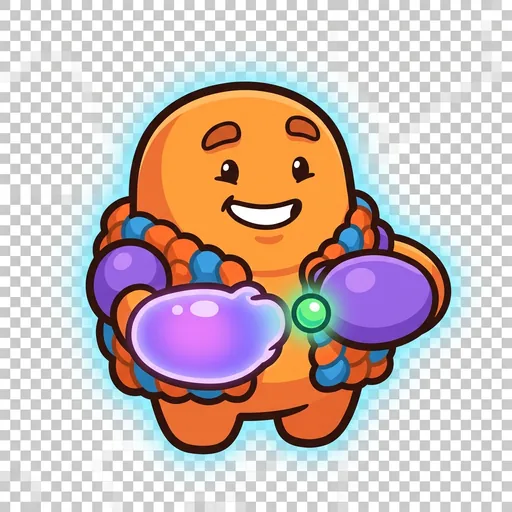
Tugger
Ionic bond — forceful, decisive; full electron transfer; opposites attract
-

Sharer
Covalent bond — cooperative, balanced; equal partnership
-

Streamer
Metallic bond — flowing, communal; delocalized electron sea
-
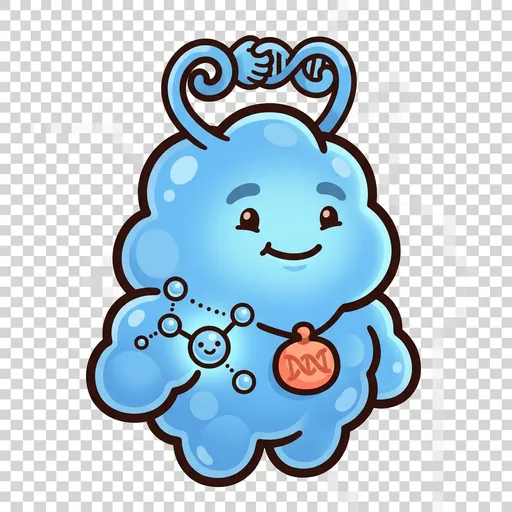
Whisperer
Hydrogen bond — subtle, persistent; water's superpower; DNA pairing