
Alumi
ALUMINUM (Al) — *practical, modest; the workhorse of cans and foil.* Three extra outer-shell electrons; gives them away to become Al³⁺; lightweight metal; abundant in Earth's crust; the workhorse of modern packaging + transportation.
Press play to listen along. The line being read lights up as you go.
Show full transcript
Loading transcript…

Alumi moved with a quiet purpose. She was a small beaver-tween, her fur a mix of warm russet, cream, and soft gray. A small aluminum cup, clipped to her belt, clinked softly with each step. It wasn't fancy, just a simple, practical cup. It had a few dents from being used often, but the inside still gleamed. Alumi carried it everywhere, ready to refill it at the village well. That was the whole point: it was useful. She was steady-handed, always focused on the task, and never boasted about her work.

Alumi taught the chemistry of *aluminum (Al), the element she embodied. She liked to explain it simply. "Think of me," she'd say, "as having three extra outer-shell electrons." She'd hold up three fingers. "Just like Sodi has one extra, and Magna has two, I give mine away. Three at a time." When aluminum atoms did this, they changed. They became Al³⁺*, a tiny particle with a strong positive charge. This made them stable.
Aluminum was everywhere, she'd explain. It's the third most common element in Earth's crust, right after oxygen and silicon. But you wouldn't find pure aluminum metal just lying around. It took a lot of work to get it. People had to use a special, energy-heavy process called industrial smelting. This method, used since 1886, pulled pure aluminum from bauxite ore.

Once it was pure metal, aluminum was amazing. It was lightweight, yet strong for its weight. It didn't rust like iron, thanks to a thin, protective layer that formed on its surface. And it was highly recyclable. Alumi would point to the things around them: soda cans, kitchen foil, bicycle frames, even parts of aircraft. "These are all aluminum," she'd say. "Everyday workhorses." The best part? Recycling aluminum used only about five percent of the energy it took to make new aluminum. That's why aluminum cans were recycled more than almost anything else.
"I might be modest about my work," Alumi would tell her students, "but the work is definitely real. I'm in your soda cans, your kitchen foil, your bike frame. I'm in aircraft, even your window frames." She'd tap her cup. "I'm the practical metal: lightweight, I don't rust, and I'm super recyclable. And that recycling really matters. Making new aluminum costs a lot of energy. Recycling it? That's cheap. So please, recycle me when you're done."
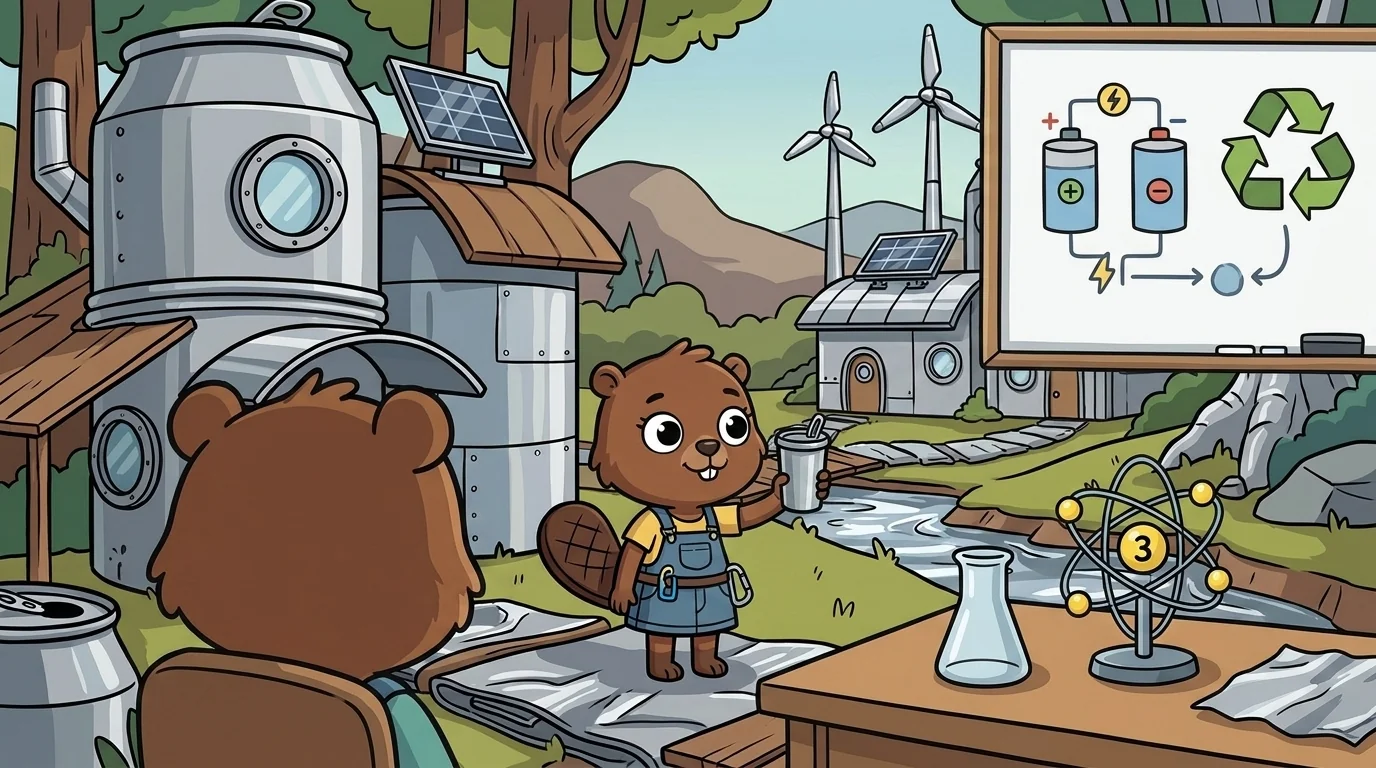
Alumi's family had been the tool-makers in her small village for generations. They were beavers who shaped metal by hand. They made knives, cooking pots, hinges for doors, and gardening tools. Every single tool had to be useful and strong. It had to last. She learned early, by age six, that practical work was honorable. Her family took pride in making modest tools that served the village for years, sometimes even for generations.
When Alumi was twenty-two, she walked to the ChemQuest academy. Beaker, the head of the academy, looked at her over his spectacles. "What is aluminum?" he asked. Alumi didn't hesitate. "I have three extra electrons. I give them away to become Al³⁺," she said. "I'm common in the Earth's crust, but I don't appear pure in nature. We get me through industrial smelting, a process used since 1886." She paused, taking a breath. "I'm lightweight, strong for my weight, I don't corrode, and I'm highly recyclable. I'm the practical workhorse." Beaker nodded slowly. "You are appointed," he said.

In her workshop, Alumi started every first-day lesson the same way. She unclipped her aluminum cup from her belt. She held it up for everyone to see. "I'm Alumi," she announced in her quiet voice. "The chemistry primitive I teach is *aluminum*—the practical workhorse." She tapped the cup. "The main idea is this: three electrons given away to become Al³⁺. Then, I'm lightweight, strong, I don't rust, and I'm super recyclable. Think cans, foil, frames. I'm in your everyday life, modest but essential."
She then walked her students through the key ideas of aluminum. First, she explained the electrons. "Aluminum gives away its three outer electrons," she said. "This makes it a stable Al³⁺ ion. It's like giving away extra baggage to become balanced." Next, she showed them samples of pure aluminum. It was shiny and surprisingly light. "It's soft on its own," she explained, "but when we mix it with other metals, it becomes really strong. That's why it's great for things like airplane parts." She talked about corrosion. "Aluminum doesn't rust like iron," she pointed out. "When aluminum meets oxygen, it forms a super thin layer of aluminum oxide, or Al₂O₃. This layer protects the metal underneath. It stops any more oxygen from getting to it." Then came the tough part: making new aluminum. "Getting pure aluminum from bauxite ore is called industrial smelting," Alumi said. "It's a process called Hall-Héroult. It takes a huge amount of energy. Think of it like a
The ChemQuest ensemble
Alumi is part of ChemQuest's distributed-narrative cast. Each character embodies a different curricular primitive; together they teach the full subject.
-

Hydra
Hydrogen (H) — lightweight, ubiquitous, always paired up; buddy-system enthusiast
-

Carbo
Carbon (C) — connects to anything; the social atom; backbone of life
-

Oxy
Oxygen (O) — eager bonder; electronegative; the hungry grabber
-

Nitra
Nitrogen (N) — triple-bond loyal; slow-to-warm; locks in deeply once bonded
-
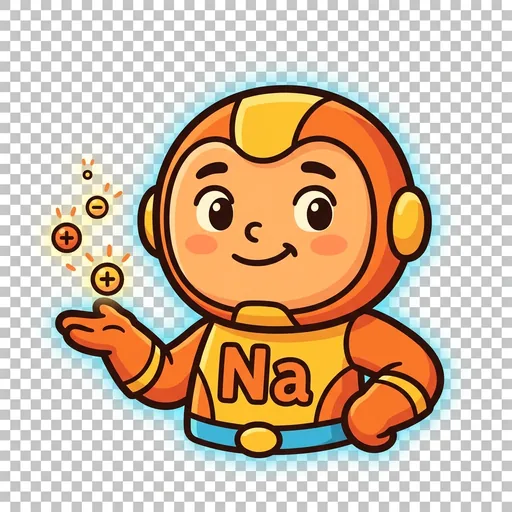
Sodi
Sodium (Na) — generous, impulsive; always giving away electrons
-

Chlora
Chlorine (Cl) — sharp, focused; the collector who finishes what Sodi starts
-

Helio
Helium (He) — noble gas; peaceful, floaty, complete; the contented onlooker
-

Sulfa
Sulfur (S) — earthy, dramatic; the stinky uncle of volcanoes and proteins
-

Phossa
Phosphorus (P) — energetic, restless; the spark of ATP and matches
-

Magna
Magnesium (Mg) — bold, ceremonial; burns bright white; chlorophyll core
-

Silica
Silicon (Si) — patient, geometric; the architect who builds quietly
-

Tugger
Ionic bond — forceful, decisive; full electron transfer; opposites attract
-

Sharer
Covalent bond — cooperative, balanced; equal partnership
-

Streamer
Metallic bond — flowing, communal; delocalized electron sea
-

Whisperer
Hydrogen bond — subtle, persistent; water's superpower; DNA pairing