
Scatter the Spread-Reader
SPREAD — the middle of the data isn't the whole story. Spread is how far apart the values are: tight and bunched, or wide and scattered. Two groups with the very same average can be completely different once you look at how spread out they are.
A story read by Scatter the Spread-Reader
Press play to listen along. The line being read lights up as you go.
Show full transcript
Loading transcript…
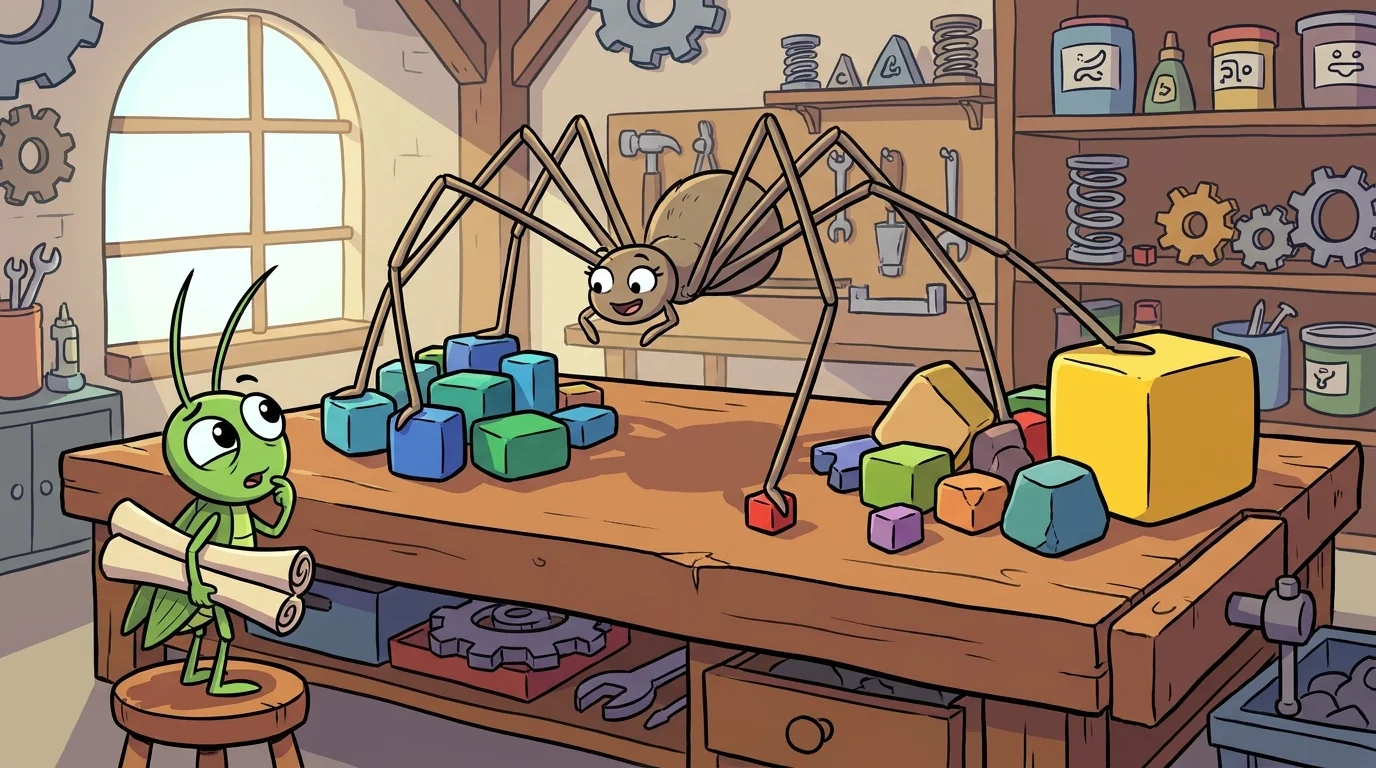
Scatter was a long-legged daddy-longlegs spider, and where everyone else looked for the middle, she looked for the width.
She had eight thin, springy legs, and her favourite trick in the ChanceForge workshop was to plant one leg on the smallest number in a pile of data and stretch another all the way out to the biggest — measuring, in a single stretch, how spread out everything was.
A young cricket named Tic brought her two lists of game scores.
"Both teams averaged ten points," Tic said. "So they're basically the same, right?"
"Are they?" Scatter said, and stretched her legs across the first list. Her legs barely opened — every score huddled close to ten: nine, ten, eleven, ten. "This team is tight. Everybody near the middle." Then she stretched across the second list, and her legs flung wide open — zero, twenty, five, fifteen. "But this team is all over the place. Same average. Completely different team. One is steady. One is wild." She wiggled her wide-flung legs. "The middle told you they matched. The spread tells you they don't."
Tic blinked. "So the average was hiding something."
"The average always hides the spread," Scatter said. "That's why you need me."
Scatter had cared about spread since she was a tiny spiderling.
She'd grown up in a great web stretched between two trees, in a family who measured everything by its middle. The average bug arrives at noon. The average wind is gentle. But little Scatter noticed that "average" kept letting them down. Some days the bugs all came at once and the web tore; some days none came at all. The average was the same. The spread was the whole difference between a calm day and a disaster.
"Stop watching the middle," she told herself one blustery afternoon, clinging to her shaking web. "Watch how far apart things get."
She started measuring it: how far was the earliest bug from the latest? The lightest wind from the strongest? She'd plant one leg at the lowest and stretch to the highest, and that distance — that range — told her more than any average could. A tight spread meant a calm, predictable day. A wide spread meant: brace yourself, anything could happen.
The first time she explained it to her family, she felt a strange, quiet pride. She wasn't seeing less than them. She was seeing the thing they'd been missing the whole time — the width of the world, not just its center.
When she was grown, Scatter climbed down to the ChanceForge workshop, because she'd heard it cared about the whole shape of data.
The old tortoise who kept the workshop asked, "What is spread?"
Scatter stretched her legs wide. "Spread is how far apart the numbers are," she said. "The middle tells you where the data sits. The spread tells you how bunched up or flung out it is around that middle. The simplest spread is the range — the biggest value minus the smallest, the whole distance from one end to the other." She pulled her legs tight, then flung them wide. "Tight spread: everyone's similar, the world is steady. Wide spread: everyone's different, the world is full of surprises. Same average can wear either one."
"And which is better?" the tortoise asked.
"Neither," Scatter said firmly. "A wide spread isn't bad. It's just honest. It tells the truth about how different things really are. The mistake is averaging it away and pretending everyone's the same."
The tortoise gave a slow, pleased nod. "You see what others overlook."
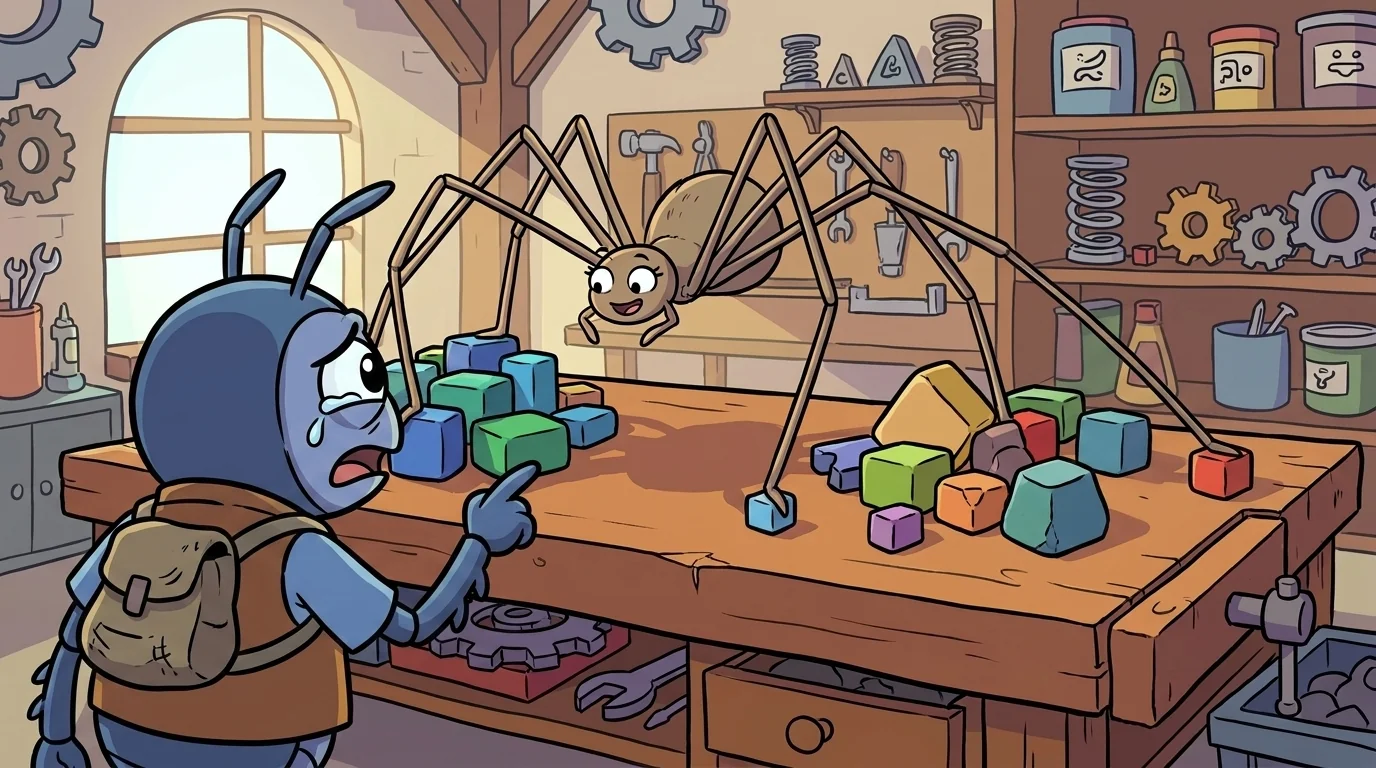
Scatter's favourite lesson was rescuing a kid who'd been fooled by a flat average.
A frustrated beetle named Cob came to her nearly in tears. "Two summer camps," he said. "Both say the average temperature is a perfect mild twenty. So I picked one. And it was miserable — freezing every morning, boiling every afternoon. How could the average lie to me?"
"The average didn't lie," Scatter said gently. "It just stayed quiet about the spread." She stretched her legs across his camp's daily temperatures — flung wide, from near-freezing to scorching. "See how far apart your days were? Cold mornings way down here, hot afternoons way up there. Huge spread. The middle was twenty, sure — but you almost never actually got twenty. You got the two wild ends." Then she pulled her legs tight around the other camp's numbers, all hovering near twenty. "This camp was tight. Mild morning, mild afternoon, mild all day. Same average. Gentle spread. That's the one that would've felt like twenty."
Cob stared at her tight legs versus her wide ones. "I should've asked how spread out it was. Not just the middle."
"Now you'll always ask," Scatter said. "The middle is where to look. The spread is what it's actually like to be there."
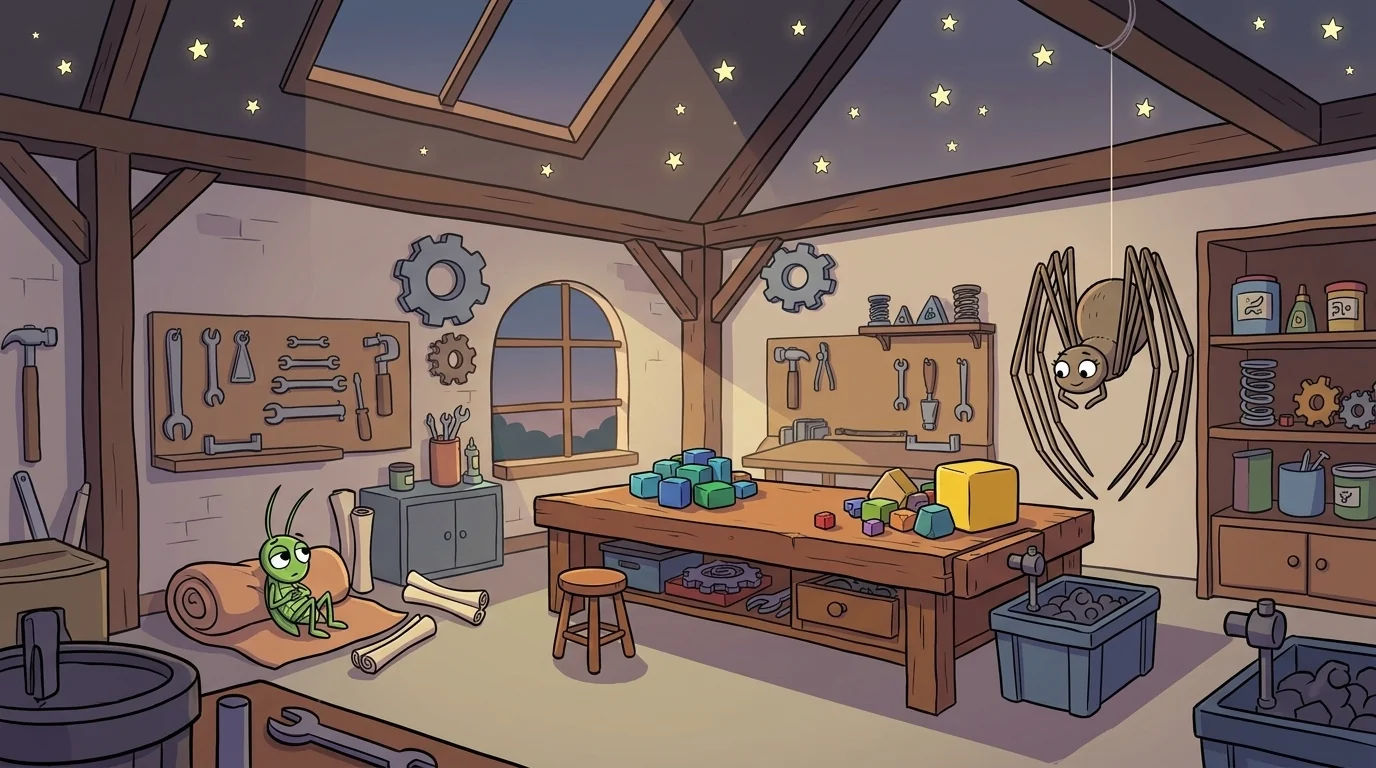
Later, when the workshop had gone quiet and the data was tidied away, Scatter hung from a single thread in the corner and watched the dusk.
Tic wandered back. "Can I tell you something? I used to wish everybody was the same. All bunched up near the middle. It felt safer. Less... scattered."
Scatter was still for a moment, her long legs drawn in.
"I understand that," she said softly. "A wide spread can feel like chaos when you're inside it — everybody so different, nobody near the middle. When I was small I thought spread was just messiness, something to fix." She let her legs unfurl, slow and easy. "But I don't see it that way anymore. The spread is where all the difference lives. The fast and the slow, the early and the late, the quiet and the loud. Squeeze it all to the middle and you lose every one of them. The width isn't the mess. The width is everybody getting to be themselves."
She looked out at the scattered stars beginning to appear, none of them bunched, all of them far-flung and bright.
And as Tic curled up beneath her web, Scatter felt the old quiet pride settle over her again — not the comfort of everyone being the same, but the deeper, warmer comfort of a world wide enough to hold how different we all truly are. The middle tells you where we gather. The spread tells you we were never really all alike — and that, she thought, is nothing to be afraid of.
The ChanceForge ensemble
Scatter the Spread-Reader is part of ChanceForge's distributed-narrative cast. Each character embodies a different curricular primitive; together they teach the full subject.
-

Tally the Counter-of-Outcomes
Data collection + frequency counting (the foundational "what happened, how often?" move)
-

Display the Picture-Maker
Graphs and visual displays (bar charts, histograms, dot plots, line graphs — turning numbers into pictures)
-

Center the Middle-Finder
Central tendency — mean, median, mode (the "what's typical?" question)
-

Sample the Estimator
Sampling, sampling distributions, inference from sample to population
-

Tree the Compound-Brancher
Compound events and probability trees — multiplication rule for independent events, addition for disjoint, conditional dependencies
-

Odds the Likelihood-Reader
Basic probability — placing a chance on the 0-to-1 scale from impossible to certain
-

Flipside the Other-Outcome-Counter
The complement rule — find the chance it doesn't happen and subtract from 1
-
Clew the Clue-Follower
Conditional probability — how chances change once you learn a new fact
-
Evens the Long-Run-Settler
Expected value and the long run — results settle toward the average over many tries