
Flipside the Other-Outcome-Counter
THE COMPLEMENT — the chance a thing happens and the chance it does NOT always add up to 1 (the whole). So when "it happens" is hard to count, you can find "it doesn't happen" instead and subtract from 1. This is the easiest way to handle "at least one" problems.
A story read by Flipside the Other-Outcome-Counter
Press play to listen along. The line being read lights up as you go.
Show full transcript
Loading transcript…
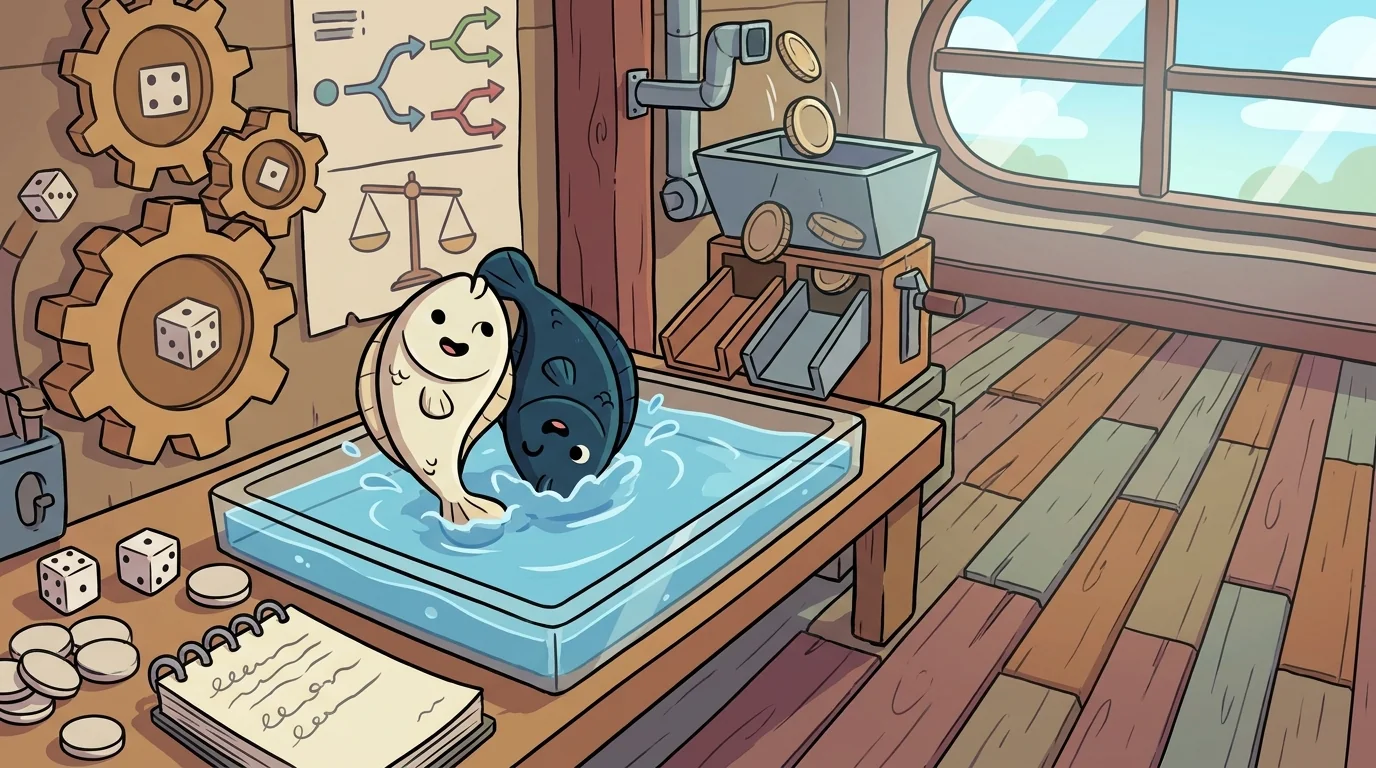
Flipside was a small flounder with two faces, and she had learned that the hardest questions get easy the moment you turn them over.
She lived in a shallow tray of water in the corner of the ChanceForge workshop, and she had a habit of flipping — light side up, then dark side up, then back — whenever she was thinking. To Flipside, every chance had two sides: the chance a thing happens, and the chance it doesn't. And those two sides, she knew, always added up to exactly one whole.
A young newt named Dap brought her a tricky question.
"If I roll a die three times," Dap said, "what's the chance I get at least one six? I tried listing all the ways and there are so many — one six, two sixes, a six on the first roll, a six on the last — I got completely lost."
"Then stop counting the sixes," Flipside said, flipping calmly to her dark side. "Count the other side instead. What's the chance you get no sixes at all? That's much simpler — just three rolls that each miss. Find that, and then —" she flipped to her light side — "subtract it from one whole. Whatever's left over is your at least one six. The hard side and the easy side always add to one. So count the easy side and flip."
Dap's eyes went wide. "You didn't solve my question. You solved the opposite one."
"The opposite one was hiding the answer the whole time," Flipside said.
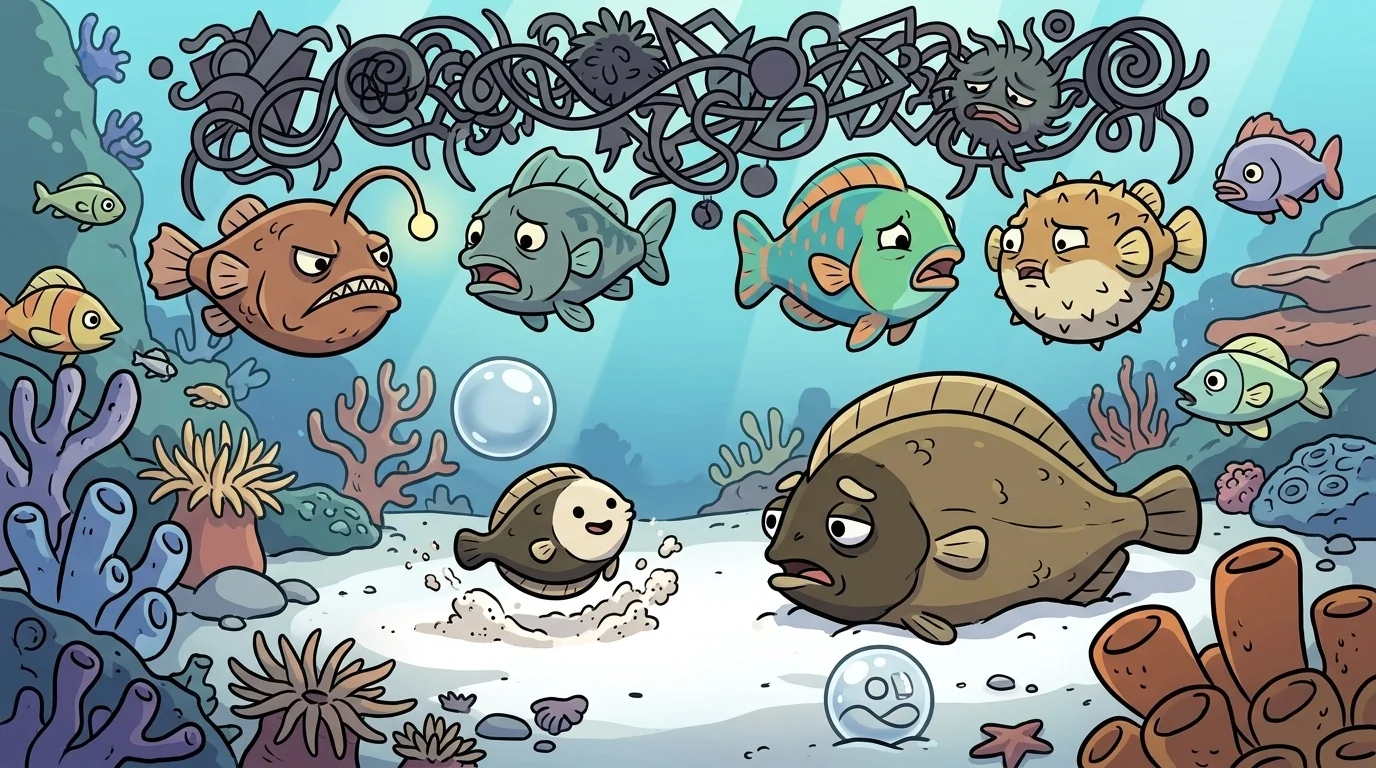
Flipside had been turning problems over since she was a fry.
She'd grown up on a busy reef where the older fish fretted constantly about danger — what's the chance a shark comes? what's the chance the current pulls us out? They'd try to count every single bad thing that could happen, and they'd tie themselves in knots, because the bad things were endless and tangled.
One day her father, exhausted from worrying, flipped onto his other side in the sand. And little Flipside had a thought that changed everything.
"Don't count all the scary things," she said. "Count the safe thing. There's really only one safe outcome — nothing bad happens — and it's easy to think about. Find how likely that is. Then everything else, all the tangled scary stuff put together, is just one whole minus the safe part."
Her father stared at her. It was so much simpler. Instead of chasing a hundred bad outcomes, you found the one clean outcome on the other side, and subtracted. The whole reef's worry, she realized, came from always counting the hard side.
She felt a small thrill the first time it worked — the feeling of a heavy, tangled problem suddenly going light in her fins, just because she'd turned it over.
When she was grown, Flipside settled into the ChanceForge workshop, because she'd heard it valued a clever turn.
The old tortoise keeper asked her, "What is the complement?"
Flipside flipped neatly from one side to the other. "The complement is the other side of a chance," she said. "If something has a chance of happening, then not happening has its own chance — and the two always add up to one whole. Nothing falls outside them. So when 'it happens' is a tangled mess to count, I find 'it doesn't happen' instead, which is usually simple, and subtract it from one. The hard side and the easy side are two halves of the same whole. You only ever have to count the easy one."
"And 'at least one'?" the tortoise asked.
"My favourite," Flipside said. "'At least one' is always a tangle to count directly. But its other side — not even one, none at all — is clean and simple. Count none, flip it, done."
The tortoise's eyes crinkled. "A welcome way of seeing."
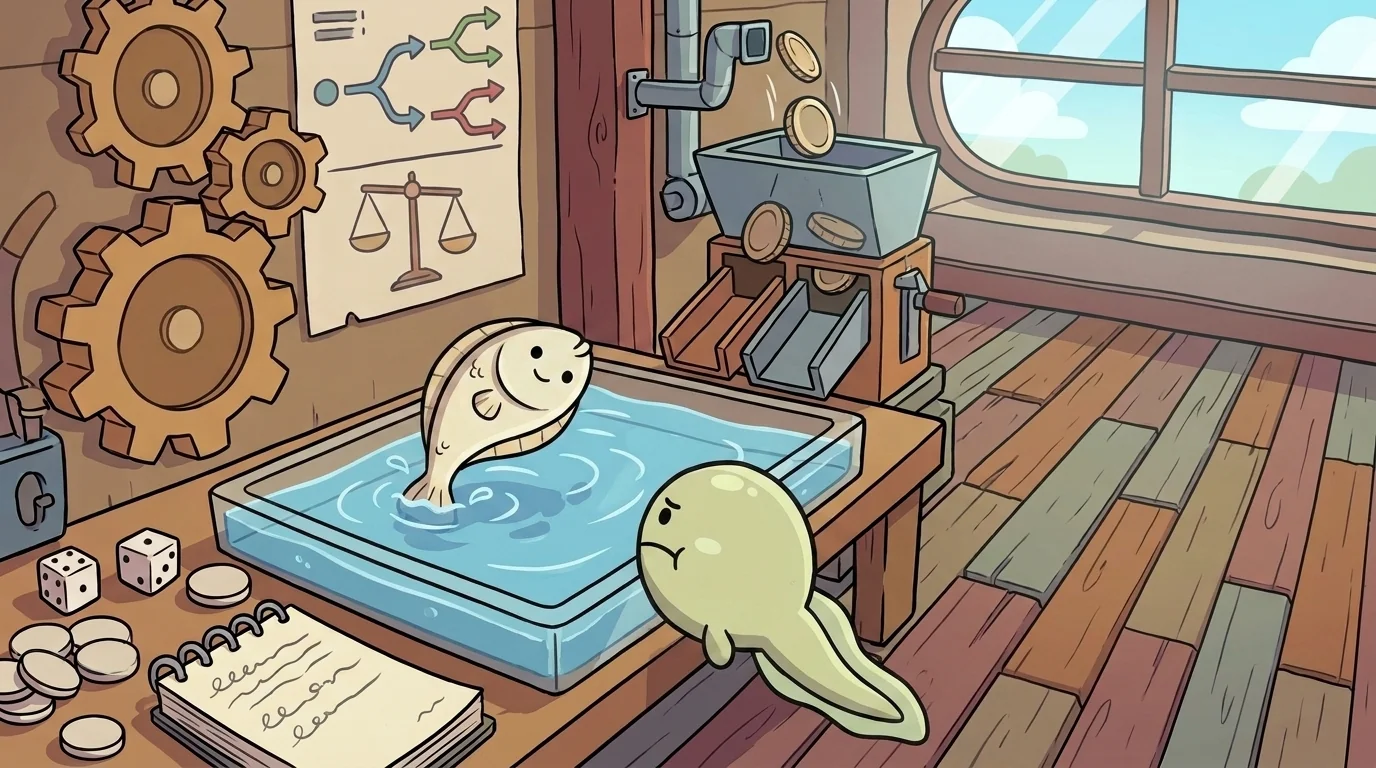
Flipside's favourite thing was lifting a worry off a kid by turning it over.
A glum tadpole named Pim came to her. "There's a big talent show," Pim said, "with so many acts, and I keep trying to figure out the chance that something goes wrong somewhere in the whole night — a missed note, a dropped prop, a forgotten line, anything — and there are a million ways it could happen and I can't stop listing them and I feel sick."
"Oh, Pim," Flipside said gently, flipping to her calm dark side. "You're counting the hard side. A million ways for something to go wrong — of course that's overwhelming. So turn it over. There's only one way for the night to go perfectly: everything goes right. Just one clean picture. How likely is that one?"
Pim thought. "Pretty likely, honestly. Everyone's practiced a lot."
"Then that's your answer-in-waiting," Flipside said, flipping to her light side. "One whole, minus the one happy picture, is the chance something slips. And since the happy picture is big, the slip-chance is small. You were drowning in a million worries when really there was just one calm outcome to weigh, and a small leftover." She settled in the water. "The tangle was never the truth. It was just the side you happened to be looking at."
Pim let out a long breath. "I turned it over and it got... small."
"Most monsters do," Flipside said, "once you see their other side."
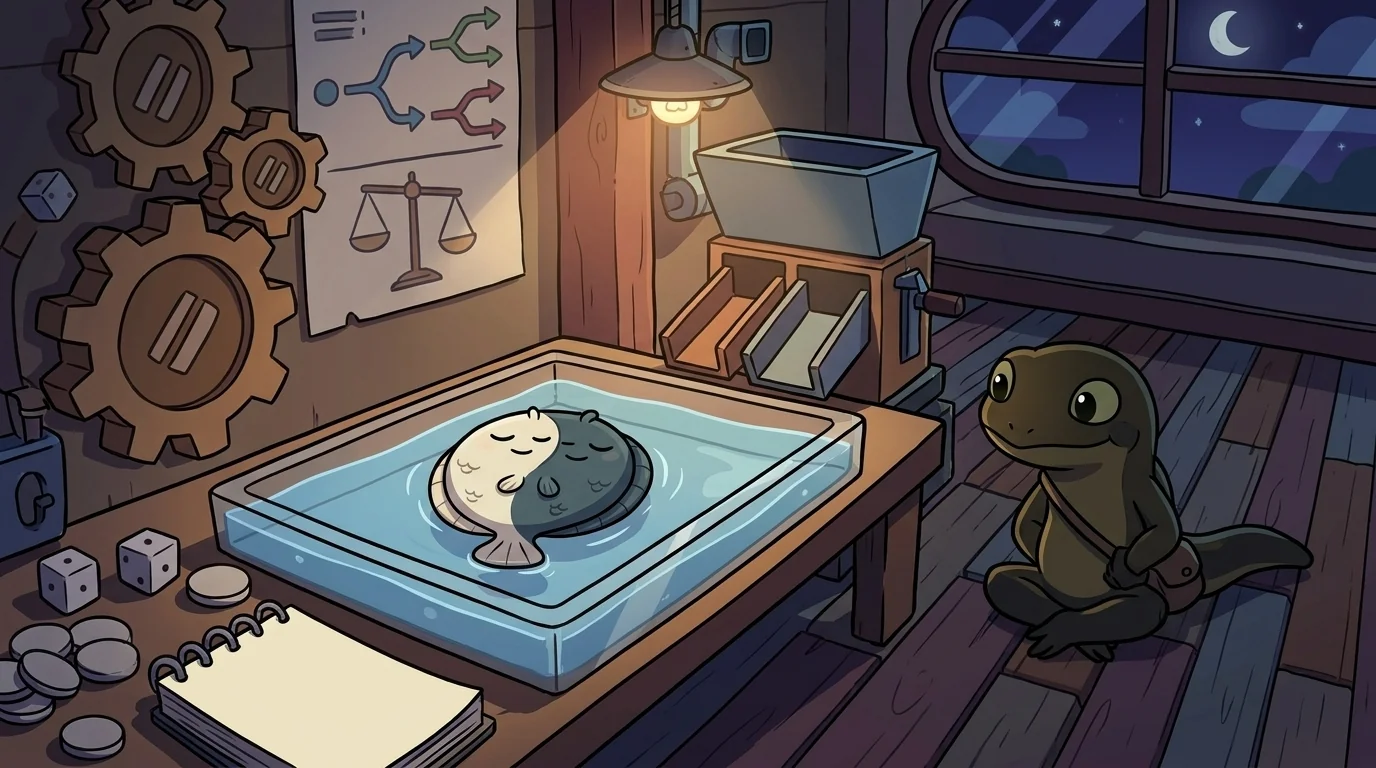
Later, when the workshop lamps dimmed and the water in her tray went still, Flipside floated quietly, flipping now and then out of pure habit.
Dap came back. "Can I ask you something? Doesn't it ever feel strange, always thinking about the thing that won't happen instead of the thing that will?"
Flipside settled flat for a moment.
"It used to feel like a trick," she said. "Backwards. Wrong-way-round. But it stopped feeling that way when I understood why it works." She flipped slowly, light to dark. "It works because nothing is ever left out. The thing that happens and the thing that doesn't — together they're the whole of it, one complete circle, with no scary leftover hiding outside. That's the part that calms me. Whatever comes, it'll be one of a complete set. There's no secret outcome lurking past the edge."
She looked up through the still water at the workshop ceiling, light side and dark side both accounted for, the whole adding gently to one.
And as Dap settled by her tray for the night, Flipside felt the deep, even comfort she always felt at the end of the day — not from knowing how things would turn out, but from knowing that the good and the bad together made one complete whole, nothing missing, nothing extra, the entire circle held safely in her two small sides.
The ChanceForge ensemble
Flipside the Other-Outcome-Counter is part of ChanceForge's distributed-narrative cast. Each character embodies a different curricular primitive; together they teach the full subject.
-

Tally the Counter-of-Outcomes
Data collection + frequency counting (the foundational "what happened, how often?" move)
-

Display the Picture-Maker
Graphs and visual displays (bar charts, histograms, dot plots, line graphs — turning numbers into pictures)
-

Center the Middle-Finder
Central tendency — mean, median, mode (the "what's typical?" question)
-

Sample the Estimator
Sampling, sampling distributions, inference from sample to population
-

Tree the Compound-Brancher
Compound events and probability trees — multiplication rule for independent events, addition for disjoint, conditional dependencies
-

Odds the Likelihood-Reader
Basic probability — placing a chance on the 0-to-1 scale from impossible to certain
-
Scatter the Spread-Reader
Spread and variability — how far apart the data is (range), not just the middle
-
Clew the Clue-Follower
Conditional probability — how chances change once you learn a new fact
-
Evens the Long-Run-Settler
Expected value and the long run — results settle toward the average over many tries