
Wellspring
GO TO THE SOURCE — *find the spring, not the puddle downstream.* A primary source is the original — the firsthand account, the actual data, the real letter. A secondary source talks ABOUT it. Both are useful, but you should know which you're holding, and trace big claims back to the original.
Press play to listen along. The line being read lights up as you go.
Show full transcript
Loading transcript…
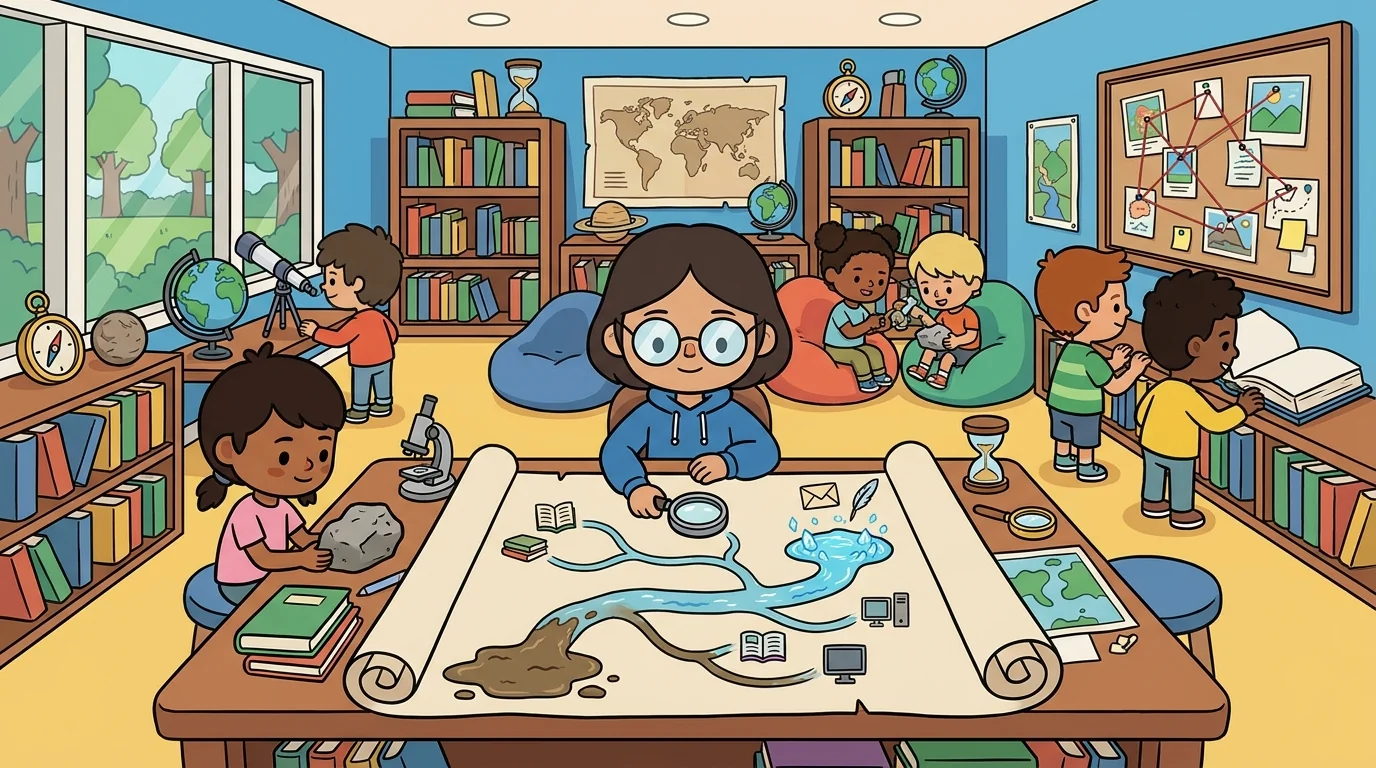
At the ResearchQuest club, where every curious kid counted as a real researcher, Wellspring was a calm, clear-eyed kid who loved tracing things back — following a fact upstream, past retelling after retelling, until she reached the original source it first flowed from.
When someone repeated a striking claim — "I read that this painting took twenty years!" — Wellspring would gently ask, "Where did that page get it?" And they'd follow the stream back: this page got it from that article, which got it from another, until — at last — the original: the artist's own letter, or the museum's record. The firsthand spring, not a puddle far downstream where the water had picked up mud along the way.
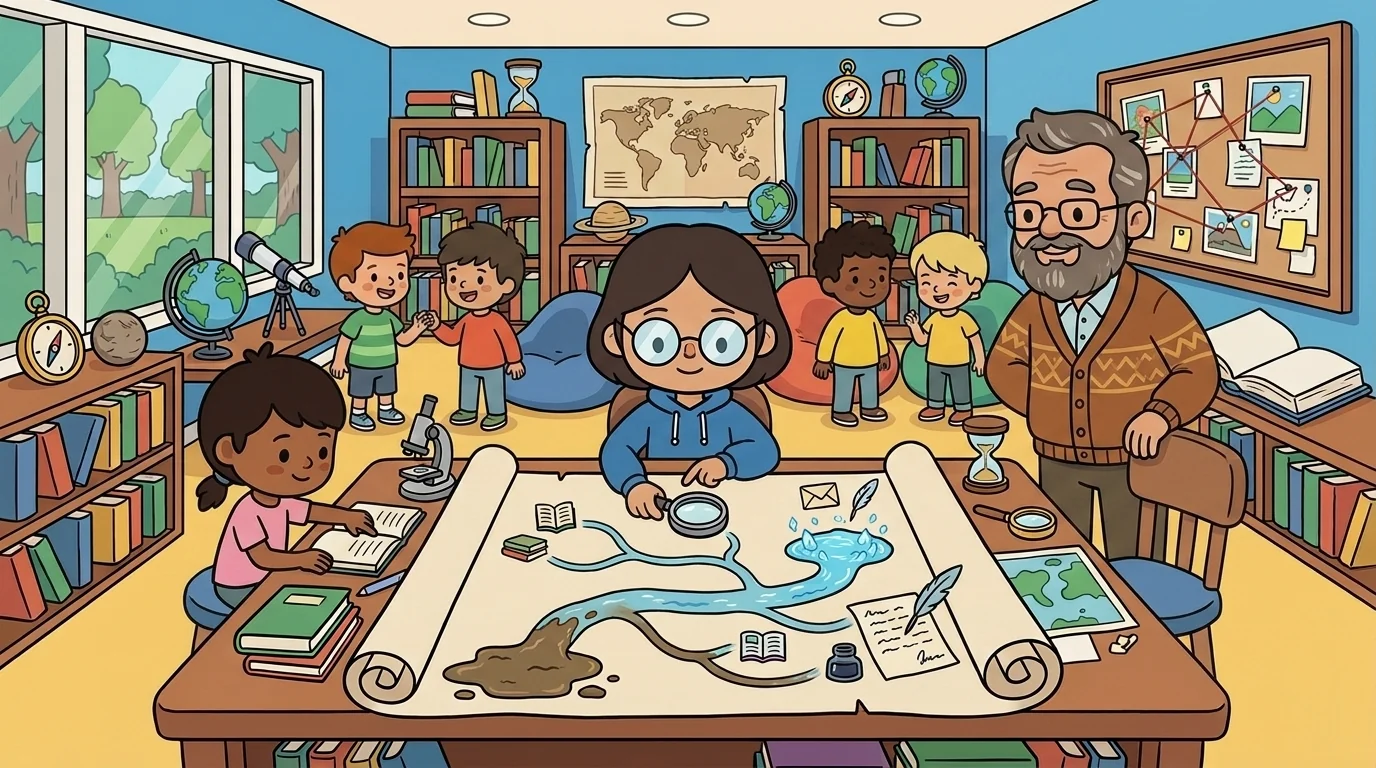
"You traced my fact all the way back to where it actually started!" a young researcher said.
"That's my favorite kind of journey," Wellspring said, miming following a stream upstream with her finger. "I'm Wellspring. I keep the sources — find the spring, not the puddle downstream." She tapped an imaginary origin. "A primary source is the original — the firsthand account, the real data, the actual letter. A secondary source talks about it. Both are useful. But know which you're holding, and trace big claims back to the spring."
Scholar, the club's warm mentor, said, "Show them the game of telephone."
Wellspring acted it out: she whispered a fact down a line of kids, and by the end it had changed completely — a number got bigger, a name got swapped. "That's what happens to a fact passed source-to-source-to-source," she said. "Each retelling can bend it a little." Then she showed the fix: go upstream to the original, where the fact is still clean. "The spring isn't muddied yet. That's why you trace back to it for anything that matters."
A young researcher frowned. "So are secondary sources bad? Should I only use the originals?"
"Not at all," Wellspring said warmly. "Secondary sources are guides — they explain, summarize, point you toward the spring. You'll use lots of them, and that's good. The skill isn't avoiding them. It's knowing which kind you're holding — and, for the claims that really matter, following the stream up to the firsthand source to see it for yourself."
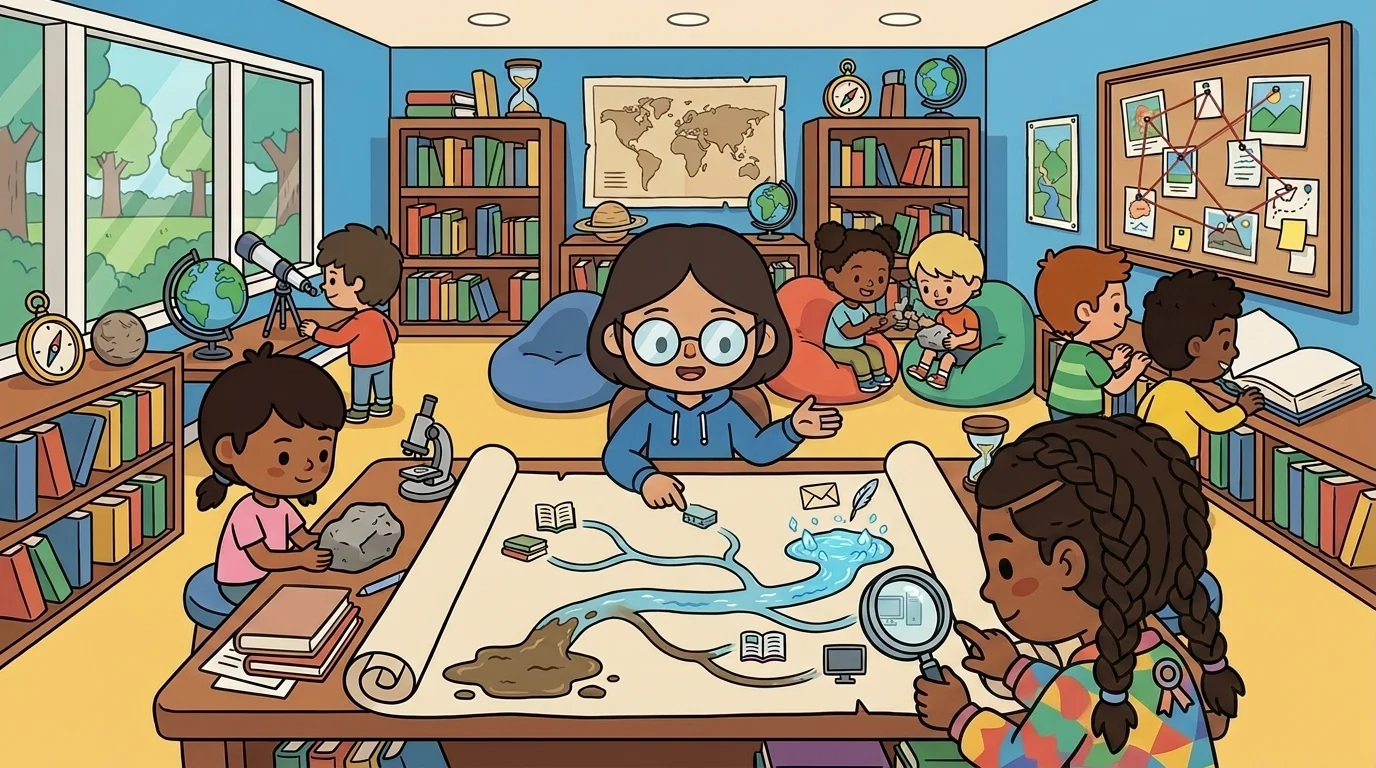
Scholar asked Wellspring to teach the club before their projects deepened. "Tether is wonderful at crediting sources," Scholar said, "but the kids don't yet notice whether a source is firsthand or a retelling. Will you teach them to trace upstream?"
Wellspring was glad to. When she teaches, she gives one rule: "For every important source, ask: is this the original, or is it talking about the original? A firsthand letter, a real photograph, the actual data — that's primary. An article explaining them — that's secondary. Use both. But for your biggest claims, follow the stream up and look at the spring yourself."
Tether, who credited every source carefully but treated them all the same, tried it. She was citing a dramatic statistic from an article, then traced it upstream — and found the article had slightly mis-stated the original study. She cited the study instead, correctly. "I was crediting the puddle," Tether said, amazed. "The spring said something a little different. Now my citation points to where the fact really lives."
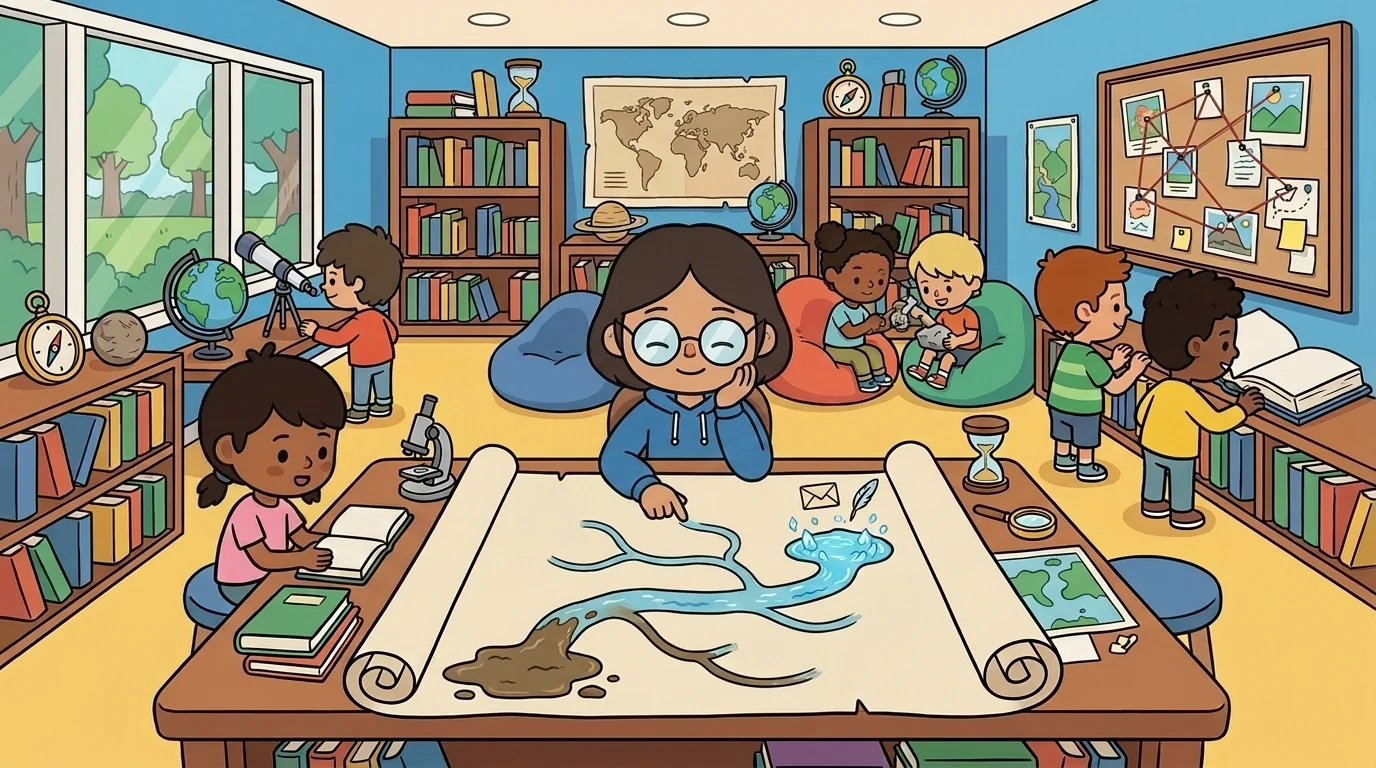
After the session, Wellspring sat tracing the path of an imaginary stream across the table, all the way back to its start, the way she always did when she was thinking.
For a long time, Wellspring had carried a small, wistful worry. The others worked with what was right in front of them — Trawl's fresh catch, Vet's verdicts, Verdict's bold claims. Wellspring was always heading backward, upstream, into old letters and original records. She'd wondered if caring so much about where things came from made her slow, or stuck in the past, while everyone else moved forward.
But sitting there following her invisible stream to its source, remembering Tether's amazement at finding the real spring, Wellspring felt the worry clear into a calm, deep gladness. Heading upstream wasn't being stuck in the past — it was the only way to reach water that hadn't been muddied by a hundred retellings. Every clean fact the club stood on had a spring somewhere, and she was the one who could find it. Knowing the difference between the original and the echo, and caring enough to trace it back — that was a quiet, essential craft, and it was hers. A clear, settled contentment flowed through her, and she traced her stream once more to its source, happy, ready to follow tomorrow's fact all the way home.
The ResearchQuest ensemble
Wellspring is part of ResearchQuest's distributed-narrative cast. Each character embodies a different curricular primitive; together they teach the full subject.
-

Wonder
Question-formulation — narrowing vague interest into focused, answerable research questions
-

Vet
Source-evaluation — CRAAP test (Currency, Relevance, Authority, Accuracy, Purpose)
-

Quote
Note-taking — quoting + paraphrasing + summarizing; keeping voices separate
-

Synth
Synthesis — combining evidence across multiple sources; finding agreement, disagreement, gaps
-

Tether
Citation — attribution + bibliography; gratitude + map back to sources
-

Survey
Background reading — read around a topic to learn the lay of the land before narrowing (W.7)
-

Trawl
Search strategy — cast a wide net of keywords, then pull it tight; refine when it comes back wrong (W.8)
-

Crosscut
Lateral reading / corroboration — don't trust one page; cross-check a claim across independent sources
-

Verdict
Forming a thesis — gather the evidence, then take a stand; 'here's what I think, and here's why' (W.1)