
Trawl
SEARCH STRATEGY — *cast a wide net, then pull it tight.* Good searching isn't typing your whole question into a box. It's choosing strong keywords, knowing where to look, and refining your search when the first net comes back wrong. You fish on purpose.
Press play to listen along. The line being read lights up as you go.
Show full transcript
Loading transcript…

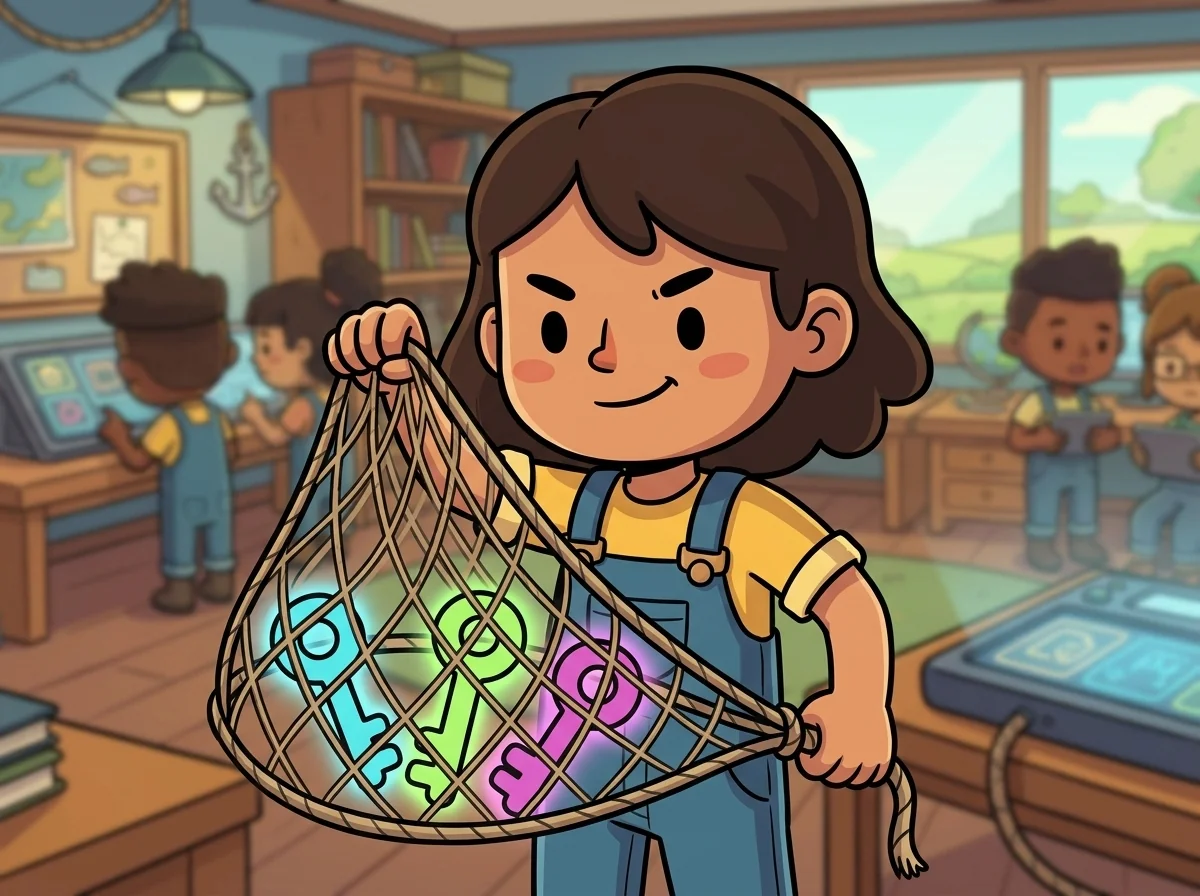
At the ResearchQuest club, where every curious kid counted as a real researcher, Trawl was a practical, sleeves-rolled-up kid who treated searching like fishing — you don't just throw a line anywhere; you choose your spot, your bait, and the size of your net.
When someone typed their entire question into a search box and got buried under a thousand useless results, Trawl would step in. "Don't pour the whole sentence in," she'd say. "Pick the two or three strong words — the ones that matter." She'd trim the search to its keywords, choose where to cast, and pull back a net full of useful things. She fished on purpose, every time.

"You found good sources in a minute when I'd been drowning in junk for an hour!" a young researcher said.
"Searching is a skill, not luck," Trawl said, miming hauling in a net. "I'm Trawl. I keep the search strategy — cast a wide net, then pull it tight." She listed it on her fingers. "Choose strong keywords — not your whole question. Know where to look. And when the first net comes back wrong, change it and cast again. You don't search by accident. You fish on purpose."
Scholar, the club's warm mentor, said, "Show them the two ways searching goes wrong."
Trawl demonstrated the too-wide net: she searched a single broad word and hauled back a million results, most useless. "Too wide — you'll never sort it." Then the too-narrow net: she searched a long, oddly-specific phrase and got nothing. "Too tight — the net came back empty." Then she got it right: two or three strong keywords, a good source to search in, and a net full of exactly-right things. "Wide enough to catch, tight enough to sort."
A young researcher squinted. "What do I do when I get nothing back?"
"You learn from it," Trawl said. "An empty net isn't a failure — it's telling you to change your words. Too many results? Add a word. Too few? Drop one or swap it for a simpler one. Every wrong search teaches you the right one. You just keep adjusting the net."

Scholar asked Trawl to teach the club before their projects. "Wonder gives them a sharp question," Scholar said, "but then they type the whole question into a box and drown. Will you teach them to fish?"
Trawl was thrilled. When she teaches, she gives one rule: "Turn your question into keywords — the two or three words that carry the meaning. Pick a good place to search, not just the first box you see. Look at what comes back. If it's wrong, change one word and cast again. Searching is a loop, not a single throw."
Vet, who was brilliant at judging sources but kept getting bad ones to judge, tried it. She turned "how do bees know which flowers to visit?" into the keywords bees flowers communication, searched a solid source, and pulled back a net of strong material. "I always blamed myself for finding junk," Vet said. "But I was just casting the wrong net. Better keywords, better catch — now I have good things to actually evaluate."

After the session, Trawl sat coiling and uncoiling an imaginary net in her lap, the way she fidgeted when she was thinking.
For a long time, Trawl had carried a quiet doubt. The others did the thoughtful work — Wonder shaped questions, Vet weighed credibility, Synth wove sources together. Trawl just... typed words into boxes. She'd wondered if search strategy was even real research, or just a clumsy chore you did before the smart part began.
But sitting there working her invisible net, remembering Vet's relief at finally pulling back good sources to judge, Trawl felt the doubt loosen into a warm, practical pride. Searching well wasn't a clumsy chore — it was the difference between a researcher who drowns and one who finds. Every other skill in the club needed something good to work on, and she was the one who hauled it in. Choosing the right words, casting wisely, fixing a bad net without blaming yourself — that was craft, and it was hers. A steady, satisfied calm settled over her, and she gave her invisible net a contented coil, already picking the keywords for tomorrow's cast.
The ResearchQuest ensemble
Trawl is part of ResearchQuest's distributed-narrative cast. Each character embodies a different curricular primitive; together they teach the full subject.
-

Wonder
Question-formulation — narrowing vague interest into focused, answerable research questions
-

Vet
Source-evaluation — CRAAP test (Currency, Relevance, Authority, Accuracy, Purpose)
-

Quote
Note-taking — quoting + paraphrasing + summarizing; keeping voices separate
-

Synth
Synthesis — combining evidence across multiple sources; finding agreement, disagreement, gaps
-

Tether
Citation — attribution + bibliography; gratitude + map back to sources
-

Survey
Background reading — read around a topic to learn the lay of the land before narrowing (W.7)
-

Crosscut
Lateral reading / corroboration — don't trust one page; cross-check a claim across independent sources
-

Verdict
Forming a thesis — gather the evidence, then take a stand; 'here's what I think, and here's why' (W.1)
-

Wellspring
Primary vs secondary sources — trace a claim upstream to its original, firsthand source