
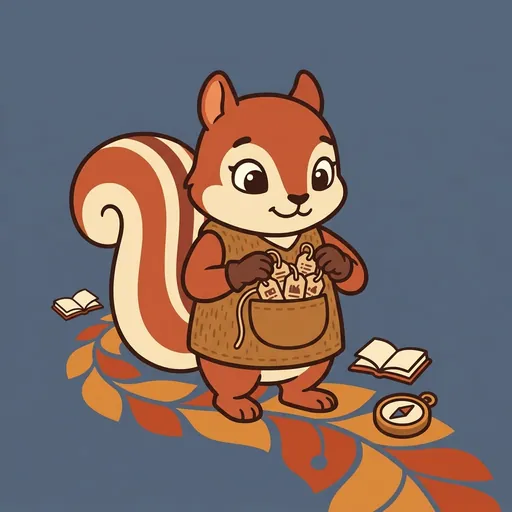
Tether
CITATION — attribution + bibliography; gratitude + map back to sources.
Listen along — Tether
Loading audio…
Press play to listen along. The line being read lights up as you go.
Show full transcript
Loading transcript…
Chapter 5 — Tether and the Trail That Remembers
At the edge of the research hall, a squirrel-tween named Tether was tying a small paper tag to the corner of a page.
The tag was no bigger than a leaf. On it, in tiny careful letters, she had written a name, a title, and a number. A thin length of cord ran from the tag, looped once, and pointed — if you followed it with your eye — back toward a battered book on the far shelf.
A girl leaned over to watch. “You’re stringing your whole report together with… string?”
“Every claim gets a thread,” Tether said, not looking up. “This sentence says wolves can smell a herd two kilometres off. I didn’t just know that. Somebody counted it, wrote it down, put it in that book.” She patted the tag. “So the thread runs from my sentence back to their book. Anybody who reads this can follow it home.”
“Why bother? It’s your report.”
Tether finally looked up, warm-russet tail curling behind her. “It’s my report. But it’s not all my finding. Half of what’s true in here, someone found before me.” She tugged the cord gently; the tag swung. “This little thread is me saying thank you. And it’s also a map — so the next reader doesn’t have to start from nothing. They can walk the trail I walked.”
The girl studied the row of tags fluttering along the margin, each one a tiny tether between a sentence and a source. It looked less like homework and more like a garden of little kites.
Tether had learned about threads long before she learned about reports.
Her family were the village trail-markers. When the good gathering-spots opened each season — the hazel grove, the far creek where the fish ran thick — it was her family who tied the cord-and-tag bundles along the paths so other foragers could find them. She had grown up watching her grandfather kneel in the leaf-litter, fastening a tag to a low branch.
One autumn, small and impatient, she’d found a new patch of chestnuts all by herself. She’d wanted, fiercely, to keep it secret — to be the one who knew. But that night her grandfather asked her a quiet question. “The patch you found. How did you get there?”
“The old creek path,” she admitted. “The one with the blue tags.”
“And who tied the blue tags?”
Tether went quiet. She didn’t know. Someone before her. Someone she would never meet, who had knelt in the leaves and thought about her without knowing her name.
Her chest went tight and strange — a feeling she didn’t have a word for yet. It was almost like being caught, except nobody was angry. It was more like realizing she’d been carried the whole way and had almost forgotten to notice.
“Tie a tag on your chestnut patch,” her grandfather said. “Not because you have to. Because someone tied one for you.” He smiled. “That’s not a rule, little one. That’s just the trail remembering who walked it.”
She tied the tag. And the tight feeling in her chest loosened into something warmer.
She walked to ResearchQuest at twenty-two, cord-and-tag bundle still in her vest-pocket.
Scholar, who kept the research hall, met her at the door with a question. “What is citation?”
Tether didn’t reach for a rulebook. She pulled a tag from her bundle, wrote a single sentence on a scrap of paper — the moon pulls the tides — and tied a thread from it toward the oldest tide-chart on the wall.
“It’s two things at once,” she said. “It’s thanks — I didn’t figure out the tides, somebody watched the sea for years and wrote it down. And it’s a map — anyone who doubts me, or wants more, can follow the thread straight to the proof.”
“And if you skip it?” Scholar asked.
“Then the trail forgets. The next reader is lost, and I’ve taken credit for a path someone else cut.” She shook her head. “I won’t do that to them.”
Scholar looked at the little tag swinging on its thread. “You belong here,” he said.
Tether’s corner of the hall was strung with threads like a spiderweb.
A boy came in one afternoon, hunched and cross, a half-finished report crumpled in his fist. “I did all the reading,” he said. “Now I have to go back and add all these citations. It’s like a punishment for using books.”
Tether knew that hunch. She’d felt it once, over a patch of chestnuts.
“Read me a sentence,” she said.
He smoothed the page. “Volcanoes can stay quiet for a thousand years and then erupt.”
“Did you know that this morning, before you read it?”
”…No.”
“So someone gave it to you.” She handed him a blank tag. “Write down who. The book, the page.” He did, grumbling. She tied a thread from his sentence to the tag. “Now. Pretend you’re a kid next year, reading your report, and you think — no way, a thousand years? What do you do?”
The boy paused. Then, slowly: ”…I follow the thread. I go find the book. I check.”
“And there it is, waiting for you. Because this you left a map.” She let the tag swing. “You didn’t get punished for using the book. You got to thank it — and hand the next kid a shortcut you had to find the hard way.” She grinned. “Skip the tag, and the trail forgets. Tie the tag, and it remembers. That’s the whole thing.”
He looked at the little thread, then at the row of them along her wall, and something in his shoulders came down.
Later, when the hall was empty, the boy came back with one more question, quieter now.
“When you tie all those threads,” he said, “and nobody’s making you — doesn’t it feel like extra work?”
Tether thought about the leaf-litter, and the blue tags, and the stranger who had knelt for her before she was born.
“It used to,” she said. “Then I figured out what the feeling really was.” She touched one of the swinging tags. “It’s not the feeling of doing a chore. It’s the feeling of being trusted with the map — and passing it on. Somebody carried me here without ever knowing my name. Every thread I tie is me carrying the next one.”
The boy nodded slowly.
She didn’t say the rest out loud, but she felt it settle in her chest, warm and steady as leaf-light: nobody finds the good spots alone. And the small, generous ache of remembering who helped you — that’s not a burden at all. That’s just gratitude, learning to point the way.
The ResearchQuest ensemble
Tether is part of ResearchQuest's distributed-narrative cast. Each character embodies a different curricular primitive; together they teach the full subject.
-
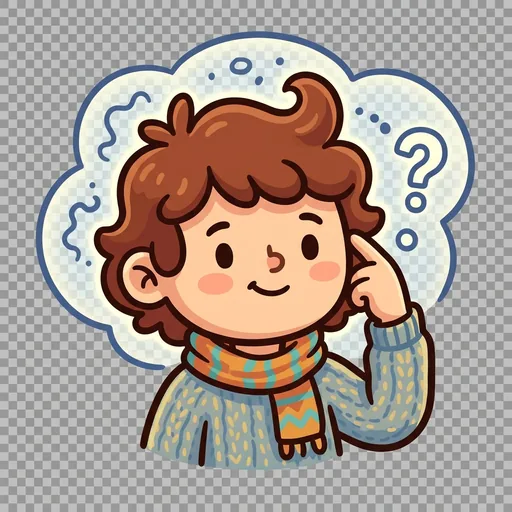
Wonder
Question-formulation — narrowing vague interest into focused, answerable research questions
-
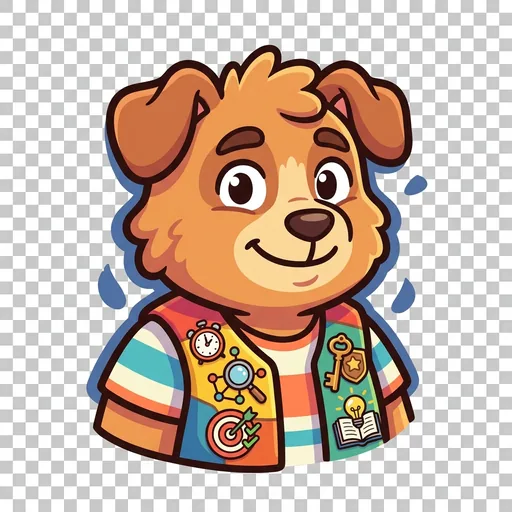
Vet
Source-evaluation — CRAAP test (Currency, Relevance, Authority, Accuracy, Purpose)
-

Quote
Note-taking — quoting + paraphrasing + summarizing; keeping voices separate
-

Synth
Synthesis — combining evidence across multiple sources; finding agreement, disagreement, gaps
-

Survey
Background reading — read around a topic to learn the lay of the land before narrowing (W.7)
-
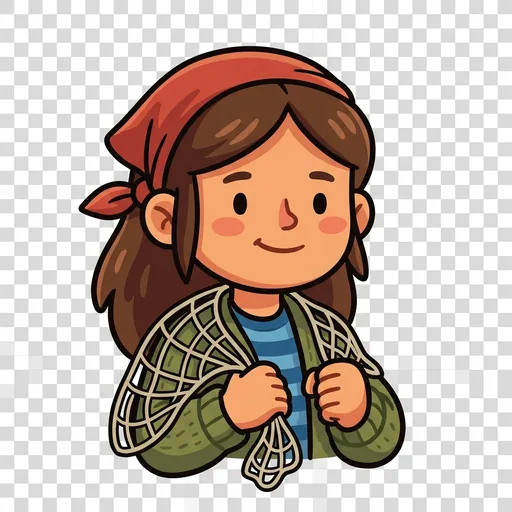
Trawl
Search strategy — cast a wide net of keywords, then pull it tight; refine when it comes back wrong (W.8)
-
Crosscut
Lateral reading / corroboration — don't trust one page; cross-check a claim across independent sources
-
Verdict
Forming a thesis — gather the evidence, then take a stand; 'here's what I think, and here's why' (W.1)
-
Wellspring
Primary vs secondary sources — trace a claim upstream to its original, firsthand source