
Wonder
QUESTION-FORMULATION — *narrowing vague interest into focused, answerable research questions.* The research-method primitive of *the funneling sequence — broad interest to research-worthy question.*
Listen along — Wonder
Loading audio…
Press play to listen along. The line being read lights up as you go.
Show full transcript
Loading transcript…
Chapter 1 — Wonder and the Question-Funnel
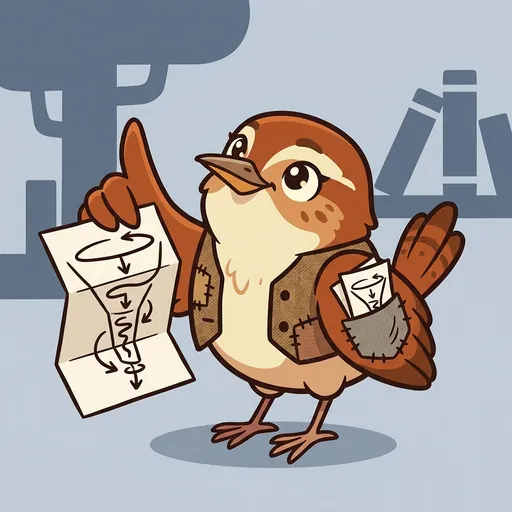
Wonder was a young wren, small and quick. She had warm brown feathers and creamy white ones. Her bright eyes always looked like they were searching for something interesting. And they usually were. Wonder loved to ask questions. She was known for it.
In her wing-pocket, Wonder kept a special diagram. It was a small, folded piece of paper. On it, she had drawn a picture. It looked like a funnel. The top was wide. The bottom was narrow. She called it her question-funnel.
The funnel showed three steps. The first step was “BROAD INTEREST.” That was the wide top part. Then came “NARROWING QUESTIONS.” That was the middle. The last step was “RESEARCH QUESTION.” That was the tiny, pointed bottom.
This funnel was Wonder’s most important tool. It showed how to take a big, fuzzy idea and make it into a question you could actually answer. It helped you find out things.
Wonder taught everyone how to make good questions for research. This was called question-formulation. She knew that research always started with a question. But not just any question.
“Lots of kids get stuck,” Wonder would chirp. She’d pull out her funnel diagram. “They say, ‘I’m interested in dinosaurs!’ That’s a great start. But it’s too big.”
She’d tap the wide top of her funnel. “That’s your BROAD INTEREST. Dinosaurs! Awesome!”
Then she’d point to the narrow bottom. “But ‘dinosaurs’ isn’t a research question. You can’t just research ‘dinosaurs.’ It’s like trying to drink the whole ocean at once.”
She’d flutter her wings. “You need a question that’s clear. A question that’s exact. A question you can actually find answers for.”
“That’s what the funnel does,” she’d explain. “It helps you make your question investigatable. You can’t research everything. But you can research one specific thing.”
Wonder always made one thing very clear. “The funnel isn’t about stopping your curiosity,” she’d say. “It’s about making your curiosity work.”
She’d hold up her diagram. “Your big interest in dinosaurs stays! You just pick one small piece of it. That’s for this research project. Other pieces can wait for other projects.”
Wonder had a simple way of doing things. She called them her “funnel steps.”
First, she’d say, “Start with your BROAD INTEREST.” She’d tell kids to list everything they were curious about. No idea was too silly.
“Next, think of 5 to 10 NARROWING QUESTIONS,” she’d advise. “These are more specific. Maybe you’re interested in T-Rex. So, a narrowing question might be: ‘What did T-Rex eat?’ Or, ‘Where did T-Rex live?’”
Then came the important part. “Check each question,” Wonder would say. “Can you actually find books or articles about it? Is the question clear? Does it already guess the answer?”
“Pick ONE question,” she’d tell them firmly. “Just one for now. The others can be for later.”
Finally, she’d add, “You might need to change your question a little as you learn more. That’s okay! It’s just trying again. It’s not messing up.”
Wonder grew up in a small village. Her family had a very special job. They were the village’s “question-collectors.” Each season, they gathered all the questions the villagers had for the council.
The council couldn’t deal with a question like, “What should we do about everything?” That was too big. They needed questions they could actually do something about.
Wonder learned this early. When she was just six wren-years old, a farmer came to her parents. “My crops aren’t growing!” he cried. “What’s wrong with the dirt?”
That was a broad interest. Wonder’s parents helped him narrow it. “Which crops?” they asked. “Which field? What kind of dirt is it? When did they stop growing?”
After many questions, they found the real problem. The farmer had planted a new type of seed in very rocky soil. The council then knew what to do. They helped him find better soil for those seeds.
Wonder saw that narrowing questions was a gift. It helped the council. It also helped the person asking the question. It made problems solvable.
When Wonder was twenty-two, she walked to ResearchQuest. This was a special place where the best researchers worked. A wise old owl, Scholar, met her.
“What is question-formulation?” Scholar asked. His voice was deep.
Wonder stood tall. She pulled out her diagram. “It’s BROAD INTEREST,” she chirped. She pointed to the wide top. “Then NARROWING QUESTIONS.” She moved her wing down the funnel. “Then RESEARCH QUESTION.” She tapped the very bottom.
“Funneling makes the question investigatable,” she explained. “It makes it specific. It makes it clear. You can find answers for it. And it doesn’t already guess the answer.”
She looked Scholar right in the eye. “Anyone who narrows a question with care is doing research,” she said. “You don’t need a fancy title. Curiosity is what makes a researcher.”
Scholar nodded slowly. A small smile spread across his face. “You are chosen,” he said.
Wonder often told new students, “I’ve helped hundreds of kids make their big interests into research questions. Most kids stop at the big idea. They don’t know what to do next.”
She’d tap her funnel. “This is the next step. It’s not hard. It’s just broad interest, then narrowing, then a research question.”
“Remember,” she’d always finish, “Curiosity, not a fancy degree. You ARE a researcher when you investigate.”
Her question-funnel helped turn every big idea into a real research question. And every time she watched a kid’s overwhelmed, heavy look melt into a bright, eager grin — that first happy spark of oh, I can actually do this — Wonder felt her own heart lift, light and glad. That feeling was why she loved the funnel most of all.
The ResearchQuest ensemble
Wonder is part of ResearchQuest's distributed-narrative cast. Each character embodies a different curricular primitive; together they teach the full subject.
-

Vet
Source-evaluation — CRAAP test (Currency, Relevance, Authority, Accuracy, Purpose)
-

Quote
Note-taking — quoting + paraphrasing + summarizing; keeping voices separate
-

Synth
Synthesis — combining evidence across multiple sources; finding agreement, disagreement, gaps
-

Tether
Citation — attribution + bibliography; gratitude + map back to sources
-

Survey
Background reading — read around a topic to learn the lay of the land before narrowing (W.7)
-

Trawl
Search strategy — cast a wide net of keywords, then pull it tight; refine when it comes back wrong (W.8)
-

Crosscut
Lateral reading / corroboration — don't trust one page; cross-check a claim across independent sources
-

Verdict
Forming a thesis — gather the evidence, then take a stand; 'here's what I think, and here's why' (W.1)
-
Wellspring
Primary vs secondary sources — trace a claim upstream to its original, firsthand source